



















If you’re new to winter sports and wondering whether to try skiblades or snowboarding, here’s the short answer: skiblades are easier to learn, more portable, and less expensive. Snowboarding, while fun once mastered, has a steeper learning curve and requires more time and effort upfront.
Why Skiblades Might Be Better for Beginners:
- Faster Learning: Most people get the hang of skiblades in just 1–3 hours, compared to 3–5 days for snowboarding.
- Natural Feel: Skiblades let you face forward, like walking or skating, and allow independent leg movement for better balance.
- Better Control: Their lightweight design makes turning and stopping simple, even in tight spaces or crowded slopes.
- Cost-Effective: Skiblades start at $250, while snowboarding gear can cost $600 or more.
- Travel-Friendly: Skiblades are small enough to fit in a backpack, unlike bulky snowboards.
Snowboarding: What to Expect
- Tougher Start: Beginners often spend a lot of time falling while learning to balance and turn.
- Specialized Gear: Requires a snowboard, boots, and bindings, which adds to the cost.
- Strengths: Snowboards excel in deep powder and terrain parks but struggle on flat areas and tight trails.
Here’s the bottom line: If you want a quicker, more intuitive way to enjoy the slopes, skiblades are the way to go. They’re perfect for beginners and casual riders who want to have fun without the frustration of a steep learning curve. Snowboarding is great for those ready to invest time and effort into mastering the sport.
Quick Comparison
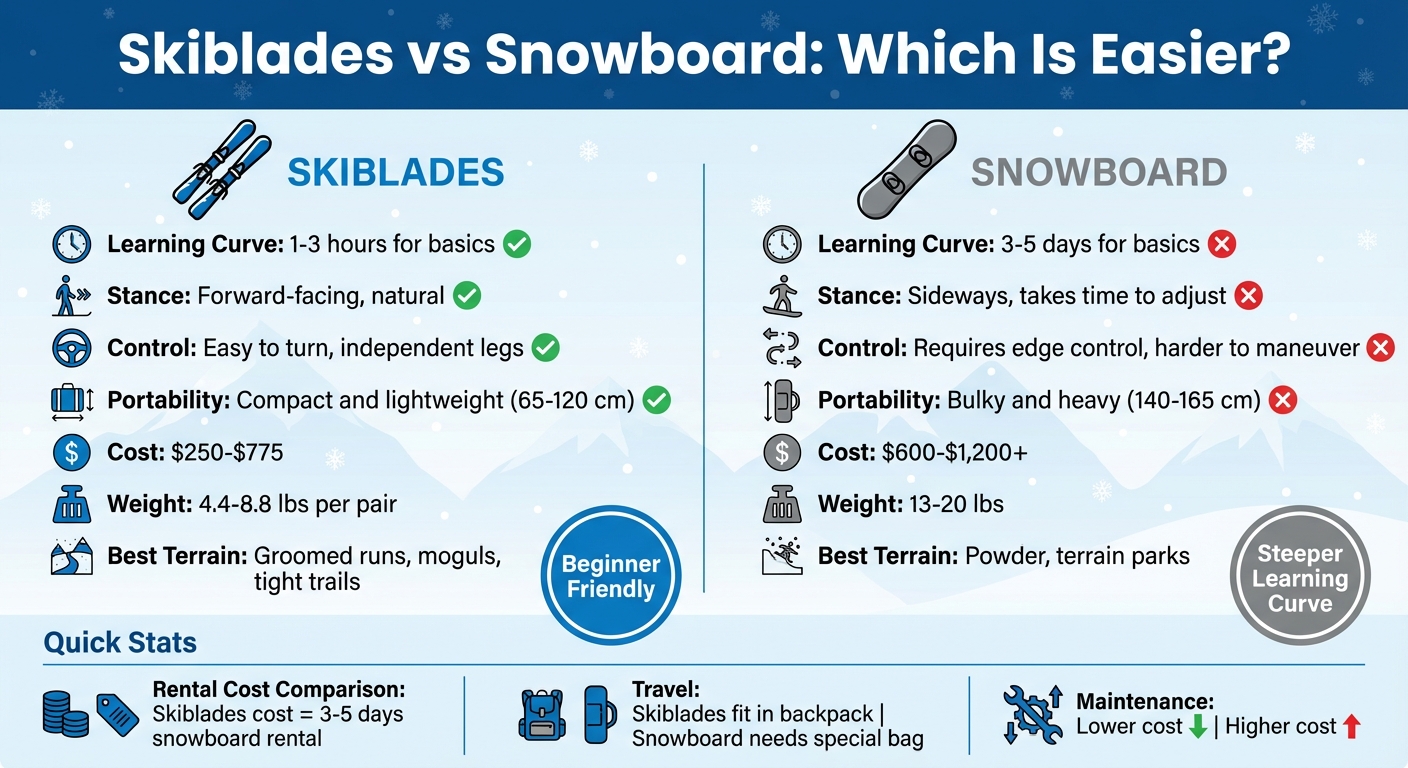
| Feature | Skiblades | Snowboard |
|---|---|---|
| Learning Curve | 1–3 hours for basics | 3–5 days for basics |
| Stance | Forward-facing, natural | Sideways, takes time to adjust |
| Control | Easy to turn, independent legs | Requires edge control, harder to maneuver |
| Portability | Compact and lightweight | Bulky and heavy |
| Cost | $250–$775 | $600–$1,200+ |
| Best Terrain | Groomed runs, moguls, tight trails | Powder, terrain parks |
Want something simple and fun? Go for skiblades. Ready for a challenge? Snowboarding might be your pick. Either way, the slopes are waiting for you!
Skiblades vs Snowboard Comparison: Learning Curve, Cost, and Portability
Learning Curve: Skiblades vs Snowboards
Skiblades: Fast Learning for Beginners
One of the standout perks of skiblades is how quickly beginners can get the hang of them. Most people find themselves in control within just 1–3 hours, compared to the 3–5 days it often takes to grasp the basics of snowboarding.
Skiblades offer a forward-facing stance and allow independent leg movement, making them feel natural - similar to walking, skating, or rollerblading. If you’ve ever tried rollerblades or ice skates, you’ll already have a sense of the motion. Their shorter length (ranging from about 25 to 47 inches for Snowfeet* models) means there’s less material to snag on the snow or trip over. Plus, since your legs move independently, it’s easy to step out if you lose balance. Stopping is just as simple, using a snowplow technique that most people pick up in minutes.
"The primary experience is that being shorter than traditional skis, these are much, much easier to turn and stop on than long skis." - Skiboards.com
Snowfeet* skiblades are designed with this easy learning process in mind. Their 65 cm model (priced at $635) is perfect for beginners looking for quick maneuverability. As you gain confidence, you can step up to the 99 cm ($675) or 120 cm ($775) models, which offer more stability but still skip the lengthy learning curve of snowboarding.
While skiblades help you hit the slopes with confidence in just hours, snowboarding takes a bit more time and effort.
Snowboards: Longer Learning Process
Snowboarding, on the other hand, comes with a steep learning curve that can be discouraging for newcomers. With both feet locked onto a single board, even basic movements like turning or stopping require full-body coordination. You’ll need to master edge control - using toe and heel pressure to guide the board - a skill that takes dedicated practice over several days.
"It's commonly accepted that linking up those first few turns on a snowboard will require a few hard lessons - meaning falls." - Snow.com
In those early snowboarding sessions, expect to spend a lot of time falling. Catching an edge - when the board’s edge digs into the snow unexpectedly - leads to frequent wipeouts. Getting back up, especially with both feet strapped in, can be tricky on steeper slopes. Even simple tasks like navigating flat areas or using chairlifts often mean unbuckling one foot, adding another layer of complexity that skiblades don’t have.
While snowboarders often say progression speeds up once the basics are nailed down, that initial phase can take several days of practice. For weekend riders or first-timers, this can mean less fun and more frustration. If your goal is to enjoy the mountain right away, skiblades clearly offer the smoother start.
Control and Maneuverability
Skiblades: Lightweight and Easy to Turn
Skiblades are all about quick reactions and smooth control. Snowfeet* skiblades, ranging from 65 cm to 120 cm in length, are designed to minimize drag, making sharp, precise turns a breeze - especially in crowded areas.
Their forward-facing stance feels natural, like walking or running, and they allow for independent leg movement. This means you can make tiny adjustments on the fly. If you lose your balance, it’s easier to recover or step out compared to gear that locks both feet in place. This freedom makes skiblades perfect for dodging other riders, weaving through tight tree runs, or tackling moguls with pinpoint accuracy - something snowboards just can’t match.
"The short length of the skis means that they are easier to control, which is especially helpful for beginners or those who may not have the strength or coordination to handle longer skis." – Snowfeet Team
Snowfeet* skiblades come in three options: the 65 cm model ($635) for playful moves, the 99 cm model ($675) for balanced riding, and the 120 cm model ($775) for high-speed control. Even on flat terrain, where snowboarders often struggle, you can use a skating motion to maintain momentum - no need to stop and unstrap.
While skiblades shine in agility and quick maneuvers, snowboards offer a different kind of riding experience.
Snowboards: Stable but Less Agile
Snowboards are built for stability, making them great for carving long, smooth turns on wide-open slopes. Their larger size and width give you a solid platform for high-speed runs and wide arcs. But, that same stability can work against you when you need to pivot quickly in tighter spots.
Making sharp turns on a snowboard requires precise edge-to-edge transitions and well-timed weight shifts. For beginners, this often means catching an edge and taking a spill. In crowded areas, mogul fields, or narrow trails where quick reactions are key, snowboards demand more core strength and leg power compared to skiblades. While seasoned snowboarders eventually master these techniques, the learning curve is steeper compared to the immediate, intuitive control skiblades provide right out of the gate.
Terrain Compatibility
Skiblades: Versatile Across Terrains
Snowfeet* skiblades are built to tackle almost any mountain terrain. Whether you're gliding down groomed runs, navigating moguls, or exploring backcountry trails, these compact skis handle it all. With lengths ranging from 65 cm to 120 cm, they’re perfect for alpine, carving, mogul, and freestyle skiing.
Their true strength shines in tricky spots where snowboards often falter. Skiblades are a game-changer on tight trails, late-day moguls, or tree-dense areas where quick, sharp turns are key. Plus, on flat sections, you can skate with ease - something snowboarders often struggle with.
The flexibility doesn’t stop there. Snowfeet* skiblades are compatible with various boots depending on the model. For instance, the 65 cm version ($635) is designed to work with snowboard boots, giving you the freedom to choose between traditional ski boots or the comfort of snowboard boots - all while retaining the agility that skiblades offer.
That said, deep, untouched powder is one area where skiblades have limitations. Their smaller surface area means less float, so you might sink a bit more in fresh snow. But for everything else - groomed runs, packed powder, icy sections, and mixed conditions - skiblades perform consistently and are easier to transport thanks to their compact size.
Snowboards: Specialists in Powder and Parks
Snowboards, on the other hand, shine in two key areas: deep powder and terrain parks. Their larger surface area provides excellent float in fresh snow, delivering that smooth, surf-like glide powder enthusiasts crave. In terrain parks, the wide platform offers stability for landing jumps and hitting features.
But this specialization comes with drawbacks. Snowboards can be a hassle on flat terrain, narrow trails, or anywhere requiring quick directional changes. With both feet strapped in sideways, your movement options are limited when the terrain gets tight or technical. Areas like moguls or tree runs - where skiblades excel - can turn into grueling challenges, demanding a lot more effort and precision to navigate.
How to choose Snowfeet* Snowblades | Skiblades | Skiboards | Short Ski
sbb-itb-17ade95
Portability and Storage
When it comes to portability, skiblades have a clear edge, making them a practical option for anyone who values convenience.
Skiblades: Compact and Easy to Transport
Snowfeet* skiblades are a dream for travelers. With lengths ranging from 65–120 cm (26–47 in), they’re about half the size of a typical snowboard, which measures 140–165 cm (55–65 in). The smallest skiblades, at 65 cm, can even fit into a standard backpack. This makes them perfect for avoiding oversized luggage fees at the airport. Even the larger 99 cm (39 in) and 120 cm (47 in) models can easily fit in most car trunks - no need for roof racks or rearranging your car seats.
Weight is another plus. Skiblades weigh between 4.4–8.8 lbs per pair, making them a breeze to carry through parking lots or onto shuttle buses. And when it’s time to put them away, they take up hardly any space in your closet - no need for bulky wall mounts or special storage systems like you’d need for a snowboard.
This compact design isn’t just handy for travel and storage - it also makes life easier on the slopes, especially in tight spaces.
Snowboards: Larger and Harder to Carry
Snowboards, on the other hand, are a bit of a headache when it comes to portability. Weighing between 13–20 lbs and measuring 55–65 in, they’re significantly larger and heavier than skiblades. Transporting them often requires dedicated bags or external racks, and you’ll likely face extra airline fees if you’re flying.
Storage at home can also be tricky. Snowboards need vertical wall space or large horizontal areas, which can be hard to find in smaller homes or apartments. On the mountain, they require bigger lockers and are harder to carry through tight hallways, up stairs, or onto public transit. Compared to the grab-and-go convenience of skiblades, snowboards can feel like a hassle.
Cost Comparison
Cost is a big deal when choosing gear, and skiblades stand out as a budget-friendly option, especially for beginners. On top of being easier to handle and carry, they’re also easier on your wallet.
Skiblades: Lower Entry Cost
Getting started with skiblades won’t break the bank. A solid skiblade setup, including bindings, typically runs between $200 and $450. For instance, Snowfeet* offers skiblades starting at $250 for their 38 cm Mini Ski Skates, with their longer 120 cm Short Skis priced at $775. That range covers various skill levels, so there’s something for everyone.
Here’s the kicker: skiblades often come with pre-installed, adjustable bindings that fit standard ski boots. Some models even work with snowboard boots, meaning you can skip buying new footwear. To put it in perspective, owning skiblades can cost about the same as renting a snowboard for just 3–5 days at a major resort. If you’re planning to hit the slopes more than a few times, buying skiblades is a no-brainer.
Maintenance? Easier and cheaper. Thanks to their smaller size, you’ll use less wax and tuning gear, and many riders can handle upkeep at home. Plus, traveling with skiblades is a breeze - no oversized baggage fees since they fit in a regular suitcase. All these perks make skiblades a cost-effective and hassle-free choice.
Snowboards: Higher Upfront Investment
Snowboards, on the other hand, come with a heftier price tag. A full snowboard setup usually costs between $600 and $1,200 or more. Unlike skiblades, snowboards are sold as separate pieces - board, bindings, and boots - which means more spending before you even start riding.
You’ll also need special snowboard boots and bindings, which aren’t compatible with other winter sports gear. This adds to the cost and can be a hurdle if you’re unsure about committing to snowboarding. As riders progress, many feel the need to upgrade to advanced boards, further increasing the expense. In contrast, skiblades are a one-time investment. As the Snowfeet* team puts it, they’re a "lifelong choice", suitable for beginners and pros alike.
"Beginners might find them [skiblades] ideal as initial skis, continuing to use the same pair as they improve." - Snowfeet Team
When you add up the lower upfront cost, minimal maintenance, and travel convenience, it’s clear why skiblades are a smart pick for beginners looking to save money without sacrificing fun or performance.
Building Confidence as a Beginner
The user-friendly design of Snowfeet* skiblades doesn’t just make learning faster - it also helps beginners feel more confident right out of the gate. By reducing the likelihood of falls, skiblades help new riders focus on enjoying the experience rather than worrying about staying upright.
Skiblades: Quick Progress with Less Risk
Skiblades are a game-changer for beginners who might feel overwhelmed by traditional skiing. Thanks to their compact size, most people can pick up the basics in just a day. The forward-facing stance feels natural, so there’s no awkward adjustment period. This design not only reduces the chance of falls but also lets you build confidence as you go.
The ability to turn and stop quickly is another huge plus. Skiblades eliminate the problem of crossed tips, and their independent leg movement gives you more control to avoid potential falls. If you’ve ever tried skating, you’ll find the transition to skiblades a breeze. Even if you’re completely new to winter sports, their responsive design helps you recover from small mistakes, keeping you on your feet and having fun.
For the best results, start with shorter models like Snowfeet’s 65 cm (about 25 inches) or 99 cm (about 39 inches) skiblades. Stick to low-traffic areas to practice quick turns and focus on keeping your weight centered. Their lightweight construction means less strain on your legs, so you can practice longer without getting worn out. This extra practice time helps you build muscle memory faster compared to heavier gear.
On the other hand, snowboards can make those first steps on the slopes a lot more challenging.
Snowboards: Tougher for Beginners
Learning to snowboard requires a lot of patience. The sideways stance doesn’t feel natural for most people, and balancing in that position can be tricky. With both feet strapped to a single board, losing your balance usually means a harder, more punishing fall. Beginners often deal with the dreaded “catching an edge,” which can lead to repeated spills on your knees or tailbone.
This high fall rate early on can be discouraging, making it harder to build confidence. While snowboards do offer great stability once you’ve mastered them, getting to that point often involves enduring a frustrating phase of constant falls - something skiblades help you avoid almost entirely.
Conclusion: Why Skiblades Are the Better Choice
When you weigh the benefits - easier learning, better control, versatility, portability, and lower cost - skiblades clearly stand out. For beginners and casual riders, Snowfeet* skiblades offer a more approachable and enjoyable experience compared to traditional snowboards. While snowboards often come with a steep learning curve and plenty of tumbles, skiblades let you hit the slopes with confidence much faster.
The Snowfeet* skiblades lineup caters to a variety of styles. Whether you’re into quick tricks with the compact 65 cm (about 25 inches) model, all-mountain versatility with the 99 cm (about 39 inches) option, or carving and powder with the 120 cm (about 47 inches) version, there’s a size for everyone. Plus, their lightweight and portable design makes them perfect for travel or tight storage spaces.
Another big win? Skiblades are easier on your wallet. They cost less upfront and don’t require as many lessons, saving you money right from the start. Add in their ability to handle groomed runs, moguls, terrain parks, and even powder, and it’s clear they’re much more adaptable than the more specialized snowboard.
One of the standout features of skiblades is their natural, forward-facing control. This intuitive design builds confidence quickly, making it easier to enjoy the slopes without the stress. As the Snowfeet Team puts it:
"Skiblades offer a fun and exciting alternative to traditional skis, and are a great option for skiers of all ages and skill levels."
With less hassle and more fun, skiblades are a fantastic choice for anyone diving into winter sports or ready to move on from the challenges of snowboarding. Snowfeet* skiblades make it easier to enjoy every moment on the mountain - your smarter, more enjoyable path to winter adventures.
FAQs
Which Snowfeet* skiblade length should I choose?
For those just starting out or who prefer a more relaxed and playful ride, the 65 cm Snowfeet skiblades* are a great choice. If you’re more experienced or want something that handles a variety of terrains, the 99 cm and 120 cm options provide better control and versatility. Your choice should match your skill level and the kind of riding experience you’re after.
Can I use snowboard boots with Snowfeet* skiblades?
Yes, you can use snowboard boots with Snowfeet skiblades, but it all comes down to the binding system. Snowfeet skiblades work with snowboard bindings, which are made to fit snowboard boots. That said, for the best control and fit, Snowfeet suggests using bindings specifically designed for skiblades. Always double-check that your bindings and boots are compatible to ensure both safety and performance.
Are skiblades safe for complete beginners?
Yes, skiblades can be a good option for beginners when handled properly. Their lightweight build and simple maneuvering make them a great tool for gaining confidence on the slopes. To stay safe, it's important to use them correctly, wear the right protective gear, and stick to beginner-friendly trails. Snowfeet skiblades, in particular, provide an easy-to-learn option that helps newcomers get the hang of controlling their movements, making them a solid pick for anyone starting out in snow sports.











Leave a comment
This site is protected by hCaptcha and the hCaptcha Privacy Policy and Terms of Service apply.