




















When it comes to burning calories and building fitness, CrossFit and ski touring are two very different beasts. Here’s the quick breakdown:
- CrossFit delivers intense, short workouts (20–60 minutes) with explosive moves like squats, pull-ups, and kettlebell swings. You can burn up to 1,200 calories per hour and build power, agility, and functional strength.
- Ski touring is a long, steady grind (4–8 hours) that combines uphill climbs and downhill descents. Depending on weight and effort, you could burn anywhere from 630 to 1,170+ calories per hour - and rack up 4,000–7,000 calories in a day. It’s a full-body workout that builds endurance and stability.
Key takeaway? CrossFit is great for quick calorie burns and explosive strength. Ski touring, especially with Snowfeet Walkski short skis, is better for extended endurance and full-body conditioning. Plus, Snowfeet’s compact, affordable design (around $690) makes ski touring more accessible compared to traditional setups costing $2,200+.
Quick Comparison:
| Activity | Calories Burned (per hour) | Duration | Main Benefit | Cost |
|---|---|---|---|---|
| CrossFit | 780–1,200 | 20–60 minutes | Explosive strength, agility | $150–$300 (sessions) |
| Ski Touring | 630–1,170+ | 4–8 hours | Endurance, full-body workout | $2,200+ (gear) |
| Snowfeet Touring | 910–1,170+ | 4–8 hours | Endurance, agility, balance | $690–$750 (gear) |
If you want a high-intensity gym workout, go for CrossFit. But if you’re after a calorie-burning adventure with long-term endurance benefits, ski touring takes the win - especially with Snowfeet’s lighter, easier-to-use skis.
Ski Touring vs CrossFit: Calorie Burn and Conditioning Comparison
Calorie Burn: Touring vs. CrossFit
Calories Burned During CrossFit
CrossFit is all about packing a serious calorie punch in a short amount of time. These high-intensity interval training (HIIT) workouts can burn anywhere from 13 to 20 calories per minute, depending on your effort level and body weight. For a 60-minute session, that adds up to 780 to 1,200 calories. And the intensity? It’s relentless. Whether you’re tackling burpees, swinging kettlebells, or climbing ropes, you’re pushing hard the entire time.
Calories Burned During Touring
Ski touring takes a different approach. Instead of short bursts, it’s all about sustained effort. The uphill climb works your entire body - legs, arms, and core - constantly. Jonas, a ski touring expert, puts it like this:
"Ski touring / Uphill is one of the highest calorie-burning activities because it engages your entire body - arms, legs, and core working together continuously".
For a 154 lb person, a moderate-intensity climb burns about 630 calories per hour. Push harder - steeper climbs, faster pace - and that number can jump to over 910 calories per hour. If you weigh more, you’ll burn even more. For example, a 198 lb individual burns around 810 calories per hour at a moderate effort.
Now, here’s where the Snowfeet* Walkski comes into play. With its compact 100 cm design, it reduces swing weight during climbs, making it easier to maintain a higher intensity. Compare that to traditional touring skis, which are typically 160–180+ cm long. Longer skis demand more energy, especially on tricky switchbacks or uneven terrain. The shorter Walkski design not only saves energy but also helps you keep up the pace, boosting calorie burn and improving overall conditioning. Check out the calorie breakdown below for a clearer picture.
Calorie Burn Comparison Table
| Activity Type | Duration | Body Weight | Total Calories Burned |
|---|---|---|---|
| CrossFit (High Intensity) | 1 hour | 155–190 lbs | 780–1,200 |
| Traditional Touring (Moderate) | 1 hour | 154 lbs | 630 |
| Traditional Touring (Moderate) | 1 hour | 176 lbs | 720 |
| Traditional Touring (Moderate) | 1 hour | 198 lbs | 810 |
| Snowfeet* Touring (Vigorous) | 1 hour | 154 lbs | 910+ |
| Snowfeet* Touring (Vigorous) | 1 hour | 176 lbs | 1,040+ |
| Snowfeet* Touring (Vigorous) | 1 hour | 198 lbs | 1,170+ |
CrossFit wins for short bursts of calorie burn, but ski touring - especially with the agility of Snowfeet* Walkski - can rival or surpass those numbers when you crank up the intensity. Plus, here’s the game-changer: while CrossFit sessions usually cap at 60 minutes, ski touring often lasts 3–4 hours or more. That means you’re looking at a calorie-burning marathon, easily reaching several thousand calories in one outing. And it’s not just about the calories - it’s about the full-body conditioning that comes with it.
Conditioning Benefits: Touring vs. CrossFit
Full-Body Strength in CrossFit
CrossFit focuses on building strength through compound movements that engage multiple muscle groups at once. Exercises like squats, deadlifts, lunges, and Olympic lifts are staples, pushing your body to work as a cohesive unit. It’s not about isolating a single muscle, like your biceps, but rather about creating synergy across multiple areas.
Explosive moves such as box jumps and kettlebell swings are also key. These exercises develop reactive strength, which helps with quick, powerful movements. Nick Renzi from NAR Supply Co. sums it up perfectly:
"CrossFit didn't just make me fitter. It made me a stronger, more agile, and more confident skier".
Another benefit? CrossFit targets smaller stabilizer muscles that often get overlooked in traditional gym routines. Strengthening these muscles can lead to better balance and improved control, which are crucial for navigating tricky terrain. On the other hand, ski touring leans more into building endurance and stability over longer periods.
Endurance and Stability from Touring
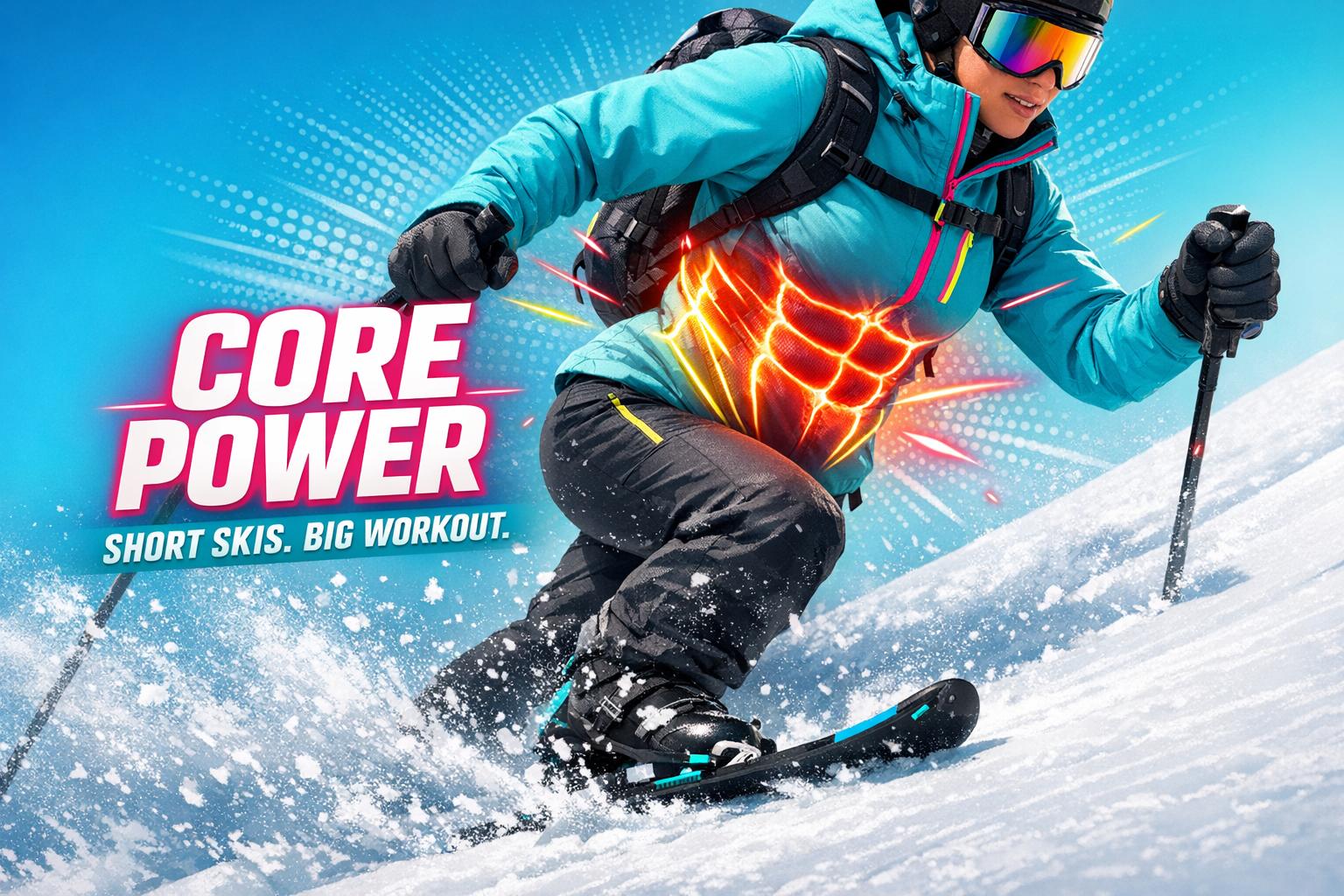
Ski touring is all about sustained strength and endurance. As you climb uphill, you’re working your quads, glutes, hamstrings, calves, and core. At the same time, the constant need for balance challenges your stabilizer muscles.
This is where Snowfeet* Walkski stands out. These compact skis, measuring just 100 cm, demand sharper balance and quicker edge control compared to traditional touring skis, which are typically 160–180+ cm. The shorter length forces your stabilizer muscles to work overtime, boosting agility - especially in tight spots like tree runs. Plus, the shorter skis make learning easier since you’re not fighting with long, heavy gear.
Coach Suzie S., Knight of Sufferlandria, highlights the cardio benefits of ski touring:
"I think ski touring is great cross training... your HR will probably be higher on skis, considering its more of a total body activity compared to cycling".
With Snowfeet*, you’ll feel that full-body engagement right away thanks to their nimble design.
Muscle Engagement and Endurance Comparison Table
Here’s a quick breakdown of how CrossFit, traditional ski touring, and Snowfeet* touring target muscles and endurance:
| Activity | Primary Muscles (Upper/Lower/Core) | Endurance Type |
|---|---|---|
| CrossFit | Full-body: Quads, glutes, core, shoulders, back, stabilizers | Aerobic & Anaerobic (High-intensity intervals) |
| Traditional Touring | Lower-body dominant: Quads, glutes, hamstrings, calves; Core: Abs, obliques; Upper-body: Shoulders, lats, biceps | Primarily Aerobic (Climbing) with Anaerobic bursts (Descents) |
| Snowfeet* Touring | Lower-body, core, agility-focused stabilizers | Aerobic/Anaerobic mix with enhanced dynamic balance |
The takeaway? CrossFit is excellent for building explosive power and high-intensity conditioning, while ski touring - especially with Snowfeet* Walkski - focuses on endurance, dynamic balance, and full-body strength over longer durations. Snowfeet*’s compact design also makes the experience more intuitive and easier to pick up, without the steep technical learning curve of traditional setups.
sbb-itb-17ade95
Why Snowfeet* Walkski Short Skis Beat Traditional Skis
Portability and Convenience
Snowfeet* Walkski short skis bring a level of ease and practicality that traditional ski setups just can’t match. Let’s face it - traditional backcountry skis are a hassle. They're bulky, heavy, and come with a steep price tag, often around $2,200. Plus, they require specialized touring boots, adding even more to the cost and complexity. Snowfeet* Walkski, on the other hand, is a game-changer. At just 100 cm long and priced between $690–$750, these skis are not only more affordable but also incredibly lightweight and compact.
One of the standout features? The patented binding system that works with regular winter boots, snowboard boots, or ski boots. No need for single-purpose gear here! As Brad Tolin, a satisfied user, points out:
"They're lightweight and much easier to carry around than full-size skis".
If you’re tired of lugging around heavy equipment, Snowfeet* Walkski makes life a whole lot easier.
Performance Across Different Terrains
Snowfeet* Walkski isn’t just about convenience - it’s built to handle a variety of conditions with ease. Whether you’re navigating powder trails, packed snow, hiking paths, or groomed slopes, these skis have you covered. Their innovative four-mode binding system - Walk (free heel), Ski (locked heel), Climb 1 (low riser), and Climb 2 (high riser) - adapts to whatever terrain you’re tackling. That’s something traditional long skis often struggle to do.
The compact design also makes quick turns and tight maneuvers a breeze. Even if you’ve only dabbled in Nordic skiing, you’ll find these skis easy to control. Lynn, a recreational Nordic skier, shares:
"I found these so easy to turn and control. I have recreational Nordic experience but was able to manage these great".
And here’s the kicker: the learning curve is practically nonexistent. While traditional touring skis can take ages to master, Snowfeet* Walkski gets you up and running in about 5 minutes. Patrick Brosseau sums it up perfectly:
"Very versatile and a lot of fun!... The versatility is definitely great when you're backcountry skiing".
Higher Calorie Burn and Better Conditioning
These short skis don’t just make skiing easier - they also give you a killer workout. Their 100 cm length forces you to constantly adjust your balance, engaging your core and stabilizer muscles in ways traditional skis don’t. This leads to a higher calorie burn, whether you’re climbing uphill or cruising downhill.
Weighing just 1,558 g per ski, they’re light enough to reduce fatigue, so you can push yourself harder for longer. And when the terrain gets steep, the high riser mode kicks your glutes, quads, and calves into overdrive. As Snowfeet* puts it:
"Performance of a touring ski, ease of a snowshoe".
This combination of uphill cardio and downhill muscle engagement delivers a full-body workout that’s hard to beat. With an overall user rating of 5.0/5, it’s clear that Snowfeet* Walkski isn’t just fun - it’s a fitness powerhouse.
Conclusion: Which Burns More Calories and Builds Better Conditioning?
Final Analysis: Touring vs. CrossFit
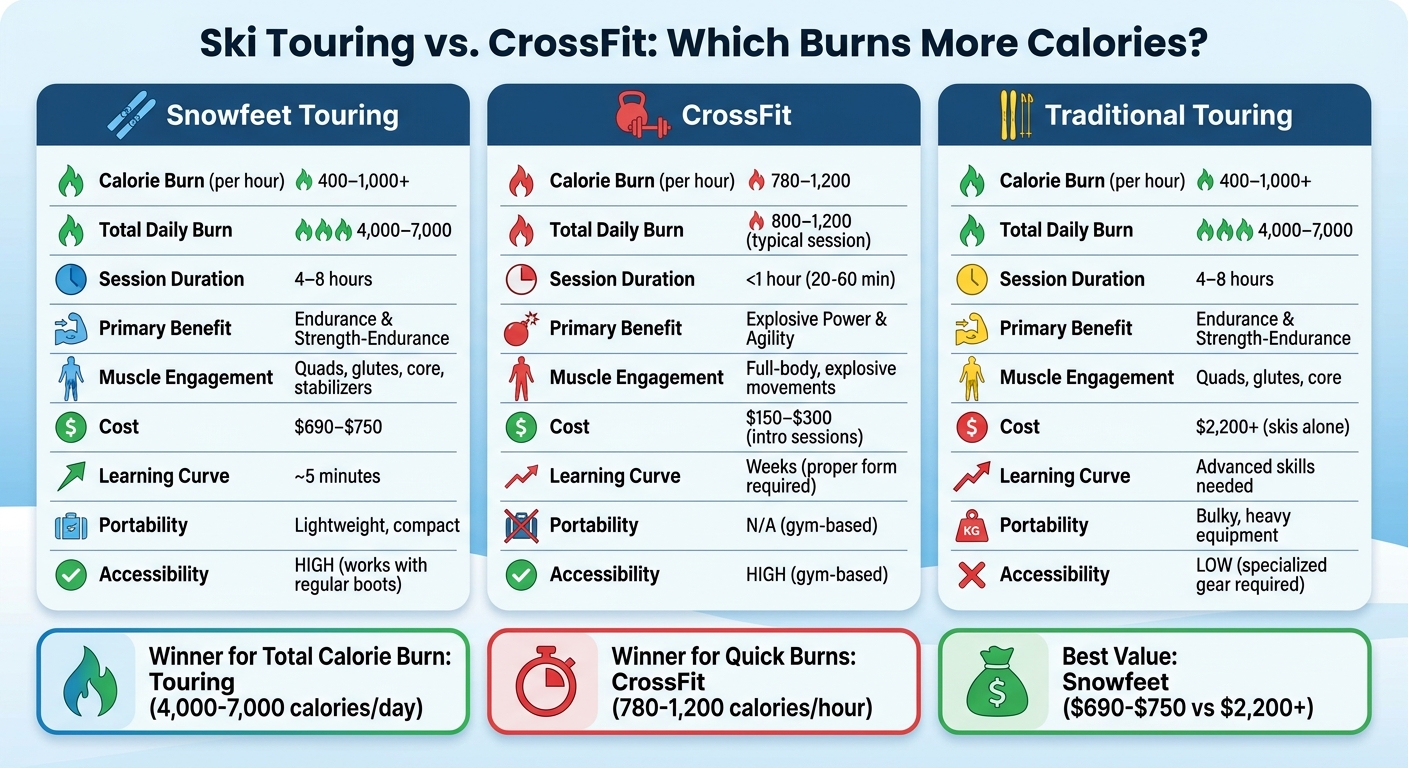
When it comes to calorie burn and conditioning, both touring and CrossFit shine in their own ways. CrossFit sessions torch between 780–1,080 calories per hour, all in under an hour. On the flip side, ski touring burns 400–1,000+ calories per hour, but it’s a marathon, not a sprint - lasting anywhere from 4 to 8 hours. That means a full day of touring can rack up a staggering 4,000–7,000 calories burned, far outpacing what you’d see in a single gym session.
In terms of conditioning, it all boils down to what you’re after. CrossFit emphasizes explosive power, agility, and functional strength through high-intensity circuits and Olympic lifts. Touring, on the other hand, focuses on strength-endurance - building the stamina to climb for hours with a pack and handle tricky descents without wearing out.
If your goal is extended calorie burn, improved cardio endurance, and a love for outdoor adventure, touring takes the crown. Snowfeet* Walkski short skis, in particular, stand out as a game-changer. Not only do they deliver the endurance and full-body workout benefits of traditional touring, but they also come at a fraction of the cost. While a traditional touring setup can set you back over $2,200, Snowfeet* are priced between $690 and $750. Plus, they’re lightweight, portable, and compatible with regular boots, making them accessible without the hassle of bulky gear or specialized boots. Touring isn’t just about burning calories - it’s about exploring rugged terrain, building grit, and getting a workout that’s tough to replicate in a gym.
Complete Comparison Table: Snowfeet* Touring vs. CrossFit vs. Traditional Touring
To wrap it up, here’s a quick breakdown of how Snowfeet* stacks up against CrossFit and traditional touring:
| Feature | Snowfeet Touring* | CrossFit | Traditional Touring |
|---|---|---|---|
| Calorie Burn (per hour) | 400–1,000+ | 780–1,080 (active circuits) | 400–1,000+ |
| Total Daily Burn | 4,000–7,000 | 800–1,200 (typical session) | 4,000–7,000 |
| Session Duration | 4–8 hours | <1 hour | 4–8 hours |
| Primary Benefit | Endurance & Strength-Endurance | Explosive Power & Agility | Endurance & Strength-Endurance |
| Muscle Engagement | Quads, glutes, core, stabilizers | Full-body, explosive movements | Quads, glutes, core |
| Injury Risk | Moderate (terrain-dependent) | High (intensity & complex moves) | Moderate (terrain & avalanche risk) |
| Accessibility | High (portable; works with regular boots) | High (gym-based) | Low (requires specialized gear & skills) |
| Terrain Options | Backcountry, trails, groomed slopes | Indoor gym only | Backcountry, steep alpine |
| Cost | $690–$750 | $150–$300 (intro sessions) | $2,200+ (skis alone) |
| Learning Curve | ~5 minutes | Weeks (proper form required) | Advanced downhill skills needed |
| Portability | Lightweight, compact | N/A | Bulky, heavy equipment |
FAQs
How do I estimate my calorie burn for touring vs. CrossFit?
Calorie burn hinges on a mix of factors: how intense the activity is, how long you’re at it, your body weight, and even the terrain you’re tackling. For instance, ski touring can torch anywhere from 400 to over 1,000 calories per hour - steeper climbs naturally push that number higher. CrossFit, with its high-intensity workouts, can match or even exceed those numbers depending on how hard you go. Want a more precise read on your calorie burn? A heart rate monitor or fitness tracker can give you a better idea based on your own effort levels.
Is Snowfeet* Walkski easier for beginners than traditional touring skis?
Snowfeet* Walkski skis are a great choice for beginners stepping into the world of backcountry skiing. Their lightweight design and straightforward setup make them much easier to handle compared to traditional touring skis. You don’t need to worry about complicated gear or advanced techniques - these skis are built to be simple and accessible. This makes it easier for newcomers to gain confidence and start enjoying the slopes right away.
What boots and bindings do I need to tour with Snowfeet*?
If you’re planning to hit the slopes with Snowfeet*, you’ll need boots and bindings that work with their universal system. Luckily, Snowfeet* WALKSKI bindings are designed to pair with most boots you probably already have - whether they’re winter boots, ski boots, or snowboard boots. They accommodate US sizes 6-13 and come with adjustable bindings for added convenience. Unlike traditional skiing or snowboarding setups, Snowfeet* don’t require any special gear, making them a flexible and easy-to-use option.











Leave a comment
This site is protected by hCaptcha and the hCaptcha Privacy Policy and Terms of Service apply.