



















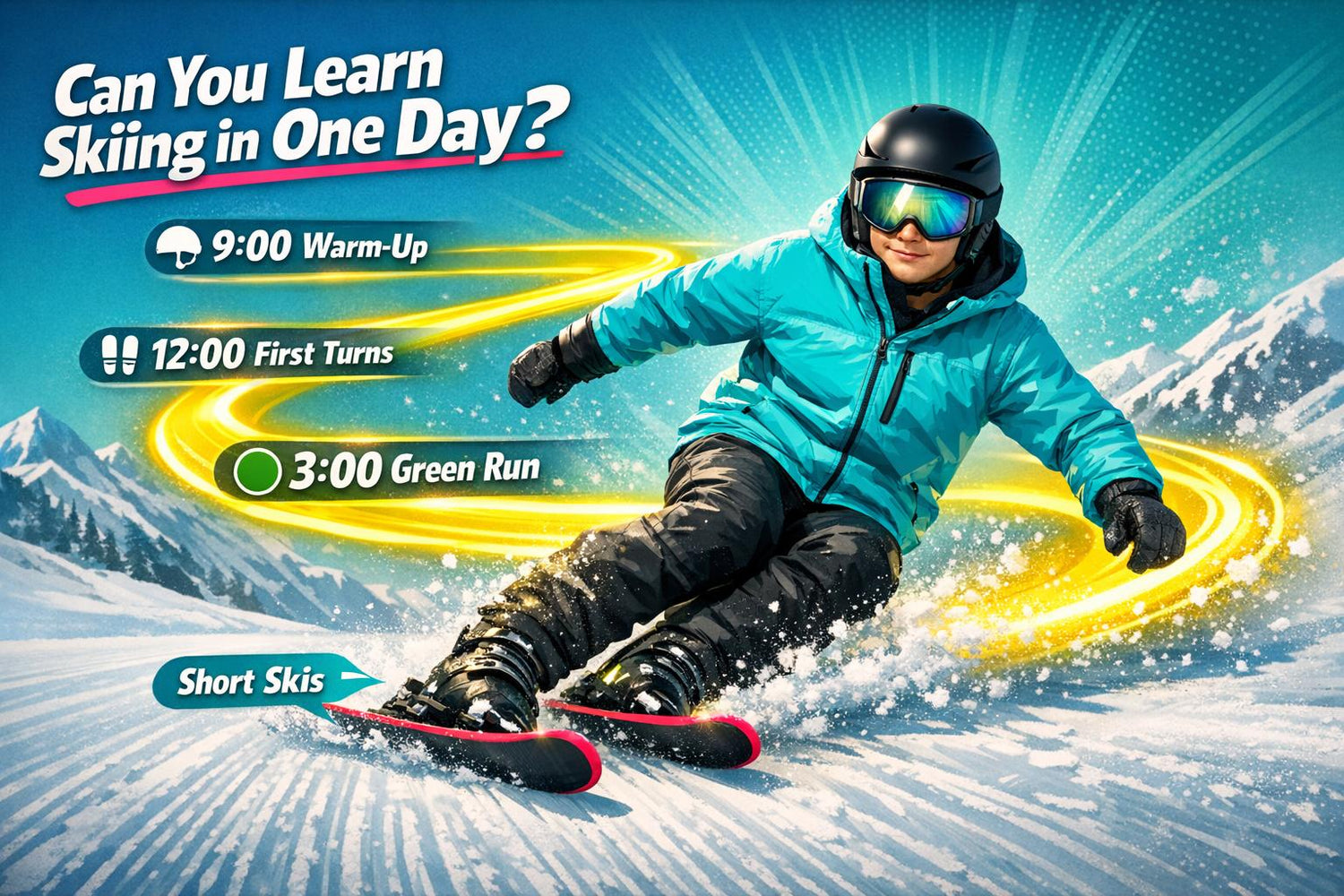
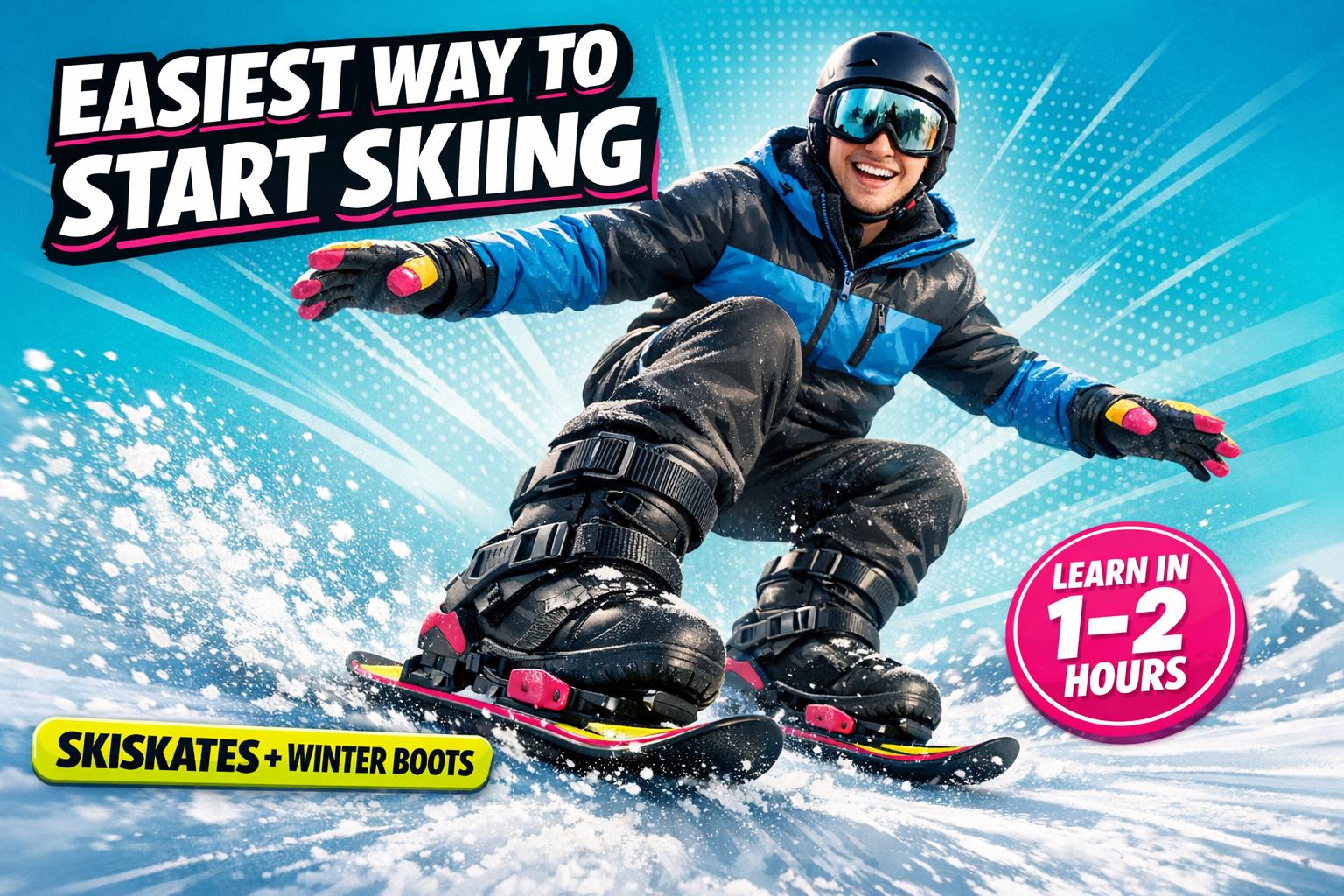
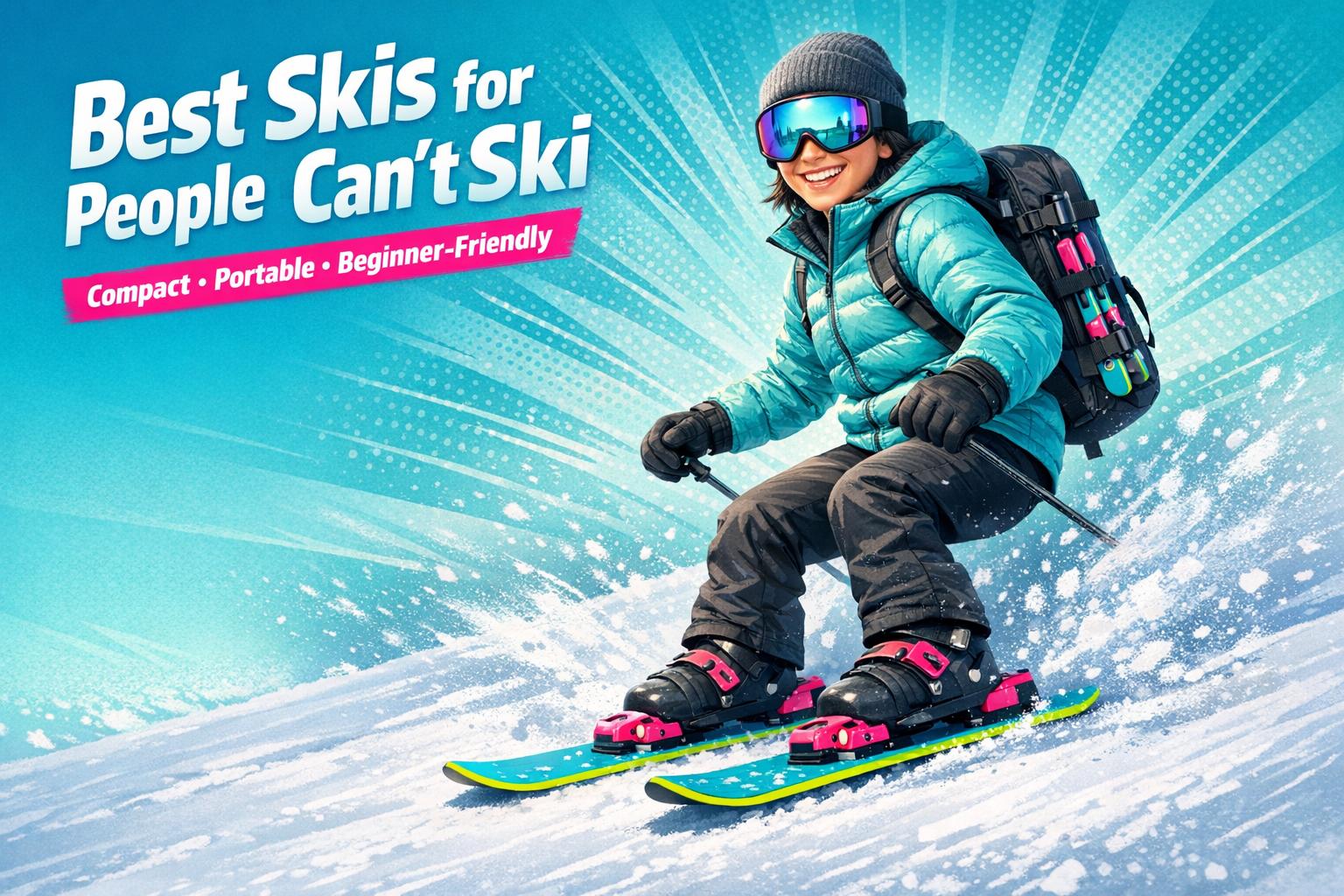
Yes, you can learn skiing in a single day - if you’ve got the right gear. The secret? Short skis like Snowfeet*. These compact skis (17–25 inches) are lightweight, easy to control, and work with your natural movements. Unlike long skis, which take days to master, Snowfeet* helps beginners confidently glide down beginner slopes in just a few hours.
Here’s how Snowfeet* makes skiing simple:
- Short Length: Easier balance, no tip-crossing, faster learning.
- Lightweight Design: Fits in a backpack, no bulky boots needed.
- Affordable: Costs $150–$300 vs. $400–$800 for traditional gear.
Follow a step-by-step schedule: practice on flat ground in the morning, tackle gentle slopes by midday, and finish the day cruising down beginner trails. Snowfeet* turns skiing into a fun, approachable experience for first-timers. Ready to hit the slopes? :)
How to Ski in a Day | 20 Tips
Why Snowfeet* Works Best for Learning Skiing in One Day
If you’re aiming to learn skiing in just one day, the right gear can make all the difference. Snowfeet* gear is designed to simplify the process, cutting out many of the challenges that come with traditional skis. Thanks to their compact size, lightweight build, and compatibility with regular winter boots, Snowfeet* lets you hit the slopes and start learning right away.
Here’s why they’re perfect for one-day beginners.
Shorter Length for Better Balance and Control
Traditional skis are long - usually between 59 and 67 inches - which can make them tricky for beginners to handle. Snowfeet*, on the other hand, ranges from just 15 to 47 inches in length. This shorter design keeps your center of gravity right over your feet, making it easier to balance and control your movements. Plus, the compact size mimics a natural walking stance, which feels more intuitive for newcomers.
Another bonus? You can skip the awkward snowplow phase that’s standard with long skis. The shorter length helps prevent your tips from crossing, so you can move on to parallel turns much faster - sometimes within just a few hours. That’s a huge confidence boost for anyone trying to pick up skiing in a single day.
Lightweight and Easy to Carry
Let’s face it - traditional ski gear can be a hassle to lug around. Snowfeet* changes that. Their gear is small enough to fit in a standard backpack. The 15-inch Mini Ski Skates are so light you’ll barely notice them, and even the larger 47-inch models are easy to carry with one hand.
Since Snowfeet* works with your regular winter boots, there’s no need for bulky, specialized ski boots. This not only saves you from extra weight but also frees up energy to focus on learning to ski instead of just getting to the slopes.
And the benefits don’t stop there. Snowfeet* is also a much more budget-friendly option.
More Affordable Than Traditional Ski Gear
Traditional ski setups can be pricey, often running between $400 and $800. Snowfeet* gear, by comparison, costs between $150 and $300, making it far more accessible.
For instance, the Snowfeet Mini Ski Skates are priced at $250, while the Snowfeet PRO comes in at $275. Both options let you start skiing right away using the winter boots you already own. Compare that to renting traditional ski gear, which can cost $50 to $75 per day, and the savings add up fast. This affordability makes skiing more accessible to newcomers and lowers the barriers to trying it out - even if you’re only planning to spend one day on the slopes.
How to Learn Skiing in One Day: A Step-by-Step Schedule
Yes, you can learn to ski in just one day! The trick is to break your day into focused sessions that build on each other. With the compact and intuitive design of Snowfeet* gear, you can speed up your progress. Here’s a step-by-step guide to take you from zero to confidently gliding down the slopes - all in one day.
Morning: Master the Basics on Flat Ground
Start your day on flat terrain or in a beginner-friendly learning zone. Avoid jumping straight onto a slope - it’s all about building a strong foundation first. Spend the first 1–2 hours getting used to your Snowfeet* Mini Ski Skates (15 inches/38 cm) or Skiskates (17 inches/44 cm). These are perfect for learning basic movements without the bulk of traditional skis.
Here’s what to focus on:
- Stance: Keep your knees slightly bent and your weight evenly distributed over both skis.
- Stopping: Practice the snowplow technique (also called the “pizza” position) to stop. Slide forward a short distance and come to a firm stop. Repeat this until you can stop confidently without leaning too much on one leg.
This session is all about safety and control. Once you’ve nailed stopping on flat ground, you’ll be ready to tackle turns.
Midday: Practice Turning on Gentle Slopes
Now that you’ve got the basics down, it’s time to move to a gentle slope. Switch to Snowfeet* Skiblades (25.6 inches/65 cm). These are a great middle ground - they’re stable but still lightweight, making them easier to handle than traditional skis.
Spend 2–3 hours practicing turns on a small hill with a magic carpet lift. Start with wide snowplow turns by shifting your weight from one ski to the other. Here’s what helps:
- The shorter length of the Skiblades gives you better control and reduces the chance of catching an edge.
- Their soft flex makes turning smoother, so you can focus on weight shifts without worrying about sudden slips.
Work on traversing the slope, initiating turns by pressing into your downhill ski. The goal here is to get comfortable with turning and controlling your speed. Once you’ve got that down, you’re ready for bigger challenges.
Afternoon: Conquer Green Runs and Build Confidence
By the afternoon, you’ll be ready to tackle green circle trails - these are beginner-friendly slopes that are wide and not too steep. Grab your Snowfeet* Skiskates or upgrade to the PRO models (20 inches/50 cm) for added performance.
Spend 2–3 hours putting everything you’ve learned into practice:
- Use the metal edges of your gear to carve into the snow, giving you better control on longer runs.
- Make wide turns to manage your speed, and keep your eyes looking 10–15 feet ahead to stay aware of the terrain.
- Keep your weight centered over your feet for balance as you gradually build up speed.
This final session is where it all comes together. With repetition, you’ll feel more confident and might even start to enjoy the thrill of picking up speed. By the end of the day, you’ll be cruising down the slopes like a pro (well, almost)!
sbb-itb-17ade95
Snowfeet* vs. Traditional Skis and Snowboards
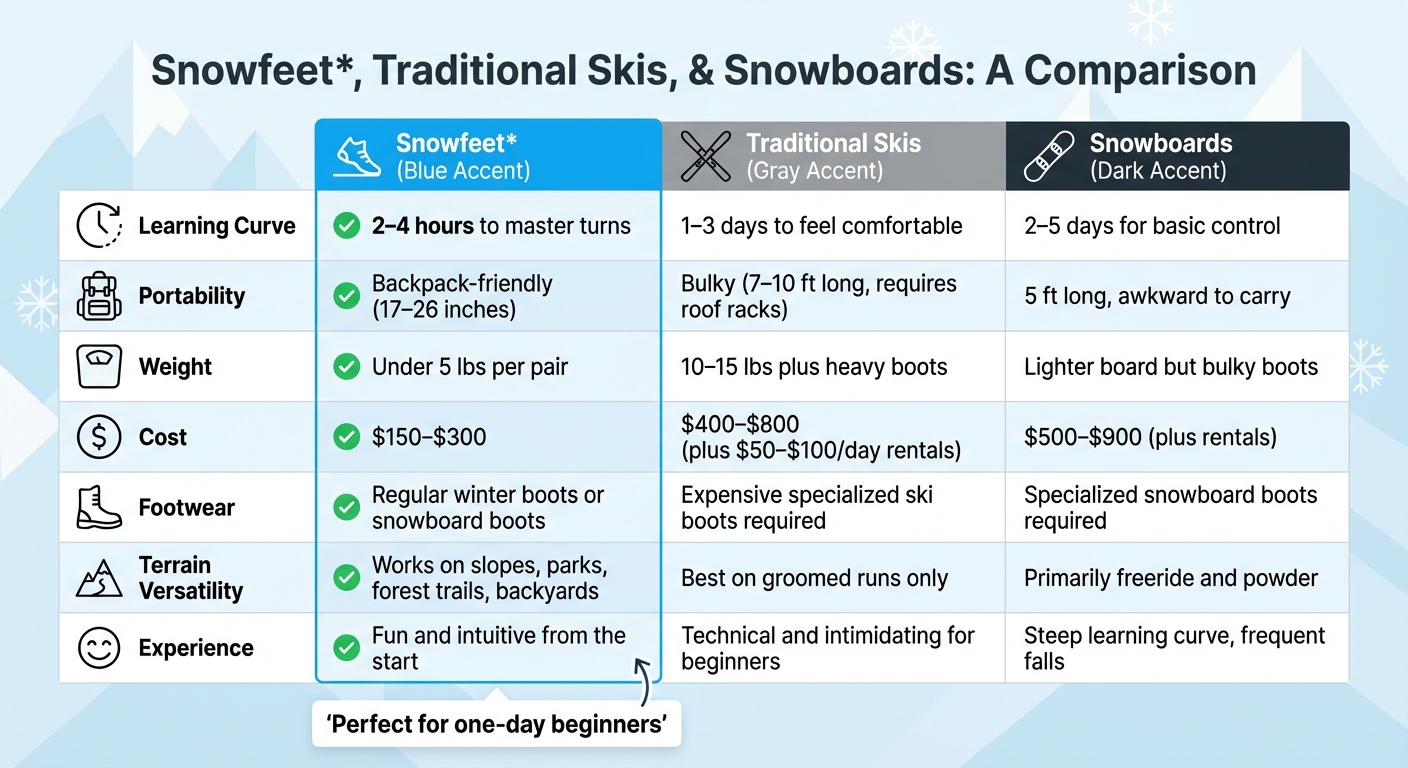
Snowfeet vs Traditional Skis vs Snowboards Comparison Chart
What Makes Snowfeet* Better for Beginners
Snowfeet* has a straightforward design that makes it a fantastic choice for beginners. Unlike traditional skis, Snowfeet* mimics natural movements like walking or skating, so you don’t have to deal with the awkward technical stances that come with skiing. Plus, their short length (17–26 inches) eliminates the dreaded "tip-crossing" problem that often trips up new skiers. This means you get immediate control and can focus on having fun instead of constantly adjusting.
Another bonus? They’re super light - under 5 lbs per pair - and can easily fit in a backpack. No need for bulky gear or roof racks!
Then there’s the price. Snowfeet* costs between $150 and $300, far less than the $400–$800 you'll spend on traditional skis or snowboards. And let’s not forget those rental fees at U.S. resorts, which can run $50–$100 per day. With Snowfeet*, you own your gear right away, so you can practice anytime without worrying about extra costs.
Side-by-Side Comparison: Snowfeet* vs. Traditional Gear
Here’s a quick look at how Snowfeet* stacks up against traditional skis and snowboards:
| Feature | Snowfeet* | Traditional Skis | Snowboards |
|---|---|---|---|
| Learning Curve | 2–4 hours to master turns | 1–3 days to feel comfortable | 2–5 days for basic control |
| Portability | Backpack-friendly (17–26 inches) | Bulky (7–10 ft long, requires roof racks) | 5 ft long, awkward to carry |
| Weight | Under 5 lbs per pair | 10–15 lbs plus heavy boots | Lighter board but bulky boots |
| Cost | $150–$300 | $400–$800 (plus $50–$100/day rentals) | $500–$900 (plus rentals) |
| Footwear | Regular winter boots or snowboard boots | Expensive specialized ski boots required | Specialized snowboard boots required |
| Terrain Versatility | Works on slopes, parks, forest trails, backyards | Best on groomed runs only | Primarily freeride and powder |
| Experience | Fun and intuitive from the start | Technical and intimidating for beginners | Steep learning curve, frequent falls |
If you’re a beginner eager to hit the slopes without spending days learning or breaking the bank, Snowfeet* is the way to go. You can master basic turns in just 2–4 hours, save hundreds of dollars, and carry your gear in a regular backpack. It’s a win-win!
Safety Tips for Your First Day of Skiing
Stick to Beginner Slopes and Take It Slow
When starting out, stick to green runs with a gentle 5–15% incline. These beginner-friendly slopes, often called bunny hills, are perfect for practicing basic techniques like the snowplow (or "pizza") position for stopping and making wide, controlled turns. Avoid crowded or steep terrain for now - green runs give you the space and time to focus on your form and build confidence. Start on flat ground or the gentlest slope to work on your posture: keep your knees bent, ankles flexed forward, and your weight centered over the middle of your Snowfeet*. Their compact 17–26 inch design makes it easier to avoid crossing your tips, so you can safely practice stopping and turning.
Stay on green runs until you’ve mastered the basics, like a quick hockey stop. Moving slowly might not seem exciting, but it’s how you develop muscle memory and confidence. Jumping to harder terrain too early can lead to falls or injuries, cutting your day short before you’ve had a chance to enjoy it.
Once you’re comfortable on beginner slopes, it’s time to focus on keeping your gear in great shape.
Check and Maintain Your Gear
Before hitting the slopes, give your Snowfeet* a quick inspection. Make sure the bindings are secure and apply Snowfeet* wax for smooth, controlled turns. A loose binding can throw off your balance mid-turn, leading to a fall. The compact size of Snowfeet* - just 17–26 inches - means you’ll need less wax than traditional skis, making maintenance a breeze.
Don’t forget to dress appropriately. Stick to the three-layer system: a moisture-wicking base layer, an insulating fleece mid-layer, and a waterproof outer shell. With temperatures at U.S. resorts often ranging between 20–40°F, add gloves, a helmet, goggles, and a neck gaiter or balaclava to protect against wind chill. Proper layering keeps you warm, comfortable, and ready to handle those inevitable first-day tumbles. Snowfeet* gear not only simplifies your learning experience but also cuts down on maintenance compared to traditional skis.
Take a Beginner Lesson
Even with your gear ready to go, a beginner lesson can make a big difference. A short 1–2 hour lesson - usually costing $50–$100 at most U.S. resorts - covers the basics of using Snowfeet*, including proper stance, snowplow stops, and how to safely use ski lifts. An instructor can provide real-time feedback to correct common beginner mistakes, like leaning too far back or letting your legs form an A-frame. By the end of the lesson, you’ll feel more confident tackling green runs on your own.
"Short skis are easier to handle and offer better control, which makes them the perfect choice for beginners and intermediates." - Snowfeet Team
Snowfeet*’s design encourages a natural, upright posture - quite different from the forward lean often needed with traditional long skis. Professional instruction can also teach you how to fall safely. For example, rolling to your side and pushing up from your knees is a quick and safe way to recover after a tumble. Lessons help you avoid bad habits and set you up for a fun, injury-free day on the slopes.
Conclusion
Mastering skiing in just one day? Totally doable - with the right gear. Snowfeet* takes the hassle out of learning by replacing traditional long skis with a compact, beginner-friendly design. Measuring just 17–26 inches, these short skis eliminate common struggles like tip-crossing and knee strain, while mimicking your natural movements. The result? You can go from practicing the basics on flat ground in the morning to confidently tackling green runs by the afternoon. It’s all about making skiing simpler and more approachable.
Snowfeet* also stands out for its convenience and affordability. Their lightweight design easily fits in a backpack, and you can skip the pricey ski boot rentals - just use your regular winter boots. Whether you're brand-new to skiing or brushing up on old skills, the intuitive design makes every turn feel smooth and effortless. Instead of battling with heavy gear, you’ll be free to enjoy the ride.
"Short skis are easier to handle and offer better control, which makes them the perfect choice for beginners and intermediates." - Snowfeet Team
Why spend days struggling with bulky equipment when you could be enjoying the slopes right away? With its shorter length, easy maneuverability, and lightweight build, Snowfeet* helps you nail the basics - like snowplow stops and wide turns - fast. By the end of the day, you’ll feel confident and ready for more. Snowfeet* turns skiing into an accessible, spur-of-the-moment adventure that anyone can enjoy.
Ready to prove that one-day skiing is within reach? Grab your Snowfeet* and hit the slopes today!
FAQs
Do I need a lesson to learn in one day?
You don’t always need a formal lesson to pick up skiing in just one day, especially if you’re using beginner-friendly gear like Snowfeet mini skis or skiblades. These shorter skis are designed to make balancing and turning feel more natural, which takes a lot of the stress out of learning. While lessons can be helpful for mastering advanced techniques or focusing on safety, many beginners find they can quickly get the hang of the basics on their own with Snowfeet products. They’re designed to simplify skiing and make it easier for anyone to dive in and enjoy the slopes.
What boots work best with Snowfeet*?
Snowfeet* work best when paired with lightweight, waterproof snow boots or winter shoes that offer solid ankle support and good grip. The beauty of Snowfeet* is that you don’t need specialized boots like you would for skiing or snowboarding. This makes them a great option for beginners and anyone looking for gear that's easy to use and more accessible.
Can I use Snowfeet* on ski resort lifts?
Yes, Snowfeet skiblades are designed to work on ski resort slopes, and you can use them on lifts. That said, it’s a good idea to double-check the resort’s rules ahead of time. Some places might have specific restrictions or require certain adjustments for this type of gear.











Leave a comment
This site is protected by hCaptcha and the hCaptcha Privacy Policy and Terms of Service apply.