



















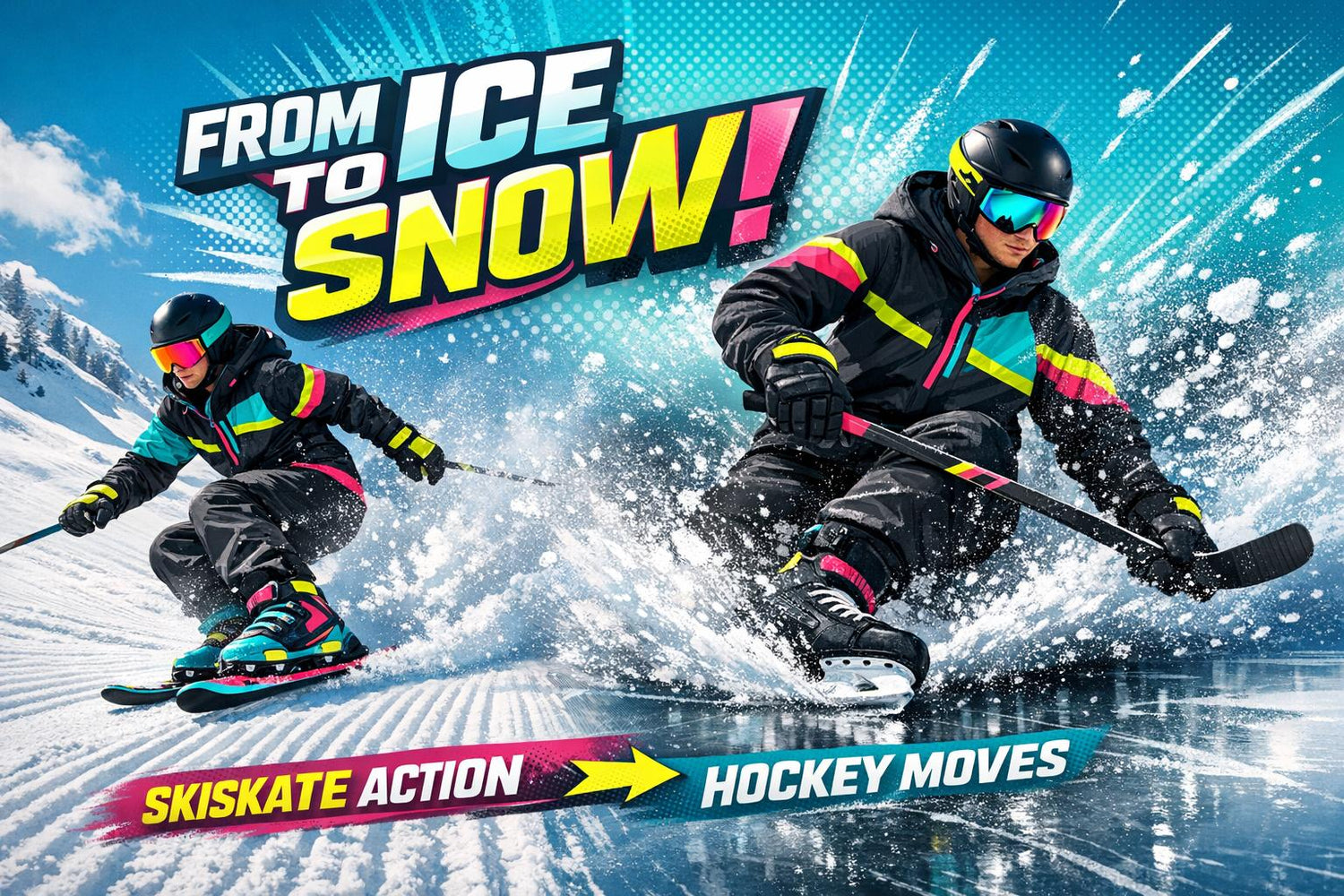
It’s like ice skating, but on snow. You strap on ultra-short skis (think 17-20 inches) and use the same skills you already know: balance, edge control, sharp turns, and quick stops. If you’ve played hockey, you’re already ahead of the game.
Here’s why skiskating is blowing up in 2026:
- Easy Transition for Hockey Players: Your hockey stride and edge control work perfectly with skiskates.
- Compact Gear: Skiskates like Snowfeet* are lightweight, fit in a backpack, and work with regular winter boots. No clunky ski boots required.
- Perfect for Groomed Slopes: Most ski resorts now allow skiskates, making it easy to hit the slopes without a steep learning curve.
Want to keep your hockey skills sharp this winter? Strap on a pair of skiskates and hit the snow. It’s fast, fun, and feels just like home for anyone who loves the ice.
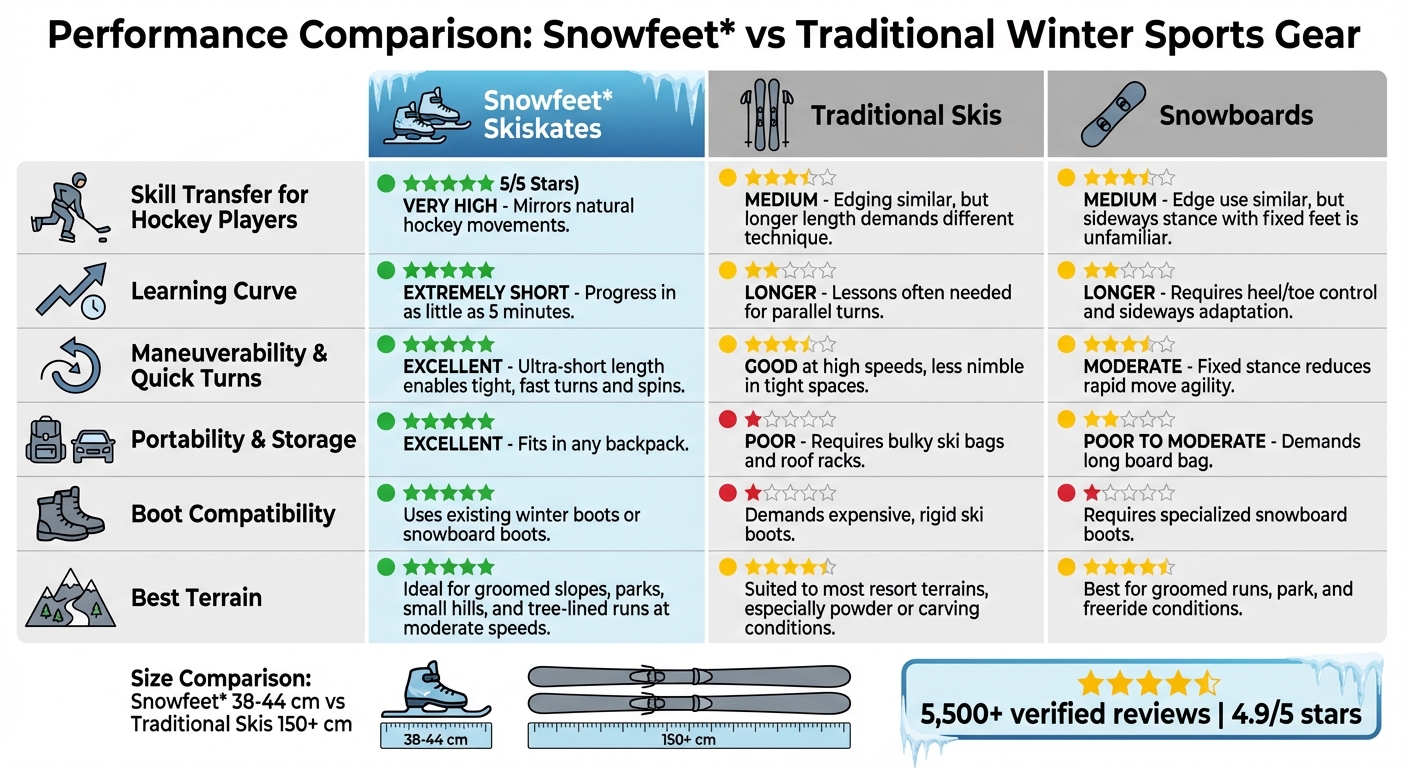
Snowfeet Skiskates vs Traditional Skis and Snowboards Comparison for Hockey Players
Hockey Player Tries Snowfeet* Skiskates | See What He Thinks | Skiboards | Short Ski | Mini Ski
How Hockey Skills Transfer to Skiskating
If you've spent years on the ice, you're already ahead of the game when it comes to skiskating. All those hours honing your balance, edge control, and quick reactions in hockey translate seamlessly to using Snowfeet* Skiskates. Let’s break down how your hockey background gives you an edge (pun intended) on the slopes and prepares you to master Snowfeet* gear.
Balance and Stance
Remember that classic hockey stance? Knees bent, hips slightly back, chest forward, and back flat? Well, it’s just as useful on Snowfeet*. The key difference? You’ll need to flex your ankles a bit more to stay stable on Snowfeet*'s compact 44 cm (about 17 inches) base, especially on softer or uneven snow. A good mental cue is: “Shins forward, weight centered over the middle of your foot.” This positioning keeps your center of mass steady, helping you stay balanced and ready for quick edge adjustments. Unlike traditional skis, where you lean forward onto your toes, Snowfeet* work best when your weight stays centered or slightly back - this prevents those short blades from digging in. Nail this balance, and you’re set for sharp edge control.
Edge Control and Carving
If you’ve ever worked on your edges in hockey, you’re already a step ahead. The pressure and technique you use to carve tight turns on ice translate directly to Snowfeet*'s metal edges. Moves like C-cuts, T-pushes, and hockey stops adapt naturally, giving you control on groomed snow. When stopping, distribute your weight evenly over both feet and keep your upper body stable, facing downhill, while your legs handle the movement. Regularly tuning your edges and waxing the base keeps your skiskates performing smoothly and prevents snow from sticking. With sharp edges and precise control, you’ll feel the agility that hockey players thrive on.
Agility and Direction Changes
Quick transitions, pivots, and tight turns - sound familiar? Your hockey agility is a perfect match for Snowfeet*. Practice rapid edge shifts, similar to cone-weaving drills, to sharpen your maneuverability. The short 44 cm length of Snowfeet* eliminates the bulky feel of traditional skis, giving you the freedom to twist, jump, and pivot with ease. Even skating backward feels natural - just shift your weight slightly forward over your toes and lift your heels. This kind of nimbleness makes it easy to manage speed and direction, keeping you in control whether you're cruising downhill or navigating tighter spaces.
Acceleration and Speed Control
Your hockey stride mechanics - pushing to the side, extending, and recovering - are perfect for building momentum on Snowfeet*. Start with strong lateral pushes to get going on groomed terrain. For speed control, try variations of the hockey stop. Partial stops and directional checks let you adjust your speed without needing to come to a full stop. You can also make subtle gliding adjustments with your edges to fine-tune your pace while keeping things smooth and fluid. Unlike traditional skis that rely on long, sweeping turns to slow down, Snowfeet* let you manage speed with the same quick, instinctive movements you’ve mastered on the ice.
Getting Started With Snowfeet* Skiskates
If you've got solid hockey skills, you're already ahead of the game. Let's dive into how to gear up with Snowfeet* and make the most of your time on the slopes.
Choosing Your Snowfeet* Gear
When picking your Snowfeet* gear, think about how it complements your hockey background. The Snowfeet* Mini Ski Skates (38 cm) are a great entry point, priced at $250. They feature central ribs that mimic the feel of hockey skates, perfect for quick, sharp moves. Want to take it up a notch? The Snowfeet* Skiskates (44 cm), starting at $575, are designed for more dynamic slope action. With a wood core, they let you glide and corner with precision - ideal for anyone used to the agility of skating on ice.
For boots, go for snowboard boots if you need solid ankle support, or stick with waterproof winter boots for a more casual vibe. Adjust your bindings at home with your chosen boots to save time once you hit the slopes. One of the best things about Snowfeet*? The setup is lightweight and simple, unlike the bulky gear you'd deal with for skiing or snowboarding.
Best Terrain for Beginners
Start on groomed slopes at your local ski resort. These smooth, packed surfaces are beginner-friendly and let you focus on nailing your technique. Most U.S. ski resorts allow Snowfeet*, and they perform best on groomed terrain. If you're feeling adventurous, snow parks with gentle features or even sledding hills can be great places to practice tricks once you're confident. For balance drills, your backyard works too - just make sure the snow is packed and no deeper than 4 inches.
Steer clear of deep powder, steep slopes, or uneven terrain with bumps and holes. While Snowfeet* can handle light powder, they truly shine on smooth, predictable surfaces where your hockey skills can translate seamlessly. Stick to these conditions to build confidence and control.
Basic Drills for Hockey Players
Start on flat snow and use your hockey stride to get moving. Push sideways with slightly bent knees, keeping your stance staggered and your shoulders steady. Focus on keeping your weight centered or slightly back - leaning forward like in skiing won't work here.
Once you're comfortable, move on to drills. Begin with C-cuts and gentle direction changes, then progress to short-radius turns. For the corridor drill, imagine a narrow path on the slope and practice making tight, quick turns to stay within it. Use your upper body for stability and let your lower body handle the agility - just like weaving through cones during hockey practice. Most people get the hang of these drills in minutes, making it easy to turn your hockey skills into Snowfeet* mastery. With a bit of practice, you'll be gliding and turning like a pro, ready to enjoy the unique advantages Snowfeet* offer over traditional gear.
sbb-itb-17ade95
Why Snowfeet* Beats Traditional Skis and Snowboards
Skill Transfer and Learning Curve
Traditional skis, often over 150 cm long, and snowboards require techniques that feel foreign to hockey players. Snowfeet*, on the other hand, measure just 38–44 cm, closely matching the dimensions of a hockey skate blade. This similarity eliminates the steep learning curve and makes transitioning a breeze.
Using Snowfeet* feels just like gliding on ice with your hockey stride. Even the hockey stop translates seamlessly, allowing for quick deceleration. For most hockey players, mastering the basics takes as little as 5 minutes. The natural front-to-back balance and edge control make it feel second nature.
"Long enough to ski, short enough to skate. Easy to Learn and Use. Strap in and ride - no lessons needed."
– Snowfeet Store
Unlike traditional skis or snowboards, which require a forward-leaning or sideways stance, Snowfeet* let you maintain an upright, centered posture - just like skating. This effortless skill transfer makes Snowfeet* a natural choice for anyone with hockey experience.
Portability and Convenience
Snowfeet* aren't just easy to learn - they're incredibly convenient. Traditional skis and snowboards are bulky, typically 5 to 6 feet long, and require roof racks, oversized bags, and plenty of storage space. Ski boots, made of rigid plastic, can cost hundreds of dollars and make walking around a hassle.
Snowfeet* flip the script. They’re compact enough to fit in a regular backpack - just 44 cm (about 17 inches) and lightweight. You can toss them in alongside your lunch and extra layers without a second thought. Plus, they work with the winter boots or snowboard boots you already own, so there’s no need to invest in specialized footwear. Adjusting the bindings is a simple task you can handle at home with a screwdriver, saving you from fumbling in the cold.
This portability means you can explore terrain that traditional gear can’t reach. Narrow hiking trails, backyard hills, and cross-country paths suddenly become accessible. And when it’s time to head to the lift or lodge, you can stroll comfortably in your regular boots - no awkward ski-boot shuffle required.
"Far more portable and affordable than traditional skis or snowboards."
– Uncrate
Performance Comparison
Here’s a quick breakdown of how Snowfeet* stack up against traditional skis and snowboards, especially for hockey players:
| Category | Snowfeet* Skiskates | Traditional Skis | Snowboards |
|---|---|---|---|
| Skill Transfer for Hockey Players | Very high – mirrors natural hockey movements | Medium – edging is similar, but longer length demands different technique | Medium – edge use is similar, but sideways stance with fixed feet is unfamiliar |
| Learning Curve | Extremely short – progress in as little as 5 minutes | Longer – lessons often needed for parallel turns | Longer – requires heel/toe control and sideways adaptation |
| Maneuverability & Quick Turns | Excellent – ultra-short length enables tight, fast turns and spins | Good at high speeds, less nimble in tight spaces | Moderate – fixed stance reduces rapid move agility |
| Portability & Storage | Excellent – fits in any backpack | Poor – requires bulky ski bags and roof racks | Poor to moderate – demands long board bag |
| Boot Compatibility | Uses existing winter boots or snowboard boots | Demands expensive, rigid ski boots | Requires specialized snowboard boots |
| Best Terrain | Ideal for groomed slopes, parks, small hills, and tree-lined runs at moderate speeds | Suited to most resort terrains, especially powder or carving conditions | Best for groomed runs, park, and freeride conditions |
Snowfeet* really shine on groomed slopes and park features, where their short length makes tight, quick turns feel effortless - almost like weaving through cones during hockey practice. While they’re not built for deep powder or high-speed carving like traditional skis, they’re perfect for hockey players looking to bring their ice skills to the snow. With over 5,500 verified reviews averaging 4.9 out of 5 stars, it’s clear that riders love how easy and fun Snowfeet* are compared to the heavy, clunky gear they used before.
Conclusion
Hockey players, here's a way to keep your skills sharp all winter long: Snowfeet* Skiskates. These compact skates are a natural fit for anyone with ice hockey experience. Your balance, edge control, and quick turns transfer effortlessly to the snow. Best of all, there’s no clunky equipment or steep learning curve - just strap them on and go.
Unlike traditional skis or snowboards that demand specialized boots and take up a ton of space, Snowfeet* are lightweight and portable. They fit right into a regular backpack and work with the winter boots you already own. Whether you're hitting groomed slopes, narrow trails, or even your backyard, these skates are ready for action.
The reviews speak for themselves. With more than 5,500 verified ratings averaging 4.9 out of 5 stars, users rave about how fun, lightweight, and easy to control Snowfeet* are. Hockey players, in particular, love how these skates feel like a natural extension of their game, offering freedom of movement and a familiar feel on the snow. And the best part? They’re great for all ages and skill levels, making winter training a breeze.
Ready to take your hockey skills to the snow? Snowfeet* offers a range of options, from the 38 cm Mini Ski Skates priced at $250 to the 44 cm model at $575. So, why wait? Strap in, push off, and make winter your new favorite season.
FAQs
What makes Snowfeet skiskates different from traditional skis and snowboards?
Snowfeet skiskates are a game-changer for anyone looking to enjoy the snow without the bulk or cost of traditional skis and snowboards. These little wonders are compact, lightweight, and easy on the wallet. At just 15–20 inches long and weighing only 3–3.5 pounds, they’re a fraction of the size and weight of standard skis or snowboards, which can be over 5 feet long and tip the scales at 6–8 pounds. Best of all, they strap right onto your regular winter boots - no need to shell out for pricey specialized gear. With prices ranging from $150 to $490, they’re a far more affordable option compared to the $1,500+ you'd spend on a full ski or snowboard setup.
The design is simple and intuitive, especially if you’ve got some skating or hockey experience under your belt. Thanks to their small size, they’re super portable - you can toss them in a backpack and head out to snow-covered trails, slopes, or even your backyard. No need for cumbersome bags or car racks. Whether you’re a first-timer or just want a more convenient way to enjoy the snow, Snowfeet skiskates offer a fun and hassle-free alternative to traditional winter sports gear.
Which hockey skills are most useful for mastering skiskating?
Hockey skills like balance, agility, and quick directional changes are a perfect match for skiskating. If you’re used to controlling your edges, shifting your weight with precision, and making sharp turns on the ice, those same abilities will come in handy when gliding through snow with Snowfeet skiskates.
These skiskates are compact, lightweight, and designed to complement your hockey expertise. They offer a portable and fun alternative to bulky skis or snowboards. If quick stops, tight maneuvers, and staying steady on ice are second nature to you, skiskating will feel like a natural - and thrilling - winter upgrade.
Can I use Snowfeet skiskates in all types of snow?
Snowfeet skiskates work best on groomed slopes and packed trails - that’s where they really perform. They’re not ideal for steep terrain or deep powder, as those conditions can affect how well they handle.
To get the most out of them, stick to well-maintained snow surfaces. That’s where you’ll truly appreciate their agility and the convenience they offer compared to traditional skis or snowboards.













Leave a comment
This site is protected by hCaptcha and the hCaptcha Privacy Policy and Terms of Service apply.