




















If you can ice skate, you can snow skate. Snowfeet gear brings the smooth glide of ice skating to snowy slopes without the hassle of bulky equipment. These mini skis fit in your backpack, work with regular winter boots, and are easy to learn - most people get the hang of it in just 5 minutes. Whether you're carving down resort slopes, cruising backyard hills, or exploring trails, Snowfeet offers three models tailored to different terrains and skill levels:
- Mini Ski Skates (38 cm): Lightweight, agile, and perfect for quick turns on small hills or trails ($250).
- PRO (50 cm): Stable and great for blue runs or light off-piste adventures ($275).
- Skiskates (44 cm): High-performance, speed-focused gear for ski resorts ($575).
With over 50,000 users worldwide and a 4.9/5-star rating, Snowfeet makes winter sports simple and fun. Ready to swap your skates for Snowfeet? Let’s dive in!
What is Snow Skating with Snowfeet
Snow Skating Defined
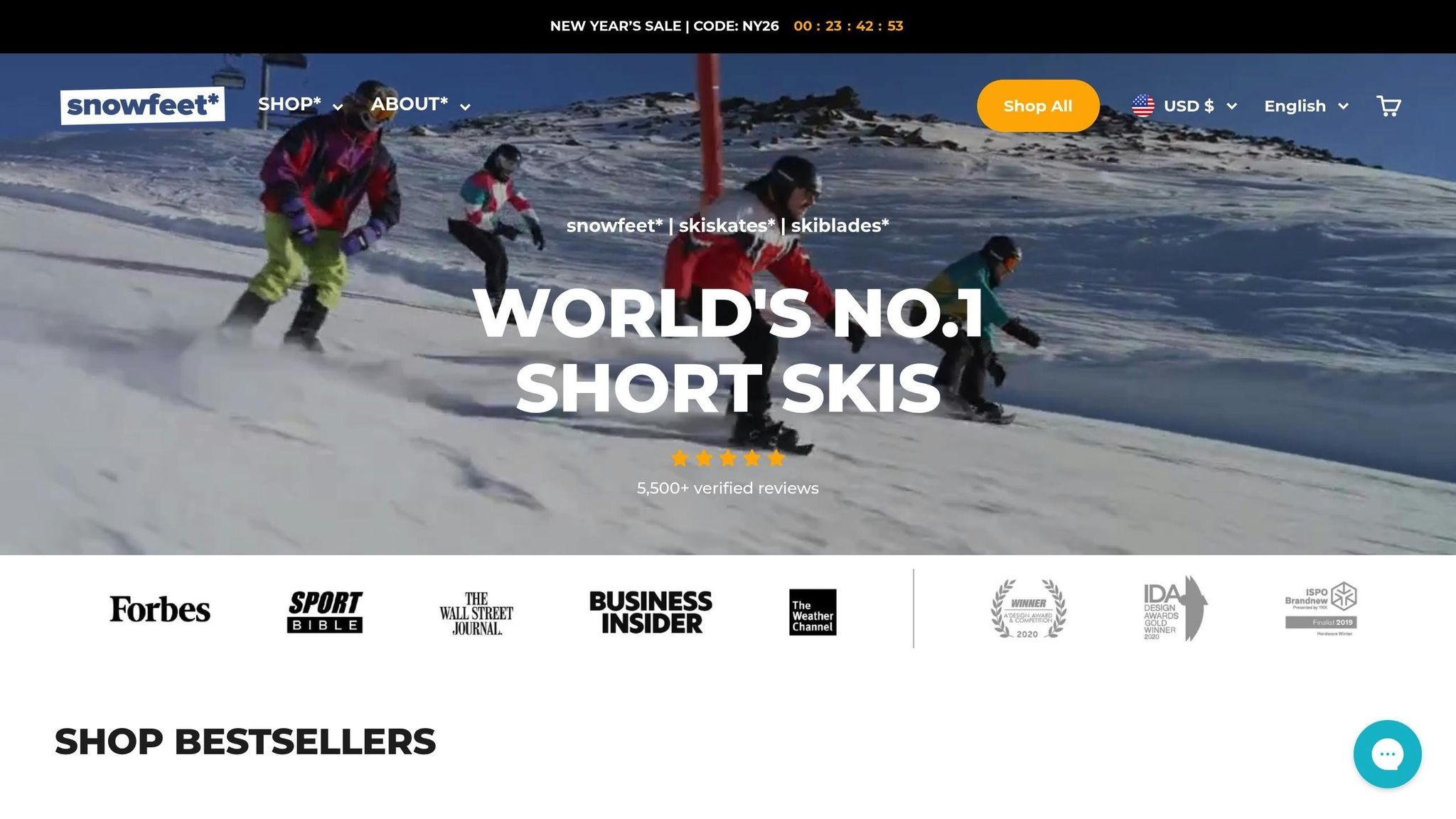
Snow skating, also called skiskating, is a winter sport that blends the techniques of ice skating with the thrill of skiing. Instead of the long skis you're used to seeing, snow skating uses compact gear like Snowfeet Skiskates (17 inches) or Snowfeet PRO (20 inches). These allow you to glide, carve, and skate your way across groomed slopes, snow parks, hiking trails, or even sledding hills.
If you've ever played ice hockey or tried inline skating, snow skating will feel pretty natural. The motion involves a lateral push with your inside edge - similar to the V-shaped stride in skate-style cross-country skiing. Unlike traditional downhill skiing, which leans you forward over your toes, snow skating focuses on side-to-side movements to keep the tips of your skates from crossing. This design makes it easier to spin, jump, and even ride backward.
Snowfeet gear is built for versatility. While traditional skis are great for deep powder or perfectly groomed runs, Snowfeet perform best on packed snow or light powder (up to about 4 inches deep). Another bonus? You don’t need bulky ski boots. Just wear your regular waterproof winter boots or snowboard boots, and you're good to go. This setup makes the transition from ice skating to snow skating feel natural and intuitive.
How Ice Skating Skills Transfer to Snow
If you’ve got experience on ice, you already have most of what you need to snow skate: balance, control over your edges, and smooth weight shifts. The balance you’ve built from figure skating or hockey translates perfectly to Snowfeet. The main difference? Snow has a little more friction than ice, giving you a gentler glide.
Edge control on Snowfeet works much like it does with ice skates. You’ll use your inside edge to carve turns or stop, and the metal edges help with hockey stops. Plus, the shorter length of Snowfeet makes them easier to handle than traditional skis.
Stopping and quick direction changes are a breeze. To stop, just turn both feet sideways and evenly distribute your weight, or use the built-in heel brake on certain models for added control. The trick is to keep your weight centered or slightly back to avoid catching the tips in the snow. Thanks to these similarities, skaters often find snow skating an easy and fun transition from the rink to the slopes.
Snowfeet* & Skiskates Tutorial - How to Become a PRO Skiskater
Picking Your Snowfeet Gear
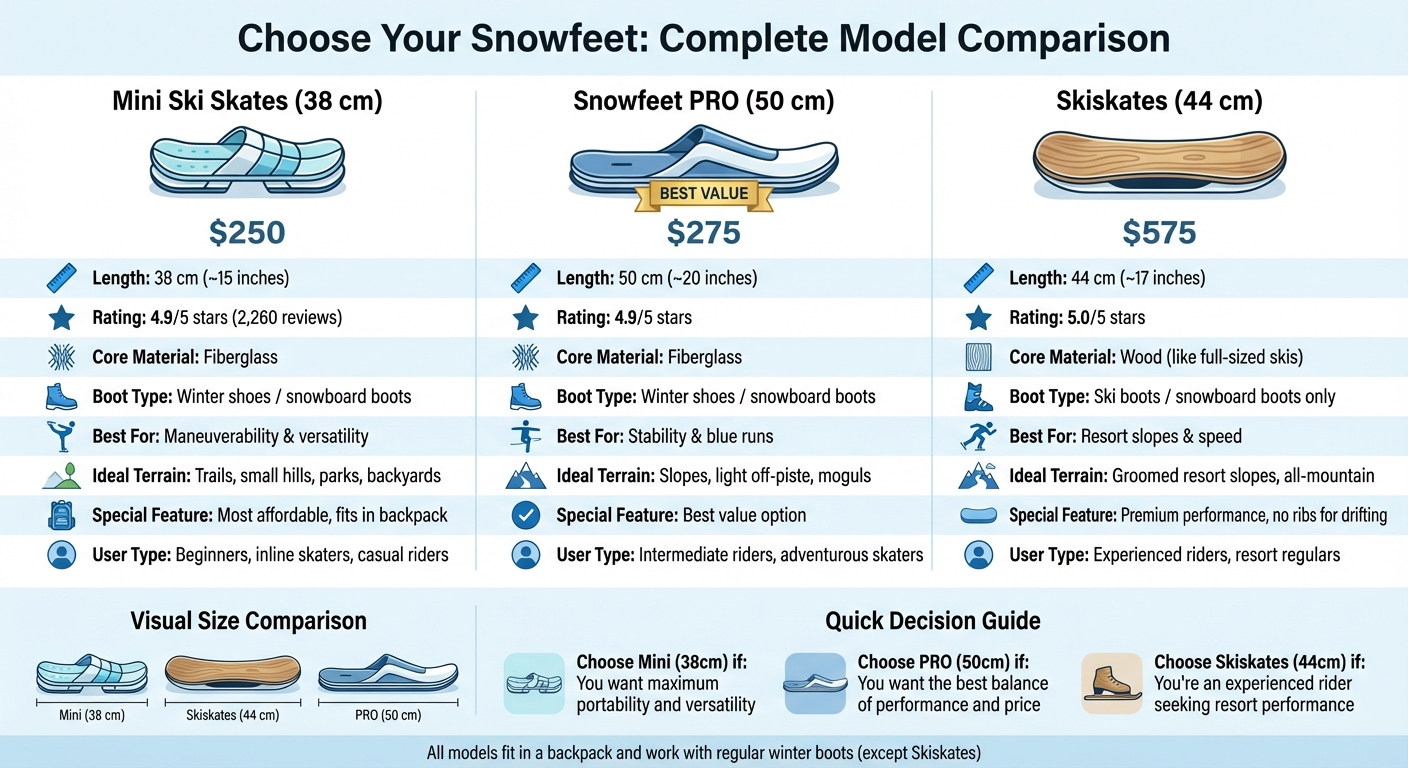
Snowfeet Models Comparison: Features, Pricing, and Best Use Cases
Choosing the right Snowfeet gear comes down to three main factors: your riding terrain, the type of boots you already own, and your skating experience. If you’ve got a background in ice skating, you’re already ahead of the game - many of the skills transfer naturally. The key is to pick a model that fits your typical winter activities. Whether you’re cruising down resort slopes or zipping through a snowy backyard, there’s a Snowfeet option for you.
Think about where you’ll be riding and what boots you’ll wear. Ski or snowboard boots? Perfect for resort runs. Regular winter boots? Great for sledding hills and off-the-beaten-path adventures. Snowfeet offers three main models - 38 cm, 44 cm, and 50 cm - each designed for specific scenarios. Matching the right gear to your boots and terrain makes a huge difference in your experience.
Snowfeet Mini Ski Skates (38 cm)
The 38 cm Mini Ski Skates are compact and super easy to carry - just toss them in your backpack. Built with a fiberglass-reinforced core, they’re the closest thing to ice skating on snow. These skates are all about quick turns, sharp pivots, and agility. Plus, they pair perfectly with regular waterproof winter boots, making them an awesome choice for impromptu rides on local hills, forest trails, snow parks, or even your backyard after a fresh snowfall.
If you’re looking for versatility beyond the ski resort, these are a solid pick. Inline skaters especially love the “ribs” on the base, which mimic the feel of wheels for a smoother ride. At $250, they’re the most affordable option and come highly rated - 4.9 out of 5 stars from over 2,260 reviews. For beginners, the Carbon Fiber edition provides a slower, more controlled ride to help build confidence.
Snowfeet PRO (50 cm)
The PRO model steps things up with an extra 12 cm of length, giving you better stability without losing control. At 50 cm (about 20 inches), these are great for riders transitioning from green runs to blue runs or tackling light off-piste terrain and moguls. The added length helps with balance at higher speeds and offers more edge contact on uneven snow, making them a fantastic choice for adventurous skaters.
Like the 38 cm version, the PRO features a fiberglass core and works with your winter or snowboard boots. Priced at $275, it’s often considered the “best value” option - offering enhanced performance without requiring specialized ski boots. One reviewer, Jonathon Langan, summed it up perfectly:
SnowFeet Pro 50cm are incredibly fun... able to enjoy steeper blue runs as-well, 10/10!
With a 4.9/5-star rating, the PRO model is ideal for confident ice skaters eager to explore real resort terrain while keeping things simple with their everyday boots.
Snowfeet Skiskates (44 cm)
The 44 cm Skiskates are in a league of their own. Built with a wood core, just like full-sized skis, they’re designed for speed, stability, and groomed slopes. These are your go-to if you’re a regular at ski resorts and already own ski or snowboard boots with compatible bindings. The trade-off? You can’t use them with regular winter boots - but the payoff is a true mini-ski experience.
At $575, they’re the premium option, but they deliver unmatched performance. As pro skater Logan (@xskyskaterx) explains:
If you are normally a skier get the SKISKATES. They have no ribs and feel more like skis (ie you can 'drift' around corners)... they deliver impressive speed.
With a perfect 5.0/5-star rating, these are built for experienced riders who want speed, carving power, and the ability to handle all-mountain terrain. If you’re an ice skater or hockey player looking for high-performance gear to shred resort slopes, this is your best bet.
| Feature | Mini Ski Skates (38 cm) | Skiskates (44 cm) | Snowfeet PRO (50 cm) |
|---|---|---|---|
| Best For | Maneuverability & versatility | Resort slopes & speed | Stability & blue runs |
| Core Material | Fiberglass | Wood | Fiberglass |
| Boot Type | Winter shoes / snowboard boots | Ski boots / snowboard boots | Winter shoes / snowboard boots |
| Terrain | Trails, small hills, parks | Groomed resort slopes | Slopes, light off-piste |
| Price | $250 | $575 | $275 |
| Rating | 4.9/5 (2,260 reviews) | 5.0/5 | 4.9/5 |
Once you’ve picked the right model, you’re ready to hit the snow and start mastering those moves!
Your First Day on Snow with Snowfeet
Snowfeet’s sleek design makes snow skating a breeze to pick up. Getting ready for your first session is simple: set up your gear at home, pick the right boots, and find beginner-friendly terrain. Unlike traditional skis with their bulky equipment and endless adjustments, Snowfeet gear gets you on the slopes in no time - usually within 5 minutes.
Gear and Safety Basics
For the 38 cm and 50 cm models, wear waterproof winter boots with solid ankle support. If you’re hitting a ski resort, snowboard boots are a fantastic option - they offer extra stability and grip on groomed slopes.
Dress for U.S. winter weather (below 32°F) with layers. Start with a moisture-wicking base, add an insulated mid-layer, and finish with a waterproof outer shell. Safety gear is a must, especially when you're starting out. Helmets and wrist guards are highly recommended. While Snowfeet are designed to make falls less intense than traditional skis, protective gear will give you the confidence to push yourself without worry.
Setting Up Your Snowfeet Gear
Get your bindings adjusted at home to avoid fumbling with them in the cold. As Snowfeet suggests:
To avoid hassle on the slopes, take your time and adjust the bindings at the comfort of your home, using a screwdriver and a shoe you are going to wear.
Use a screwdriver to fit the bindings to your boot size by selecting the correct holes on the toe and ankle straps. If the straps are too long, trim the excess material. For larger boots, swap in the replacement front toe straps; for smaller boots, adjust or replace the back ankle straps.
After each session, take care of your gear. Wipe down the metal edges to prevent rust and wax the base of fiberglass models (38 cm and 50 cm) for a smoother ride. Regularly maintain the metal edges to keep your glide smooth and consistent.
Once your gear is ready, you’re all set to find the perfect beginner terrain.
Best Terrain for Beginners
For your first run, stick to safe and predictable terrain. Groomed, flat snow - like local sledding hills - is perfect for practicing balance and basic movements. Packed snow on hiking trails also works well for your initial sessions.
Avoid deep powder (anything over 4 inches) since Snowfeet are designed for groomed snow rather than deep, fluffy conditions. Stay clear of steep slopes or ungroomed areas with bumps or holes until you’re more experienced. Keep your stance shoulder-width apart, knees slightly bent, and remember this tip from the Snowfeet team:
Don't place your weight over your toes as you would with skis, because you will fall. Instead, place your weight over the middle or back of your feet.
Most ski resorts welcome Snowfeet since they feature standard metal edges. If anyone at the resort has questions, just let them know the metal edges meet standard safety requirements.
sbb-itb-17ade95
Learning Snow Skating Techniques
Once you've got the hang of staying balanced on safe, gentle slopes, it's time to dive into the fun part - honing your snow skating skills. If you’ve ever ice skated or played hockey, you’re already ahead of the game. Snow skating borrows a lot from those sports, but the snow adds more friction and softer landings, so you’ll need to tweak your technique a bit. Think deeper knee bends and sharper weight shifts. Oh, and always keep your eyes on where you’re heading - not down at your Snowfeet. A quick warm-up with ankle circles and hip rotations can also help loosen you up before you hit the snow.
Basic Moves: Gliding, Turning, and Stopping
Gliding is the bread and butter of snow skating. Start on flat, groomed snow with your feet about hip-width apart. Keep your knees bent and your weight centered. To get moving, use a skating motion similar to what hockey players do - push off with one foot at a time, keeping your edges gentle. If you dig in too much too soon, you might lose your balance.
For carving S-turns, start by gliding across the slope at a shallow angle. Roll your ankles so your Snowfeet rest on their uphill edges, then turn your legs from the hips while your upper body faces slightly downhill. Let your Snowfeet naturally follow the arc across the slope. Shift your weight to the outside foot as you change edges, and repeat the motion in the opposite direction.
Stopping is where your ice skating experience really pays off. Use a hockey stop by sliding both metal edges sideways to create friction. Since Snowfeet are shorter than skis, balance is key - leaning too far forward or back can throw you off. If you’re not ready for a full stop, use the heel brake to control your speed before attempting a hockey stop. Once you’ve got these basics down, you can start exploring steeper slopes.
Moving to Steeper Slopes
Before tackling steeper terrain, make sure you can link smooth S-turns, control your speed with turns, and stop confidently whenever needed. Start small - try a mild green slope and practice traverses, S-turns, and transitions from wedge to parallel turns. Once you’re comfortable, move on to shallow sections of blue runs. A good approach is to enter from the side, make a few controlled turns (three to five), and then exit back to easier terrain. As an example, Jonathon Langan shared in a review that his girlfriend, a figure skater, managed “steeper blue runs” without falling during her first outing on Snowfeet 50 cm gear.
To maintain control as the slopes get steeper, work on garland turns. Begin by gliding across the hill, dip slightly toward the fall line, and then turn back uphill without fully crossing it. You can also practice short-radius turns to master quick edge changes. For rhythm, try counting out loud - “1-2-turn” - to keep a steady pace.
Converting Ice Skating Moves to Snow
If you’ve got ice skating skills, you’re in luck - they transfer well to Snowfeet, with a few tweaks. For example, forward crossovers become carving turns. The same edge pressure and weight shifts apply, but keep your steps smaller so both Snowfeet stay in contact with the snow. Transitions, like going from forward to backward, are easiest as small 180° pivots on flat terrain. Think of them as wider versions of three-turns or mohawks, keeping both Snowfeet under your hips for balance.
For backward skating, lean slightly forward, keeping your weight over your toes and your heels just a bit lifted. Edge drills from the rink - rolling from inside to outside edges - work beautifully on flat snow to fine-tune your control.
When you’re ready to try tricks like jumps and spins, start small. Begin with tiny hops while gliding straight on gentle slopes. Then work up to 180° flat spins by using controlled upper-body rotation - just like you’d practice off-ice. Keep your jumps low and land with deeply bent knees to absorb the impact. Always pick a spot with a clear runout, and steer clear of crowded or icy areas when experimenting.
For advanced skaters, slow-motion drills are a great way to refine your skills. Practice slow S-turns, long wedge stops, and one-foot glides on easy terrain to sharpen your edge control. Keep your movements centered from the hips down, and avoid twisting from your shoulders alone - this helps prevent edge catches and surprise spins.
Why Snowfeet* Outperforms Traditional Skis and Snowboards
Snowfeet* gear offers a sleek, cost-effective alternative to bulky traditional skis and snowboards. While skis typically measure 150–180 cm (5–6 feet) and snowboards around 140–165 cm (4.5–5.5 feet), Snowfeet* are a compact 38–50 cm (15–20 inches). If you’ve got ice skating skills, you’ll find Snowfeet* a natural fit for navigating snowy slopes with precision. Let’s break down how Snowfeet* stand out in terms of control, affordability, and portability compared to traditional equipment.
Shorter Length Equals Better Agility and Precision
The small size of Snowfeet* makes them incredibly nimble. Unlike traditional skis, where beginners often struggle with crossing tips - leading to awkward falls - Snowfeet* reduce this risk. Their compact design allows for quick pivots, sharp turns, and smooth navigation through crowded slopes or tight trails. Logan, a professional skater, shared his experience:
I really can't see myself picking up skis ever again. They are fast and agile, convenient and light.
With Snowfeet*, you’re not wrestling with oversized gear - you’re carving your way down the mountain with ease.
Affordable and Convenient
Let’s talk dollars and convenience. Traditional skis often cost upwards of $500, not including the specialized boots and bindings. Snowfeet* Mini Ski Skates, on the other hand, start at $250, with the PRO model priced at $275. Even better? You can use them with your regular winter boots or snowboard boots. No need to shell out extra cash for stiff ski boots.
Their compact design is another game-changer. Snowfeet* fit neatly into a standard backpack, making them perfect for road trips, flights, or casual outings. For those who love mixing up their weekend activities - sledding in the morning, slopes in the afternoon - the portability of Snowfeet* is hard to beat.
Snowfeet* vs. Traditional Gear: A Quick Comparison
Here’s a side-by-side look at how Snowfeet* stack up against traditional skis and snowboards:
| Feature | Snowfeet* Mini (38 cm) | Snowfeet* PRO (50 cm) | Snowfeet* Skiskates (44 cm) | Traditional Skis | Snowboards |
|---|---|---|---|---|---|
| Length | 38 cm (~15 in) | 50 cm (~20 in) | 44 cm (~17 in) | 150+ cm (~60+ in) | 140+ cm (~55+ in) |
| Portability | Fits in backpack | Fits in backpack | Fits in backpack | Requires car rack/large bag | Requires large bag |
| Learning Curve | Very fast (minutes) | Fast (skating skills) | Fast (skating skills) | Moderate to slow | Moderate to slow |
| Boot Type | Winter or snowboard boots | Winter or snowboard boots | Ski or snowboard boots | Specialized ski boots | Specialized snowboard boots |
| Terrain | Slopes, trails, backyards | Slopes, trails, backyards | Primarily ski slopes | Ski slopes/backcountry | Ski slopes/backcountry |
| Cost | From $250 | $275 | From $575 | $500+ | $400+ |
Chan Saelee, a seasoned snowboarder, highlighted one of Snowfeet*’s most practical advantages:
Getting on and off the chairlift with SnowFeet was simple and stress-free - way easier than snowboarding or skiing.
When you’re not lugging around nearly 5 feet of gear or worrying about expensive equipment, you can focus on what really matters - enjoying the mountain. Snowfeet* make that effortless.
Conclusion
If you can glide across an ice rink, you're already well on your way to mastering snowy slopes with Snowfeet*. Transitioning from ice skating to snow skating is almost effortless, thanks to Snowfeet* gear designed to make that leap easy. Whether you go for the compact Mini Ski Skates at 38 cm (~15 inches), the all-around PRO at 50 cm (~20 inches), or the performance-driven Skiskates at 44 cm (~17 inches), you’re getting lightweight, portable gear that works with your regular boots and doesn’t break the bank like traditional ski setups.
Snowfeet* gear isn’t just versatile - it’s ridiculously convenient. Toss them in your car, and you’re ready for a spontaneous winter adventure. No need to book an expensive ski resort; these work just as well on hiking trails, sledding hills, snow parks, or even a snowy patch in your backyard. That kind of portability changes the game, making winter sports way more accessible.
The best part? The skills you’ve honed on the ice - quick turns, sharp pivots, and that smooth skating rhythm - carry over to snow. Snowfeet* lets you explore terrain that’s a hassle with traditional skis, giving you the freedom to enjoy winter without the bulk. With over 50,000 riders worldwide and more than 5,500 verified reviews averaging 4.9 out of 5 stars, it’s clear this gear has earned its place as a favorite among winter enthusiasts.
This season, why not take your skating moves to the slopes? Start on a beginner hill close to home and see how naturally your skills adapt to snow. It’s no wonder so many are ditching long, cumbersome gear for Snowfeet*. If you can skate, you can snow skate - and you’ll love the agility, convenience, and affordability that come with it.
FAQs
How are Snowfeet more portable and convenient than traditional skis?
Snowfeet offer a level of portability and ease that traditional skis just can’t match. Regular skis are often over 5 feet long and weigh between 7–9 pounds. In contrast, Snowfeet are super lightweight - starting at just 2.2 pounds - and compact, measuring only 15 to 20 inches. They’re small enough to slip into a regular backpack, so you can leave those bulky ski bags and car racks behind.
Another big plus? Snowfeet work with your regular winter boots. No need to invest in specialized ski boots or bindings. This means you can pull them out of your bag and hit the slopes with minimal setup. And let’s talk cost - Snowfeet start at about $150, a much friendlier price compared to the $400–$800 range for a traditional ski setup. It’s an affordable, no-fuss way to enjoy winter sports without all the extra gear.
Can I use Snowfeet with regular winter boots on all types of snow?
Snowfeet are made to fit snugly onto your regular winter boots, making them super easy to use and incredibly handy. Whether you're cruising down ski slopes, venturing into untouched snowy trails, or just having some fun in your backyard, Snowfeet work smoothly across all kinds of snowy terrain.
Thanks to their lightweight and compact design, you can take them pretty much anywhere. They turn your winter outings into a fun and hassle-free experience - no need to lug around heavy ski or snowboard gear.
What ice-skating skills can you use for snow skating with Snowfeet?
Many ice-skating techniques work perfectly when using Snowfeet. For starters, keeping your balance is crucial - stand with your feet shoulder-width apart, bend your knees slightly, and lean forward just a bit. When it comes to weight distribution, aim to keep it centered or lean slightly back. Avoid leaning too far forward, as that can throw you off balance.
Edge control and stopping skills, much like those used in hockey skating, are also super handy when using Snowfeet. If you’ve got those moves down, switching from the ice rink to snowy hills feels natural and, honestly, a lot of fun. Snowfeet offers a fresh, exciting way to dive into winter sports and make the most of the season.













Leave a comment
This site is protected by hCaptcha and the hCaptcha Privacy Policy and Terms of Service apply.