



















Cross-country skiing is an excellent winter training option for runners. It’s easier on your joints, gives you a full-body workout, and keeps your cardio fitness up when icy roads make running tough. Plus, it’s a great mental reset from your usual routine. Choosing between classic vs. skate skiing depends on your goals; classic closely mimics running for a natural transition, while skate skiing builds lateral strength to help prevent injuries.
If traditional skis feel too bulky or pricey, compact options like Snowfeet Nordic Cross-Country Skate Skis might be for you. They’re lightweight, work with regular winter boots, and are beginner-friendly. Whether you’re looking to maintain your fitness, recover from injuries, or just enjoy winter outdoors, skiing is a smart way to stay active.
Here’s what to know:
- Low-impact cardio: Skiing spares your joints compared to running.
- Full-body strength: Builds muscles in your core, arms, and legs.
- Mental benefits: A change of scenery can keep you motivated.
- Gear options: Snowfeet skis are compact and easy to use for runners.
- Training tips: Start on flat terrain, mix skiing with short runs, and aim for steady progress.
Ready to try it? Let’s break it down step by step.
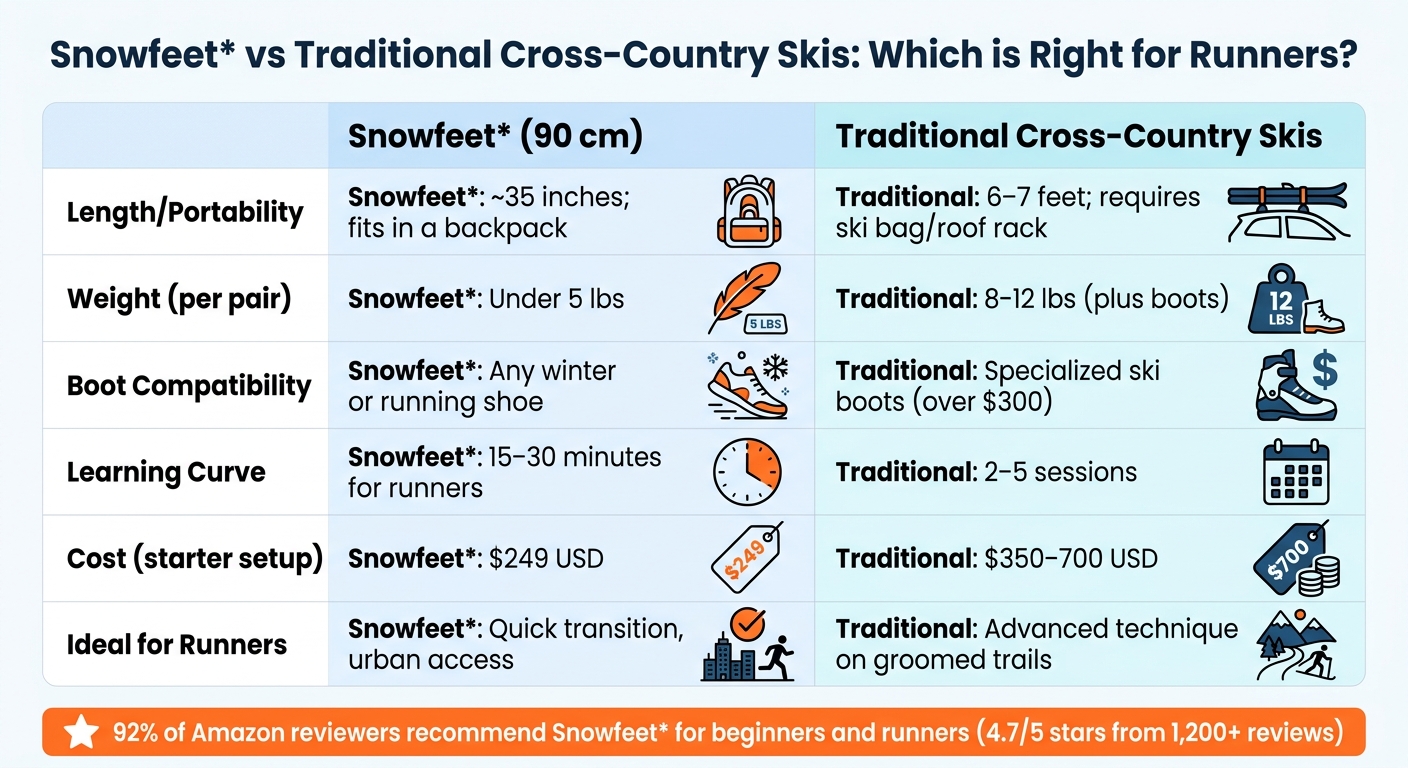
Snowfeet vs Traditional Cross-Country Skis Comparison for Runners
Benefits of Cross-Country Skiing for Runners
Low-Impact Cardio That Protects Your Joints
Running puts a lot of stress on your body - every step can hit your joints with forces 2–3 times your body weight. Cross-country skiing, on the other hand, uses a smooth gliding motion where one ski always stays on the snow. When starting out, it's important to choose the right cross-country skis for your local terrain. This spares your joints from the constant pounding that comes with running.
This makes skiing a great option for active recovery or rehab, letting you maintain your cardio fitness without risking further injury. Former world champion runner Ingrid Kristiansen once said:
Skiing enabled me to train with less risk, sparing my feet from constant impact.
Skiing also keeps your heart working in the 70–85% max heart rate zone, which is perfect for improving VO2 max and holding onto your aerobic base during the winter months. And because skiing spreads the workload across your whole body, you can push harder aerobically without overworking your legs. It’s a joint-friendly way to stay fit and complements running perfectly.
Building Strength and Endurance
Cross-country skiing doesn’t just keep you fit - it builds a stronger, more balanced body. Running mainly targets your quads, hamstrings, glutes, and calves. Skiing, however, adds your core, triceps, shoulders, and upper back into the mix. Each pole plant activates your arms and torso, turning every stride into a full-body workout. This extra strength, especially in your posterior chain and quads, can make you a more stable and efficient runner. As coach TJ David put it:
The strength you develop in the posterior chain, and eccentric strength in the quads, translates very well to being more stable and handling the impact forces of downhill running better.
Skate skiing also strengthens your lateral hips, an area where many road runners are weak. This can help you stay injury-free.
Elite trail runner Sean Van Horn also praises skiing for its low-impact nature, which lets athletes train at higher volumes than running typically allows. He explained:
Skiing athletes are able to train their cardiovascular systems more than most runners by adding more relative volume and intensity.
Thanks to this low-impact training, you can push your aerobic capacity without the wear and tear that comes from logging extra miles. It’s a win for endurance, strength, and injury prevention.
Mental Benefits of Winter Training Outdoors
Forget the treadmill. Skiing through snow-covered forests is a refreshing change from the monotony of indoor workouts or repetitive road running. It offers a mental reset, helping you avoid the burnout that often comes with winter training. The new scenery and skills involved can make winter workouts something to look forward to instead of just enduring the cold.
On top of that, skiing builds mental toughness. Learning to navigate snowy trails and manage fatigue on skis helps you develop the same grit you need for tough running sessions. But it does so in a way that feels less draining than repeating the same routine day after day. By the time spring rolls around, you’ll feel mentally recharged and physically ready to chase your running goals. It’s a perfect way to stay sharp and motivated during the colder months.
How to Adapt Your Running Form to Cross-Country Skiing
Converting Forward Drive Into Gliding Motion
Running propels you forward, but skiing relies on a smooth, lateral push. In classic skiing, the movement mirrors running with a diagonal stride - alternating arms and legs in a "kick-and-glide" motion. Use the grip zone of your skis to push off and glide forward.
For skate skiing, things get a bit trickier. Instead of a forward push, you’ll generate momentum by pushing sideways in a V-shape. Forget rolling through the ball of your foot like in running. As Nordic Ski Lab explains:
In walking, you strike the ground with your heel and roll forward through the ball of the foot... You must cure walking feet to skate ski. You have to stop rolling through the ball of your foot and start rolling through the inner edge of the foot.
To get the hang of it, try skiing uphill without poles. This forces you to adopt the wide V-shape needed for skate skiing and strengthens your legs without relying on your upper body. When training, focus on time-based workouts instead of distance, since snow conditions can significantly affect your pace.
Once you’ve nailed the gliding motion, master the cross-country skiing basics to improve balance and core strength for more controlled skiing.
Balance and Core Stability on Skis
Switching from running to skiing means rethinking how you balance. On pavement, footing is predictable and stable. Snow, on the other hand, is much more dynamic, forcing your core to work overtime. To stay stable, you’ll need to keep your torso engaged to transfer power effectively from your poles to your skis. As Trace Williams from Skimo Co explains:
Skiing without ever involving your core is nearly impossible.
To improve balance, keep your ankles, knees, and hips slightly bent. This lowers your center of gravity and gives you a bigger "success zone" for staying upright. Distribute your weight evenly across your foot to stay steady during the glide phase.
Drills like double poling are great for building full-body tension and improving core stability. By isolating your upper body mechanics, these drills help you focus on fluid motion without worrying about your legs.
Classic vs Skate Skiing: Which Style to Learn First
When adapting your running form, the style of skiing you start with matters. For most runners, classic skiing is the best introduction. Its diagonal stride mimics running, making it feel more intuitive. You’ll glide along parallel tracks, maintaining a familiar forward rhythm. Coach Carrie McCusker puts it this way:
Classic offers a balanced, familiar motion accessible for those on the cusp of their snow experience.
On the other hand, skate skiing is a bit more challenging to pick up. It demands greater coordination, stronger lateral hip muscles (an area where many runners are weak), and mastering that tricky inside-edge foot roll. But it’s worth learning eventually. GRP trail runner Britta Clark highlights its benefits:
Classic skiing is probably closer to running in terms of technique, but skating especially builds lateral hip strength, which is something many runners... struggle with.
Start with classic skiing to build a solid foundation in weight transfer and gliding. Once you’re comfortable, add skate skiing to develop lateral hip strength and improve overall athletic performance. If you’re looking for an easier entry point, Snowfeet* Nordic Cross-Country Skate Skis are a great beginner-friendly option, making both styles more approachable.
Choosing the Right Gear: Snowfeet* Nordic Cross-Country Skate Skis (90 cm) vs Traditional Skis

Why Snowfeet* Works Better for Runners
Snowfeet* Nordic Cross-Country Skate Skis simplify the transition to skiing for runners by making the gear more accessible and reducing the learning curve. At just 35 inches long and weighing under 5 pounds per pair, they’re compact enough to fit in a backpack and work with any US size 5–13 winter boot or trail shoe. This eliminates the need for pricey ski boots, saving you over $300. In comparison, traditional cross-country skis are 6–7 feet long, requiring special storage and transport.
With Snowfeet*, you can use your own winter boots or trail running shoes. Adjustable straps secure the skis to your footwear, giving you better ankle flexibility and reducing the likelihood of blisters.
Most runners can pick up the basics within 15–30 minutes. Snowfeet* builds on familiar movement patterns like balance, core stability, and forward propulsion. The shorter length also prevents the tangled skis that often frustrate beginners using traditional gear. Nordic skiing expert Sarah Lee highlights this benefit:
For runners, Snowfeet* cuts the intimidation factor by 70%, turning first tries into fun workouts.
You’ll be gliding at speeds of 4–6 mph in no time, burning 500–700 calories per hour while staying within your running heart rate zones.
Snowfeet* vs Traditional Cross-Country Skis
Traditional skis often require precise weight shifts and long glides, which don’t align well with the compact stride habits of runners. This mismatch contributes to beginner dropout rates of up to 40%, according to USSA statistics. Snowfeet*, on the other hand, converts your natural running push-off into an easy gliding motion. It’s no surprise that 92% of Amazon reviewers (with an average rating of 4.7/5 from over 1,200 reviews) recommend them for beginners and runners.
Here’s a quick comparison of Snowfeet* and traditional skis:
| Feature | Snowfeet* (90 cm) | Traditional Cross-Country Skis |
|---|---|---|
| Length/Portability | ~35 inches; fits in a backpack | 6–7 feet; requires ski bag/roof rack |
| Weight (per pair) | Under 5 lbs | 8–12 lbs (plus boots) |
| Boot Compatibility | Any winter or running shoe | Specialized ski boots (over $300) |
| Learning Curve | 15–30 minutes for runners | 2–5 sessions |
| Cost (starter setup) | $249 USD | $350–700 USD |
| Ideal for Runners | Quick transition, urban access | Advanced technique on groomed trails |
Traditional skis can be great for experienced runners aiming for higher speeds on groomed tracks (10–15 mph). But Snowfeet* is perfect for those who want to start training right away without the extra hassle. Ultrarunner Mike Johnson from New York logged 200 miles on Snowfeet* during his 2026 winter training and later completed a 50K ski race.
It preserved my marathon legs.
This ease of use makes Snowfeet* a practical option for maintaining running fitness during winter while also strengthening lateral hip muscles - perfect for hitting the trails again in spring. Up next, learn how to incorporate these skis into your winter training routine.
How to Start Cross-Country Skiing as a Runner
Practice on Flat Terrain First
Starting out on flat, groomed trails - like those in parks or golf courses - is a great way to ease into cross-country skiing. These surfaces make it easier to learn the essentials: weight transfer, gliding, and stopping. If you're using Snowfeet* Nordic Cross-Country Skate Skis, you'll likely find the skating motion familiar, especially if you've done inline skating or played ice hockey. Many runners can get the hang of it in just 5 minutes.
During your first few sessions, focus on balancing your weight from front to back. The compact design of Snowfeet* provides extra stability, which can help avoid the dreaded ski tangles that often trip up beginners. Practice pushing laterally, much like you would when ice skating. Steer clear of deep powder (anything over 4 inches) and uneven, ungroomed terrain until you've logged at least three sessions on smooth snow.
Start small - aim for 20–30 minute sessions to begin with, and then gradually add 5–10 minutes each week. This approach gives your arms, shoulders, and core time to adjust without overloading your body. Once you've nailed the basics on flat terrain, you'll be better prepared to tackle more varied conditions.
Adding Cross-Country Skiing to Your Winter Training Schedule
After mastering the fundamentals, it's time to weave skiing into your regular training. Keep at least one short run in your weekly routine - whether it's outside or on a treadmill. This helps maintain the neuromuscular adaptations that come from running and keeps your legs conditioned for impact forces. Remember, running places a load of 2–3 times your body weight on your joints with each stride, so staying consistent is key.
Skiing makes for a fantastic active recovery option after tough running workouts. A relaxed 45-minute ski can help ease leg fatigue while sparing your joints. Plus, one hour of Nordic skiing delivers similar cardiovascular benefits to about 75–80 minutes of running, making it an efficient workout. Since skiing uses your entire body, your heart rate can quickly climb to 70–85% of its max. To avoid overdoing it, start at a comfortable pace and focus on smooth, controlled movements.
Here’s an example of how you might structure your week:
- Tuesday: Tempo run
- Wednesday: Easy 45-minute ski
- Thursday: Recovery run (30 minutes)
- Saturday: Long ski session (60–90 minutes)
- Sunday: Easy 40-minute run
Don’t forget to bring water and snacks on your ski outings. The full-body effort burns a lot of energy, and cold, dry air can lead to dehydration faster than you’d expect.
Setting Goals and Measuring Improvement
With your technique coming along and a routine in place, it’s time to set some goals to track your progress. Use a GPS watch or fitness app to monitor distance, time, and heart rate. Start with small milestones, like skiing for 45 minutes without stopping or covering 3–4 miles on flat terrain. As you improve, you’ll likely notice your heart rate staying lower for the same level of effort - proof that your body is adapting.
To stay motivated, consider signing up for a late-winter ski event or a spring trail race. Many runners find that cross-country skiing strengthens their hips and core, which can give them a boost in uphill running once spring rolls around.
Set achievable goals: work on perfecting the diagonal stride in your first week, tackle gentle hills by week three, and aim for 90-minute sessions by week six. Pay attention to how your body feels - a tough ski session might mean swapping your next workout for an easy recovery run.
sbb-itb-17ade95
How to Classic Ski with Olympian Judy Rabinowitz
How to Maintain Your Snowfeet* Skis
Taking good care of your Snowfeet* skis is key to keeping them in top shape and ensuring they last for years.
Cleaning and Waxing
After every use, make sure to clean your Snowfeet* skis. Wipe off any moisture, dirt, or debris to protect the bindings and metal parts from wear and tear. Pay extra attention to removing grit like sand or road salt - these can scratch the base or mess with the bindings.
Snowfeet* 90 cm skate-style skis have a smooth base specifically designed for lateral pushing and smooth gliding. Unlike traditional Nordic skis that need specialized waxing for glide and grip zones, these skis are all about the glide. A quick wipe-down - seriously, it takes under two minutes - keeps the surface low-friction and helps extend the life of your skis.
Checking Bindings and Straps
Before you hit the snow, give your straps a once-over. Check for fraying, cracks, or loose connections that could affect safety or reduce your power transfer. Make sure all metal parts move freely and that the straps fasten securely. If you spot any damage, replacement straps are affordable, starting at just $6. Taking 30 seconds to inspect your gear can save you from equipment issues later on.
Snowfeet* bindings are designed to be easy to maintain, unlike traditional cross-country ski setups that might need professional tweaks. Understanding the difference between XC skiing and Nordic skiing can help you choose the right maintenance routine for your gear. With regular checks and a little care, your skis will stay ready for action, letting you focus on perfecting your stride.
Conclusion
Cross-country skiing gives runners an excellent way to stay in shape during the winter months while reducing the impact on their joints. It’s a full-body workout that boosts cardiovascular fitness and offers a refreshing change from treadmill sessions. Former world champion runner Ingrid Kristiansen once said, "Skiing allowed [me] to train more with less risk of injuries, sparing [my] feet from the relentless pounding of running". By incorporating skiing into your routine, you can build incredible aerobic capacity without the wear and tear that running often brings.
Of course, having the right gear makes all the difference. Traditional cross-country skis, while effective, can be bulky, expensive, and require groomed trails - making them less convenient for runners. That’s where Snowfeet* Nordic Cross-Country Skate Skis come in. At just 90 cm (about 35 in), they’re compact, easy to transport, and work on most packed snow surfaces. No need to fuss with waxing or complicated bindings, and they’re much easier to learn than traditional skis.
With Snowfeet*, runners can enjoy a workout that’s efficient and effective. Just one hour of skiing can match the cardiovascular benefits of 75–80 minutes of running, while also engaging the upper body - something running doesn’t typically do. This added strength can even improve your running efficiency when spring rolls around.
If you’re looking to mix up your winter training, avoid injury, and keep your fitness on track, Snowfeet* offers a simple, accessible way to do it. Whether you’re aiming to avoid winter training ruts, build endurance, or just enjoy the outdoors when the roads are slick, cross-country skiing is a perfect solution. With Snowfeet*, you can ditch the hassle of traditional skis and embrace winter training with ease, keeping your body strong and ready for the miles ahead.
FAQs
How often should I ski instead of run in winter?
When it comes to deciding how often to swap running for skiing in the winter, there’s no one-size-fits-all answer. Cross-country skiing is an excellent low-impact activity that pairs nicely with running. It helps build strength, improves balance, and boosts aerobic fitness - all while being gentler on your joints.
Many runners hit the trails 1-3 times a week during the heart of winter to keep their endurance up and shake up their training routine. How often you ski really depends on your personal goals and how much time you’ve got to spare.
Classic or skate skiing - which is easier for runners?
Classic skiing tends to be a smoother transition for runners moving to snow sports. The striding motion feels a lot like running, making it less daunting and physically taxing for beginners. On the other hand, skate skiing is more energetic and demands better balance and coordination, which can be tricky for newcomers. If you're looking to ease into winter training, Snowfeet Nordic Cross-Country Skate Skis* are a great choice for classic skiing. They're portable and simple to use, helping runners adjust comfortably to snowy adventures.
Can Snowfeet* skis work on neighborhood snow and parks?
Snowfeet* skis are a fantastic choice for neighborhood snow and park adventures. Their lightweight, compact design makes them easy to carry and perfect for smaller, local areas. Unlike traditional skis, they’re built for quick, casual sessions right in your yard or at the park. If you’re looking for a fun and convenient way to enjoy winter close to home, these are a great pick!












Leave a comment
This site is protected by hCaptcha and the hCaptcha Privacy Policy and Terms of Service apply.