



















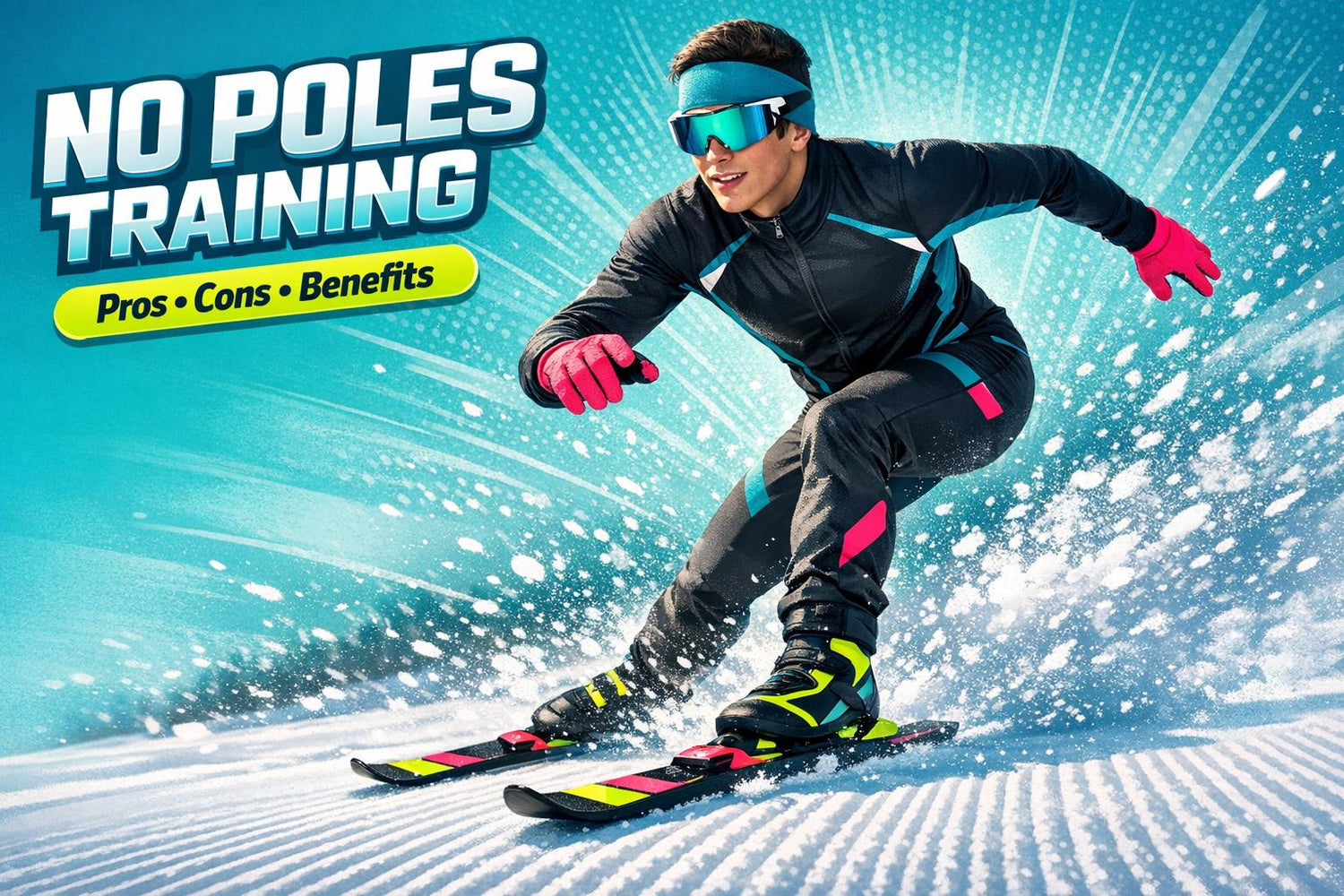
Sure, you can cross-country ski without poles! It’s a great way to focus on your lower body, improve balance, and build core strength. By ditching the poles, you rely entirely on your legs and core for movement, sharpening your technique and making skiing simpler. Here’s a quick breakdown:
- Why Try It? It strengthens your legs and core, improves weight transfer, and simplifies your setup. Plus, it’s great for beginners or freestyle skiers who need their hands free.
- Challenges: Without poles, you’ll have less speed and power, and your legs will tire faster, especially on steep or icy terrain.
- Best Gear: Short skis like Snowfeet* make pole-less skiing easier. They’re lightweight, portable, and designed for better control.
Whether you’re training or just looking for a fun way to switch things up, skiing without poles is worth a shot. Ready to glide hands-free? Let’s dive in!
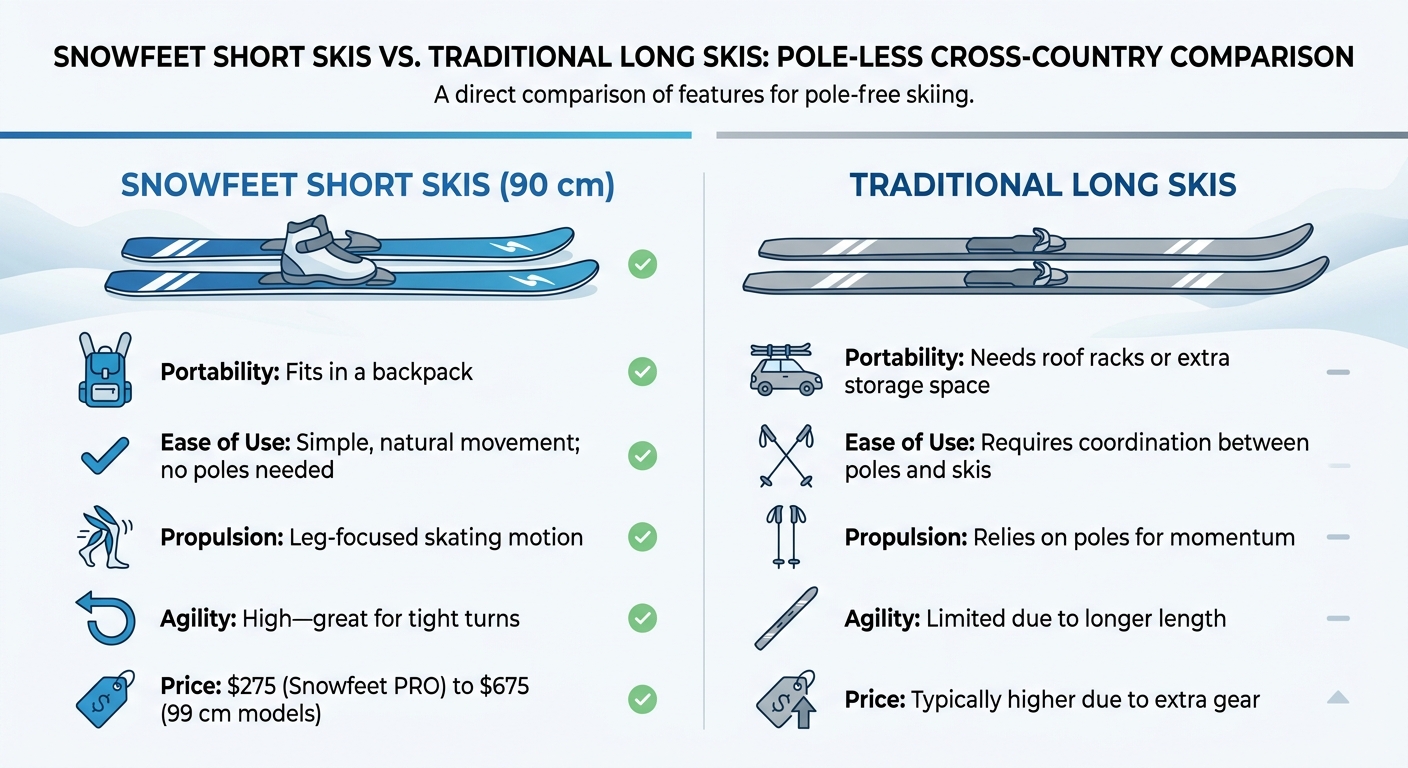
Snowfeet Short Skis vs Traditional Long Skis Comparison
Nordic Byte: No Pole Striding
Benefits of Cross-Country Skiing Without Poles
Let’s dive into how skiing without poles can take your technique and strength to the next level.
Builds Core Strength and Balance
When you ski without poles, your torso does all the heavy lifting to stabilize each stride. This means you’re transferring your weight fully with every glide, which sharpens your core engagement and improves your overall balance. Plus, it eliminates the crutch of leaning on poles for support, so any flaws - like poor weight transfer or misaligned hips - become glaringly obvious. The result? A stronger core and better skiing form.
Develops Better Skiing Form
No poles? No problem. This forces you into an athletic stance, keeping your hips and legs aligned for maximum energy efficiency and control. You’ll find yourself naturally adopting a "chest over knee" position, which helps maintain momentum and prevents slipping. By extending the glide phase and practicing balance on one ski, you’ll rely more on your legs and less on poles for stability. Bonus: without poles, your gear setup is simpler and more portable.
Easier to Carry and Use
Ditching poles means less gear to haul around, making it much easier to move across flat terrain or easy slopes. For beginners, this setup puts the focus squarely on lower-body balance and control, without the distraction of poles. If you’re into lightweight, portable options, Snowfeet* short skis (17 to 47 inches long) are perfect for agile, pole-free skiing.
Drawbacks of Cross-Country Skiing Without Poles
Skiing without poles comes with its fair share of challenges that can affect performance and endurance.
Less Speed and Power
Poles are a key part of generating forward momentum in cross-country skiing. Without them, you lose the ability to push off the snow effectively, which makes it tough to start smoothly or maintain speed. As SENDY.io puts it:
In cross-country skiing, poles play a crucial role in propulsion. They provide power in diagonal stride, skate skiing, and double poling techniques, making movement more efficient.
Without this extra push, your efficiency takes a hit, and covering long distances becomes a lot harder. The lack of propulsion also means your legs have to work overtime, which can lead to quicker fatigue.
Faster Leg Fatigue
When you don’t have poles, your legs are left to do all the heavy lifting. This added workload speeds up lactic acid buildup, leaving your muscles exhausted much faster. Poles typically help distribute the effort between your arms and legs, but without them, your core, glutes, and hips have to step up to stabilize your movements. Overcompensating often leads to leaning back too much, which puts extra strain on your quads. SkyTechSport highlights this issue:
Leaning back = More strain on quads = Faster fatigue.
On top of that, the additional strain on your lower legs during the swing phase can lead to issues like ankle instability or even foot drop.
Harder on Steep or Technical Trails
Poles aren’t just for propulsion - they’re also essential for maintaining balance and stability, especially on uneven, steep, or icy terrain. Without them, recovering your balance becomes much harder. Ski instructor Ollie Barbour from Ski Addiction emphasizes this point, noting that poles are vital for making micro adjustments to prevent falls. They also help coordinate upper and lower body movements, which is crucial for navigating technical trails. Without poles, executing short-radius turns and maintaining rhythm becomes a real challenge, forcing you to rely heavily on precise leg positioning and core strength.
For those looking to minimize these challenges, Snowfeet* short skis can be a helpful alternative, offering better agility and control on tricky terrain.
sbb-itb-17ade95
Training Methods for Pole-Less Skiing
Skiing without poles is a fantastic way to sharpen your balance, build stronger legs, and improve core stability. It’s especially effective with Snowfeet* short skis, which are lighter and more compact than traditional skis. Whether you're just starting out or you're a seasoned skier looking to fine-tune your skills, ditching the poles forces you to rely on your lower body, helping you master proper mechanics and control.
Core and Balance Exercises
When it comes to cross-country skiing, your core does more work than you might think. Nordic Ski Lab explains:
"Double Poling teaches you how to create full body tension; how to be both braced and activated throughout your core, but still make movements that are fluid and smooth."
Without poles, your training shifts to focus on core strength and weight transfer. Start with one-ski gliding drills on flat terrain to get comfortable transferring your weight fully onto the gliding ski. For downhill practice, glide without poles to refine balance, and on uphill sections, use a wide V-shape stance with a low position to maximize leg power.
A quick tip: Avoid standing too upright, and roll through the inner edge of your foot instead of the ball of your foot. This prevents the ski tips from catching and helps you maintain smooth, controlled movement.
Off-Snow Training to Boost Skills
If you want to train off the snow, activities like stand-up paddleboarding (SUP) are a great choice. They simulate unstable surfaces while strengthening your core and legs. Snowboard instructor Ginny Peck highlights this benefit:
"I also do stand up paddleboarding to get in shape for riding because it helps with balance, core, and leg strength."
Other off-snow drills to try include single-leg balance exercises like "The Compass", "Single Leg Halos", and the "Piano Key Drill." Football-style lateral footwork and bounding (jumping side to side) are also excellent for mimicking the lateral push-off used in skate skiing. These exercises pair well with on-snow drills, giving you a solid foundation for more advanced terrain work.
Best Practice Situations
For beginners, flat and groomed terrain is your best friend. Start by walking on skis to focus on balance and glide without worrying about poles. Emma Garrard, Cross Country Director at Park City Ski & Snowboard, explains:
"Very fit people that try cross country skiing - even those who are already good downhill skiers - are caught off guard by the amount of balance needed for cross country. In cross country skiing, all of your weight is on one ski at a time and you're gliding on it."
Advanced skiers can level up with short uphill repeats, which encourage proper leg engagement instead of relying on arm strength. For a well-rounded routine, try 10–15 minute sessions of pole-less skiing on varied terrain. Use gentle downhills to practice speed control, flat sections to find your rhythm, and short uphills to boost power. Snowfeet* short skis are perfect for these drills - they’re lightweight and compact, making it easier to focus on lower-body technique without the bulk of longer skis getting in the way.
Why Snowfeet* Short Skis Beat Traditional Skis for Pole-Less Skiing
When you ditch the poles, your choice of skis becomes crucial. Traditional long skis are built with poles in mind, relying on upper-body strength to keep things moving. Snowfeet* short skis, on the other hand, are all about leg power. Their design makes pole-less skiing smoother, more intuitive, and way more portable.
Compact and Easy to Carry
At just 90 cm long, Snowfeet* Nordic Cross-Country Skate Skis are small enough to fit in a backpack or the trunk of your car. No need for roof racks or bulky carriers. They’re compact, lightweight, and easy to pack alongside your boots, so you’re ready to hit the trails in no time.
Compared to traditional long skis, which often require extra gear like poles and bindings, Snowfeet* short skis are refreshingly hassle-free. Whether you’re hiking to a trailhead or switching between runs, their portability is a game-changer.
Versatile Across Different Terrain
Snowfeet* short skis shine on flat trails and gentle slopes - perfect for pole-less skiing. Their 90 cm length makes them agile, allowing for quick turns and easy navigation through tight spots. The skate-style design lets you power through with your legs, eliminating the need for poles.
This added maneuverability is ideal for crowded trails or technical sections. With Snowfeet*, you can pivot, carve, and adjust effortlessly, making them a great choice for varied terrain. They’re built for skiers who want to focus on lower-body movement without missing a beat.
Snowfeet* vs. Traditional Long Skis
Here’s how Snowfeet* short skis stack up against traditional long skis:
| Feature | Snowfeet* Short Skis (90 cm) | Traditional Long Skis |
|---|---|---|
| Portability | Fits in a backpack | Needs roof racks or extra storage space |
| Ease of Use | Simple, natural movement; no poles needed | Requires coordination between poles and skis |
| Propulsion | Leg-focused skating motion | Relies on poles for momentum |
| Agility | High - great for tight turns | Limited due to longer length |
| Price | $275 (Snowfeet PRO) to $675 (99 cm models) | Typically higher due to extra gear |
The takeaway? Snowfeet* short skis are designed specifically for pole-less skiing, offering agility, portability, and a natural feel. Unlike traditional long skis that depend on poles, Snowfeet* puts everything in your legs, creating a more fluid and enjoyable experience.
Conclusion
Cross-country skiing without poles isn't just doable - it’s an excellent way to strengthen your core, improve balance, and refine your lower-body technique. Without poles, your legs take on the entire workload, which usually gets shared with your upper body. This shift means your core and legs have to work harder, especially on steep or tricky terrain, leading to quicker fatigue. But for training or casual skiing on flat or gentle slopes, ditching the poles can sharpen your skills and make you a more balanced, stronger skier.
When it comes to equipment, gear designed specifically for pole-less skiing makes all the difference. Traditional long skis are built with pole use in mind, relying on diagonal strides and upper-body power. Snowfeet* short skis flip this concept on its head. At just 90 cm long, these skis are designed for a leg-focused skating motion. They’re agile, easy to turn, and provide a smooth, lower-body-centered experience. This design encourages a more fluid technique and makes pole-less skiing more practical and enjoyable.
And let’s not forget portability. Snowfeet* is a game-changer here. Unlike traditional skis, which require roof racks or bulky carriers, Snowfeet* is compact and easy to transport. Toss them in your bag, and you’re ready to go. At $275 for the Snowfeet PRO model, you get an all-in-one solution for pole-less skiing - no extra gear, no hassle, just simplicity and freedom on the trails.
FAQs
Is it safe to ski without poles?
Skiing without poles can be a safe option if you focus on using the right technique and pay close attention to the terrain. That said, it might make you feel less stable, especially on bumpy or tricky slopes. While this method can help improve your balance and strengthen your core, it’s important to be cautious to prevent falls or unnecessary strain.
What terrain is best for pole-less skiing?
Flatter, more predictable terrain - like groomed trails or gentle slopes - is perfect for skiing without poles. These settings let you concentrate on refining your balance, building core strength, and honing lower body techniques without the added difficulty of steep or uneven surfaces.
Do Snowfeet* work better than long skis without poles?
Snowfeet* products, such as the Nordic Cross-Country Skate Skis, stand out for their compact size, portability, and ease of use. They’re designed to offer great balance and engage your core, making them a fun and practical choice. Unlike traditional long skis, which focus on speed and smooth gliding, Snowfeet* prioritize agility and quick maneuverability. This makes them perfect for beginners or anyone looking for a more straightforward, versatile snow experience - no poles required!











Leave a comment
This site is protected by hCaptcha and the hCaptcha Privacy Policy and Terms of Service apply.