




















Night cross-country skiing can be magical - quiet trails, starlit skies, and a headlamp lighting your path. But to enjoy it safely, you’ll need the right gear and preparation. Here’s the quick rundown:
- Headlamp Brightness: At least 1,200 lumens for groomed trails; up to 2,000 lumens for steeper or faster runs.
- Battery Tips: Cold drains batteries fast - keep spares and store them in a warm pocket.
- Safety Gear: Wear bright, reflective clothing and use rear safety lights.
- Route Planning: Stick to well-marked trails, download offline maps, and always let someone know your plans.
- Ski Choice: Shorter skis, like Snowfeet* NORDIC (35 inches), are easier to control in low-light conditions compared to longer, bulkier skis.
The right lighting and gear make all the difference. Snowfeet* NORDIC skis, paired with a reliable headlamp, offer better control and agility for night skiing. Ready to hit the trails? Let’s dive into the details!
The beauty of Night XC skiing in Norway
Lighting Gear for Night Skiing
When it comes to night skiing, a good headlamp is non-negotiable. It helps you spot terrain changes, avoid obstacles, and stay balanced. Thankfully, modern headlamps make choosing the right one much easier.
What to Look for in a Headlamp
For night skiing, brightness is key. Experts recommend 1,200 lumens for groomed trails and up to 2,000 lumens for more technical terrain, following the standards set by Scandinavian teams.
But brightness isn’t the only thing to consider. Beam pattern is just as important. Look for headlamps with "Intelligent Light" technology. This combines a long-reaching spotlight with a wide floodlight, so you don’t have to constantly move your head to see what’s ahead. This setup reduces fatigue and helps with balance.
Cold weather can quickly drain batteries, so plan ahead. Use a 51-inch extension cable to keep the battery in a warm pocket, and always have a spare or upgrade to a high-capacity battery (36 Wh or 72 Wh).
Other handy features to look for include:
- IPX5 water resistance: Keeps your headlamp working in snow or wet conditions.
- Modular designs: These allow you to swap out batteries or lamp units, making the headlamp more versatile.
- Cooling technology: Systems like Airflow prevent the lamp from dimming due to heat when running at full brightness.
With these features in mind, you’ll be ready to pick the right headlamp for your skiing adventures.
Headlamp Recommendations
For most skiers, the Silva Free 2000 S ($209.99) is a fantastic all-around option. It delivers 2,000 lumens, uses the Intelligent Light dual-beam system, and even won the ISPO Award in 2023 for its lightweight, modular design.
If you’re on a budget or skiing at moderate speeds, the Silva Free 1200 S ($169.99–$219.99) is a great choice for groomed trails and forested areas.
"A modular headlamp is great if you are a multi-sports enthusiast with different needs. The Silva Free Series is lightweight, yet offers powerful brightness and numerous adjustment options." - ISPO Award Jury
For high-speed skiing or extreme conditions, check out the Silva Free 3000 S ($254.99) or the Silva Ignite, which offers up to 10,000 lumens but comes with a hefty price tag of around $600.
Always pack spare batteries. Even the best headlamp won’t help if it dies mid-trail. Carry a backup battery or a small secondary lamp (250 lumens is usually enough) for emergencies. A good tip: dim your headlamp to 80–100 lumens during slow uphill climbs to save power, then crank it back up when needed.
Pair your headlamp with additional safety lighting to ensure full trail visibility.
Other Lighting Options
Rear red safety lights are crucial for staying visible from behind, especially on shared trails. Many headlamps, including those in the Silva Free series, come with built-in red safety lights on the back of the headband. These can help avoid collisions with other skiers or snowmobilers.
For tasks like reading maps or adjusting gear, switch to red light mode to preserve your night vision.
Lastly, make sure your headlamp has an adjustable, secure mount that stays in place over beanies or sweatbands. Modular systems often include options for helmet or handlebar mounts if you’d rather position the light elsewhere. Snowfeet* NORDIC’s 90 cm design also offers better maneuverability, requiring fewer adjustments compared to traditional longer skis.
With the right lighting gear, you’ll be set for a safe and enjoyable night on the slopes.
Safety Tips for Night Trails
Staying safe on night trails means prioritizing visibility, navigation, and smart route planning. Here's how to gear up and prepare for a secure adventure after dark.
Visibility Equipment
Visibility is key when you're out at night. Wear bright, high-contrast clothing - think a neon orange or yellow vest over your ski suit. This makes you easier to spot in low light. For your eyes, clear lenses are a must. They protect against wind and impacts without reducing your ability to see in the dark. Save those UV-blocking sunglasses for daytime runs.
For added safety, attach a blinking light to your helmet or belt. This is especially helpful in shaded areas or on trails shared with snowmobiles.
Navigation and Communication
Before heading out, download offline trail maps. GPS devices are more reliable than cell phones in remote areas where service might be spotty. Use your headlamp's red light mode when checking maps to preserve your night vision.
Always carry a backup light source, like a second headlamp or a small flashlight. Many high-end headlamps come with an SOS mode, providing about 100 lumens of light for up to 20 hours - an absolute lifesaver in emergencies.
Route Planning and Awareness
When planning your route, stick to well-marked, packed trails. Avoid technical or loose terrain, which can be even trickier to navigate after dark. Remember, temperatures drop roughly 3–5°F for every 1,000 feet of elevation gain. Layer up accordingly to stay warm.
Never ski alone. Share your trip plan with someone and bring a satellite communicator for emergencies. Check the weather forecast and trail conditions within two hours of your departure, as sudden changes - like unexpected cloud cover - can make natural light disappear fast.
One more tip: Snowfeet* NORDIC skis, with their 35-inch design, offer faster stops and better maneuverability compared to traditional 6–7-foot skis. This can be a game-changer when dodging obstacles on dark trails.
sbb-itb-17ade95
Snowfeet* NORDIC vs. Traditional Cross-Country Skis

Snowfeet NORDIC vs Traditional Cross-Country Skis Comparison
Low-light skiing can be tricky, especially when maneuverability and visibility are limited. Picking the right skis can make all the difference in how enjoyable - and safe - your experience is.
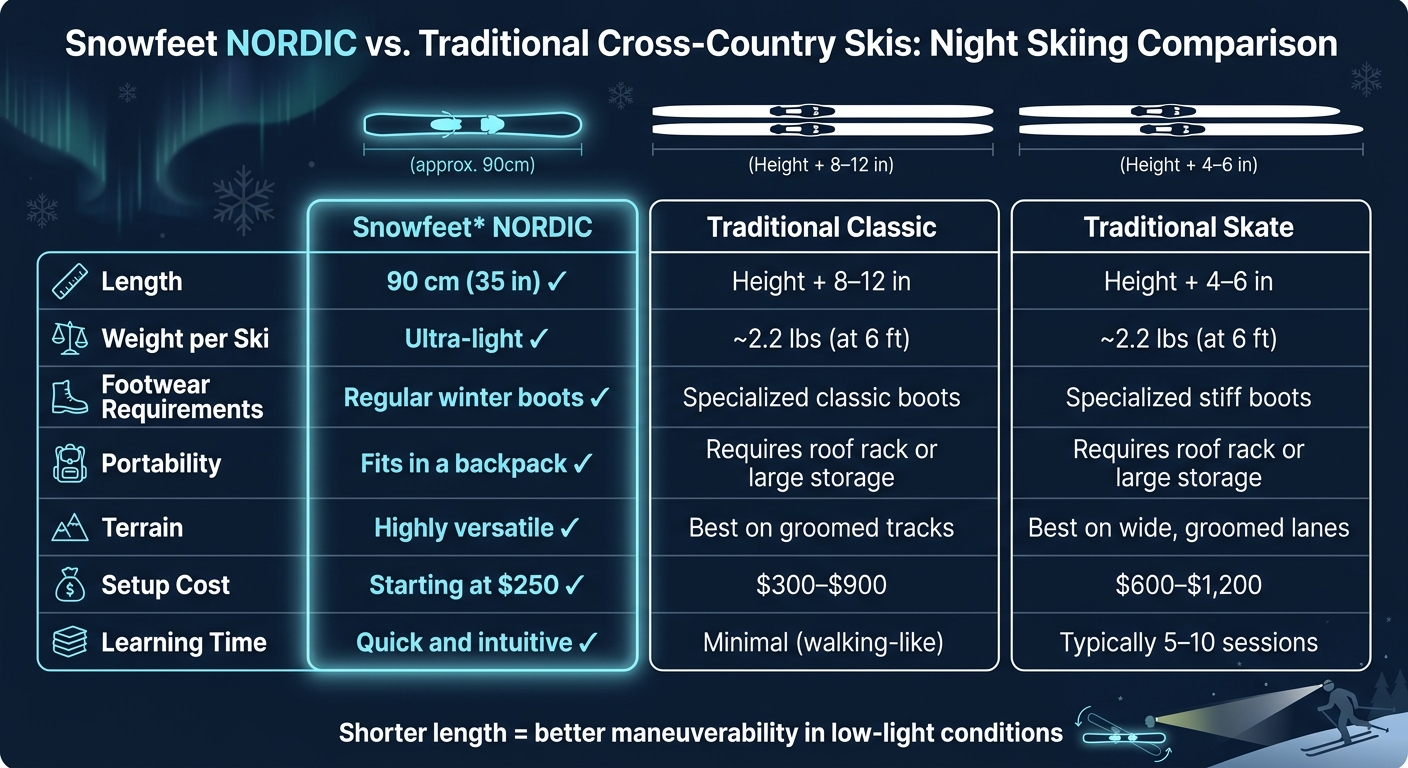
For night skiing, traditional cross-country skis, whether classic or skate, can feel bulky. Classic skis are typically your height plus 8–12 inches, while skate skis add 4–6 inches. That’s a lot of length to handle in the dark! On the other hand, Snowfeet* NORDIC skis are just 90 cm (about 35 inches), making them much easier to manage in nighttime conditions.
Portability and Storage
One thing that stands out about Snowfeet* NORDIC is how portable they are. Unlike traditional skis, which often require roof racks or extra storage space, Snowfeet* can fit right into a backpack. For example, a performance classic ski like the Fischer Twin Skin Race weighs around 2.2 lbs per ski and stretches about 6 feet long. That’s a lot to lug around! Plus, traditional skis require special boots that match specific binding systems like NNN or Prolink. Snowfeet*, on the other hand, work with regular waterproof winter boots, so you don’t need to invest in extra footwear.
Learning Curve and Terrain Use
Traditional skate skiing can take multiple sessions to get the hang of, and classic skiing ties you to groomed tracks with parallel grooves. Snowfeet* NORDIC skis, however, are much more intuitive. Their short design combines a skating motion with excellent maneuverability, making them great for groomed trails, parks, or even your backyard. That versatility is a game-changer, especially in low-light conditions where flexibility and quick adjustments are key.
"Using the wrong gear for the wrong style is like playing tennis with a badminton racket: technically possible, practically miserable."
– The Smarter Play Editorial Team
Side-by-Side Comparison
Here’s a quick look at how Snowfeet* NORDIC stacks up against traditional skis:
| Feature | Snowfeet* NORDIC | Traditional Classic | Traditional Skate |
|---|---|---|---|
| Length | 90 cm (35 in) | Height + 8–12 in | Height + 4–6 in |
| Weight per Ski | Ultra-light | ~2.2 lbs (at 6 ft) | ~2.2 lbs (at 6 ft) |
| Footwear Requirements | Regular winter boots | Specialized classic boots | Specialized stiff boots |
| Portability | Fits in a backpack | Requires a roof rack or large storage space | Requires a roof rack or large storage space |
| Terrain | Highly versatile | Best on groomed tracks | Best on wide, groomed lanes |
| Setup Cost | Starting at $250 | $300–$900 | $600–$1,200 |
| Learning Time | Quick and intuitive | Minimal (walking-like) | Typically 5–10 sessions |
With their shorter length, Snowfeet* NORDIC skis make it easier to stop quickly or dodge obstacles - perfect for when something suddenly appears in your headlamp’s beam. Traditional skis, at 6–7 feet long, just don’t offer the same level of responsiveness. If you’re looking for a compact, easy-to-use option for nighttime cross-country skiing, Snowfeet* might just be the perfect fit.
Getting More Enjoyment from Night Skiing with Snowfeet*
Once your lighting and safety gear are set, it's time to hit the slopes. Snowfeet* NORDIC skis bring a whole new level of fun to night skiing, offering the kind of control and responsiveness that's ideal for low-light conditions.
Better Turning and Control
At 90 cm (about 35 inches) long, Snowfeet* NORDIC skis make tight turns feel effortless - exactly what you need when your headlamp is guiding the way. Unlike longer skis designed for speed, these shorter skis are all about agility and control. This means you can adjust your line quickly on dark trails, making smooth and precise movements. Pair this level of control with powerful lighting, and you’ll feel more confident tackling every twist and turn.
Using Snowfeet* with Proper Lighting
For high-speed runs, pair your Snowfeet* with a 2,000-lumen headlamp. If you're on easier terrain, a 1,200-lumen option works just fine. The shorter length of Snowfeet* skis allows you to react quickly to obstacles or changes in the terrain as they come into view. Look for headlamps with dual beam technology - it helps you maintain balance and reduces the need for constant head movement.
Why Shorter Skis Work Better
While longer skis are great for stability on groomed tracks, they’re not ideal for night skiing. Snowfeet* NORDIC skis, with their shorter length and single camber design, excel in maneuverability. They allow for smooth carving and efficient edge control, giving you the responsiveness you need to enjoy night skiing safely and comfortably. This combination of features makes Snowfeet* an excellent choice for your nighttime adventures on the slopes.
Conclusion
Night skiing opens up a whole new world of winter fun, but it’s not something to jump into unprepared. A reliable headlamp is your best friend out there. Go for at least 1,200 lumens for forest trails, but if you’re tackling high-speed runs or tricky descents, aim for 2,000 lumens to light your way with confidence.
Safety is key. Make sure you’re visible, stay connected, and plan your route ahead of time. Pack a spare battery for your headlamp, wear reflective gear, and always let someone know where you’re heading. Night skiing is thrilling, but it’s always better to be cautious.
Speaking of gear, Snowfeet* NORDIC Cross-Country Skate Skis are a game-changer for night skiing. These skis, at just 35 inches long, give you the kind of control and quick handling you need when skiing by headlamp. Their shorter length makes it easier to carve tight turns and react to whatever your light picks up on the trail.
When you combine solid lighting with responsive gear, night skiing turns from a challenge into pure excitement. Whether you’re gliding along groomed trails or testing yourself on steeper slopes, having equipment that keeps up with you in low-light conditions is a must. Snowfeet* NORDIC skis deliver that quick response while keeping the experience fun and approachable.
So, gear up with the right lighting, plan your first night run, and give Snowfeet* a try. Their maneuverability might just change the way you think about skiing after dark!
FAQs
How do I choose a headlamp beam pattern for night skiing?
When choosing a headlamp for skiing, it's all about matching the beam pattern to your speed and the type of terrain you're tackling. For cross-country skiing on lit tracks or forest trails, a headlamp with around 1200 lumens usually does the trick. But if you're hitting higher speeds or navigating downhill sections, you'll want something brighter - 2000 lumens or more is ideal.
Also, consider a headlamp with adjustable beam patterns. A wide beam can help with peripheral visibility, while a focused beam is better for seeing further ahead. Bonus points if it has multiple lighting modes to handle different conditions on the fly.
What’s the best way to keep headlamp batteries from dying in the cold?
To keep your headlamp batteries from dying in cold weather, opt for a headlamp designed with cold-resistant batteries, specifically made for winter sports. Before using the headlamp, store the batteries in an inner pocket close to your body to keep them warm. Only insert them right before you hit the slopes. Snowfeet headlamps are a great choice for these conditions, as they perform better in winter compared to many traditional ski or snowboard brands.
Are Snowfeet* NORDIC skis good for night trail skiing?
Snowfeet* NORDIC skis are a solid choice for night trail skiing. Their compact and lightweight build makes them easy to control, even in low-light settings. Unlike bulky traditional skis, these are portable and adaptable, giving you stability and the ability to tackle different terrains. The design helps boost confidence and adds to the fun, making nighttime skiing not just safer but way more enjoyable.












Leave a comment
This site is protected by hCaptcha and the hCaptcha Privacy Policy and Terms of Service apply.