



















Yes, anyone can try skiskating - even if you’ve never skied or snowboarded before. It’s a fun, beginner-friendly way to enjoy the slopes using short, lightweight skiskates (like Snowfeet Skiskates). These are only 44 cm long, portable enough to fit in a backpack, and work with regular winter boots. Unlike skiing, where you need to deal with long skis and tricky techniques, skiskating feels more like ice skating - just push off and glide.
Here’s why skiskating is great for beginners:
- Easy to Learn: Most people feel comfortable in 25 minutes, compared to hours with skiing.
- Affordable Gear: Skiskates cost under $200 and don’t require special boots.
- Lightweight and Portable: At just 3.5 lbs per skate, they’re easy to carry.
- Beginner-Friendly Stops: The heel brake and low center of gravity make stopping simple.
Skiskating removes the hassle of heavy gear and complicated techniques, letting you enjoy the snow with less effort. Whether you’re on groomed slopes, sledding hills, or backyard trails, skiskating is an easy, fun way to get started with winter sports.
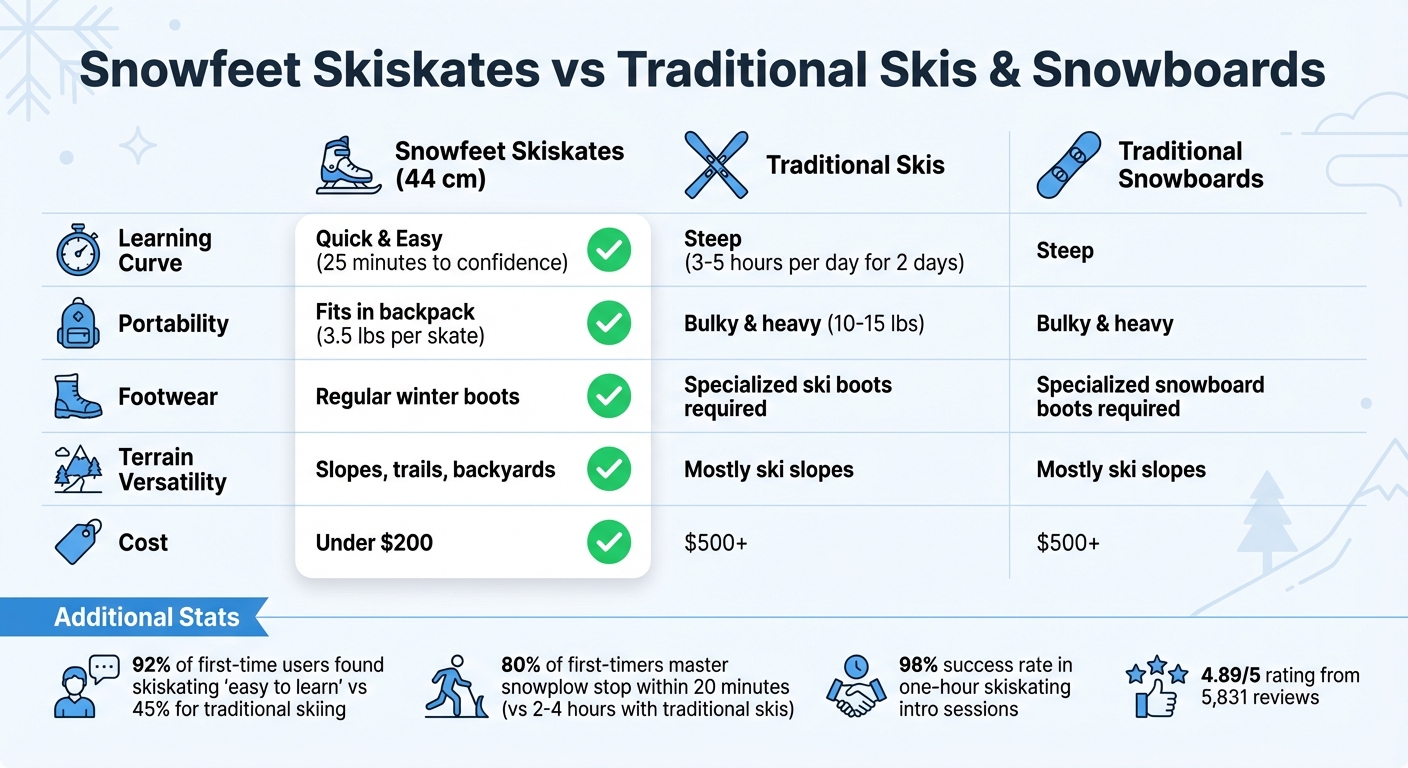
Snowfeet Skiskates vs Traditional Skis and Snowboards Comparison
What is Skiskating and Why Choose Snowfeet* Skiskates?
Skiskating combines the smooth glide of skiing with the rhythmic strides of skating, creating a motion that feels natural and is especially beginner-friendly. You move by pushing off with alternating legs - just like skating - while enjoying the stability and control of skis on snow.
Snowfeet* Skiskates, measuring 44 cm, come with adjustable strap bindings that fit regular winter boots. That means you can skip the expensive, specialized gear - just grab your waterproof hiking boots, strap on the skiskates, and you’re ready to go. With an entry cost well under $500, these skiskates make it easier and more affordable to get started.
Why Skiskating is Great for Beginners
The motion is intuitive, and the gear is simple, making it easy for beginners to pick up quickly. According to surveys from Snowfeet, 92% of first-time users found skiskating "easy to learn", compared to only 45% for traditional skiing. Most beginners are sliding confidently in just 25 minutes.
Even stopping feels manageable. Expert testers report that 80% of first-timers master the snowplow stop within 20 minutes, a skill that typically takes 2–4 hours to learn with traditional skis. The low center of gravity and forgiving edges help prevent falls, while the forward motion mirrors movements your body already knows, like walking or skating. U.S. resorts such as Keystone, Colorado, have seen a 98% success rate in one-hour skiskating intro sessions.
Features of Snowfeet* Skiskates (44 cm)
These skiskates are built to last. Their multilayer Canadian poplar wood core, reinforced with fiberglass and a sintered base, absorbs shocks and holds up for over five seasons. They’re tough too - 95% of users report no damage after their first day, even with crashes. Designed to support up to 220 lbs, they work well on groomed trails and powder alike.
Weighing just 3.5 lbs per skate, they’re light enough to carry around easily - unlike traditional skis, which can weigh 10–15 lbs. The universal strap bindings fit EU sizes 36–47, so you can use them with any insulated winter boots or hiking shoes. Best of all, with an entry cost under $200, they’re a much more affordable option compared to the $500+ price tag for traditional ski gear. Snowfeet* Skiskates make it easy and budget-friendly to dive into the world of skiskating.
Problems with Traditional Skiing and Snowboarding for Beginners
Steep Learning Curve of Traditional Equipment
Traditional skiing isn’t something you pick up in an afternoon - it’s a commitment. As The Editors at Ski Magazine explain:
Skiing isn't a sport that takes an hour to learn - it takes a lifetime.
For beginners, the first two days on the slopes, typically three to five hours each day, can feel like a nonstop struggle. You’re not just learning to ski; you’re learning to balance, stay low, and move with agility. And let’s be real - falls are part of the package. Techniques like the snowplow often lead to tangled skis and wipeouts.
Then there’s the gear. Rigid ski boots, while necessary for the sport, don’t exactly make life easier. As Jonathan Fine from Harvard points out:
The problem is that the boots keep you from flexing your ankles, so you can't get your legs under you very well.
Trying to go it alone without lessons? That’s another layer of difficulty. Ski instructor Christian Aigner cautions:
Learning to ski on your own is difficult and potentially dangerous if you can't stop or turn effectively.
He also advises against skipping lessons:
Don't get fooled and waste your own time, energy and money on a lift pass without some lessons booked too.
And all of this is before you even consider the sheer bulk of traditional ski gear.
Heavy and Hard-to-Transport Equipment
Let’s talk logistics. Traditional skiing comes with a lot of baggage - literally. You’ll need long skis, specialized boots, and a collection of accessories. Transporting all of this can feel like a workout in itself. Roof racks, oversized bags, and the awkward shuffle to and from the car are all part of the experience.
Boots are another headache. They need to fit perfectly, or your day on the slopes could be ruined. A bad fit can lead to cold feet, soreness, or even circulation issues. And let’s not forget, these boots are designed exclusively for skiing, making them impractical for anything else.
This is where Snowfeet* Skiskates shine. They skip the bulk and offer a lightweight, easy-to-use alternative that simplifies the entire process for beginners. No heavy gear, no awkward transport - just a more accessible way to enjoy the slopes.
Why Snowfeet* Skiskates Are Better for Beginners
Snowfeet* Skiskates vs. Traditional Skis and Snowboards
Snowfeet* Skiskates make learning easier for beginners by offering a design that's simple to use and convenient to carry around.
| Feature | Snowfeet* Skiskates (44 cm) | Traditional Skis | Traditional Snowboards |
|---|---|---|---|
| Learning Curve | Quick and easy | Steep | Steep |
| Portability | Fits in a backpack | Bulky and heavy | Bulky and heavy |
| Compatibility | Regular winter shoes | Specialized boots | Specialized boots |
| Terrain Versatility | Slopes, trails, backyards | Mostly ski slopes | Mostly ski slopes |
The compact 44 cm length eliminates the risk of skis crossing, making it easier to glide smoothly. Plus, you can wear your own winter boots, which allow for better ankle movement. This makes it simpler to stay balanced and recover quickly if you fall.
Practical Benefits for First-Time Users
Snowfeet* Skiskates aren’t just technically easier - they’re also more practical for anyone new to snow sports.
Their short size helps you focus on the path ahead, keeping your movements natural and balanced. Since they’re so portable, you can toss them in a backpack or leave them in your car trunk - no need for bulky roof racks or dealing with rental gear. You can even practice in your backyard or explore local trails, all without a big production.
The best part? Snowfeet* Skiskates take the stress out of learning. Instead of struggling with the steep learning curve of skis or snowboards, you can start enjoying yourself right away. The intuitive design means you’ll spend less time figuring things out and more time having fun. It’s a confidence booster that makes trying a new winter sport feel exciting, not overwhelming.
sbb-itb-17ade95
How to Start Skiskating with Snowfeet* Skiskates
Getting Started: Gear Up and Practice Basics
Getting started with Snowfeet* Skiskates is pretty simple. Just strap them onto your regular winter boots. Slide your boots into the bindings - this takes less than two minutes per skate. For the best experience, make sure your boots have solid ankle support and a flat sole. Secure the front clip first, then tighten the heel strap so it’s snug but not uncomfortable. Pro tip: adjust the bindings at home using a screwdriver and the boots you plan to wear.
"Adjust the bindings at the comfort of your home, using a screwdriver and a shoe you are going to wear." – Snowfeet*
Before you hit the slopes, spend a few minutes practicing balance drills on flat snow. Stand with your feet shoulder-width apart and shift your weight from side to side for about 30 seconds. Then, march in place, lifting your knees high to engage your core. You can also try standing on one leg for 10 seconds at a time to build ankle strength. These exercises help you get the hang of the skates quickly - most people feel comfortable in just 10–15 minutes. Once you’ve nailed balance, you can move on to learning how to glide and stop.
Learning to Move and Stop
When you're ready to move, bend your knees about 20–30° and push off one foot at a time, just like skating. Keep your weight centered over the middle of your feet - this is key to staying balanced. Start with short glides of about 5–10 feet. Avoid leaning back or locking your knees, as that can throw off your balance.
"Don't place your weight over your toes as you would with skis, because you will fall. Instead, place your weight over the middle or back of your feet." – Snowfeet*
Stopping is straightforward thanks to the built-in heel brake. Lift your toes slightly and press your heels into the snow, shifting about 70% of your weight onto your heels. This method can stop you from 10 mph in about 10–15 feet on packed snow. For extra control, combine the heel brake with a snowplow position by pointing your toes inward. It’s a good idea to practice stopping on a gentle slope (around 5–10 degrees) while keeping your speed low. Most beginners feel confident gliding and stopping within 20–30 minutes.
Moving to Trails and Slopes
Once you’ve got the basics down, it’s time to explore some easy trails. Start with beginner-friendly runs - green slopes with a grade of less than 15 degrees and groomed snow. These slopes are usually 100–200 yards long, which is perfect for practicing. Keep your speed below 8 mph and use the heel brake often. If you lose your balance, try rolling sideways instead of backward, and get back up by kneeling first before standing.
To build momentum, use a skating motion, and practice turns by making figure-8 patterns. The compact size of Snowfeet* Skiskates - just 44 cm (about 17 inches) - makes turning a breeze. You can pivot 180 degrees in just 5 feet, compared to the 20 feet or more needed with traditional skis. This agility makes trails feel manageable, even for beginners. Take short breaks every 15 minutes to stay fresh and avoid fatigue.
For safety, always wear a helmet - it can lower the risk of head injuries by up to 60%. Stick to areas with good snow conditions and avoid icy patches or crowded spots until you’re more experienced. According to user reviews, about 80% of beginners feel confident on their first trail within an hour. So, gear up, stay safe, and enjoy the ride!
Beginner Success Stories with Snowfeet* Skiskates
In February 2026, Valentina Angelici Horecki's partner - an inline skater and hockey player but new to skiing - gave the 44 cm Snowfeet* Skiskates a shot. In just a week, they were confidently cruising blue, red, and even black slopes at speeds of 31 mph (50 km/h). Pretty impressive, right?
That same month, Dave used the 44 cm Snowfeet* model to teach his 5-year-old how to ski. He raved about how the compact design gave him better control, even letting him ski backward to guide his child - something you just can’t do with traditional skis. Mike E. shared a similar story: his wife, initially hesitant about skiing, fell in love with the experience and ended up ordering her own pair. These stories show how Snowfeet* Skiskates can open the door to skiing fun, even for total beginners.
User reviews back this up:
"I'm a beginner in the snow and I feel so comfortable learning with these." – Jayme Harris
"It was much easier to learn. After going down on the slope a couple of times, I was going pretty smoothly." – RK
With an impressive 4.89 out of 5 rating from 5,831 reviews, it’s clear that skiskating isn’t just for the pros. These firsthand accounts show that anyone - no matter their age - can pick it up and enjoy the ride. Forget the myth that learning to ski as an adult is a huge challenge. Snowfeet* makes it easier than ever.
Conclusion: Snowfeet* Skiskates Make Skiskating Accessible to Everyone
Skiskating with Snowfeet* Skiskates is something anyone can try, regardless of experience. At just 44 cm long, these skiskates prove you don’t need years of ski lessons or expensive rentals to hit the slopes. They work with natural, skating-like movements, making them easy to pick up for beginners.
"There is a common myth that learning to ski as an adult is very hard, but it's simply not true." - Christian Aigner, Austrian Full Cert. Ski Instructor
Snowfeet* Skiskates have quickly become a favorite among beginners, offering effortless control and fun for all ages. They break down common barriers like the need for specialized boots, lessons, or a steep learning curve.
Now, the freedom to glide down the mountain isn’t just for lifelong skiers. With Snowfeet* Skiskates priced well under $500, you’re getting lightweight, easy-to-use equipment that’s budget-friendly. They’re a game-changer for winter sports, opening the slopes to everyone, no matter their age or skill level.
FAQs
Are Snowfeet* Skiskates allowed at most U.S. ski resorts?
Snowfeet* Skiskates are widely allowed at many ski resorts across the U.S. Thanks to their compact size, straightforward design, and ease of use, they’re a great choice for beginners looking to try something new. That said, each resort may have its own policies, so it’s a smart move to contact the resort ahead of time to double-check their rules about skiskates.
What boots work best with Snowfeet* Skiskates?
Snowfeet* Skiskates are compatible with most winter or ski boots, as long as they offer solid ankle support. To get the most out of your experience, opt for boots that fit snugly and allow for smooth movement. Steer clear of boots that are too bulky - they might not fit the bindings correctly.
Are Snowfeet* Skiskates safe for kids and older adults?
The provided details don’t specifically mention whether Snowfeet* Skiskates are safe for kids or older adults. That said, their small size, lightweight build, and features designed for beginners could make them simpler to handle than traditional skis or snowboards. As always, it’s important to take proper safety measures and ensure supervision when younger or older individuals are using them.












Leave a comment
This site is protected by hCaptcha and the hCaptcha Privacy Policy and Terms of Service apply.