



















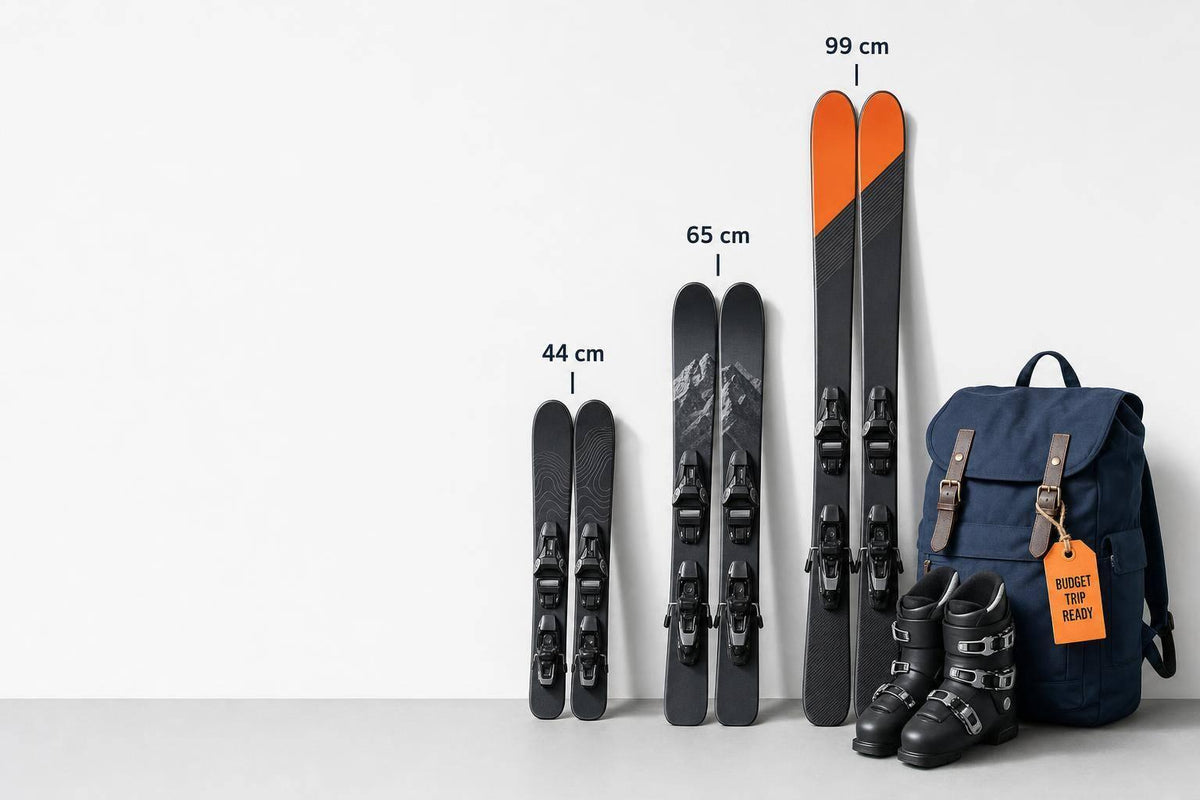
If you’re a college student, short skis make the trip easier: less gear to haul, less space to store, and a lower buy-in than a full ski setup. In this guide, I’d narrow it down like this: 44 cm if you want max portability, 50 cm if price matters most, 65 cm if you want the best mix of control and size, and 99 cm if you want the most stable ride.
Here’s the short version:
- Best low-price pick: Snowfeet PRO 50 cm at $299
- Smallest to carry: Skiskates 44 cm at $460
- Best middle ground: Skiblades 65 cm at about $490
- Most stable: Skiblades 99 cm at $550 to $690
- Rental math matters: resort rentals often run $40–$125 per day
- Trade-off: shorter skis are easier to pack, but they give up float in powder and feel less steady at speed
So, if your ski trips mean shared cars, buses, dorm closets, and tight budgets, these short skis make a lot of sense. You save space. You skip rental lines. And you don’t need to wrestle a giant ski bag like it’s a second roommate :)
Snowboarder tries Snowfeet* | Which Snowfeet* Short Ski is the Best? | Snowblades 44, 65, 99 Review
Quick Comparison
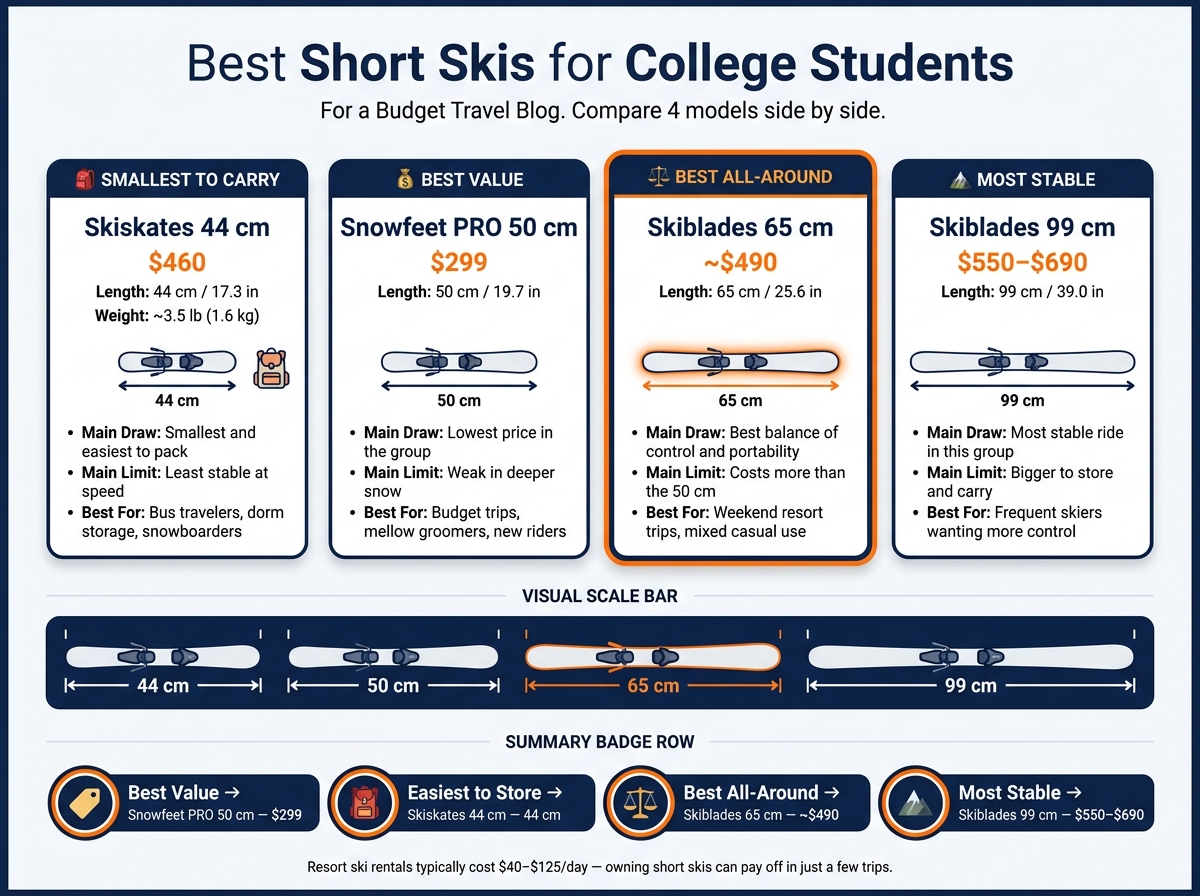
Best Short Skis for College Students: Side-by-Side Comparison
| Model | Price | Length | Main Draw | Main Limit | Best For |
|---|---|---|---|---|---|
| Skiskates 44 cm | $460 | 17.3 in | Smallest and easiest to pack | Least steady at speed | Students with tiny storage, bus travel, snowboarders |
| Snowfeet PRO 50 cm | $299 | 19.7 in | Lowest price | Weak in deeper snow | Budget trips, mellow groomers, new riders |
| Skiblades 65 cm | $490 | 25.6 in | Best balance of control and portability | Costs more than the 50 cm | Weekend resort trips, mixed casual use |
| Skiblades 99 cm | $550–$690 | 39.0 in | Most stable in this group | Bigger to store and carry | Students who ski more often and want more control |
A couple quick things before buying:
- Check resort rules
- Match the binding to your boots
- Think about total trip cost, not just ski price
If I were helping a student at the shop counter, I’d say this: buy for the way you actually travel, not the way you wish you traveled. That one call saves money fast.
1. Snowfeet* Skiskates 44 cm
At 44 cm (17.3 in), Snowfeet* Skiskates are short enough to slip into a duffel or even a backpack-size bag. That’s a big deal if you’re a student and don’t want to drag full skis through an airport or across campus. They turn and stop more like skates than standard skis, which gives them a different feel right away. Total weight is about 3.5 lb (1.6 kg).
Total Trip Cost
At $460, this isn’t the low-cost way in. But if you use them for more than one trip, the math starts to look better. Lift tickets, food, and travel will still hit your wallet the hardest, so gear you can keep using helps spread out the cost over time.
Portability
This is where the 44 cm model shines. The short length makes it much easier to carry through airports, bus stations, parking lots, and cramped college housing. You’ll still want to protect the edges and bindings, and you should check airline or bus baggage rules before you leave. Even so, this is way less of a hassle than lugging around full-length skis.
Resort Performance
These Skiskates do best on groomed beginner runs at moderate speed. They can handle groomers and light powder, but they have clear limits. Deep snow, steep slopes, icy patches, moguls, terrain parks, and fast carving will push them past their comfort zone. So, they’re a better fit for short, laid-back resort sessions than full-day downhill laps. Also, check your resort’s gear policy before you go, since not every place treats this kind of equipment the same way.
Boot Compatibility
There are two binding versions:
- The ski-boot version fits US sizes 4.5–14.5 (EU 36–49)
- The snowboard-boot version fits US sizes 6–14.5 (EU 38–49)
Pick the version that matches the boots you already own.
If you want a bit more stability but still want something easy to carry, the 50 cm PRO is the next move.
2. Snowfeet PRO 50 cm
At $299, the Snowfeet PRO 50 cm is the lowest-cost pick in this group. It sits right in the middle: not as tiny as the 44 cm Skiskates, and not as planted as the longer Skiblades.
Total Trip Cost
The main savings start with that $299 price. It also works with regular winter boots and snowboard boots, which can help you skip ski-boot rentals.
Portability
At 50 cm (19.7 in), it fits in a duffel bag, dorm storage, or a shared car trunk. That makes travel pretty easy. The catch? In deeper snow, the short length starts to show its limits.
Resort Performance
The PRO feels quick and easy to turn on groomed runs at casual speeds. It’s fun for mellow resort laps. Deep snow is the weak spot, though. At 50 cm, it just won’t float like a longer ski.
Boot Compatibility
The adjustable bindings fit U.S. sizes 6–13 and work with regular winter boots and snowboard boots. Go with waterproof boots that have firm soles and solid ankle support. Some bulky snowboard boots may not fit, so check your pair before you head out.
If you want more stability and a longer sweet spot on snow, the 65 cm Skiblades come next.
3. Snowfeet* Skiblades 65 cm
At about $490 on sale, the Skiblades 65 cm hit a sweet spot. You get more stability than the shorter models without giving up the easy-to-carry feel that makes Snowfeet* gear fun in the first place. For students who want one setup for weekend trips, carpool runs, bus rides, and tight dorm storage, this is the pick that makes the most sense.
Total Trip Cost
The $490 price is the biggest cost up front, and shipping plus sales tax can push it a bit higher. Still, the math gets better the more you use them. After five trips, you're looking at about $98 per outing before travel and lift tickets. After ten trips, that drops to about $49 per trip.
That’s the main pitch here: you pay more at the start, but you get a short ski that works well across more trips and more resort days.
Portability
At 65 cm (26 in), these are still easy to live with. They fit in most trunks, slide across a back seat, and stash in a dorm closet or gear bag without a fight. That’s what this length fixes. It stays compact for casual travel, but feels more planted on resort runs than the 44 cm or 50 cm options.
Resort Performance
On groomed slopes, the 65 cm length makes quick turns feel smooth and natural. It balances carving and agility better than the 50 cm PRO, and the build is more stable for repeat resort use. So if you're heading out again and again, that extra sturdiness matters.
There is a catch, of course. In deep powder or at high speeds, it still won’t match full-length skis. If your resort gets heavy snowfall, that’s worth keeping in mind.
Boot Compatibility
You can choose either the ski-boot or snowboard-boot binding, based on what you already own. That makes this model easier on a student budget. If you already have snowboard boots, picking that binding option can save you from renting ski boots at the resort.
If you want more stability and more all-mountain range, the 99 cm Skiblades are the next move.
sbb-itb-17ade95
4. Snowfeet* Skiblades 99 cm
At 99 cm, these are the most stable short skis in the lineup. The 6-meter turning radius helps them carve better on groomed runs, which makes them the top pick if you want more control and stability without jumping to full-length skis.
Total Trip Cost
The standard 99 cm model costs $550, while the powder-focused version costs $690. That makes this the most expensive option in this group. So, it makes the most sense if you want one setup you can use across many trips. If you only head to the mountains once in a while, the higher upfront cost may be hard to justify.
Portability
At 39 in, they still fit in a car trunk, bus rack, or even a dorm closet. You get more stability than the shorter models, but they’re still compact enough for casual student travel. That’s a nice middle ground.
Resort Performance
The 6-meter turning radius gives this model more stability on groomed runs than the 44–65 cm versions. For frequent weekend travelers and intermediate riders, that’s a big plus. You still give up some performance in deep powder and at high speed compared with long skis, though.
Boot Compatibility
Ski-boot bindings fit about US 4.5–14.5 (EU 36–49), and snowboard-boot bindings fit about US 6–14.5 (EU 38–49). That makes this the best Snowfeet* crossover option for snowboarders. Just make sure you check the binding type before you order.
That trade-off gets even clearer in the next comparison: short skis versus long skis.
Short Skis vs. Long Skis: What Students Actually Save (and Give Up)
Short skis give up some on-snow performance, but they make travel WAY easier. Long skis flip that deal around. They ski better in more conditions, but they’re a pain to haul around. For college trips, the easy-to-carry part often matters more.
Where short skis genuinely help students: A 44 cm Snowfeet* Skiskate fits in a backpack. Even a 99 cm Skiblade can fit in a car trunk. That’s a big deal when you’re juggling roommates, small cars, dorm closets, and weekend plans. For students, the biggest money saver is simple: you can skip rental fees and avoid the whole rental-shop hassle on short trips. Resort ski rentals often cost $40–$125 per day, so if you use your gear across a few trips, the numbers can swing in your favor pretty fast.
Where long skis still win: Long skis do better at higher speeds and in powder. Snowfeet* says this clearly:
"Snowfeet* handle light powder up to 10 cm, but for real powder riding go with Snowfeet* Skiblades 99, 120, or 99 Powder." - Snowfeet* Official
Here’s the quickest way to size up the trade-offs:
| Criterion | Short Skis (Snowfeet* compact models) | Full-Length Skis |
|---|---|---|
| Portability | Fits in a backpack or car trunk | Often needs a ski bag, roof rack, or larger vehicle |
| Dorm/apartment storage | Closet shelf or under-bed | Usually needs more dedicated storage space |
| Learning curve | Fast - easier to pivot and turn at low speeds | Steeper - more deliberate steering required |
| Groomed resort runs | Great for casual cruising and beginner slopes | Better for sustained carving and full-day sessions |
| Deep powder | Limited to about 4 inches or less | Much better flotation and control |
| High-speed stability | Less stable above moderate speeds | Higher - longer platform provides more support |
| Long traverses | Slower on long flats | Better tracking and efficiency |
| Best fit | First-timers, casual riders, weekend travelers, snowboarders | Frequent skiers, powder riders, high-speed or varied terrain |
That table gets to the heart of it. If your trip is short, your storage is tight, and you don’t want to burn cash on rentals, short skis make a lot of sense. If you care more about powder, speed, and all-day resort laps, full-length skis still have the edge.
Pros, Cons, and Which Model Fits Your Situation
The cost and performance trade-offs can feel a bit like picking between a backpack, a duffel, and a full roof box. They all get the job done. The right pick comes down to how you ride, how much space you have, and how much stability you want on snow.
Use this quick fit guide to pick the right short ski for your trip.
| Model | Pros | Cons | Best For |
|---|---|---|---|
| Skiskates 44 cm (~17.3 in) | Smallest and easiest to carry; works with ski or snowboard boots | Least stable at speed; limited flotation in deep or uneven snow | Snowboarders, bus travelers, dorm storage, first-time student riders |
| Snowfeet PRO 50 cm (~19.7 in) | Lowest-cost option here; compact and easy to learn on groomed runs | Less stable than 65 cm or 99 cm; not great for powder or fast cruising | Park riders, students who want tricks without a big gear bag |
| Skiblades 65 cm (~25.6 in) | Best all-around mix of control and portability | More expensive than the PRO; still gives up some edge control compared with traditional skis | First-timers, weekend travelers, mixed-terrain resort days |
| Skiblades 99 cm (~39 in) | Most stable choice for students who want more control | Largest to store; harder to fit in small cars or dorm closets | Students who already ski and want more stability |
If you want the shortest answer, here it is:
- 🏷️ Best value: Snowfeet PRO 50 cm
- 🎒 Easiest to store: Skiskates 44 cm
- ⚖️ Best all-around: Skiblades 65 cm
- 🏔️ Most stable: Skiblades 99 cm
Conclusion
After you stack up cost, storage, and on-snow use, the answer is pretty clear: for college students, short skis win on convenience.
They just fit student life better. A dorm closet. A car trunk. A duffel bag. That alone makes a big difference. And if you only hit the resort now and then, short skis are simpler to bring, store, and pay for.
So, which Snowfeet fits your trip best?
- Skiskates 44 cm: best for maximum portability
- PRO 50 cm: best budget all-around pick for beginners and snowboarders
- Skiblades 65 cm: best mix of control and packability
- Skiblades 99 cm: best for the most stability
Before you order, make sure the binding version matches your boots. And don’t just look at the ski price. Budget for the whole trip.
For most college students, Snowfeet* is the most practical choice: compact, easy to store, and easier to travel with than full-length skis.
FAQs
How many trips make short skis worth buying?
It’s less about how many trips you take and more about what fits your life.
If you live in a dorm or a small apartment, ride public transit, or just don’t want to deal with the cost and hassle of a full alpine setup, short skis like Snowfeet* can make sense from day one. They’re easier to store, easier to carry, and a lot less of a headache when you want to get out for a quick session.
Traditional skis still win for high-speed carving and deep powder. That part’s pretty simple. But for casual resort days, local hills, and those spur-of-the-moment trips where you just want to grab your gear and go, Snowfeet* are often the more practical pick.
Can beginners use short skis safely?
Yes. Short skis are a safe, beginner-friendly pick because they’re light and compact, which makes them easier to control, turn, and stop than longer skis.
Snowfeet* products are extra easy to learn on. Many new riders start to feel at ease after just a few runs. The design also helps stop crossed tips, and it includes key safety features like metal edges and leashes.
Which short ski length fits my travel style?
Choose based on portability, storage, and the way you like to ride.
- 44–50 cm: best if you want max portability and an easy, playful feel
- 65 cm: a nice middle ground between control and portability
- 99–120 cm: the closest to standard skis, with more stability and better edge hold
Traditional long skis (160 cm+) make more sense mainly for high-speed runs, deep powder, or steep, technical terrain.











Leave a comment
This site is protected by hCaptcha and the hCaptcha Privacy Policy and Terms of Service apply.