



















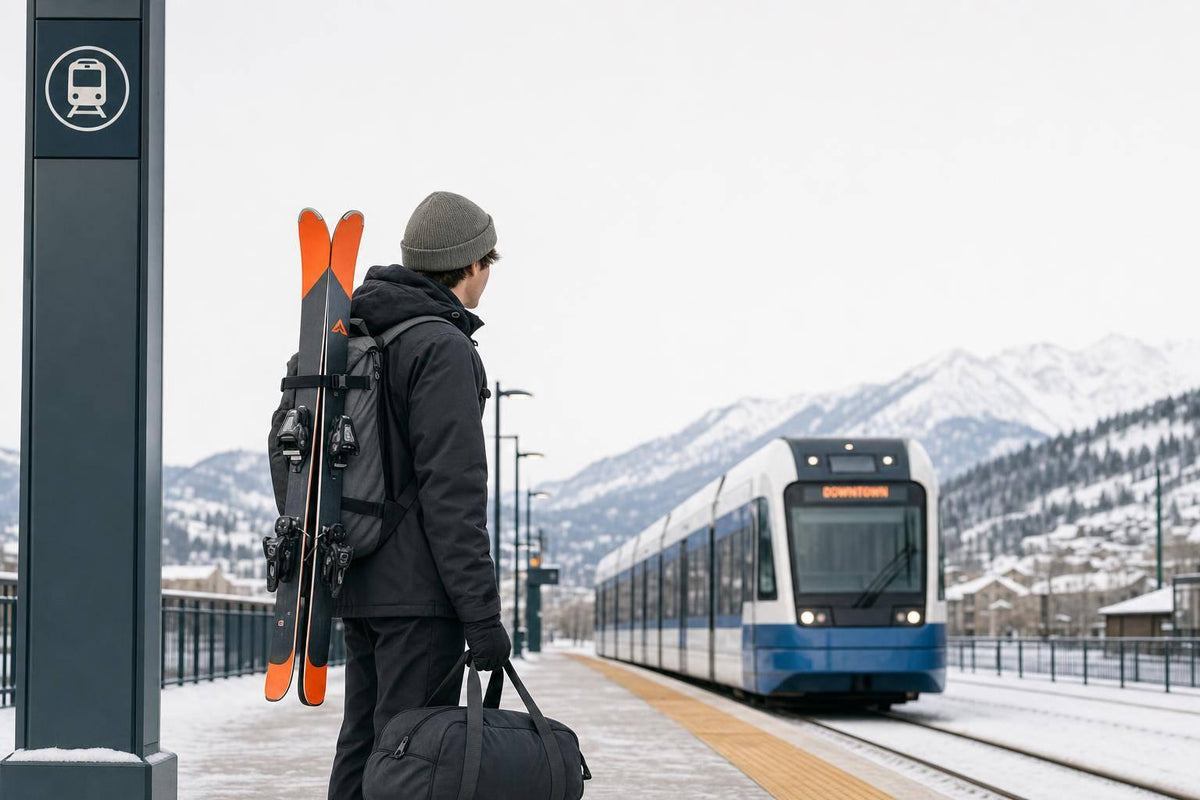
Yes - for most car-free students, short skis make more sense than full-size skis. If you ride local hills, use buses or rideshares, and live in a dorm or small apartment, shorter gear is easier to carry, easier to store, and often costs less.
Here’s the short version:
- Transit: Full-size skis are often 67–71 in. (170–180 cm) long. That’s awkward on buses, trains, and in small cars.
- Storage: Long skis can eat up 5–6 ft. of space in a dorm or shared room.
- Cost: A basic alpine setup can run about $720–$1,520, and that’s before lift tickets.
- Short skis fix a lot of that: Models in the 44–65 cm range are far easier to haul around, and some work with boots you may already own.
But there’s a catch. Short skis give up some stability at high speed and don’t do as well in deep powder. So if you want steep lines, huge resorts, and fast carving all day, full-length skis still win.
If I had to sum it up in one line: short skis fit student life better, while long skis fit big-mountain days better.
| Option | Best for | Main downside |
|---|---|---|
| 44 cm skiskates | Smallest setup, easy carrying | Least stable |
| 50 cm short skis | Better balance of size and control | Still not built for fast charging |
| 65 cm skiblades | More ski-like feel on groomers | Less compact than the shortest options |
| Full-length skis | Speed, powder, big resorts | Hard to carry, store, and pay for |
So, if you’re walking across campus with gear on your back, trying not to whack a bus door or your roommate’s lamp, short skis are often the better call :)
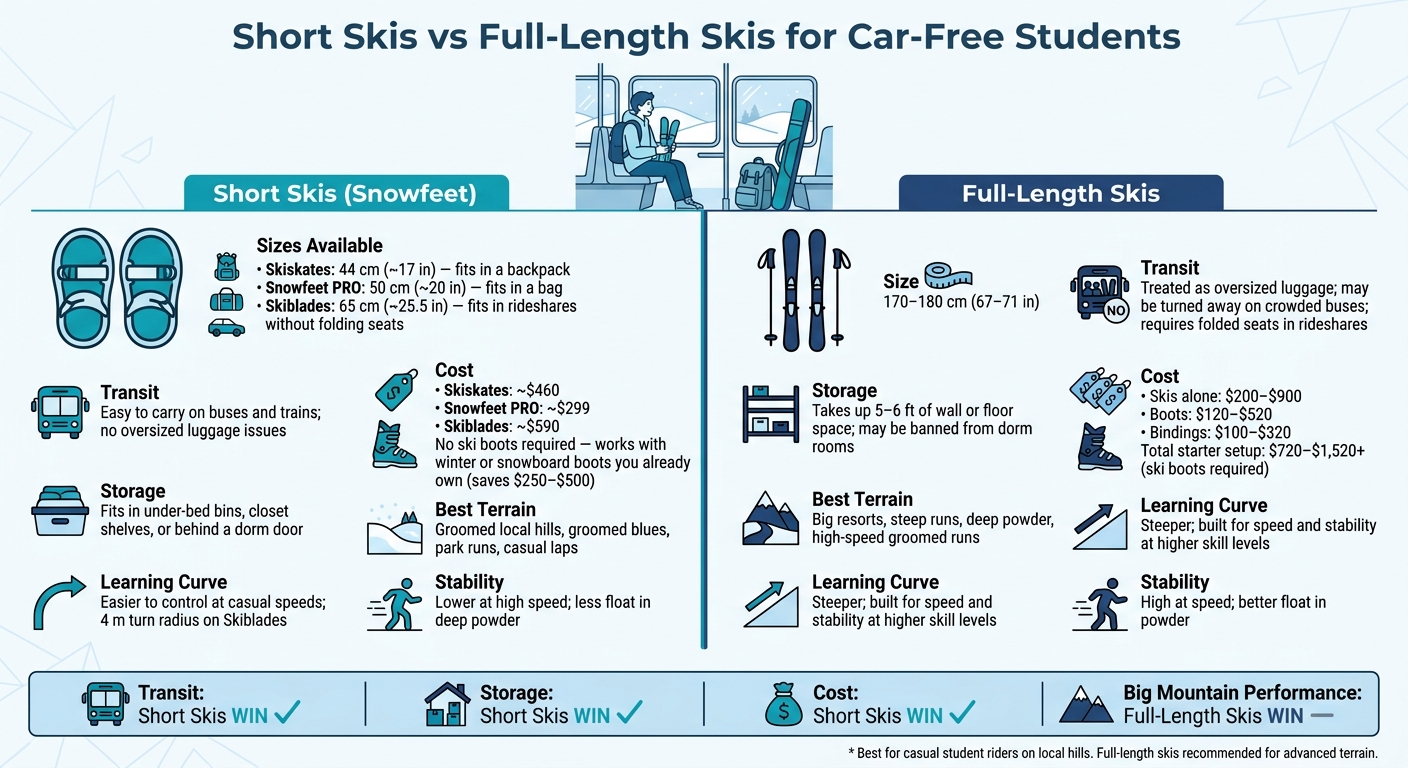
Short Skis vs Full-Length Skis: Student Life Comparison
Snowboarder tries Snowfeet* | Which Snowfeet* Short Ski is the Best? | Snowblades 44, 65, 99 Review
The Real Constraints: Transit, Storage, and Budget
Full-length skis make transit, storage, and budget harder for students without a car.
Why Long Skis Are a Hassle on Public Transit and Rideshares
For students without a car, three things tend to cause the most pain: transit, storage, and cost.
A standard pair of skis is 67–71 inches (170–180 cm) long. That’s a lot of gear to drag onto a crowded bus or train. Most transit systems do allow skis, but they’re usually treated as oversized luggage. That means you’re expected to keep them upright and clear of aisles and doors. And if the bus is packed, the driver can turn you away.
Rideshares don’t make life much easier. Long skis often won’t fit in a standard trunk unless seats get folded down. That leaves less room for people in the car. In some cases, you end up booking a larger ride just to haul your gear, and yep, that usually costs more.
Snowfeet gear is much easier to deal with:
- Snowfeet Skiskates at 44 cm (~17 in) fit in a backpack
- Snowfeet PRO at 50 cm (~20 in) fits with no fuss
- Skiblades at 65 cm (~25.5 in) still fit well in rideshares and on transit without folding seats down
If carrying the gear is a pain, storing it is usually next in line.
Dorm Rooms and Shared Apartments Cannot Fit 67–71 in Skis
A 170–180 cm pair of skis stored flat takes up 5–6 feet of wall space. That’s a big ask in a dorm room or small shared apartment. Stand them upright, and you still need almost the full height of the skis, which can clash with low ceilings, shelves, or other furniture. Some dorms also limit large sports gear in rooms because of fire safety or clutter rules, so students may have to use basement storage or lockable cages that aren’t easy to get to for last-minute trips.
Short skis dodge most of that mess. Skiskates at 44 cm can fit in an under-bed bin or on a closet shelf. Skiblades at 65 cm can lean behind a door or slide into a standard dorm wardrobe without eating up clothing space.
Cost is the third roadblock, and for a lot of students, it’s the one that hits hardest.
What Students Actually Spend on Ski Gear
A standard ski setup can chew through a semester budget in a hurry. Skis alone usually cost $200–$900, boots $120–$520, and bindings $100–$320. Put that together, and a starter setup often lands around $720–$1,520 before lift tickets.
| Product | Price |
|---|---|
| Snowfeet PRO (50 cm) | ~$299 |
| Snowfeet Skiskates (44 cm) | ~$460 |
| Snowfeet Skiblades (65 cm) | ~$590 |
Even the priciest option here is still less than many standard ski-and-binding packages by themselves. That’s a big deal for students. Snowfeet doesn’t just cost less. It also cuts down on what you need to carry and where you can store it. And there’s another money saver here: Snowfeet models work with boots you may already own, like regular winter boots or snowboard boots. That removes a $250–$500 ski-boot purchase from the equation.
That’s where Snowfeet starts to pull ahead of long skis. The lower price helps, sure, but it matters even more because the gear also fixes the carrying and storage headache.
How Snowfeet* Short Skis Address Each Student Pain Point
Which Models Are Easiest to Carry on Buses, Trains, and on Foot
Lower cost helps. But for students, it helps even more when the gear doesn’t turn the daily commute into a circus act.
That’s where Snowfeet’s small size stands out. It makes the trip from the dorm hallway to the bus stop to the hill way less of a hassle.
Skiskates (44 cm) and Snowfeet PRO (50 cm) are the easiest to carry on buses and trains. Skiblades (65 cm) are still much easier to deal with than full-length skis. And that smaller size isn’t just nice in transit. It also makes the skis easier to handle once students get on snow.
Boot Flexibility Cuts Down on Gear Students Need to Carry
Boot compatibility helps trim one more big piece from a student setup.
The Skiblades 65 cm work with ski boots (US sizes 4.5–14.5) and snowboard boots (US sizes 6–14.5). That means fewer things to buy, fewer things to haul around, and no separate ski boot purchase taking a bite out of a semester budget.
For a student, that’s a big deal. One less bulky item can mean one less thing to stuff in a closet, drag across campus, or wrestle onto a bus :)
Why Short Skis Are Easier for Casual Riders to Pick Up Fast
Once the setup gets lighter, the next win is how fast it starts to feel manageable on snow.
Long alpine skis are built for speed and stability. Short skis are easier to control at the slower, student-friendly speeds many casual riders want. The 65 cm Skiblades have a 4 m turn radius for quick turns on groomed runs. So instead of spending ages figuring out the gear, students can get into the fun part sooner.
That lines up well with riders who want quick, low-stress laps on local hills or small resorts. Less wrestling with equipment. More actual skiing.
sbb-itb-17ade95
Trade-Offs and Comparisons: Where Full-Length Skis Still Win
The trade-off is pretty simple: more portability usually means less stability on the way down.
High-Speed Runs, Deep Powder, and Big-Resort Cruising
Short skis are a blast, but there’s a catch. You give up some speed and stability to get that easy-to-carry setup. For students without a car, that trade can make a lot of sense on groomed local runs. On huge mountain terrain, not so much.
Full-length skis stay steadier at high speeds and deal with chopped-up snow better. Snowboards also tend to float better in powder. In deep powder, short skis sink more and can start to feel twitchy once the snow gets deeper than boot-top.
So, if a student wants to charge hard on double-black terrain at a big Western resort, full-length gear is still the better pick. That’s where it shines. Short skis aren’t the right tool for that kind of riding. But for groomed local hills and fast laps after class, the trade-off swings toward Snowfeet*.
You can see that trade-off pretty clearly in the side-by-side below.
| Feature | Skiskates 44 cm | Snowfeet PRO 50 cm | Skiblades 65 cm | Full-Length Skis |
|---|---|---|---|---|
| Boot needs | Winter or snowboard boots | Winter or snowboard boots | Ski boots or dedicated bindings | Ski boots required |
| Best terrain | Local hills, groomed runs, park play | Local hills, groomed runs, freestyle | Groomed blues, carving, park | Big resorts, steep runs, deep powder |
Snowfeet* vs Bigfoot, Figl, Salomon Snowblades, and ODR
Snowfeet* isn’t the only short-ski option out there. Bigfoot, Figl, Salomon Snowblades, and ODR are in the mix too. But here’s where things get practical.
A lot of competing short skis still need ski boots. That cuts into the whole gear-light appeal. Some also run closer to 80–100 cm. That extra length can help with stability, sure, but you lose a big chunk of the portability. At that point, they’re less backpack-friendly and start to feel more like compact short skis than grab-and-go student gear.
Snowfeet* covers 44 cm to 65 cm, and several models work with regular winter boots or snowboard boots students already own. For someone hopping on a city bus to a local hill, that matters. A lot.
That leaves the final question: which setup gives students the best mix of convenience and ride quality?
Conclusion: Are Short Skis Worth It for Students Without a Car?
For most car-free students, yes. They make a lot of sense for casual laps at local hills or smaller resorts, not full-send days on steep runs or deep powder.
Why? It comes down to three plain old student problems: transport, storage, and cost. Long skis are a pain on buses and rideshares. They’re tough to stash in a dorm room. And buying a new alpine setup isn’t cheap. A full alpine setup can easily cost $1,000–$2,000 for a new skier. Short skis that work with winter boots or snowboard boots you already own solve all three headaches in one shot.
If you’re trying to match a model to your student life, here’s the quick take:
- Snowfeet* Skiskates 44 cm: best if you want the smallest, easiest option to carry
- Snowfeet* PRO 50 cm: a nice middle ground with more stability
- Skiblades 65 cm: the closest thing to a ski-like feel for groomed carving
The trade-off is pretty simple: the shorter the ski, the easier it is to carry.
That said, short skis aren’t for everyone. If you spend your days hunting high-speed groomers or deep powder, full-length skis still come out on top for stability and float.
FAQs
Can beginners learn on short skis?
Yes. Short skis are a great pick for beginners because they’re much easier to control than long, standard skis.
Most riders feel at home on Snowfeet products after just a few runs - sometimes in as little as five minutes. Their small, light build makes turning and stopping feel natural. That’s even more true if you’ve done ice skating or inline skating before.
For the easiest start, go with Snowfeet PRO 50 cm or Skiblades 65 cm.
Which short ski size is best for college students?
The best size comes down to what kind of ride you want and how much you want to spend.
- Snowfeet PRO 50 cm: the best all-around pick for the money. It’s affordable, easy to carry, and works with regular winter boots or snowboard boots.
- Skiskates 44 cm: the top choice if you want a playful feel and like tricks. They’re small enough to toss in a backpack.
- Skiblades 65 cm: a better fit if you want more stability and a feel that’s closer to regular skiing, but still easy to store and carry.
Are short skis enough for most local ski trips?
Yes - short skis are enough for most local ski trips, especially at smaller U.S. hills with shorter runs and mellow speeds. Snowfeet* short setups do well on groomers, in parks, through moguls, and on casual terrain. They’re also a lot easier to carry, stash, and bring on public transit.
The trade-off is simple: you get less stability at high speeds, on steep icy terrain, or in deep powder. That’s where full-length skis still do a better job.











Leave a comment
This site is protected by hCaptcha and the hCaptcha Privacy Policy and Terms of Service apply.