



















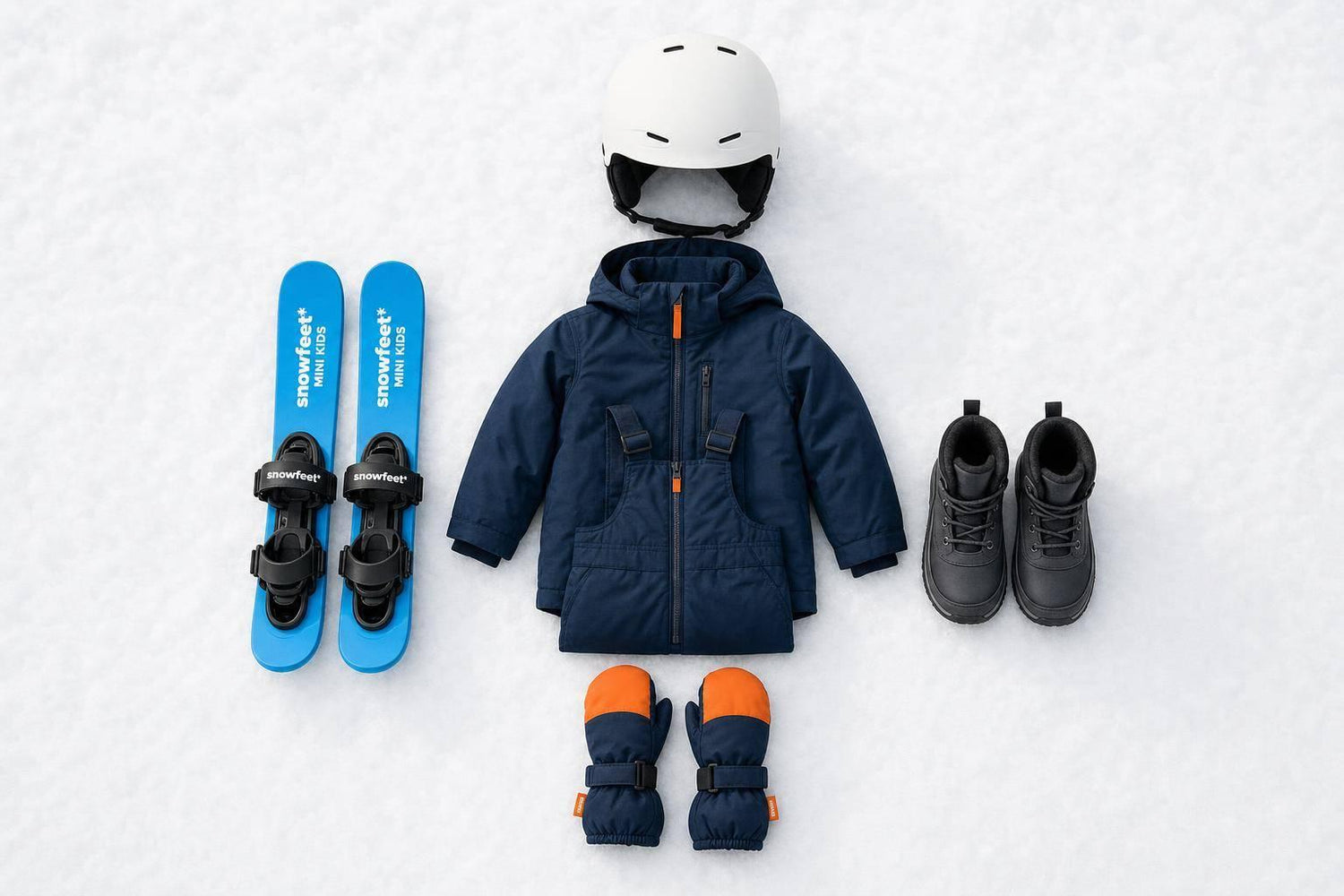
If I were buying first snow gear for a 5-year-old today, I’d keep it simple: start with Snowfeet* MINI KIDS, waterproof winter boots, a new helmet, waterproof mittens, and a jacket with bib snow pants. That setup is lighter, easier to carry, and less of a hassle than a full ski kit.
Here’s the short version:
- Best first-on-snow pick: Snowfeet* MINI KIDS - $250
- Best if you plan ski lessons at a resort: kids’ skis + boots - about $400+
- Most important clothing items: waterproof boots, bibs, mittens, and base layers
- Safety item you should not skip: a new helmet
- Key stat: helmets cut snow-sport head injuries by 35% overall and by about 59% for kids under 13
So, if your goal is a fun first day instead of a gear wrestling match in the parking lot, I’d go with the lighter setup first. Then add the warm, dry stuff that keeps the day from ending after one wet fall :)
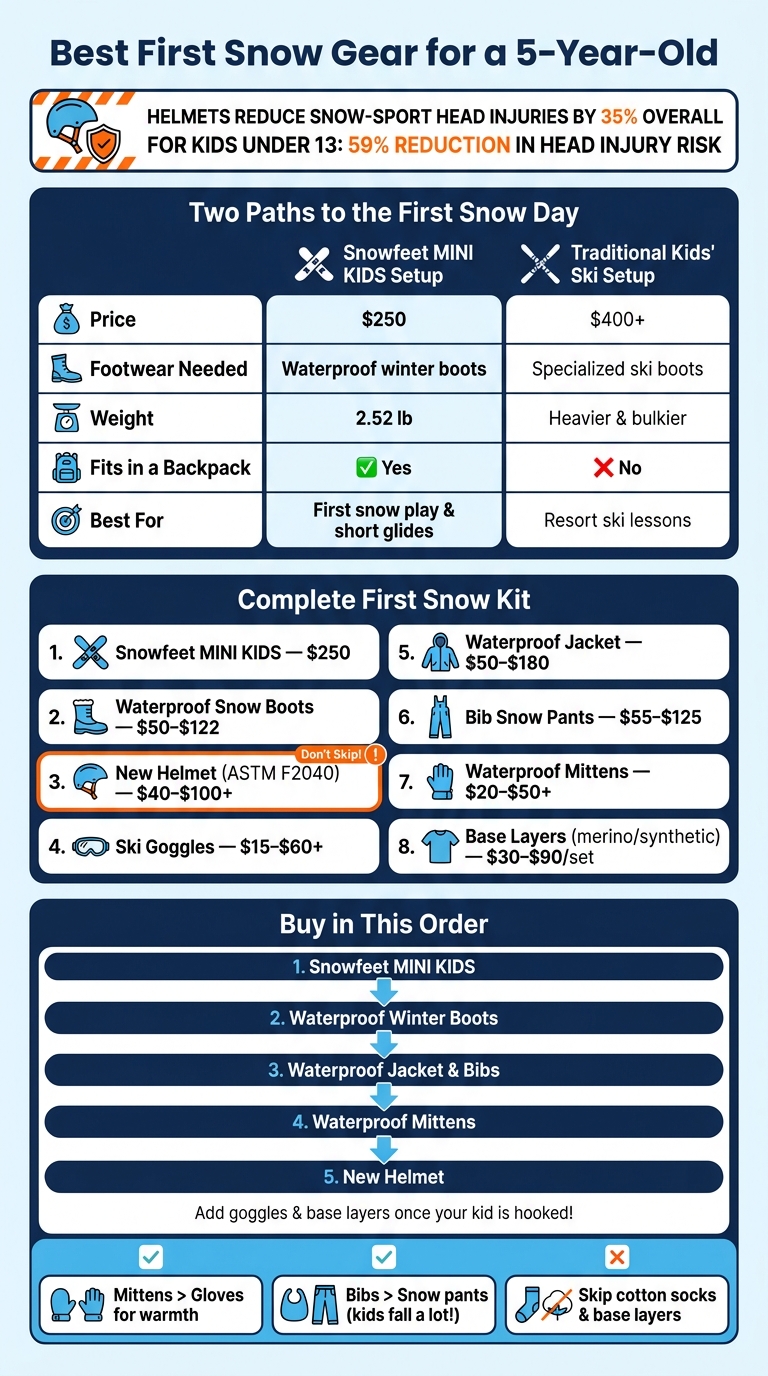
Best First Snow Gear for a 5-Year-Old: Quick Comparison Guide
How to Choose the Best Skis for Kids
Quick Comparison
| Item | Best For | What I’d Know Before Buying | Typical Price |
|---|---|---|---|
| Snowfeet* MINI KIDS | First snow play and short glides | Light, clips onto winter boots, works best on packed snow | $250 |
| Kids’ skis | Resort lessons | More gear, ski boots needed, bulkier to carry | $400+ |
| Waterproof boots | Warm feet and boot support | Look for waterproofing and ankle hold | $50–$122 |
| Helmet | Head protection | Buy new; aim for ASTM F2040 | $40–$100+ |
| Goggles | Wind, snow, and UV protection | Match them with the helmet | $15–$60+ |
| Jacket + bibs | Staying dry after lots of falls | Bibs help keep snow out | $50–$180 jacket; $55–$125 bibs |
| Mittens | Warm hands | Mittens are warmer than gloves for most 5-year-olds | $20–$50+ |
| Base layers | Dry, warm comfort | Merino or synthetic; skip cotton | $30–$90 per set |
A few quick takeaways I’d keep in mind:
- Use waterproof boots with firm ankle support if you choose Snowfeet* MINI KIDS.
- Bibs beat pants for most 5-year-olds because kids fall, sit, roll, and scoop snow with zero shame.
- Mittens beat gloves for warmth.
- Skip cotton for socks and base layers.
If you want a simple first buy order, I’d do this:
- Snowfeet* MINI KIDS
- Waterproof winter boots
- Jacket and bibs
- Waterproof mittens
- New helmet
Helpful video searches on YouTube:
Bottom line: I’d skip the big-kid ski setup for day one unless you’re heading straight into resort lessons. For most families, simple, warm, dry, and easy to carry wins.
1. Snowfeet* MINI KIDS
Price: $250 | Weight: 2.52 lb per pair | Sizes: US Kids 10 – Adult 6
Beginner Confidence
Snowfeet* MINI KIDS clip onto waterproof winter boots, which makes the whole setup feel a lot less intimidating for kids. No ski boots. No long skis to drag around. Just a lighter, simpler way to get started.
That matters, especially for young kids. Since they’re small and light, even a 5-year-old can move in a more natural way instead of wrestling with gear that feels too big. The motion is closer to skating than skiing, and for many beginners, that just clicks faster.
They also come with metal ski edges to help with stopping, plus a built-in heel brake for extra speed control. That can give kids a bit more confidence on snow. They work best on groomed or packed snow.
Fit and Safety
The ratchet binding is simple to tighten and adjust, so it’s easier to get a snug fit without much fuss. Snowfeet* MINI KIDS fit shoe sizes from US Kids 10 up to Adult 6.
Since they attach to regular boots, the boots matter more than you might think. You’ll want waterproof winter boots with decent ankle support. That’s not the place to wing it.
At the smallest listed sizes, one reviewer noted that there may be extra toe space, so it’s smart to check the fit before you head out.
Portability and Value
At 2.52 lb per pair, these are light enough to toss in a backpack and carry without a second thought. That alone is a big shift from a full ski setup.
Here’s the quick side-by-side:
| Snowfeet* MINI KIDS | Traditional Kids' Ski Setup | |
|---|---|---|
| Price | $250 | ~$400+ (skis + boots) |
| Footwear needed | Waterproof winter boots or shoes | Specialized ski boots |
| Weight | 2.52 lb | Heavier and bulkier |
| Where you can use them | Groomed slopes, sledding hills | Primarily ski resorts |
| Fits in a backpack | Yes | No |
One small upkeep note: wax the base on a regular basis so they don’t stick on the snow. Next, we’ll compare Snowfeet* MINI KIDS with traditional kids' skis.
2. Kids' Skis
Price: About $403.45 (Atomic Maverick J skis + Fischer Two boots)
If MINI KIDS feels a bit too stripped down, a standard kids' ski setup gives you more of the full ski experience.
Beginner Confidence
Junior skis like the Atomic Maverick J have a softer flex built for light beginners, so even a small 5-year-old can start making turns without wrestling the skis. That matters on day one, when most kids start with the wedge, or "pizza", turn.
Ski length plays a big role here. A good rule: the tips should come up to about chin height.
If the skis are too long, kids tend to lean back. Then things get messy fast. They have a harder time steering, stopping, and staying in control.
Fit and Safety
Standard skis need alpine boots and bindings fitted by a shop, which means more cost and more setup time. For very young beginners, the Fischer Two is a common choice because it has a soft flex, a waterproof shell, and wide openings that make it easier to get little feet in and out.
A couple things here matter a lot:
- Bindings need to be fitted by a pro to match your child's boots. Don't try to adjust them yourself.
- If you buy used skis, have a ski shop inspect the bindings before your child uses them.
This is one of those "better safe than sorry" moments.
Portability and Value
Now for the not-so-fun part: hauling the gear. You're dealing with skis and boots, and the setup is bulky enough that you may need a roof rack or a big trunk.
If your family only skis a few days each season, renting can make more sense. Buying gets pricey in a hurry compared with a simpler setup.
Longer skis start to help once kids pick up speed. But for a first day on snow, the full boot-and-binding setup can feel like a lot.
That’s exactly why boots and bindings matter so much for first-time skiers.
3. Kids' Snow Boots
Price: $50–$122
Snow boots are the control point for a first snow setup: warm, waterproof, and easy to move in.
Beginner Confidence
Boots matter a lot, plain and simple. When the binding depends on a secure, stable fit, the wrong boot can make things feel wobbly fast. For MINI KIDS, boot fit matters because the boot is part of the control system.
Warmth and Dryness
Start with a fully waterproof boot. That’s non-negotiable. Wet feet can wreck a snow day in about five minutes.
Synthetic insulation, such as PrimaLoft, keeps kids warmer when conditions get damp. That makes it a better pick than down for kids. And for socks, go with merino wool or synthetic. Skip cotton. Cotton gets wet, stays wet, and then everybody has a bad time.
Fit and Safety
A good kids' snow boot should:
- Hold the ankle snugly
- Close tight
- Have a tall shaft to keep snow out
If your child will use MINI KIDS, firm ankle support matters even more.
Portability and Value
One nice perk here: standard winter boots let you skip ski-boot rentals or extra boot purchases. That can save money and cut down on gear chaos in the parking lot, which, uh, counts for a lot with kids.
Budget-friendly picks include the Crocs Toddler Classic Neo Puff (~$50) and Sorel Commander Toddler Boot (~$55). If you want the premium option, look at the North Face Toddler Alpenglow II (~$122).
Once feet are warm and stable, head protection comes next.
4. Kids' Snow Helmet
Price: $40–$100+
A helmet isn't optional. It's a must. After warm boots, this is the next thing that makes a first day on snow much less stressful.
The numbers back that up. Research shows helmets cut snow-sport head injuries by 35% overall. For kids under 13, they lower the odds by about 59%.
Beginner Confidence
Go with a light helmet that has soft padding and a chin buckle that's easy to use. If a 5-year-old can wear it without a battle, you're on the right track. That matters more than people think. If the helmet feels heavy, pinchy, or annoying, kids will mess with it all day. And yeah, that's no fun for anyone :)
Fit and Safety
Choose a helmet with ASTM F2040 certification. If it also has MIPS, that's a nice plus for added protection against rotational impact.
Fit matters just as much as the label. Set the helmet about 1 inch above the eyebrows. Tighten the rear dial until it feels snug, not squeeze-your-brain tight. Adjust the chin strap so there's about one finger of space. Then try it on with goggles. You want no gap between the helmet and goggles.
A bad fit can turn a good helmet into a pain fast. Think of it like ski boots: close enough usually isn't close enough.
Portability and Value
In-mold helmets tend to weigh about 12–16 oz, which helps keep kids comfy on the hill. A dial-fit system can also help the helmet last longer as your child grows.
One more thing: buy new. Used helmets may hide impact damage, even if they look fine from the outside. That's a gamble not worth taking.
Next up: goggles, which keep wind and snow from ending the fun early.
sbb-itb-17ade95
5. Kids' Ski Goggles
Price: $15–$60+
Kids' ski goggles protect little eyes from UV rays, wind, and blowing snow. Look for 100% UVA/UVB or UV400 protection. Kids' eyes are more sensitive to UV than adults', so this part matters a lot. And when a 5-year-old can see well and keep their eyes clear and dry, the whole day usually goes a lot smoother.
Once vision is covered, the next step is keeping the rest of the outfit warm and dry.
Beginner Confidence and Fit
Wide, anti-fog lenses help kids see clearly, which can help them stay calm on the snow. Soft foam around the frame is a big deal too. If it pinches their nose or feels awkward, odds are they'll yank the goggles off by lunchtime.
Fit the goggles with the helmet on. That’s the only way to know if they sit right. You want shatter-resistant polycarbonate lenses that meet the high-impact standard for ski goggles. The goggles should sit flush against the helmet with no gap, so wind and snow don’t sneak in.
If your child wears prescription glasses, an OTG (over-the-glasses) design is worth paying extra for. It saves a lot of fuss, and, well, fewer gear battles is always nice :)
Warmth and Dryness
Check for ventilation channels along the frame so humid air can escape. That helps cut down on fog. A thick foam gasket also helps seal out drafts on cold or windy days.
Portability and Value
For a first season, a good mid-range pair in the $30–$60 range usually gives the best mix of anti-fog performance, comfort, and durability. Age labels can help, but helmet-on fit matters more.
A couple of simple habits help them last:
- Store goggles in a microfiber pouch
- Keep them strapped to the helmet when not in use
After goggles, the real comfort test is waterproof outerwear.
6. Waterproof Jacket and Bib Snow Pants
Once your kid’s eyes are covered, outerwear does the heavy lifting. A good jacket-and-bib combo keeps a 5-year-old warm, dry, and happy for longer. Get it wrong, and, well, the day can end fast.
Warmth and Dryness
Start with weather protection. Look for at least 10,000 mm waterproofing, taped seams, and a DWR finish. For beginners, that setup helps keep snow out while letting sweat move away, so kids stay warm instead of damp and clammy.
After that, fit matters just as much. Even a good waterproof rating won’t help much if snow can sneak in through gaps.
Bibs are usually the better pick than regular snow pants for this age. They cover more of the torso and do a better job of blocking snow when kids sit down or wipe out. That helps a lot with Snowfeet* MINI KIDS, since beginners spend plenty of time sitting, falling, and starting again. It’s kind of the whole deal at first :) If your child is newly potty-trained, though, regular snow pants may still be easier for fast bathroom breaks.
Fit and Safety
The jacket should let your child hug themselves with no tight pulling. When they lift their arms, the wrists should stay covered. And when they reach overhead, the jacket should still stay closed at the waist. If there’s a gap between the jacket and bibs, snow will find it. Snow is sneaky like that.
For bibs, look for:
- Adjustable shoulder straps
- An elasticated back
- Enough room for a base layer and a light fleece underneath
That combo makes it easier to get a snug fit without squashing the insulation.
Skip jackets with neck drawstrings. They can be a safety risk for young kids. Reflective details are also nice to have for low-light afternoons near parking lots or busy sledding hills.
Portability and Value
A midweight insulated jacket and bib can pull double duty as everyday winter gear and ski-day outerwear. That’s a nice win for parents who don’t want a closet full of one-use stuff.
Look for extendable cuffs or size-adjustment systems that add about 2 inches of length. That can help the set last across two seasons. And don’t overlook the small things: simple Velcro adjusters and big zipper pulls make dressing a wiggly kid much easier, especially when gloves are already on.
7. Waterproof Mittens
Mittens usually keep 5-year-old hands warmer and drier than gloves. That lines up with pediatric guidance for cold-weather play too. On a first snow day, this matters fast. Kids fall a lot, push off the ground, and grab snow with both hands, so wet gloves can turn into a problem in a hurry.
Warmth and Dryness
For typical winter weather, look for about 80–150 g of synthetic insulation. If the day is colder and windier, 150–200 g is a better bet.
You’ll also want the mitten to block water without turning into a sweaty little sauna. Look for:
- a waterproof lining that still lets sweat escape
- a water-repellent shell
- sealed seams
- at least 5,000 mm waterproofing
If your kid will be stomping through slush, 10,000 mm+ tends to hold up better.
Fit and Safety
Fit matters more than many parents expect. The mitten should feel snug, with about 1/4 to 1/2 inch of space at the fingertips. Too tight, and hands get cold. Too loose, and it’s harder for kids to move around. Brand sizing can be all over the map, so check the sizing chart before you buy.
Go with gauntlet-style cuffs that cover the wrist and overlap the jacket sleeve. That extra coverage helps keep snow from sneaking in. Kids using beginner gear like Snowfeet* MINI KIDS put their hands in the snow a lot while they learn to balance and stand back up, so a gauntlet with a drawcord or Velcro tab helps during repeat wipeouts. And yes, there will be repeat wipeouts :)
Wrist leashes are handy because they help stop mittens from disappearing halfway through the day. Skip the back-connected cords, though. They can snag on lifts.
Portability and Value
If you only need mittens for one or two casual snow days, pairs in the $20–$30 range often hit the sweet spot for warmth, waterproofing, and wear. Budget pairs under $15 can lose water resistance after only a few wet outings. At the other end, mittens around $35–$50+ make more sense if your child will be out on snow a lot through the season.
Reinforced palms and fingertips help them last longer. After use, let them air-dry. Skip high heat, since it can wear down the waterproofing.
With hands covered, the next comfort layer is what goes underneath: merino or synthetic base layers.
8. Merino or Synthetic Base Layers
After outerwear, the last comfort layer is the one that sits right against the skin.
Go with merino or synthetic. Skip cotton. Cotton holds moisture and stays wet, and that can make kids cold in a hurry.
Warmth and Dryness
Merino and synthetic are the two best picks.
| Feature | Merino Wool | Synthetic (Polyester) |
|---|---|---|
| Retains warmth when wet | Excellent | Fair |
| Drying speed | Moderate | Fast |
| Odor resistance | High | Low |
| Price | Higher | Lower |
| Durability | Good | High |
Here’s the simple version: merino stays warm even when damp, while synthetic dries faster and costs less.
Fit and Safety
A base layer should fit snugly, not tight. That close fit helps kids move with less bulk, which matters when they’re using Snowfeet* MINI KIDS.
Once the fit is dialed in, the next thing is plain old parent math: cost and whether you’ve got a backup set ready to go.
Portability and Value
Buy two sets if you can:
- one to wear
- one dry spare
That dry backup matters more on a first day out than a fancy logo. If money’s tight, well-fitting fleece pajamas can work as a spare.
If you want a simple synthetic pick, the Patagonia Capilene Midweight Top ($35) and Bottoms ($29) are a solid option. If you want merino, the Iksplor Baby Ikplorer Set ($89) is 100% merino. The Reima Trivsam Wool & Lyocell Set ($70) mixes wool and lyocell, which gives it a softer feel at a slightly lower price.
Merino usually needs less washing because it resists odor well. Synthetics often need more washing, but they dry faster between uses.
These material picks matter most when you stack them up against the full first-snow setup.
Pros and Cons by Parent Priority
Every piece in a first-snow setup does a different job. So, the best pick comes down to what matters most to you: confidence, warmth, safety, or value.
This table pulls the key points into one spot.
| Item | Best For | Pros | Cons | Typical Price |
|---|---|---|---|---|
| Snowfeet* MINI KIDS | Easiest first day on snow | Simplest first-day option; clips onto winter boots; light and easy to carry | Not for deep powder; needs skating-like balance | $250 |
| Kids' skis | Ski-school lessons | Best for resort lessons, but bulkier and comes with more gear | Needs specific ski boots; harder to carry | Rental recommended for beginners |
| Waterproof snow boots | Warmth and boot compatibility | Needed for warmth and for Snowfeet* boot compatibility | Taller styles can be tough to pull on | $50–$122 |
| Snow helmet | Safety | Non-negotiable head protection | Fixed vents can lead to overheating on warm days | $60–$80 |
| Ski goggles | Eye protection | Blocks UV, resists fog, and fits under a helmet | Lenses scratch easily | $30–$50 |
| Waterproof jacket and bib snow pants | Coverage for falls and wet snow | Best coverage for falls and wet snow; adjustable sizing helps them last across seasons | Premium shells can get expensive | Jackets $50–$180; pants $55–$125 |
| Waterproof mittens | Easiest to manage | Easier than gloves for small hands | Limited finger dexterity | $28–$45 |
| Merino or synthetic base layers | Moisture management | Next-to-skin layer that manages sweat | Merino costs more; synthetics can hold odor | $30–$90 per set |
For most families, the main decision is pretty simple: go with the easiest first-day setup or follow the standard ski path.
Next: the simplest first setup for most 5-year-olds.
Our Pick for a First Snow Setup
For most first-time 5-year-olds, start with Snowfeet* MINI KIDS and a pair of waterproof winter boots with firm ankle support. That combo keeps day one lighter, simpler, and a lot less spooky than a full ski setup.
Then build from there. Get a waterproof jacket and bibs next, then a new helmet and waterproof mittens. You can add goggles and base layers later once your kid is hooked and asking for “one more run” :)
| Purchase Order | Item | Category | Typical Price |
|---|---|---|---|
| 1 | Snowfeet* MINI KIDS | Must-Have | $250 |
| 2 | Waterproof winter boots | Must-Have | Price varies |
| 3 | Waterproof jacket & bibs | Must-Have | Price varies; bibs $55–$125 |
| 4 | Waterproof mittens | Must-Have | Under $30 |
| 5 | Snow helmet (buy new) | Must-Have | Price varies |
Optional later buys: merino socks, goggles, and base layers.
Why this setup works: MINI KIDS gives new riders an easier, faster first-day learning curve than long skis. There’s less gear to deal with, less bulk, and less chance your 5-year-old feels like they’ve been strapped into a science project.
Start small. A backyard hill or mellow sledding slope is the best place to get those first glides in before heading to a resort.
FAQs
Do Snowfeet* MINI KIDS work at ski resorts?
Yes. Snowfeet MINI KIDS* are made to work at ski resorts, with the best fit on bunny hills, learning zones, and green runs.
They use the same metal ski edges as regular skis, so they usually meet standard resort rules. That said, there isn't one official list of approved resorts for this gear. So, it’s a good idea to check with each resort before you go.
Think of it like calling ahead to ask if a small sled hill is open. It takes two minutes and can save you a headache at the lift :)
How do I know if my child’s boots fit Snowfeet* MINI KIDS?
Check that the boots fit the binding size range: US Kids 10 to US Adult 6 (EU 27–38, 17–23 cm).
Use sturdy, waterproof winter boots with solid ankle support. Skip soft fashion boots. They may look cute, but they don’t hold the foot well, and that can get sketchy fast.
Place the boot in the binding and tighten the straps until the heel feels snug, but not squeezed. You want a secure fit without cutting off circulation.
Here’s a simple test:
- Your child should still be able to wiggle their toes.
- The boot shouldn’t slide around when walking.
- It also shouldn’t shift during a light jump.
If the heel stays put and the toes can still move, you’re in good shape :)
What should I buy first on a tight budget?
Start with Snowfeet MINI KIDS. They’re a solid pick for beginners ages 3–6, and they clip onto your child’s current winter boots. That means you can skip the extra $150–$300 you’d often spend on ski boots. It also makes the whole thing feel less bulky, more comfy, and way less scary for little kids.
Then keep the rest simple: a certified helmet, anti-fog goggles, and warm, waterproof gloves. That’s all you need for a setup that stays compact, easy to carry, and budget-friendly.











Leave a comment
This site is protected by hCaptcha and the hCaptcha Privacy Policy and Terms of Service apply.