







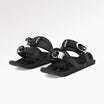












Yes - for many first-time skiers, short skis are worth it. If your goal is to feel less shaky, turn with less effort, and keep day one from turning into a yard sale on the bunny slope, short skis can help.
Here’s the short version:
- Short skis (about 44–99 cm) are easier to move at low speed
- They can feel less scary than rental skis that are often 150 cm+
- They’re best for groomed green runs, easy blues, and casual ski days
- They’re not the top pick for high speed, deep powder, or long carved turns
- If you ski only 1–5 days a season, short skis often make more sense than a full setup
- A ski rental can cost $40–$70 per day, and ski boots often run $300–$600
- Some short-ski setups can lower gear hassle since some models work with winter boots or snowboard boots
So, what’s the catch? You get easy control and simple handling, but you give up some calm at speed and some support in soft snow.
If I were helping a new skier in my shop, I’d put it like this:
- Pick short skis if you want fun, simple first days
- Pick standard skis if you plan to ski a lot and want to build full ski skills
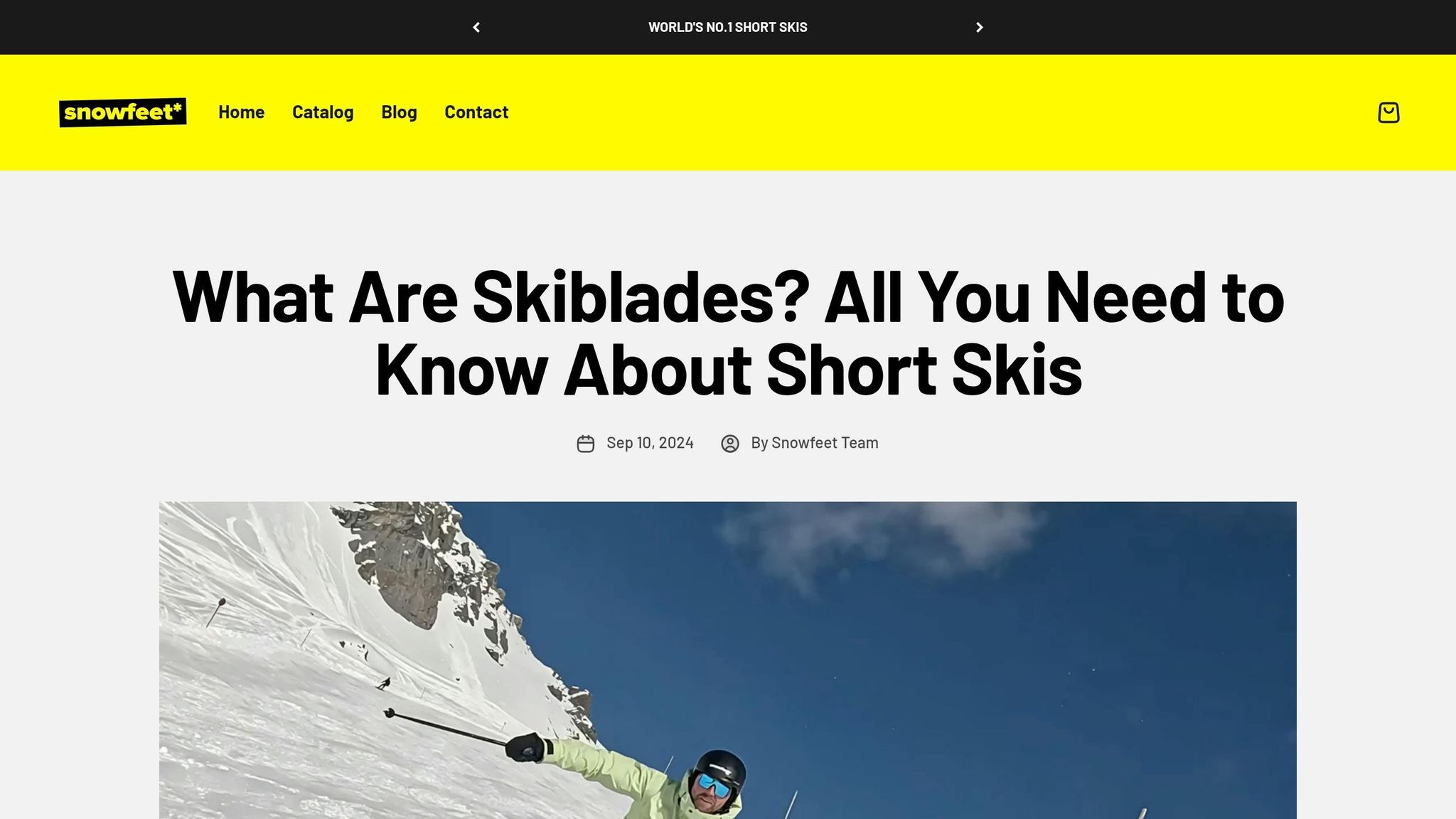
Snowboarder tries Snowfeet* | Which Snowfeet* Short Ski is the Best? | Snowblades 44, 65, 99 Review
Quick Comparison
| Option | Best for | Main upside | Main downside |
|---|---|---|---|
| Short skis / skiblades | First-timers, casual riders, travel | Easier turns, compact size | Less stable at speed |
| Ultra-short models (38–50 cm) | Very cautious beginners, skaters | Easiest to move around | Limited once speed builds |
| Mid-length short skis (65 cm) | Beginners who want more ski feel | Better balance of control and support | Still not great for powder |
| Long short skis (99 cm) | Bigger riders, mixed snow | More stable than tiny models | Less playful than shorter options |
| Standard beginner skis | Ski school, long-term progress | Better for carving and faster skiing | More awkward at first |
Bottom line: if you want a low-stress start and mostly ski groomers, short skis make a lot of sense. If you already know you want speed, carving, and bigger terrain, go with standard skis.
If you want, I can also turn this into a shorter SEO intro, a product-led intro, or a featured snippet version.
How Short Skis Change the Learning Experience
That control matters most on day one. Tiny movements can be the difference between a smooth first turn and a full-on flail-fest.
Why Shorter Skis Feel Easier on Day One
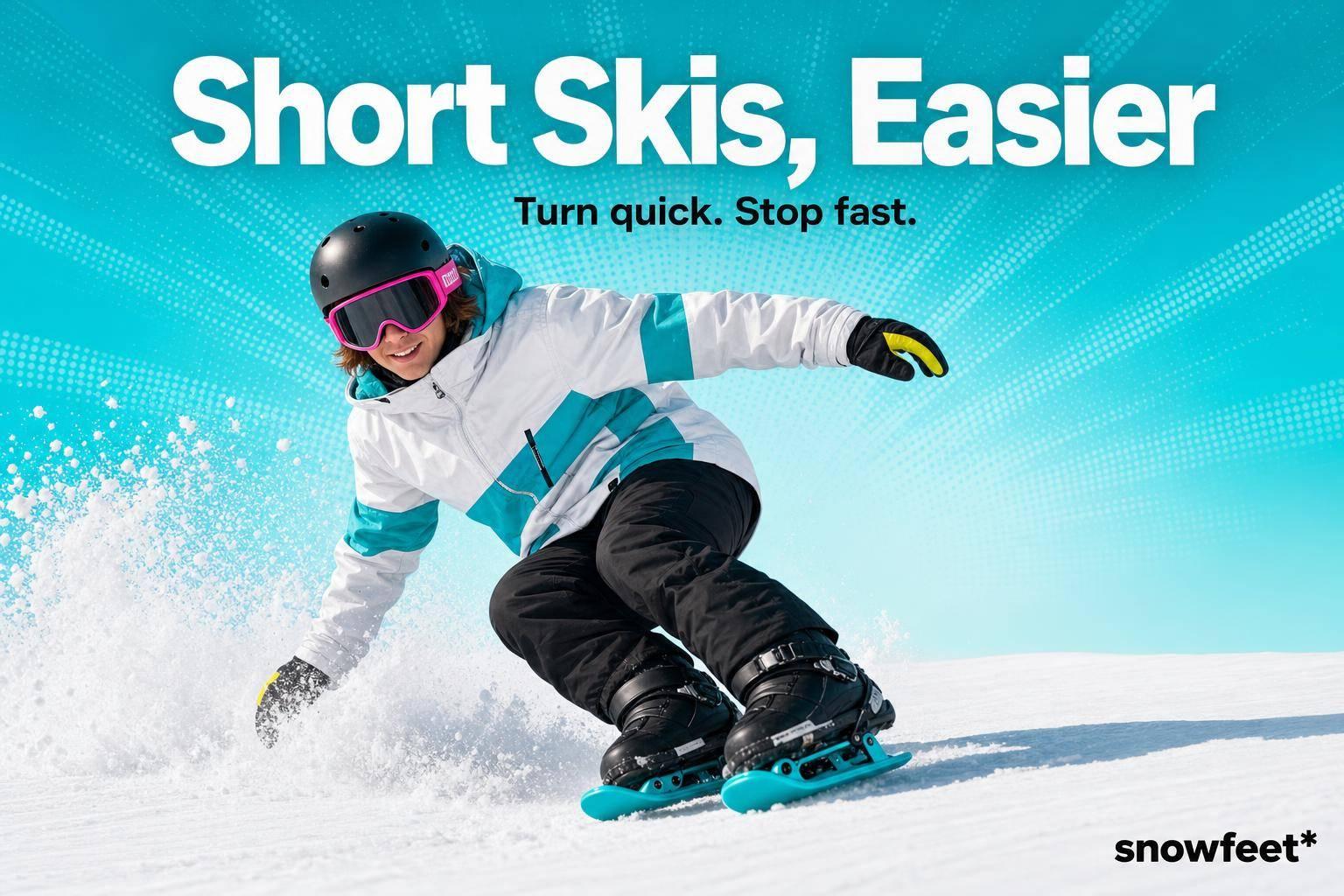
Short skis pivot faster and switch edges with less effort. So, steering left or right feels simpler from the start. On a bunny slope or green run, those first turns tend to feel more natural and less tiring.
People with some sideways-sports background often click with them faster too. Skaters, hockey players, and snowboarders usually adapt with less fuss. At low speeds, short skis also tend to feel more predictable, which helps beginners fix mistakes without feeling like the skis are fighting back.
That’s why Snowfeet* Skiskates 44 cm and Snowfeet PRO 50 cm can feel especially easy on day one. The 65 cm and 99 cm models still keep that short-ski feel, but add more calm once speed starts to build.
That easy first-day feel does come with a few trade-offs once you start going faster, carving more, or heading into softer snow.
The Real Trade-Offs: Speed, Carving, and Powder
Short skis give up some stability at speed. They also don’t hold as well through long carved turns, and they sink more in powder or chopped-up snow.
If your plan is casual laps on groomed runs, the upsides of short skis often matter more than the downsides. They’re fun, easy to move around on, and less work at slow speeds. But if you already know you want to ski fast, lay into hard carves, or head off-piste, there’s a good chance you’ll outgrow short skis pretty fast.
The trade-off is pretty simple: short skis make early control easier, while longer skis give you more speed and better snow performance.
| Factor | Short Skis / Skiblades | Traditional Beginner Skis |
|---|---|---|
| Low-speed turning | Faster pivot, less effort | Requires more technique |
| Stopping | Easier to skid or pivot to slow down | Reliable with proper technique |
| Portability | Easier to carry, store, and travel with | Less compact |
| Powder and chopped snow | Sinks more easily, less float | Better surface area and float |
| High-speed stability | Less stable at speed | More stable at speed |
That’s the core trade-off when you compare short skis with standard beginner skis.
sbb-itb-17ade95
Short Skis vs. Standard Skis: Which One Fits Your Goals?
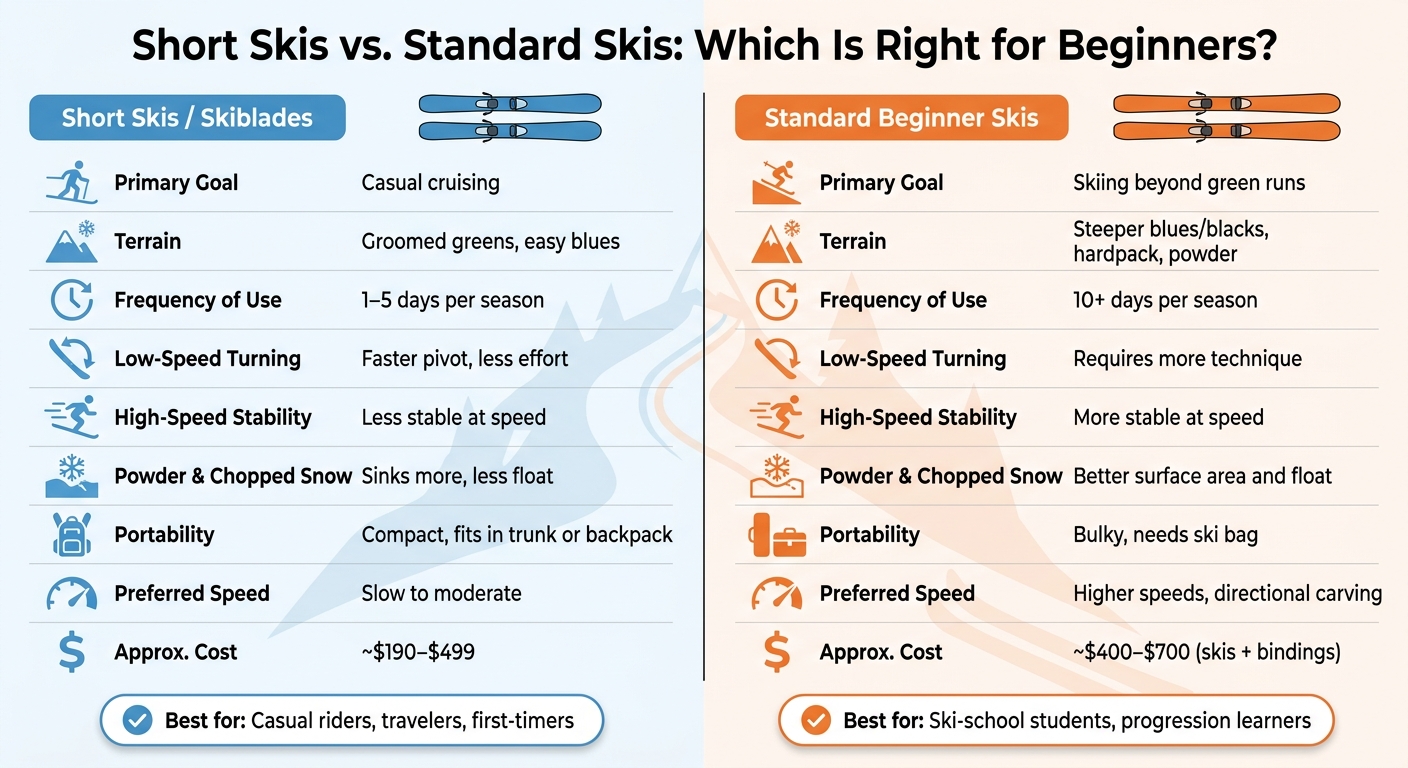
Short Skis vs. Standard Skis: Which Is Right for Beginners?
Short skis are a good match for beginners who want simple, low-stress control. Standard skis fit beginners who care more about long-term progress. Once you understand the trade-offs, the main thing is pretty simple: where do you ski, how often do you go, and how much do you care about keeping gear easy?
When Short Skis Make Sense: Casual Days, Travel, and Easy First-Day Learning
Short skis shine on casual ski days, travel days, and first outings where the goal is to feel comfortable fast. If you ski a few days each season and stick to easy terrain, they line up well with that kind of trip.
A 65 cm Skiblade can fit in a trunk or closet without the whole ski-bag circus. That alone is a big win for some people. They also work well for riders who want to use regular winter boots or just keep the setup simple. For many first-timers, short skis cut down the hassle that stops people from trying skiing in the first place.
If that sounds like your setup, the next step is choosing the right Snowfeet size.
When Longer Skis Are Still the Better Choice
Standard skis are still the better pick if you plan to ski often and want to build full ski technique. If you ride a lot, care about form, or need more support underfoot, you’ll get more from a standard ski. And if you want one ski you can keep growing with over the next few years, this is usually the smarter path.
Taller or heavier riders often do better with the extra edge length. It gives you better grip on East Coast hardpack and more float on Western powder days. If your goal is clean parallel turns, standard skis are built for that. The longer edge and sidecut give you more support for that style of control.
If your season is more about progress than convenience, standard skis stay the safer long-term pick.
| Short Skis / Skiblades | Standard Skis | |
|---|---|---|
| Primary goal | Casual cruising | Skiing beyond green runs |
| Terrain | Groomed greens, easy blues | Steeper blues/blacks, hardpack, powder |
| Frequency of use | 1–5 days per season | 10+ days per season |
| Preferred speed | Slow to moderate | Higher speeds, directional carving |
The next section breaks down which Snowfeet size fits each beginner type.
Which Snowfeet* Model Is Right for a Beginner?
If short skis match what you want, the next step is simple: pick the Snowfeet* length that fits how you plan to ride. Think about your use case, your boots, and how much stability you want.
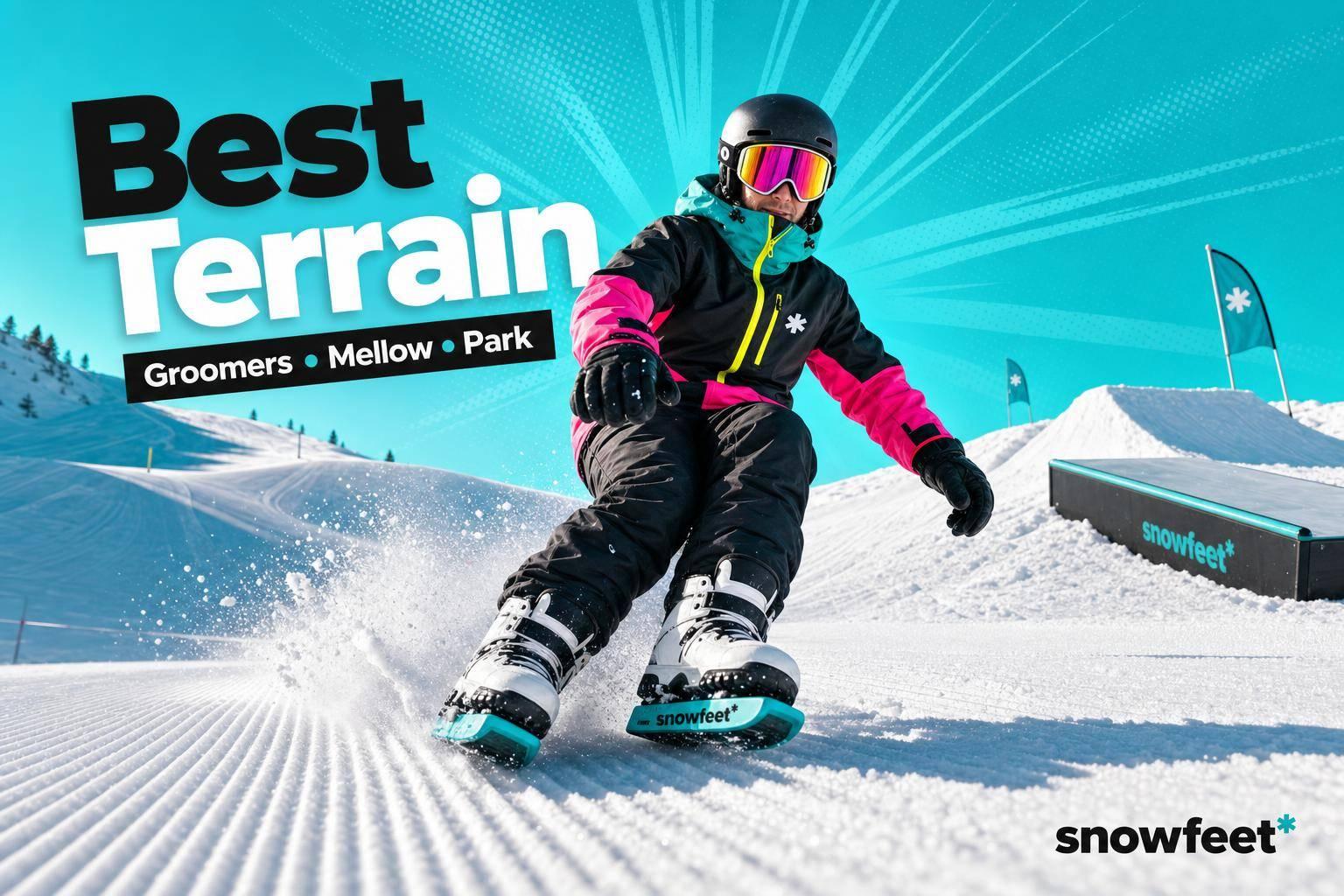
Mini Ski Skates and Skiskates (38 cm to 50 cm): Best for Simplicity
Go with the shortest models if you want the easiest first-day control.
The Snowfeet Mini Ski Skates (38 cm) and Snowfeet PRO (50 cm) are the simplest way to start. Setup is easy, and the commitment feels low. They also pack small, which is nice if you don’t want your gear taking over the whole trunk.
The Skiskates 44 cm make sense for riders who want a more playful, quick-turn feel on groomed green runs. They fit in a backpack, so they’re a handy pick if you’re flying to a U.S. resort or squeezing gear into a compact car.
These super-short models do best on groomed green runs, small hills, and learning areas. They’re not made for speed or powder. But if you’re brand new and just want the easiest way to start sliding, they’re tough to top.
Skiblades 65 cm and 99 cm: More Stability Without Going Full-Length
Pick 65 cm if you want more stability but still want the upside of short skis.
The Skiblades 65 cm sit in a nice middle spot for beginners who want something that feels closer to skiing. They give you steadier turns and less wobble at speed than the ultra-short models, while still being much easier to carry and store than full-length skis. They also handle groomed runs, light crud, and small bumps well.
The Skiblades 99 cm and POWDER 99 cm are the top short-ski pick for heavier riders or mixed snow. The POWDER version is wider, so it does better in softer snow. This is the most ski-like Snowfeet* option, but it still stays in the short-ski lane.
Why Snowfeet* Beats Generic Snowblades for Most Casual Riders
Older snowblade-style products often came in fewer sizes and leaned more toward park riders or skilled skiers. Snowfeet* has a range from 38 cm to 99 cm, keeps the focus on beginner comfort and easy on/off bindings, and some models work with regular winter boots or snowboard boots. That can keep startup costs lower than a standard ski setup.
For many casual U.S. riders who get out only a few weekends each year, that mix of size options, easy transport, and beginner-first design is where Snowfeet* has the edge.
Here’s the quick side-by-side view before the final verdict.
| Snowfeet* Mini / PRO Ski Skates | Snowfeet* Skiskates 44 cm | Snowfeet* Skiblades 65 cm | Snowfeet* Skiblades / POWDER 99 cm | Standard Beginner Skis | |
|---|---|---|---|---|---|
| Typical user | Casual first-timer, traveler, or skater | Play-first rider, skater | True beginner wanting a ski-like feel | Taller/heavier beginner, mixed conditions | Ski-school student, progression learner |
| Compatible boots | Regular winter boots or snowboard boots | Ski or snowboard boots | Standard ski boots | Standard ski boots | Standard ski boots |
| Learning curve | Very quick | Quick | Moderate | Moderate | Moderate |
| Stability | Low at speed | Low–moderate | Moderate | High | High |
| Ideal terrain | Groomed green runs, small hills, learning areas | Groomed runs, resort slopes | Groomed runs, light crud, small bumps | Mixed snow, soft/powder conditions | Green and blue runs, variable snow |
| Portability | Ultra-portable | Ultra-portable (backpack fit) | Very portable | Portable | Bulky (needs more storage space) |
| Approx. price | About $190–$299 | About $460–$480 | About $499 | About $690 | About $400–$700 (skis + bindings) |
Final Verdict: Are Short Skis Worth It for Beginners?
For most casual beginners, yes - short skis are worth it.
Why? They’re easier to turn, less intimidating, and much simpler to deal with. That matters a lot when you’re new and just trying to stay upright :) The trade-off is pretty clear: short skis lean toward control and convenience, while standard skis lean toward speed and better performance in mixed snow.
That said, short skis aren’t the top pick for speed, deep powder, or more advanced skiing. If that’s where you want to go, standard-length skis make more sense as a long-term tool.
Use the checklist below to see where you land.
A Quick Checklist Before You Buy
Run through these questions. The more you answer yes, the better fit Snowfeet* short skis are for you.
- Do you ski only a few days per season?
- Do you mostly stick to groomed green or easy blue runs?
- Do you need compact gear?
- Are you more interested in fun than technical progression?
- Do you have a skating background, like ice skating or rollerblading?
- Do you want to avoid renting or buying a full ski setup?
If several of these sound like you, short skis will likely fit your needs better than standard skis.
Then match your answer to the model below.
Best Picks by Beginner Type
| Beginner Type | Best Pick | Why |
|---|---|---|
| First-time adult seeking easy control | Snowfeet* PRO 50 cm or Skiblades 65 cm | Easiest control for new riders |
| Skater or rollerblader | Mini Ski Skates 38 cm or Skiskates 44 cm | Best fit for skating background |
| Taller, heavier, or stability-focused beginner | Skiblades 99 cm or POWDER 99 cm | More stability for bigger riders |
| Speed or carving learner | Standard beginner skis | Best if speed and carving matter most |
The main idea is simple: match the ski to where you are right now, not where you might be in two seasons. Snowfeet* sizes run from 38 cm to 99 cm, so it’s easy to pick a model that lines up with your current skill level.
FAQs
Do short skis help you learn faster?
Yes. Short skis can help people learn faster than long, old-school skis. They’re lighter, easier to turn, and easier to stop.
That often means more confidence right away and less fatigue after a few runs. So instead of wrestling with big, clunky gear, beginners can put their focus where it should be: on basics like edge control and weight distribution.
With Snowfeet, a lot of new riders pick up the basics in one session, and some do it in just a few minutes.
What length of short skis is best for beginners?
For beginners, shorter skis are usually the better call. They’re easier to turn, easier to control, and a lot less intimidating than long skis.
Here’s the simple breakdown:
- 38 cm Mini Ski Skates: best for absolute beginners who are just learning balance and how to shift weight
- 44 cm Skiskates or 50 cm PRO: a nice next step if you want a bit more stability
- 65 cm Skiblades: the most flexible beginner pick, with easy control and a smoother path toward traditional skiing
If you’re brand new, think of it like this: shorter gear feels less like wrestling the skis and more like learning the movement step by step :)
Can I use short skis with regular winter boots?
Yes. Unlike standard skis, Snowfeet products use universal bindings, so they work with many types of footwear. That includes regular winter boots, snowboard boots, and telemark boots.
For the best ride, pick boots with:
- firm soles
- waterproofing
- good ankle support
That combo makes short skis more convenient, more comfortable, and easier to use for casual riders.











Leave a comment
This site is protected by hCaptcha and the hCaptcha Privacy Policy and Terms of Service apply.