



















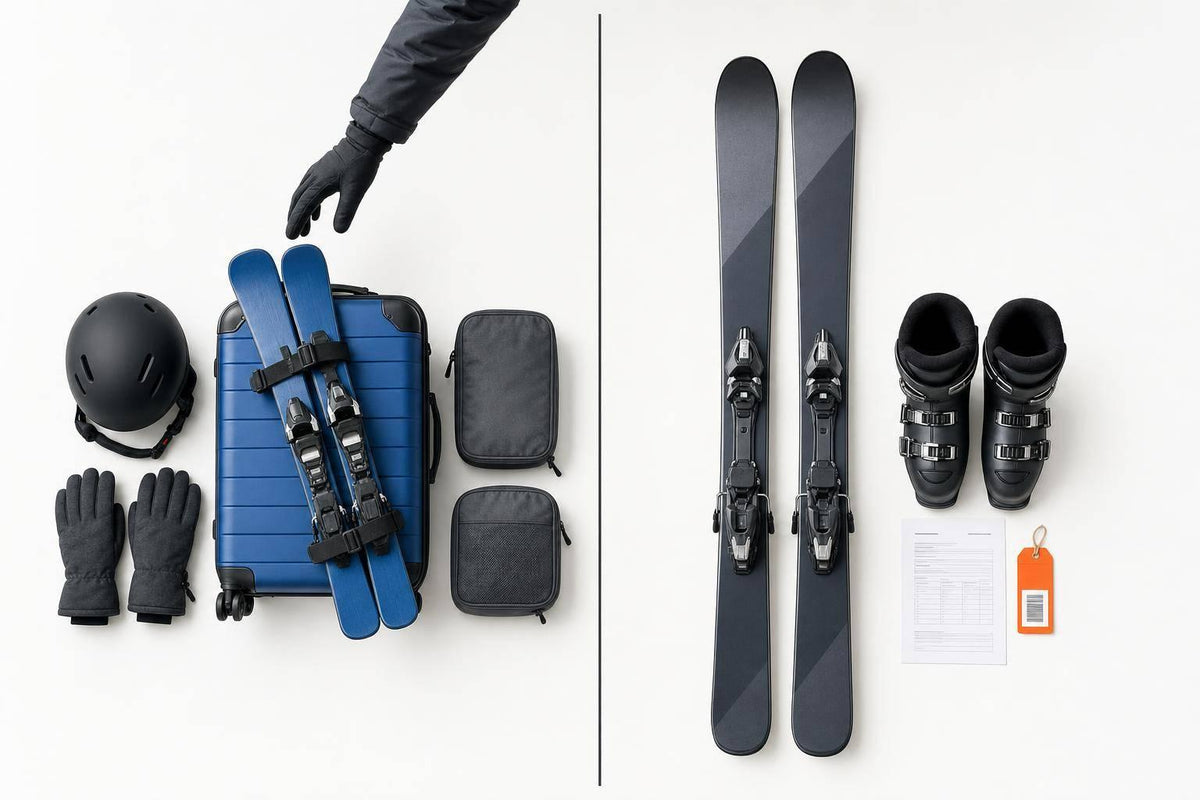
If I only had 2–3 days to ski, I’d pick the setup that saves time and keeps things easy. That’s the whole story here: 120 cm short skis win for casual weekend riders, while rental skis still make more sense for one-off trips, high speed, and deep snow.
Here’s the short version:
- Short skis are easier to pack, carry, and store
- Rentals cost less up front: about $50–$100 per day
- Short skis can save 30–90 minutes over a weekend by skipping pickup and return
- 120 cm skis are often easier for beginners, casual skiers, and snowboarders trying skis
- Rental skis feel better at speed and in deeper powder
- Buying short skis at $950 only makes sense if you’ll use them on more than one trip
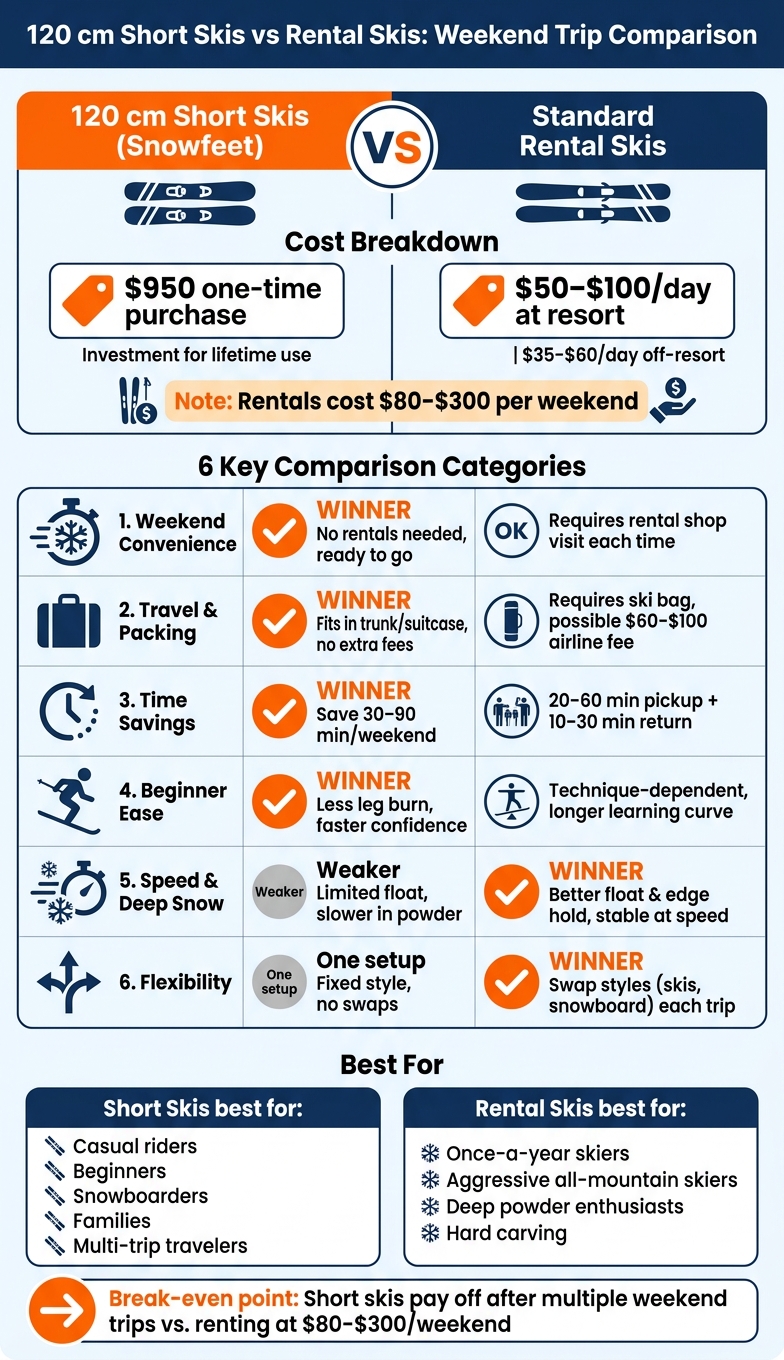
120 cm Short Skis vs Rental Skis: Weekend Trip Comparison
Short Skis vs. Long Skis
Quick Comparison
| What matters | 120 cm Short Skis | Rental Skis |
|---|---|---|
| Weekend convenience | Better | OK, but shop time adds up |
| Travel and packing | Easier | Lighter trip, but more on-site hassle |
| First-day feel | Easier for most casual riders | Better if you already ski well |
| Groomers and bumps | Fun, easy turns | More stable in long turns |
| Speed and deep snow | Weaker | Better |
| Cost for one trip | High at $950 | Lower for one weekend |
So, if you want the plain answer: buy or bring 120 cm short skis for easy resort weekends, but rent if you ski once a year or want more speed and float. That’s the call in a nutshell :)
Packing, Travel, and Resort Convenience
120 cm Skis Are Easier to Pack and Carry
At about 4 feet long, Snowfeet* 120 cm Short Skis are a lot easier to deal with than full-size skis. In many cases, they fit crosswise in a trunk or fully inside an SUV cargo area. Standard adult skis, which are often 5–6 feet long, usually need folded seats or a roof rack.
For air travel, that size gap matters too. Full-length skis often mean bringing a ski bag. But 120 cm skis can often fit in a checked suitcase or a compact sports bag. That may help you skip oversized-bag fees. And those fees aren’t small. Some budget airlines charge $60–$100 each way for winter sports gear.
They’re also less of a pain once you get to the resort. In a lodge or hotel room, short skis fit more easily in a corner and take up less floor space. Nice little win, especially when the room already has boots, jackets, bags, and the usual mountain chaos :)
Rental Skis Cut Down What You Bring but Add On-Site Hassle
Renting does make travel lighter. You show up with your clothes and boots, and that’s about it. No ski bag. No gear Tetris in the car. That’s a solid plus if you’re flying, moving fast, or just don’t want ski gear sitting around at home.
But the tradeoff hits when you arrive at the resort. Busy weekend mornings can mean 20–60 minutes for pickup and fitting, plus 10–30 minutes to return gear. On a short ski weekend, that lost time adds up fast. Saving even one hour can mean an extra run, a slow lunch, or just less standing around in a rental shop under bright lights.
| Factor | Snowfeet* 120 cm Short Skis | Standard Rental Skis |
|---|---|---|
| Car packing | Can usually fit crosswise in a trunk or cargo area | Usually needs folded seats or a roof rack |
| Air travel | Can often fit in a checked suitcase or compact sports bag | Usually requires a ski bag and may involve extra fees |
| Hotel/room storage | Fits more easily in small rooms and tight corners | Takes up more space and is harder to store |
| Resort carry | Easier to carry through crowds | Longer and less convenient to carry |
| Pickup and return time | Park, boot up, and head to the lift | Rental pickup, fitting, and return add extra time |
Once the logistics get simpler, the next thing that matters is how the skis feel on day one.
sbb-itb-17ade95
Learning Curve, Comfort, and Confidence for Casual Riders
Why Snowfeet* 120 cm Short Skis Feel Easier on Day One
Once you’ve dealt with the gear hassle, the next thing that matters is simple: how does it feel on day one?
On a 2–3 day ski weekend, there’s no time to wrestle with gear that feels awkward. Snowfeet* 120 cm skis are easier to steer, so turning and stopping take less work. That usually means less leg burn, fewer crossed skis, and a faster boost in confidence for beginners and snowboarders trying skis.
For snowboarders, this makes a lot of sense. The shorter length tends to feel more natural because steering comes from smaller movements. You don’t have to muscle the skis around as much, which is a nice little gift to your legs :)
Where Standard Rental Skis Can Feel Harder but More Familiar
Standard rental skis work well for classic alpine technique. If you already know how to pressure the edges and finish longer turns, they’ll feel familiar. But for people who ski once in a while, they often ask for more precise body position and more effort to start each turn. That can wear you out early.
They do have a plus side. Once you’re moving with confidence, rental skis can feel more planted in longer, faster turns. Skiers who’ve taken lessons or like that classic alpine feel often find that reassuring. So, yes, rentals feel familiar if you know the old-school pattern. They just aren’t always the easiest pick for a short weekend trip.
| Factor | Snowfeet* 120 cm Short Skis | Standard Rental Skis |
|---|---|---|
| Ease of learning | Faster to get comfortable; less length to manage | More technique-dependent; slower to feel natural |
| Turning response | Quick, low-effort turns; great for stop-and-start skiing | Longer arcs; more stable once balanced and moving |
| Confidence for beginners | High; less intimidating and more manageable at low speeds | Moderate; can feel unwieldy without solid technique |
| Boot comfort | Less lower-body effort can help you stay comfortable longer | More effort can make feet and legs tire sooner |
| Overall fatigue | Lower for casual riders; easier pivoting reduces leg strain | Higher for infrequent skiers who lose efficiency quickly |
Boot fit matters more than ski choice. A bad boot fit will ruin your day way faster than the wrong ski. If the boots are too loose or too tight, you’ll get tired fast. Keep the fit snug: your toes should touch the front when standing upright, your heel should stay down, and the buckles should feel snug, not cranked down.
If your feet hurt after the first run, don’t just tough it out. Head back and ask for an adjustment before going out again. That small fix can save the whole day.
Once comfort is set, the next difference is how each option handles groomers, bumps, and speed.
On-Snow Performance: Groomers, Bumps, Speed, and Mixed Conditions
For a short ski weekend, this is where things get simple. Most people aren’t lining up for a race run. They’re skiing groomers, poking through bumps, and dealing with whatever mixed snow the mountain serves up that day.
Where Snowfeet* 120 cm Short Skis Stand Out
On groomed blue runs and busy intermediate trails, Snowfeet* 120 cm skis feel nimble. They start turns fast, which makes short, controlled turns easy and low stress.
That same short length helps in moguls and chopped-up snow too. You can pivot through bumps, snake through tighter lines, and get back on track when the snow gets messy. They also keep things playful for small jumps and that loose, laid-back style a lot of weekend skiers like.
In light powder and mixed soft snow, they still do a nice job. But once the snow gets deep, that’s where they start to give up ground.
Where Rental Skis Still Perform Better
Here’s the tradeoff: once speed goes up, the snow gets firmer, or the powder gets deeper, standard rental skis still have the edge.
Longer all-mountain rentals grip firm morning groomers better and feel more planted as you go faster. If you like long, sweeping carves on wide runs, rentals usually feel steadier and more sure of themselves.
In deeper powder or broken snow, longer skis also float better and track with more calm. So if your plan is to hunt powder stashes or ski with a more aggressive style, rentals still make more sense.
| Condition | Snowfeet* 120 cm Short Skis | Standard Rental Skis |
|---|---|---|
| Groomed runs (green/blue) | Quick, low-effort turns; great for casual pacing | More stable at speed; better for long, sweeping carves |
| Moguls & chopped snow | Easy pivoting; short length helps weave tight lines | More stable in bigger bumps at speed; better for stronger technique |
| Light powder / mixed soft snow | Good for light resort powder; less suited to deep snow | Better float and stability in deeper snow |
| High-speed stability | Less stable as speed increases; can feel loose on fast runs | Stronger edge hold and directional stability at higher speeds |
That’s the main split most weekend riders will notice. Snowfeet* lean toward quick, playful, easy skiing. Rental skis lean toward speed, grip, and better performance when the snow gets deep.
Cost, Rental-Shop Hassle, and the Best Pick for Your Weekend Trip
Once travel and on-snow feel are clear, price and hassle become the last tiebreakers.
For a weekend trip, cost and convenience usually make the call. Rentals cost less at the start. But Snowfeet* can pay off if you use them on more than one trip. Snowfeet* Short Skis 120 cm cost $950 as a one-time buy, while resort rentals usually run about $50–$100 per day at the base or $35–$60 per day at an off-resort shop.
Then there’s the time factor. Bringing Snowfeet* means no rental counter, no fitting line, and no end-of-day return stop. You just show up and ski. That’s a pretty nice way to start a weekend :)
| Snowfeet* 120 cm Short Skis | Standard Rental Skis | |
|---|---|---|
| Upfront cost | $950 one-time purchase | $0 upfront |
| Per-trip cost (2–3 days) | No rental fee after purchase; the per-trip cost falls as you use them more | Roughly $80–$300 per weekend depending on resort and package |
| Time hassle | No rental lines; arrive with your own gear | Fitting, paperwork, and possible adjustments, plus return logistics at the end of the trip |
| Best for | Travelers, beginners, casual skiers, snowboarders, and families who want easy, playful resort skiing | Single trips, aggressive all-mountain skiing, deep powder, and long-radius carving |
When Buying or Bringing Snowfeet* Makes More Sense
Snowfeet* makes more sense when you plan to use the same gear for a few weekend trips. At that point, you stop feeding the rental-shop meter every trip and skip the whole shop routine too. If you fly to ski destinations, the case gets even stronger. 120 cm skis are much easier to pack than full-length skis, and you’re less likely to need oversize ski bags or roof racks.
They’re also a good match for beginners, casual skiers, snowboarders, and families. If the goal is playful resort skiing at moderate speeds, not charging hard down every run, Snowfeet* fits that job well.
When Standard Rental Skis Are Still the Better Call
Rentals still make sense if this is a one-time or once-a-year trip. Why buy gear you may barely use? They’re also the better pick for stronger skiers who want more speed, deep snow performance, or hard carving. In those cases, longer all-mountain skis usually do a better job.
Rentals also help if you like to switch things up from trip to trip. Maybe one weekend you want a wider ski. Next time, a different length or flex. Rentals let you test and swap without locking yourself into one setup.
Conclusion: The Clearest Choice for Most Casual Weekend Riders
So, the choice is pretty simple. For most casual weekend riders, Snowfeet* 120 cm short skis are the stronger overall pick. They’re easier to travel with, easier to learn on, and more fun for the kind of skiing most weekend riders do. Standard rental skis still have the edge for speed, deep snow, and all-mountain performance, but on a casual resort weekend, that edge often doesn’t matter much.
FAQs
Are 120 cm short skis enough for a beginner weekend trip?
Yes. 120 cm short skis are a smart pick for a beginner weekend trip because they’re easier to turn, control, and move around than standard 150–180 cm rental skis.
For new skiers, that can make a big difference. Shorter skis often feel less intimidating, so it’s easier to get the hang of basic turns and stop with more control. That usually means you can build confidence faster instead of fighting the gear.
That said, standard rental skis still have their place. They tend to work better for high-speed carving, deep powder, or steep terrain. But for the kind of skiing most beginners do on a weekend trip - resort groomers and blue runs - 120 cm skis are a strong fit.
How many ski trips make buying short skis worth it?
Buying short skis usually starts to make sense when you ski often enough that the gear can take the place of rental fees.
If you're heading out for a one-time trip, renting is still the simple, practical move. No surprise there.
But if you plan to ski more than once in a while, Snowfeet gear often pays for itself after 4 to 10 days on the snow. That’s a pretty short runway.
For the higher-end 120 cm models, the math takes a bit longer. In most cases, the break-even point lands around 15 to 20 days compared with daily resort rentals.
Can I use 120 cm short skis in powder and at higher speeds?
Yes, but there are limits.
120 cm short skis feel more stable than shorter Snowfeet models, and they ski a lot more like regular skis. That said, they’re not built for deep powder or hard charging at high speed.
They work best on groomed runs, where they give you solid control and easy turning. If you want to ski deep powder or make fast, aggressive carves on steep terrain, 150–180 cm traditional skis are still the better pick.











Leave a comment
This site is protected by hCaptcha and the hCaptcha Privacy Policy and Terms of Service apply.