



















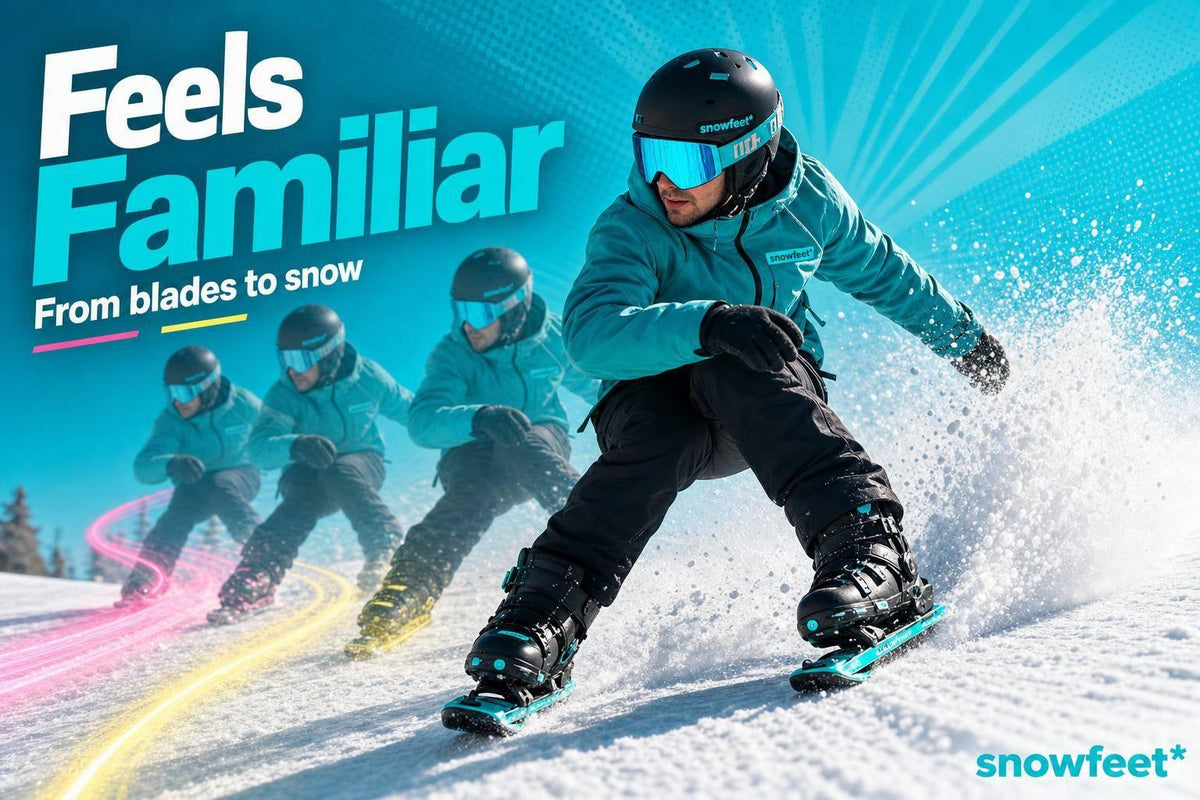
If you already skate, skiskates will likely feel more normal than long skis on day one. The main reason is simple: your stance stays centered, your turns come from edge pressure, and your stops feel closer to a hockey stop than a snowplow.
Here’s the short version:
-
Rollerbladers and ice skaters already know the core moves
- edge control
- one-foot balance
- side-to-side pressure
- fast stopping
-
Long skis often feel awkward at first
- too much ski in front and behind your feet
- less natural for tight turns
- more gear and more technique to learn
-
Snowfeet* skiskates keep things closer to skating
- 44 cm model: best if you want the most skate-like feel
- 50 cm model: better if you want a bit more support at speed
I’d put it this way: if long skis can feel like standing on two yardsticks, skiskates feel much closer to stepping onto snow with your skating habits still intact :)
A few useful numbers from the article:
- Snowfeet* Skiskates 44 cm start at $460
- Snowfeet* PRO Ski Skates 50 cm start at $299
- Long skis often run around 160–180 cm
- The skiskate options here are just 44 cm and 50 cm, so the platform is much shorter underfoot
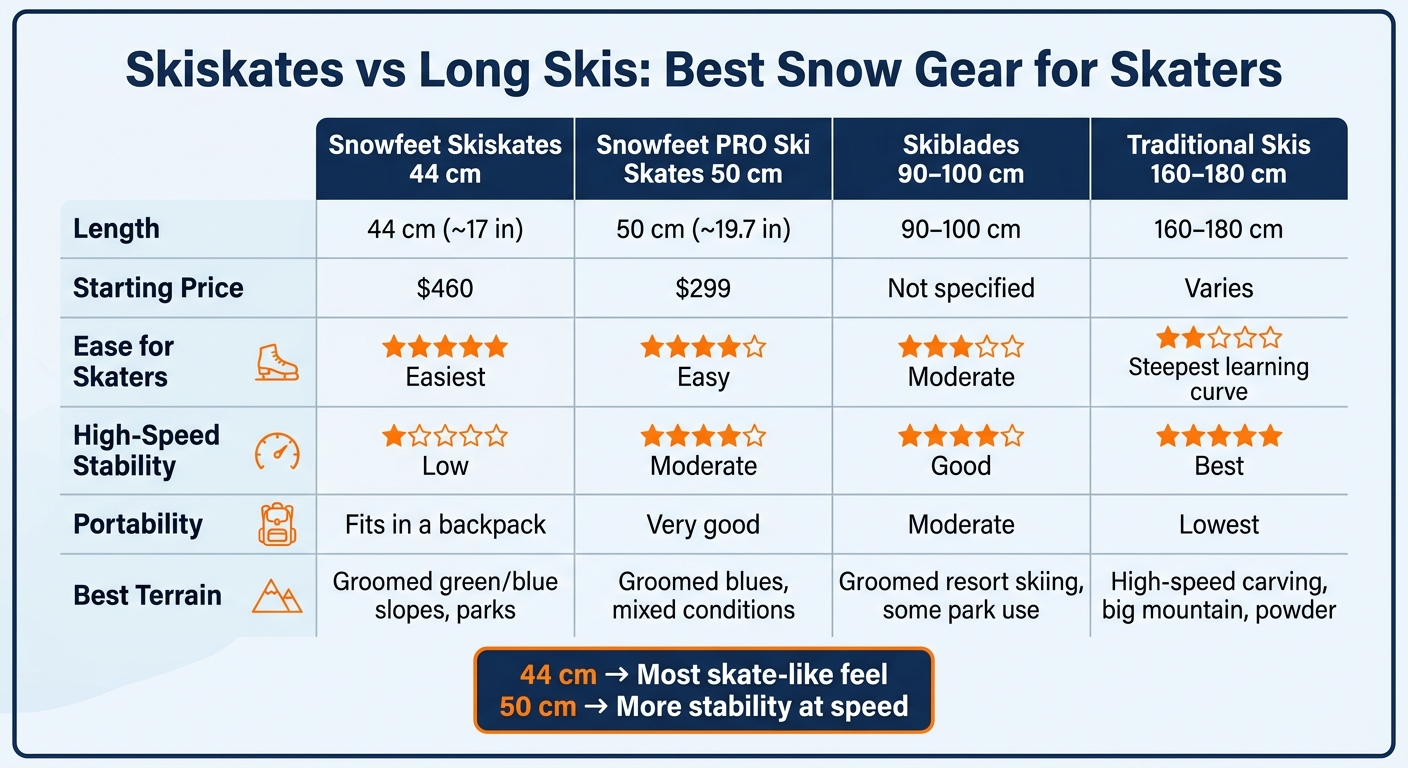
Skiskates vs Long Skis: Best Snow Gear for Skaters
Snowfeet* & Skiskates Tutorial - How to Become a PRO Skiskater
Quick Comparison
| Option | Best for | Feel for skaters | Stability at speed | Portability |
|---|---|---|---|---|
| Snowfeet* Skiskates 44 cm | Tight turns, skate-style riding | Highest | Lower | Fits in a backpack |
| Snowfeet* PRO Ski Skates 50 cm | Mixed snow, a calmer ride | High | Medium | Very good |
| Skiblades 90–100 cm | Groomed runs, some park use | Medium | Higher | Medium |
| Long skis 160–180 cm | Fast carving, steep runs, powder | Lowest for most skaters | Highest | Lowest |
So, if you skate now and want a winter option that makes sense fast, skiskates are the easier jump. The big choice is simple: 44 cm for the closest skate feel, or 50 cm for more support.
Why Skiskates Feel Familiar on Snow
Centered Stance Over the Middle of the Foot
Start with the stance you already know from skating: feet hip-width apart, knees bent, hips over your midfoot, and your torso a bit forward from the ankles.
On Snowfeet* Skiskates 44 cm, that position feels natural right away. The support stays close under your feet, so your balance feels more like skates than long skis. With long skis, even small weight shifts can feel bigger because the platform stretches so far in front of and behind you.
A simple way to picture it: stand like you would on inlines or hockey skates right before you push off.
Edge Control, Carving, and Quick Direction Changes
This is where a lot of skaters start to smile :) You already know how to use edges.
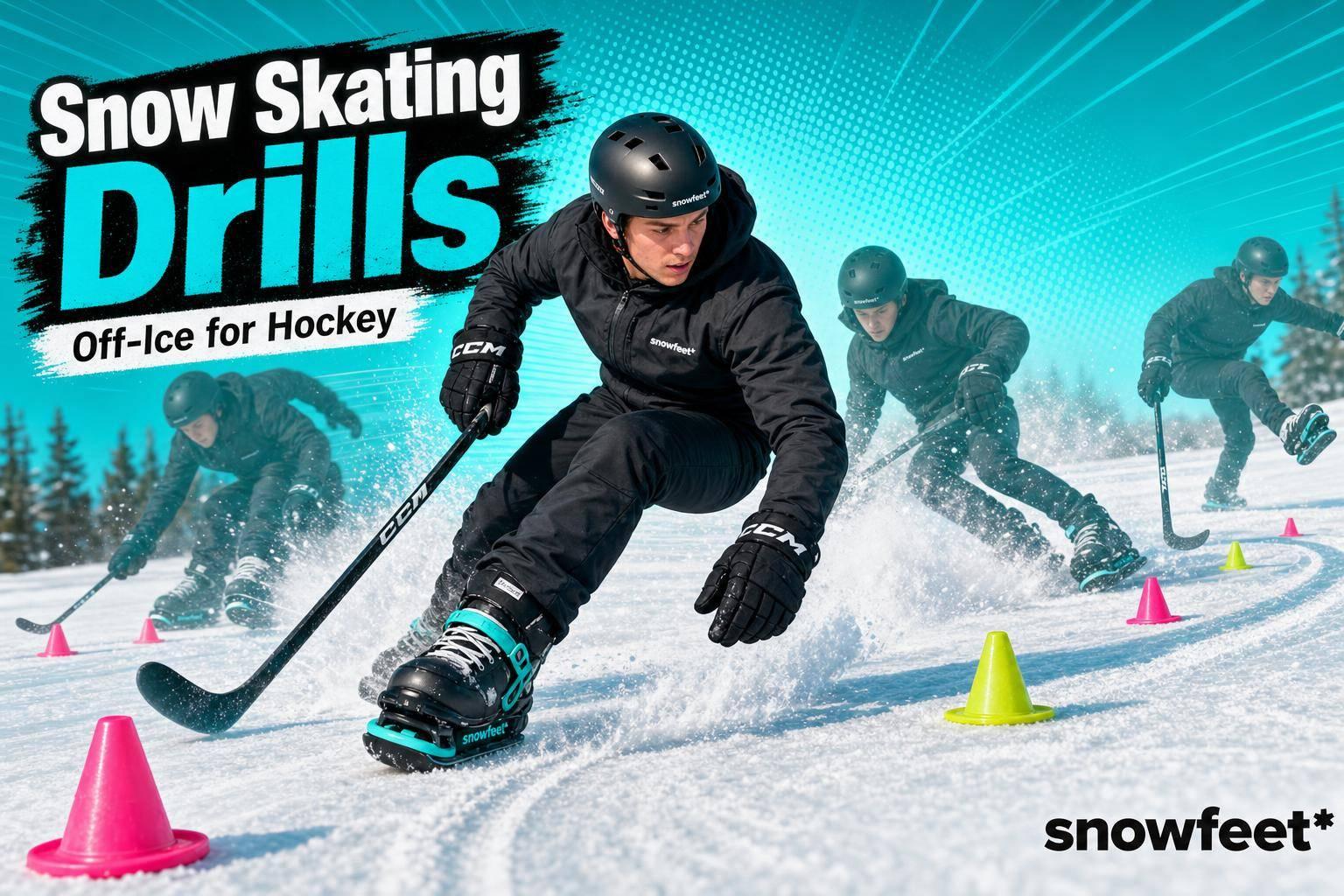
On ice or inline skates, you guide turns by tipping through your ankles and knees. On Snowfeet*, the steel edges answer in much the same way. If you’ve done crossovers, slalom drills, or tight hockey turns, you’ve already trained the main movement pattern.
Because the platform is only 44 cm long, turns feel fast and snappy. You don’t have to wait on a long ski to come around. It reacts more like what your body expects from skating.
Use the same cue many skating coaches give: tip with your knees and ankles, not your hips. That works on snow too.
That familiar edge feel also helps balance feel easier to trust.
Short-Platform Balance and Skating-Style Stops
Skaters are used to balancing on a compact base, and Skiskates keep that support right underfoot. So when you need to correct balance, the movement stays small, quick, and driven by your feet instead of your whole body.
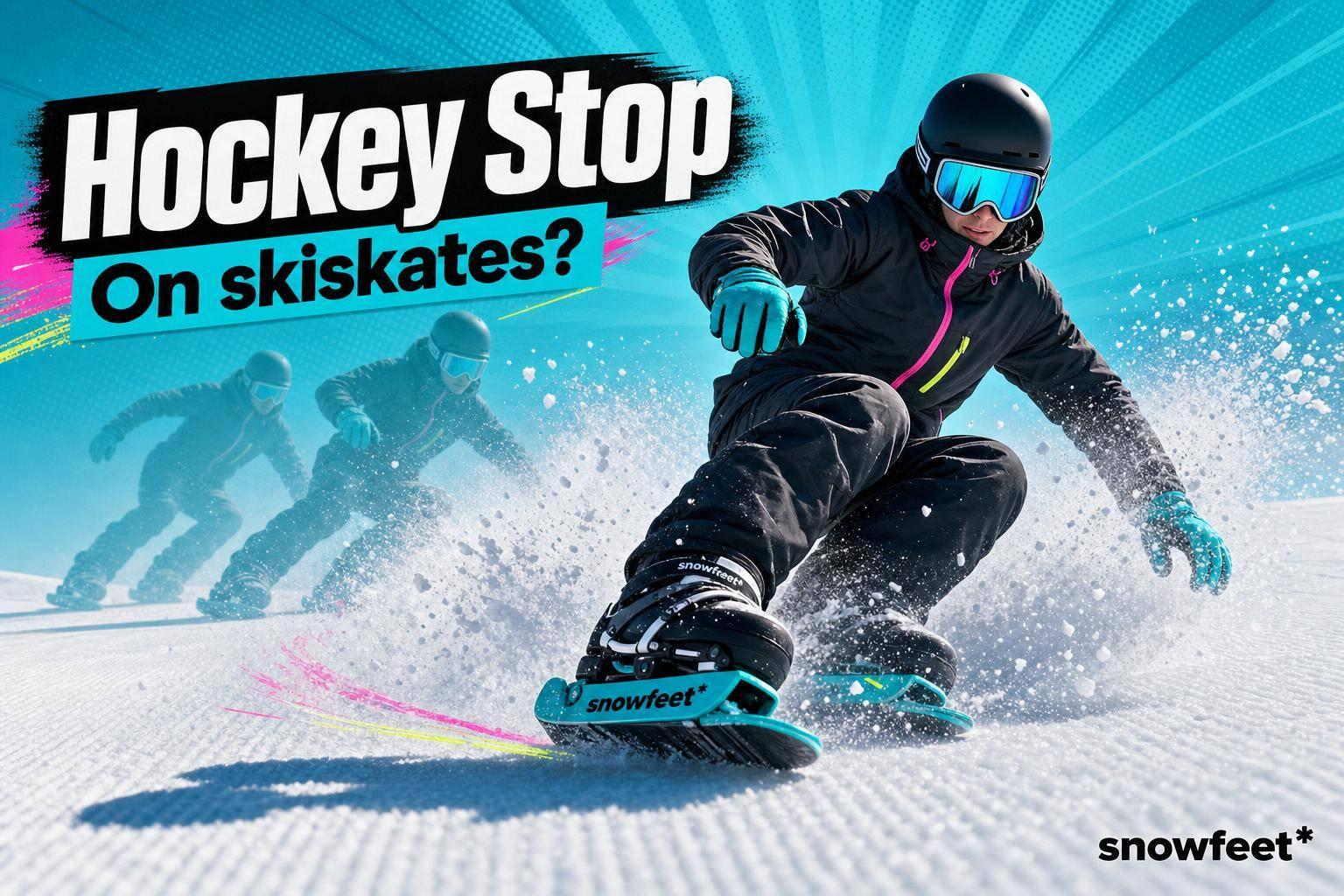
Stopping transfers well too. Turn both Skiskates across the slope and lean onto the uphill edges to skid to a stop. That feels much closer to a hockey stop or powerslide than a beginner snowplow.
So, the movement patterns come over fast. The main shift is just getting used to a few snow-specific habits.
sbb-itb-17ade95
Which Skating Skills Carry Over and What Needs Adjusting
Skating Skills That Transfer Almost Directly
Skaters already know how to read an edge, stack over one foot, and steer with pressure. That’s why Skiskates tend to feel familiar fast. The skill set is already there. The main shift is how much force snow asks for.
Edge awareness carries over right away. Tip the Skiskate onto its edge, and your body already has a sense of what should happen next. The same goes for one-foot balance. If you’re used to stacking your hips over a single foot, a brief weight shift on uneven snow won’t throw you into panic mode.
Side pressure through your hips and ankles carries over too. It’s the same basic movement that drives crossovers and carving on skates. On Skiskates, that motion turns into controlled edge pressure with almost the same feel. So, yeah, many skaters get comfortable pretty fast, often within a few practice runs.
Small Adjustments Skaters Need to Make on Snow
The biggest change is the boot. Winter boots are stiffer, so they limit ankle flex, but they also give you more support. That means the tiny ankle-led corrections you lean on while skating won’t work the same way here. You’ll need to do more of that edging and balance work with your knees and hips instead.
On a mellow slope, try small knee shifts and pay attention to when the edges start to bite. That simple drill helps a lot.
Snow has its own personality too. Packed snow can grip hard, so even a small edge angle may turn more than you expect. Soft snow does the opposite in some spots. It scrubs speed fast, especially on flatter sections.
There’s also a mental shift. On skates, you often create speed yourself. On snow, you’re managing downhill speed. That changes timing. You’ll want to start turns a bit earlier than feels normal and think in smooth, linked S-curves instead of quick direction changes.
A lot of skaters over-steer at first. They snap onto an edge the way they would in a hockey stop, and on mixed or uneven snow, that can feel twitchy. The fix is simple:
- Think gradual pressure, not a hard snap
- Use smooth arcs, not sharp hits
That’s why the 44 cm Skiskates usually feel closest to skating, while the next section shows when the 50 cm PRO makes more sense.
Best Snowfeet* Models for Rollerbladers and Ice Skaters
Now it comes down to one thing: do you want more skate feel or more stability?
Snowfeet* Skiskates 44 cm for the Most Skate-Like Feel
If you’re a skater and want snow gear that feels the closest to what you already know, go with the Snowfeet* Skiskates 44 cm (about 17 inches).
This model gives you the quickest edge response and the tightest turns. In plain English, it feels the most like skating on snow. The wood core and steel edges help it grip well on groomed slopes, and the underfoot binding placement keeps your balance feeling natural and quick.
At $460, it works with ski boots (US 4.5–14.5) or snowboard boots (US 6–14.5), which is nice if you want to rent boots and keep your setup light for travel.
For most rollerbladers and ice skaters, this is the best first pick.
Snowfeet* PRO Ski Skates 50 cm for More Support and Stability
If you want that same skate-style ride but with a bit more support, the Snowfeet* PRO Ski Skates 50 cm (about 19.7 inches) makes more sense.
The longer platform gives you a little more margin for error, which helps as speed picks up. The fiberglass core keeps the ride steadier on mixed snow, and it feels more forgiving at moderate speeds. That can help later in the day when the snow gets chopped up and messy.
Starting at $299, it’s also the lower-cost way in. So if you want a calmer ride without giving up that skating feel, the PRO 50 cm is a smart middle ground.
How Snowfeet* Compares with Long Skis and Other Short-Ski Options
Traditional 160–180 cm skis are still better for high-speed carving, big-mountain terrain, and deep powder. No way around that. But for skaters, the learning curve feels very different.
Here’s the quick comparison:
| Equipment | Ease for Skaters | High-Speed Stability | Portability | Best Terrain |
|---|---|---|---|---|
| Snowfeet* Skiskates 44 cm | Easiest | Low | Fits in a backpack | Groomed green/blue slopes, parks, side hits |
| Snowfeet* PRO 50 cm | Easy | Moderate | Very good | Groomed blues, mixed conditions |
| Skiblades (90–100 cm) | Moderate | Good | Moderate | Groomed resort skiing, some park use |
| Traditional skis (160–180 cm) | Steepest for skaters | Best | Lowest | High-speed carving, big mountain, powder |
The short version is simple:
- 44 cm if you want the most skate-like feel
- 50 cm if you want a bit more stability
That’s the trade-off. One feels more nimble. The other gives you a calmer ride when things speed up.
Conclusion: Why Skiskates Are an Easier Winter Crossover for Skaters
If you already rollerblade or ice skate, skiskates tend to click fast. The reason is simple: they use movement patterns you already know. On day one, snow feels a lot less intimidating than it does on long skis. That’s why the 44 cm version usually feels the most natural.
The Snowfeet* Skiskates 44 cm are the closest match to that skating feel. They react fast, make tight turns, and feel the most like skating on snow. For most rollerbladers and ice skaters, this is the natural first pick.
Want a bit more stability? Move up one step. The Snowfeet* PRO Ski Skates 50 cm give you a little more support for faster runs and rougher snow.
To be clear, long skis are still the better tool for high-speed carving, steep black runs, and big-mountain terrain. That’s the trade-off: pure skate feel or more downhill stability. For casual riders who want a fun, portable winter crossover, skiskates are the easier way in.
For skaters, Snowfeet* makes winter feel familiar instead of foreign. And honestly, that’s a big deal :)
FAQs
Do I need ski experience to ride skiskates?
No. You don’t need ski experience to ride skiskates.
They’re built to feel a lot like ice skating or rollerblading. So if you’ve done either of those, Snowfeet can feel pretty natural from the start.
If you already skate, you’ve likely got a head start with:
- balance
- edge control
- weight shifting
That means you can often pick up the basics in just a few hours.
Should I choose the 44 cm or 50 cm Snowfeet* model?
It comes down to how you want to ride.
If you want the closest thing to ice skates or rollerblades on snow, go with the 44 cm Skiskates. They feel the most nimble and quick on groomed slopes. Great for fast turns, spins, and hockey-style stops.
If you want a little more stability, the 50 cm Snowfeet PRO makes more sense. It handles light powder and mixed terrain better, while still being small enough to fit in a backpack.
Can skiskates handle rough snow and faster runs?
Snowfeet skiskates shine on groomed runs and packed snow. That’s where their metal edges can do their job, giving you sharp control and quick response. If you like fast turns, nimble movement, and that playful side-to-side feel, they’re a blast :)
That said, they’re not built for deep powder or very steep, expert-level alpine slopes. In those spots, you’ll want more ski under your feet.
If you’re after more stability and smoother performance on mixed terrain or at higher speeds, Snowfeet’s 120 cm short skis are the better pick. They give you more balance and control, but they’re still much easier to handle than long, old-school skis.











Leave a comment
This site is protected by hCaptcha and the hCaptcha Privacy Policy and Terms of Service apply.