



















Switching to short skis can completely change how you experience the slopes. Here’s the quick scoop on why so many skiers are making the switch:
- Easier Turns: Shorter skis are lighter and more responsive, making sharp turns feel effortless - even in tight spots like tree runs or moguls.
- Faster Learning: Beginners love them because they’re less intimidating and easier to control, speeding up the learning curve.
- Less Strain: They’re gentler on your knees and reduce fatigue, so you can ski longer without feeling wiped out.
- Better in Crowds: Their compact size makes navigating busy slopes and narrow trails a breeze.
- Convenient to Transport: Unlike long skis, short skis fit in your car trunk or even a backpack, making travel and storage hassle-free.
Forget the myth that shorter skis lack stability or speed. With models like Snowfeet Skiblades (39–47 inches) and Skiskates (just 17 inches), you’ll get plenty of control and even improved performance in certain conditions. Whether you're a seasoned skier or just starting out, short skis might be the game-changer you didn’t know you needed.
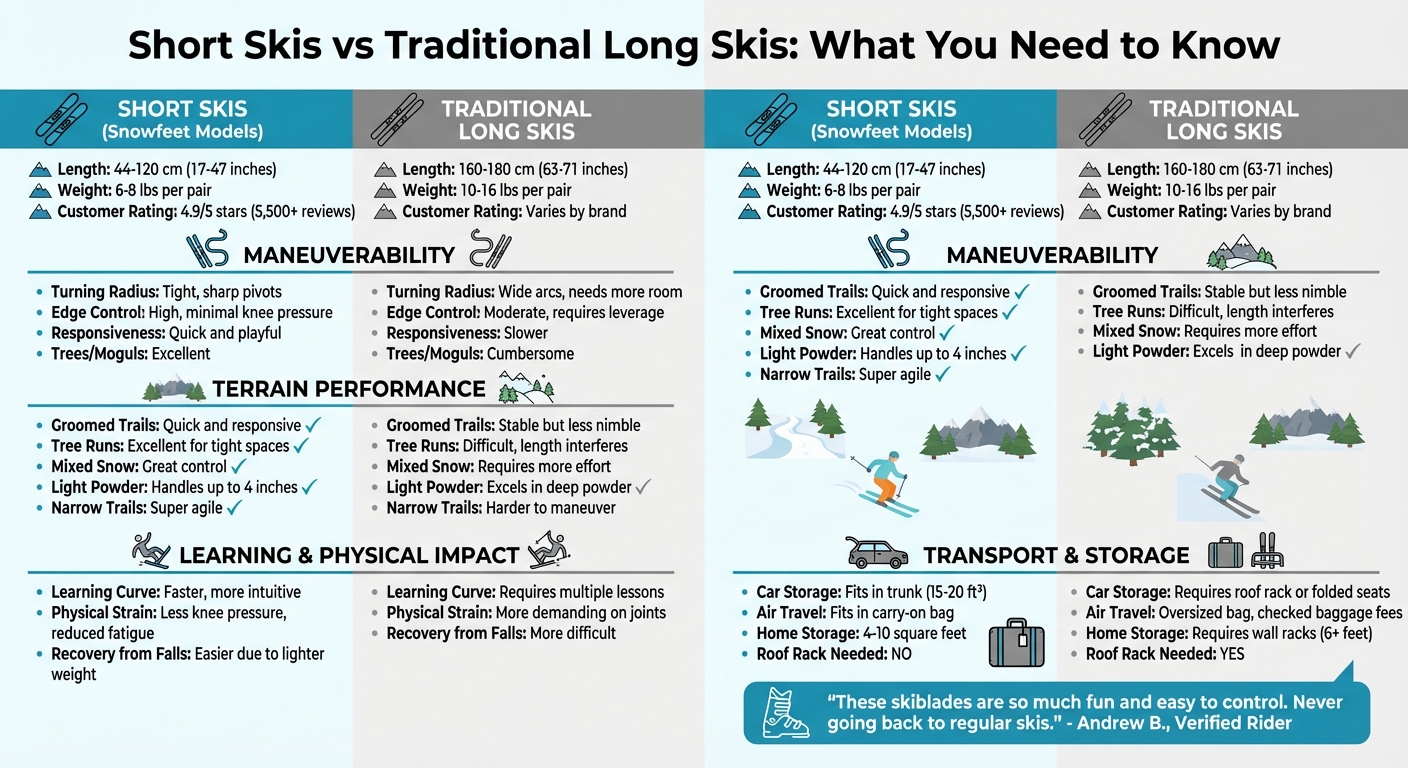
Short Skis vs Traditional Long Skis: Complete Performance Comparison
Short Skis vs. Long Skis
1. Better Maneuverability on the Slopes
Skiers love the ease of navigating tight spaces, and that's where shorter skis shine. Traditional long skis - much longer than Snowfeet* models - can feel bulky and awkward when you're trying to weave through trees or make quick moves on busy slopes. Snowfeet* Skiblades (available in lengths of about 26, 39, and 47 inches) and Skiskates (around 17 inches) ditch the extra length, giving you the freedom to move with precision and ease.
This compact design allows for sharper, faster turns without needing big, sweeping body movements. It makes carving feel smooth, almost like ice skating. This kind of control is exactly what you need for navigating moguls or tight trails, and it becomes even more critical when the slopes are crowded.
1.1 Handling Crowded Slopes and Narrow Trails
Crowded slopes and narrow trails are where traditional long skis often fall short. Their length requires more space to turn, which can be a hassle when you're dodging slower skiers or squeezing through a dense tree run. Snowfeet* products, on the other hand, make sharp directional changes a breeze. No need to slow down or worry about your ski tips or tails getting caught on obstacles. Plus, their skating motion lets you glide along flat sections or even climb small inclines - something traditional skis struggle to match.
"I hate getting stuck on a hill in skis because they're so long and bulky. Since these are shorter, you can just skate right up." - Sophia Kane, Verified Rider
Another bonus? Short skis put less strain on your knees when tilting onto their edges. This means carving and quick direction changes feel effortless, not exhausting. Check out the table below to see how short skis stack up against traditional long skis.
1.2 Comparison Table: Short Skis vs. Long Skis for Maneuverability
| Feature | Short Skis (Snowfeet* Models) | Traditional Long Skis |
|---|---|---|
| Turning Radius | Tight; allows sharp pivots in small spaces | Wide arcs; needs more room for turns |
| Edge Control | High; requires minimal knee pressure | Moderate; needs more leverage and skill |
| Responsiveness | Quick and playful; reacts instantly to foot movements | Slower; hampered by longer tips and tails |
| Weight | Ultra-light; reduces leg fatigue | Heavier; can cause strain over time |
| Maneuverability in Trees/Moguls | Excellent; easily navigates obstacles | Cumbersome; harder to handle in tight spots |
The feedback speaks for itself - Snowfeet* products have earned a 4.9 out of 5-star rating from over 5,500 verified reviews. Compared to the bulkier, heavier options from brands like Rossignol or K2, the difference in performance on the slopes is clear.
2. Faster Learning and Less Physical Strain
Snowfeet* products are designed to make skiing more accessible and enjoyable, especially for beginners. Their precise handling not only helps you move more easily on crowded slopes but also leads to quicker learning and less fatigue. For newcomers switching to shorter skis, the learning curve is surprisingly smooth. Snowfeet* Skiskates and Skiblades rely on a natural skating motion and lightweight construction, which makes picking up the basics faster. In comparison, traditional long skis - like those from Salomon or Atomic - often demand several lessons just to master basic turns. Many skiers also report feeling much less worn out after a day using these shorter skis. The combination of intuitive design and reduced physical strain makes short skis a game-changer for recreational skiers.
2.1 How Beginners Learn Faster
Short skis make learning feel natural. Thanks to their compact size, they eliminate much of the intimidation that comes with traditional ski gear. Snowfeet* Skiskates, for instance, allow for quick edge-to-edge transitions and a playful responsiveness that builds confidence fast. Because they’re easier to handle, beginners can navigate slopes with less fear of falling.
This user-friendly design helps new skiers focus on developing proper techniques. It also means they can move from basic lessons to intermediate skills in a shorter amount of time.
2.2 Reduced Physical Stress
Short skis aren’t just about easier learning - they’re also about making skiing less physically demanding. Their lightweight build reduces the effort needed to control them. For example, carving on short skis requires much less pressure on your knees, which is a big plus for older skiers, those recovering from injuries, or anyone dealing with joint issues. Unlike traditional long skis, which demand more force to maneuver, short skis are gentler on your body, helping to prevent fatigue.
Even falling is less of a hassle. With their smaller size and lighter weight, recovering from a fall is much easier compared to long skis or snowboards. This means you can spend more time enjoying the slopes and less time worrying about physical strain or recovery.
3. Performance Across Different Terrain Types
If you're used to traditional skis, switching to short skis might feel like a gamble. But here's the thing: short skis handle a wide range of terrain like pros. Products like Snowfeet* Skiblades and Skiskates shine on groomed trails, in tree runs, and even in tricky snow conditions. Their lightweight, responsive design gives them a serious edge over the bulkier, long skis from brands like Rossignol or K2.
Thanks to their nimble handling and easy learning curve, these skis perform impressively across various conditions. Unlike long skis that can feel clunky in tight spots or require extra effort to dodge obstacles, short skis let you weave through trees and narrow paths with ease. And don't worry about losing control - Snowfeet* keeps things steady with a forgiving design that balances agility and stability.
3.1 Handling Mixed Snow Conditions
Short skis also prove their worth when snow conditions are less than ideal. Whether you're cruising on freshly groomed runs in the morning or dealing with choppy, uneven snow later in the day, Snowfeet* Skiblades stay responsive and agile. Models like the 39-inch and 47-inch versions strike a great balance between stability and maneuverability.
Here's where they really stand out: the skating motion. When you hit flat areas or slight inclines where traditional skis might slow you down, short skis let you skate right through. This added freedom means you're not stuck on perfectly groomed slopes - you can explore more of the mountain without worrying about getting bogged down or losing control.
This ability to handle mixed conditions sets the stage for a head-to-head comparison with traditional skis.
3.2 Terrain Comparison: Short Skis vs. Traditional Skis
| Terrain Type | Short Skis (Snowfeet* Skiblades/Skiskates) | Traditional Long Skis |
|---|---|---|
| Groomed Trails | Quick and responsive; easy, sharp turns | Stable but less nimble |
| Tree Runs | Excellent for tight spaces; compact size | More difficult; length gets in the way |
| Mixed Snow | Great control in uneven conditions | Requires more effort and skill |
| Light Powder | Handles up to 4 inches well | Excels in deep powder |
| Narrow Trails | Super agile, perfect for tight turns | Harder to maneuver due to length |
This table spells it out: short skis bring agility and control to the table, making them a fantastic choice for recreational skiers who stick to resort terrain. Even for backcountry touring, the Snowfeet* Walkski (39 inches) proves its versatility, showing that short skis aren't just limited to groomed slopes. Their lighter weight, responsive feel, and ability to adapt to different terrains make them a surprisingly capable option.
All these perks make it clear why Snowfeet* products outshine traditional skis when it comes to agility and versatility.
sbb-itb-17ade95
4. Easy Transport and Storage
Switching to short skis often comes with an unexpected bonus: they’re a breeze to transport. Traditional skis from brands like Rossignol or Atomic usually measure between 160–180 cm (63–71 inches) and weigh about 10–16 lbs per pair, bindings included. That bulk can make storage and travel a hassle. On the other hand, Snowfeet* Skiblades and Skiskates are much more compact, ranging from just 44 cm to 120 cm (roughly 17–47 inches) and weighing only 6–8 lbs per pair. Lighter, shorter, and far easier to handle.
"Fits in a backpack. Light, compact, and ready to go. Snowfeet fit your gear, your car, and your lifestyle." - Snowfeet*
Their small size means no need for roof racks - they fit diagonally in a standard 15–20 ft³ trunk. This not only simplifies packing for ski trips to places like Vail or Tahoe but also helps lighten your car’s load, which could even save on gas during long road trips. Let’s break down how these dimensions make travel and storage so much simpler.
4.1 Compact Size for Travel
Snowfeet* short skis are built for portability. The 44 cm Skiskates and even the 99 cm Skiblades can easily fit into a standard carry-on bag (usually under 22 x 14 x 9 inches) or a regular backpack. Compare that to traditional skis, which require oversized bags stretching 6–8 feet - leading to checked baggage fees and crowded luggage compartments. For U.S. travelers flying to ski spots like Denver or Salt Lake City, this convenience is a game-changer.
It’s not just about air travel, either. These short skis are ideal for buses or trains heading to resorts, offering a practical solution for those who prefer public transportation. No more awkwardly lugging around massive ski bags.
4.2 Simpler Storage Solutions
The convenience doesn’t stop once you’re home. Traditional skis, often over 6 feet long, need dedicated wall racks or mounts - tricky to manage in smaller apartments common in ski towns. Snowfeet* Skiblades, however, take up just 4–10 square feet. They can tuck neatly into a closet corner, slide under a bed, or sit on a standard shelf without eating up precious space.
In your car, the story’s the same. Short skis fit snugly in the trunk or backseat without forcing you to fold seats or sacrifice passenger comfort. Unlike long skis, which often end up awkwardly positioned, these compact options make packing stress-free. For skiers who value ease and efficiency alongside performance, this streamlined storage is a clear win.
5. The Truth About Stability and Speed
Traditional long skis - those over 170 cm (67+ inches) - are often praised for their stability at high speeds, especially in racing scenarios. But let’s be honest, most of us aren’t tearing down slopes like Olympic athletes. Recreational skiing is a whole different game, involving carving groomed trails, weaving through crowds, and soaking in the mountain vibes. So, how do shorter skis hold up when it comes to stability and speed in everyday skiing? Let’s dig in.
5.1 Stability in Everyday Skiing
Short skis require a bit more precision when it comes to balance since they don’t have the extra surface area that long skis provide. But here’s the good news: once you master your technique, stability becomes second nature. Snowfeet* riders seem to agree - over 5,500 verified reviews, averaging 4.9 out of 5 stars, highlight how stable these shorter skis feel after a short adjustment period.
"My first run the skis did shake but soon thereafter by distributing better my weight on my toes - I was flying like never before. Going fast I was in complete control of every move, turns, and stops." - Daniel Siouffi
This aligns with the earlier point about better control and responsiveness, especially in tight or crowded areas. Picture a packed slope on a weekend at Vail or navigating a tricky tree run - short skis like the Snowfeet* Skiblades (99 cm or 39 inches) shine in these situations. Unlike traditional long skis that can feel bulky and unwieldy, these shorter models allow for quick movements and adjustments. The 99 cm length strikes a great balance: easier to stabilize than ultra-short 44 cm Skiskates, but far more nimble than traditional long skis.
5.2 Speed Performance Explained
When it comes to speed, short skis offer a different kind of advantage. While long skis are engineered for straight, downhill racing, shorter skis excel in maintaining momentum through turns and technical terrain. Snowfeet* models, built with wood cores and metal edges (the same high-quality edges you’d find on traditional skis), are designed for sharp carving and precise stops - no matter how fast you’re going.
The idea that short skis are "slow" is more about perception than reality. Their responsiveness makes you more aware of your speed, giving you the ability to adjust and control it with ease. Sure, long skis might let you bomb straight down the hill, but Snowfeet* Skiblades (starting at $590 for the 99 cm wood core model) let you navigate varied terrain with pinpoint accuracy. Plus, keeping fiberglass models waxed ensures a smooth, fast glide, making short skis an excellent option for skiers who prioritize both control and speed on real-world slopes.
6. Sharper Edge Control and Carving
Skiers often find themselves amazed by how precise and responsive short skis can be when carving. Unlike traditional long skis, which require a lot of effort and leverage to tilt their edges, short skis like Snowfeet* Skiblades make edge engagement feel almost effortless. The result? A smoother, more controlled carve with less strain on your body.
Snowfeet* achieves this through a minimalist design that eliminates the extra bulk found in long skis. By cutting down on unnecessary material, these skis dramatically reduce swing weight, making it easier to transition from edge to edge. And don't let their compact size fool you - Snowfeet* Skiblades are equipped with high-quality metal edges, just like traditional skis, ensuring reliable grip and control on everything from groomed slopes to more unpredictable terrain.
This enhanced edge control, combined with the added maneuverability and faster learning curve, is what sets Snowfeet* apart from the pack.
6.1 Faster Edge-to-Edge Transitions
Thanks to their lightweight construction and smart design, shorter skis offer lightning-fast transitions. Traditional long skis - think 170 cm (67 inches) or more - require noticeable effort to shift weight and wait for the skis to catch up. But with Snowfeet* Skiblades, available in sizes like 99 cm (39 inches) or the ultra-compact 44 cm (17 inches) Skiskates, that delay is virtually eliminated. This quick response makes them ideal for navigating moguls, weaving through tight trees, or handling crowded slopes with ease.
"Short skis are easier to carve and to turn than long skis, since you don't need to put too much pressure on your knees to actually tilt the skis on their edge." - Snowfeet Team
For example, the 99 cm Skiblades, starting at $675 for the wood core model, strike a perfect balance between agility and stability. They’re light enough to pivot smoothly, yet sturdy enough to hold a confident edge. Compared to traditional skis from brands like Rossignol or Salomon, which can feel sluggish during quick adjustments, these skiblades deliver a snappier, more responsive ride.
This fast edge-to-edge movement sets the stage for even sharper and more dynamic turns.
6.2 More Responsive Turns
If sharp, precise turns are your thing, short skis are where they truly shine. Their compact sidecut allows for tight, aggressive turns that feel almost like a dance on the snow. With less swing weight to manage, initiating and completing turns becomes nearly instant - an incredible advantage when the terrain changes on a dime.
While carving with short skis is much easier, keeping proper front-to-back balance is key, especially during deep carves. But once you’ve got your technique down, the level of control you experience is next-level.
With over 5,500 verified reviews averaging 4.9 out of 5 stars, it’s clear that skiers are loving what Snowfeet* has been championing all along: shorter skis make carving not only easier but also more fun. Whether you go for the 65 cm Skiblades (starting at $635) for a skate-like feel or the 120 cm Short Skis (starting at $775) for a more aggressive ride, Snowfeet* delivers edge control that outperforms the bulk and sluggishness of traditional long skis.
7. Conclusion
Switching to short skis brings three standout perks: easier handling in tight spots, quicker learning with less effort, and the convenience of lightweight gear.
When you consider these benefits, the common doubts about short skis don’t hold up. Snowfeet* stands out from traditional setups, excelling in mixed terrain, edge control, and overall stability - all while being gentler on your knees and less physically taxing.
Snowfeet* Skiblades and Skiskates (ranging from 44 cm to 120 cm) feature durable metal edges, lightweight materials, and compatibility with various boots - something big-name brands like Rossignol and Salomon can't quite match.
"These skiblades are so much fun and easy to control. Never going back to regular skis." - Andrew B.
For skiers looking to ditch heavy, complicated gear, Snowfeet* offers a refreshingly straightforward option. From effortless handling on crowded trails to easy transport, every feature makes Snowfeet* a top pick for modern skiers. Simply put, Snowfeet* changes the game for anyone hitting the slopes.
FAQs
Why are short skis easier to maneuver than traditional skis?
Short skis are built shorter and lighter, making them perfect for quick, tight turns and smooth edge-to-edge transitions. This design makes sharp turns feel effortless and helps you tackle narrow trails or busy slopes with better precision and control.
Because of their smaller size, short skis offer more agility, which is great for carving and handling sudden terrain changes. They’re more responsive than longer skis, giving beginners an easier learning curve and experienced skiers a lively, dynamic ride.
Can short skis handle different snow conditions and terrains?
Short skis are a fantastic option for tackling all kinds of snow conditions and terrains. Whether you're slicing through groomed runs, weaving through moguls, or venturing onto snowy trails, their quick-turn ability and added control make them a dependable choice.
Because of their compact size, short skis are easier to handle and more forgiving, which makes them great for skiers at any skill level. Whether you're on packed powder or softer snow, short skis - like the ones from Snowfeet - deliver a fun, lively ride that keeps things exciting on the slopes.
What makes short skis a great choice for beginners?
Short skis come with some big perks for beginners, making them a solid pick if you're just starting out. Thanks to their lightweight build and easy-to-handle design, they’re much simpler to control. This means you can focus on learning the basics and building confidence without constantly worrying about losing your balance. Plus, their forgiving nature makes turning feel smoother, so you can skip the frustration that often comes with mastering longer skis.
Another bonus? Short skis like Snowfeet* Skiblades and Skiskates are super portable. Unlike traditional long skis or bulky snowboards, these are a breeze to carry around. They’re also easier on your wallet, offering a budget-friendly way to dive into skiing without a hefty upfront cost. With short skis, you’ll spend less time wrestling with gear and more time enjoying the slopes!











Leave a comment
This site is protected by hCaptcha and the hCaptcha Privacy Policy and Terms of Service apply.