



















Struggling to stay steady on icy slopes? The secret is in your edges - and Snowfeet* Skiblades make it easier than ever. With their shorter lengths (65 cm, 99 cm, and 120 cm), sharp metal edges, and responsive design, these skiblades help you carve and grip ice like a pro. Whether you're making tight turns or speeding downhill, they’re lighter, easier to control, and far less demanding on your knees than those bulky, long skis.
Here’s what you’ll learn:
- Why shorter skiblades grip ice better
- Simple maintenance tips to keep your edges sharp
- Easy steps to improve your stance and edge control
- How different skiblade lengths perform on ice
Snowfeet* Skiblades are ready for icy challenges straight out of the box. With over 50,000 riders and a stellar 4.9/5 rating from 5,500+ reviews, they’re a favorite for good reason. Let’s break it down so you can master icy slopes in no time.
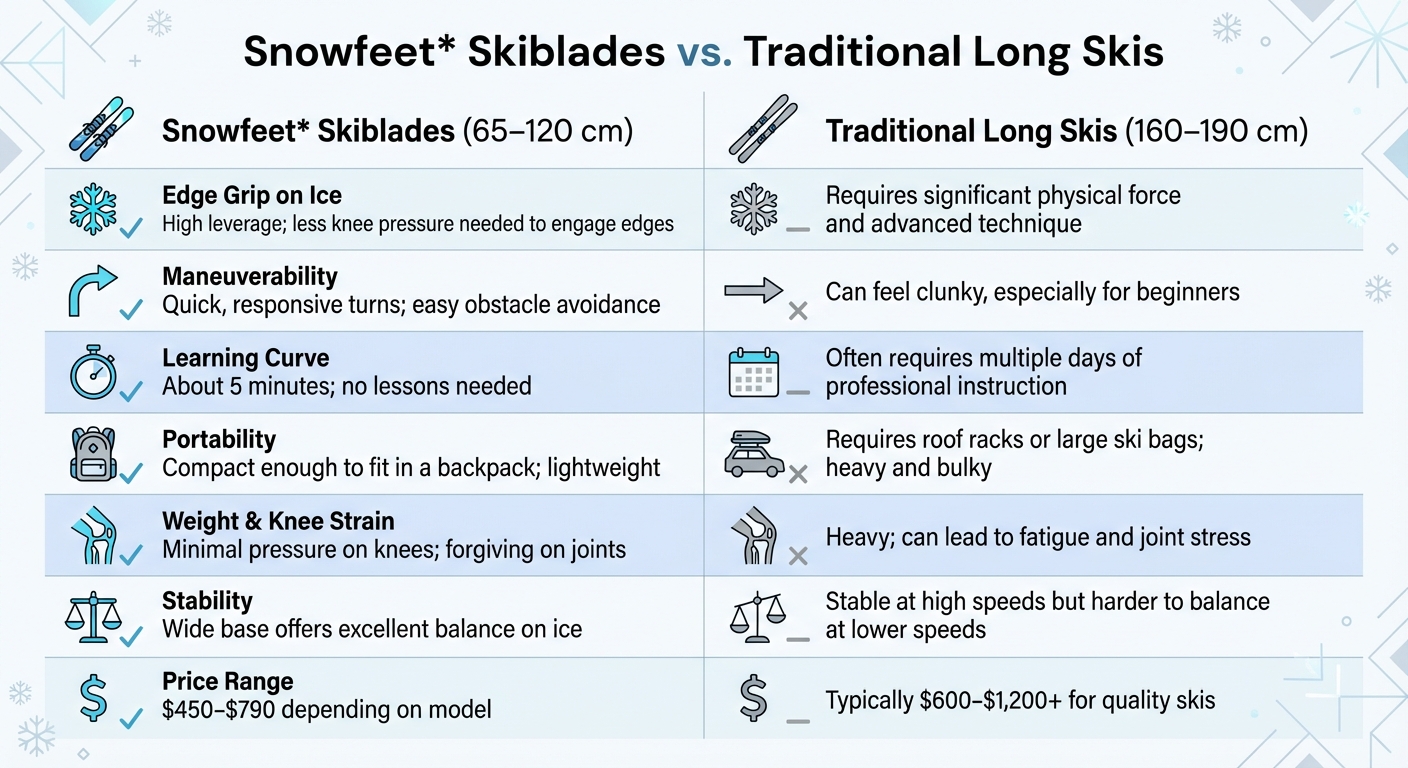
Snowfeet Skiblades vs Traditional Long Skis: Complete Comparison for Ice Performance
Snowfeet* & Skiskates Complete Guide | All you need to know about Skiskating
Why Snowfeet* Skiblades Work Better on Ice
When you're tackling icy terrain, having solid edge control can make or break your experience. Traditional skis, which range from 160 to 190 cm in length, require a lot of effort and precise technique to handle hard, icy surfaces. But Snowfeet* Skiblades, available in shorter lengths like 65 cm, 99 cm, and 120 cm, make this process far easier.
The secret lies in how they distribute leverage and pressure. Their compact size eliminates the need for intense knee action or tricky adjustments to engage the edges. With Snowfeet* Skiblades, you can apply pressure exactly where it’s needed, and their wider base gives you a stable platform that traditional, narrower skis just can’t offer.
These skiblades feature the same high-quality metal edges used in traditional skis, but in a lightweight, portable design. They’re so compact you can stash them in a backpack, making them perfect for reducing fatigue and keeping your focus on technique rather than lugging around bulky gear. No more wrestling with cumbersome setups or committing to long lessons.
"Snowblades are very light and easy to control, so you don't need to put too much pressure on your knees to turn or stop." – Anna, Snowfeet* Team
This combination of ease, control, and portability makes Snowfeet* Skiblades a standout choice for icy conditions. And if you're wondering how to fine-tune their edges for even better performance, stick around - we’ll cover that in the next section.
Snowfeet* Skiblades vs. Traditional Long Skis
| Feature | Snowfeet* Skiblades (65–120 cm) | Traditional Long Skis (160–190 cm) |
|---|---|---|
| Edge Grip on Ice | High leverage; less knee pressure needed to engage edges | Requires significant physical force and advanced technique |
| Maneuverability | Quick, responsive turns; easy obstacle avoidance | Can feel clunky, especially for beginners |
| Learning Curve | About 5 minutes; no lessons needed | Often requires multiple days of professional instruction |
| Portability | Compact enough to fit in a backpack; lightweight | Requires roof racks or large ski bags; heavy and bulky |
| Weight & Knee Strain | Minimal pressure on knees; forgiving on joints | Heavy; can lead to fatigue and joint stress |
| Stability | Wide base offers excellent balance on ice | Stable at high speeds but harder to balance at lower speeds |
| Price Range | $450–$790 depending on model | Typically $600–$1,200+ for quality skis |
How to Maintain Your Skiblade Edges
Sharp edges can make or break your time on the slopes. They’re the difference between carving confidently and sliding out of control on icy patches. Snowfeet* Skiblades come equipped with high-quality metal edges, much like traditional skis. The good news? Their shorter length makes them easier to maintain at home. Taking care of these edges ensures they perform their best, especially when you're tackling icy conditions.
Here’s the deal: base edges and side edges need different care routines. Side edges are the key players for gripping ice and should be checked frequently - daily, if you're riding on hard, icy terrain. Base edges, on the other hand, only need to be set once and then lightly polished from time to time.
Want a pro tip? Use a permanent marker to darken the edges before you start working on them. This trick helps you see where material is being removed and ensures you keep the angles consistent. Once the marker ink is gone, you know you’ve hit the right depth.
Oh, and don’t skip the wipe-down! After each session, dry your edges thoroughly to prevent rust. Even a little rust can mess with your grip on ice. A quick wipe keeps your Snowfeet* Skiblades ready for action.
Base Edge Beveling: Set the Right Angle
Base edge beveling is all about precision. It slightly lifts the steel edge off the snow - usually between 0.5° and 1° - to make turns smoother and more predictable. If you're riding on ice, stick to a bevel between 0.5° and 0.7°. This keeps more of the edge in contact with the surface, giving you better stability and grip.
"Too little base edge bevel causes a ski to hook up before the skier is ready and excessive base edge bevel creates instability as the edges are raised too far off the snow." – BEAST Tuning
To maintain this bevel, use a medium diamond stone (400–600 grit). It polishes the surface and removes burrs without taking off too much steel. Pair it with a base bevel guide, and always file on the pull stroke to keep the angle consistent. Check your progress with the marker trick to ensure even material removal. This attention to detail enhances the performance of your Snowfeet* Skiblades, especially on icy terrain.
Side Edge Sharpening: Maximize Ice Grip
If you’re riding on ice, sharp side edges are non-negotiable. They determine how well your edges bite into hard snow. For Snowfeet* Skiblades, a side edge angle between 2° and 3° works best. Unlike base edges, side edges need daily attention in icy conditions to stay sharp.
Here’s a quick test: run your finger along the edge, then drag a fingernail across it. If your nail catches slightly, the edge is sharp enough. If it feels dull, grab a diamond stone - not a metal file - to sharpen it without removing too much material.
Use a side file guide set to your preferred angle (2°–3°) and make smooth, consistent strokes. After sharpening, run a gummi stone at a 45° angle to clean up any burrs.
| Edge Type | Angle for Ice | Maintenance Frequency | Recommended Tool |
|---|---|---|---|
| Base Edge | 0.5°–0.7° | Set once; polish as needed | Diamond stone (400–600 grit) |
| Side Edge | 2°–3° | Daily (icy conditions) | Diamond stone + side file guide |
One more tip: rotate your left and right skiblades every other day. This helps even out wear and extends the life of your edges. Considering these skiblades range from $635 to $775, a little maintenance goes a long way in protecting your investment.
Now that your edges are sharp and ready, let’s move on to how to use them effectively on ice in the next section.
sbb-itb-17ade95
How to Use Skiblade Edges on Ice
Now that your edges are sharp and ready, it’s time to put them to work on icy terrain. Snowfeet* Skiblades, being shorter and more responsive than traditional skis, need less effort to engage edges on ice. Think of it like skating - your lower legs and ankles do most of the heavy lifting.
Icy slopes demand precision. A small mistake can send you sliding instead of carving. Here’s how to master edge control on ice in four steps.
Step 1: Get Your Stance and Weight Right
Your stance is the foundation of everything. Start by centering your weight over your skiblades. This balance is especially important with shorter skis, particularly during sharp carving. Keep your core and chest stacked above your feet, then shift slightly “down the hill” to press into the outside skiblade.
Here’s a common mistake: leaning too far back. Instead, keep your weight slightly forward, toward your toes, for better control at higher speeds and during stops. Daniel Siouffi from the Snowfeet* team shared his experience:
"My first run the skis shook, but after redistributing my weight toward my toes, I was flying like never before. Going fast I was in complete control of every move, turns, and stops."
To get that edge to grip, roll your outside ankle and feel the pressure under the ball of your foot. At the same time, roll your inside leg away from the outside leg to keep your shins parallel. Shorten the inside leg by lifting your heel and thigh - this increases the edge angle and boosts your grip.
Avoid tipping your outside knee inward. It might seem like it helps, but it actually reduces pressure on the skiblade and increases the risk of injury. Instead, focus on keeping your core aligned over your outside leg, avoiding any “banana bends” at your waist.
Step 2: Use Your Lower Legs to Create Edge Angle
Once your stance is solid, focus on creating the right edge angle. On icy terrain, a steeper edge angle is key for grip. Roll your outside ankle toward the slope to press the edge into the snow, while shortening your inside leg to steepen the angle even more.
Thanks to Snowfeet* Skiblades’ compact design, you don’t need much leverage to initiate a carve. The movement should feel smooth and natural - you’re guiding the skiblade, not forcing it. If your edges feel overly sharp or “grabby,” making turns difficult, your side edges might need a slight adjustment at the tips and tails. A side edge bevel of 2° to 3° typically provides excellent grip on icy surfaces.
Step 3: Add Pressure for Smooth Carving
An edge angle alone won’t do the job - you need to apply pressure too. Shift your core and chest over your feet and slightly downhill to press into the outside skiblade. This helps the ski flex and bite into the ice.
Apply pressure gradually. Too much can make you unstable, while too little can lead to sliding. The goal is to find that sweet spot where your edge bites cleanly, allowing the skiblade to carve a smooth arc.
With their shorter length, Snowfeet* Skiblades respond quickly, making them easy to control when your weight is properly distributed. Many users note how they feel “in complete control of every move” once they get the hang of it. As you finish your turn, smoothly transition to the next edge to maintain stability.
Step 4: Transition Between Edges Fluidly
The mark of a skilled rider is a smooth edge-to-edge transition. To switch edges, move your core and chest over your feet and downhill to press into the new outside skiblade.
As you start the new turn, lift your inside heel and thigh to shorten the leg, while rolling your knee toward the snow. This creates a steeper edge angle and keeps you stable. Front-to-back balance is crucial here - because skiblades are shorter, even small imbalances can cause you to lose grip on icy terrain.
Narrower skiblades, like the 65 cm model, are designed for quick edge-to-edge transitions on groomed, icy runs. Wider models, such as the 99 cm and 120 cm, offer a balance of agility and stability at higher speeds.
Advanced Techniques for 2026
Once you've nailed the basics, it's time to take your skills up a notch. With Snowfeet* Skiblades, you can fine-tune your edge control for icy slopes like never before. Each model is designed with specific scenarios in mind - whether you're carving tight turns, speeding down steep descents, or transitioning between powder and ice. These skiblades offer a level of performance that traditional skis just can't match on icy terrain.
Carving Tight Turns with 65 cm Skiblades
The 65 cm skiblades are perfect for pulling off sharp, precise turns. Thanks to their wood core and metal edges, they provide excellent carving ability, far beyond what shorter snowskates can offer. The compact design makes it easy to navigate tight, controlled turns that aren't possible with traditional skis. As Nathan F. puts it:
"Absolute game-changer! They're light, fast, and incredibly fun to ride."
For the best grip on hard-packed ice, sharpen your side edges to 87°–88°. And here's a pro tip: keep your weight balanced. Leaning even slightly backward during deep carving can cause you to lose edge contact. Andrew B. also shared his thoughts:
"These skiblades are so much fun and easy to control. Never going back to regular skis."
If you're looking for more stability at higher speeds, consider upgrading to longer models.
High-Speed Stability with 99 cm and 120 cm Skiblades
When it comes to tackling steep, icy slopes at high speeds, the 99 cm and 120 cm skiblades shine. These longer models offer extended edge contact, giving you the stability and control you need for aggressive descents. To maintain grip, shift your weight forward and keep pressure on the outside skiblade. With regular ski boot release bindings, they deliver that "classic control" feel, paired with a fast and thrilling ride.
With over 50,000 Snowfeet* riders worldwide and an impressive 4.9/5 rating from more than 5,500 verified reviews, these skiblades have proven themselves as reliable companions for high-speed adventures.
Powder-to-Ice Transitions with Snowfeet* POWDER
Once you've mastered icy slopes, it's time to conquer mixed terrain. The Snowfeet* POWDER model (99 cm) is built for one of the toughest challenges: transitioning from soft powder to hard ice. While standard Snowfeet* handle light powder up to 4 inches, the POWDER model is specifically designed for deeper powder while still maintaining the metal edges needed for icy sections.
During these transitions, balance is key. Distribute your weight evenly across both skiblades to avoid catching an edge. The 99 cm length gives you more surface area and stability compared to shorter models, making it easier to stay in control when the terrain suddenly changes. As one user noted:
"Snowfeet* handle light powder up to 10 cm, but for real powder riding go with Snowfeet* Skiblades 99, 120, or 99 Powder."
Conclusion
Getting the hang of edge control on ice calls for a mix of solid technique and the right gear. Snowfeet* Skiblades are a game-changer when it comes to icy terrain. With their top-notch metal edges, shorter length for quick response, and wider base for better maneuverability, they offer a level of stability and control that traditional long skis just can’t match.
Here’s the bottom line: keep your edges sharp for grip, balance your weight to control your turns, and practice smooth edge transitions. These simple yet crucial tips, paired with proper edge maintenance and stance adjustments, unlock the full potential of Snowfeet* Skiblades. With over 50,000 riders worldwide and an impressive 4.9/5 rating from more than 5,500 verified reviews, these skiblades have earned their reputation as a go-to for icy conditions.
Unlike traditional long skis, which might feel steady in a straight line but can be clunky when quick adjustments are needed, Snowfeet* Skiblades shine on unpredictable ice. The 99 cm and 120 cm models offer extended edge contact for better stability at high speeds, while the 65 cm version brings unmatched agility and precision to the table.
As winter sports gear trends toward lighter, more adaptable equipment in 2026, Snowfeet* Skiblades are set to stay ahead of the curve. They’re easier on the knees, simpler to transport, and quicker to master compared to traditional skis - all while delivering top-tier performance on icy slopes. Combine these skiblades with sharp edges and good technique, and you’re ready to take on any icy challenge.
Pick the model that fits your style: 65 cm for freestyle and tight turns (starting at $550), 99 cm for all-around versatility (from $590), or 120 cm for maximum high-speed stability ($790). With Snowfeet*, icy terrain doesn’t stand a chance!
FAQs
How do Snowfeet Skiblades perform on icy terrain compared to traditional skis?
Snowfeet Skiblades shine on icy slopes, offering excellent edge control and improved stability. Their shorter lengths - available in 65 cm, 99 cm, and 120 cm - focus your weight on a smaller surface area. This design provides a stronger grip on hard-packed or icy snow, making sharp, precise turns feel effortless and helping you recover quickly if you slip. On top of that, their lightweight and compact size means you can easily toss them in a backpack, making them super portable.
On the other hand, traditional long skis spread your weight over a larger area, which can reduce edge grip on icy terrain. They’re also bulkier, heavier, and require more skill to manage edge control, especially in tight turns. Snowfeet Skiblades offer a mix of better traction, easy handling, and day-to-day convenience, making them a solid choice for anyone - from beginners to seasoned riders - looking to take on icy runs with confidence.
What’s the best way to keep my Snowfeet Skiblade edges sharp and ready for icy conditions?
Taking care of your Snowfeet Skiblade edges isn’t just about keeping them looking good - it’s about performance. A little regular maintenance goes a long way in ensuring they grip ice like a pro and carve smoothly.
Start by wiping down the edges after each session. Use a soft, damp cloth to get rid of snow, salt, and debris. These can lead to rust if left unchecked. While you’re at it, give the edges a quick inspection. Look for nicks or dull spots - these can mess with your grip on icy patches. Got a minor imperfection? A fine-grit diamond stone or ski-edge file can smooth things out in no time.
When it’s time to sharpen, aim for a 1°–2° bevel. That’s the sweet spot for Snowfeet models, giving you great bite on ice without sacrificing smooth carving. Use a guided edge-tuning tool for accuracy (trust me, it’s worth it). Once sharpened, clean off any metal filings with a brush, then finish with a thin layer of ski wax. This not only protects against corrosion but also keeps the edges slick and ready to shred.
Storing your Skiblades properly is just as important. Keep them in a dry spot - either on a wall-mounted rack or flat on a padded surface. This prevents moisture damage and ensures the edges stay straight and ready for action.
With these easy steps, your Snowfeet Skiblades will stay sharp and ready to dominate even the iciest slopes.
Which Snowfeet Skiblade model offers the best stability at high speeds?
The 65 cm Snowfeet Skiblade is built for speed and control. With metal edges and a graphite base, it grips the snow like a pro and glides effortlessly, even on icy patches. This design ensures you can handle fast, confident runs without missing a beat.
Unlike traditional skis, these skiblades offer a whole new level of maneuverability without sacrificing stability. Whether you're weaving through tight turns or charging down steep slopes, they’ve got you covered.











Leave a comment
This site is protected by hCaptcha and the hCaptcha Privacy Policy and Terms of Service apply.