




















Riding skiblades without poles might sound tricky, but it’s actually all about balance, posture, and movement. Skiblades are shorter and lighter than regular skis, making them easy to maneuver with a skating-like motion. Here’s the gist:
- Stay Centered: Keep your weight over the middle or slightly back on your feet - not on your toes.
- Perfect Your Stance: Stand upright, knees bent, feet shoulder-width apart. A staggered stance (one foot slightly ahead) adds stability.
- Turn Like a Pro: Shift your weight to the outside leg, use your edges, and let your upper body stay steady.
- Skip the Poles: Use your legs and core for control. Think of it like hockey or ice skating.
Snowfeet skiblades range from 25 to 47 inches. The shorter ones are great for tricks and tight turns, while longer ones offer more stability for beginners or speed lovers. With over 50,000 riders giving them a 4.9/5 rating, they’re a fun, lightweight alternative to traditional skis.
Ready to ride? Let’s break it down step by step. :)
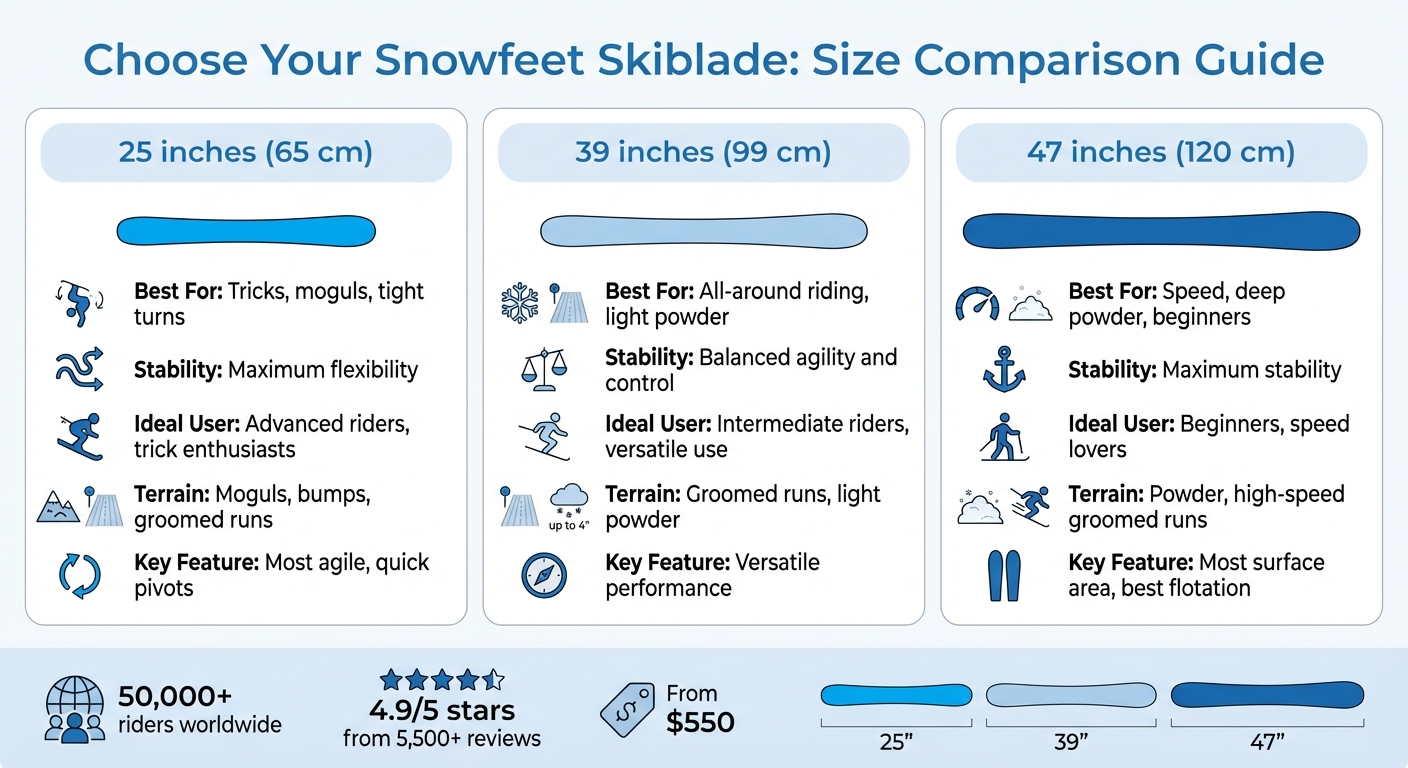
Snowfeet Skiblade Size Comparison Guide: Features and Best Uses
Three No Pole Ski Exercises - MUST TRY!
How Balance Works on Skiblades
Skiblades handle balance differently than traditional skis, thanks to their shorter length, center-mounted bindings, and pole-free design. Understanding these differences can help you tweak your technique and stay steady on the slopes. Let’s break down how these features affect your balance.
How Short Length Affects Stability
Snowfeet* skiblades are compact, making them far more agile than standard skis. Traditional skis, which are around 63–75 inches long, offer more surface area, giving you some leeway to correct mistakes. In contrast, Snowfeet* skiblades range from about 25 to 47 inches, requiring you to stay actively engaged with your posture and weight distribution.
The shorter length means you can turn on a dime and maneuver with ease, but it also demands precision. If you lean too much in any direction, you’ll notice how quickly balance can slip away. According to ski enthusiasts, skiblades are great for honing your balance on groomed runs, even though their smaller surface area means you’ll need to master precise edging.
For instance, the 25-inch model is perfect for tricks and tackling moguls, offering maximum flexibility. On the other hand, the longer 39-inch and 47-inch options give you more stability, making them a better fit for beginners or those chasing speed. Regardless of the length, staying centered over your feet and making constant micro-adjustments is the secret to staying upright.
Center-Mounted Bindings and Control
Snowfeet* skiblades come with center-mounted bindings, which completely change how you balance. Unlike traditional skis with rear-mounted bindings that encourage a forward-leaning stance, skiblades position the bindings right in the middle. This placement aligns your center of mass with the ski’s sweet spot.
The result? A natural, upright posture that makes the skiblades feel like an extension of your feet rather than clunky gear. As the Snowfeet* team explains:
"You have to keep a front-back balance especially during deep carving. It's just that simple."
For beginners, this centered setup is a game-changer - it eliminates the need for the forward-leaning stance typical of traditional skis, making balance easier to grasp. Even seasoned skiers appreciate the extra control this design offers, especially in tight spaces or on varied terrain. It allows for quick weight shifts, nimble turns, and fast reactions to changing snow conditions. To maintain balance, keep your weight centered or slightly back on your feet - don’t lean forward like you might with longer skis. This alignment is key for smooth, pole-free riding.
Why You Don't Need Poles
With skiblades, poles are unnecessary. Instead, you rely on core strength and dynamic movement. The short length of skiblades makes it easy to use a skating motion - similar to hockey or inline skating - to generate speed and control your direction. Push off to the side while rotating your body and using the edges of the skiblades to gain momentum.
Skiers often find that going pole-free helps develop stronger balance skills since you’re depending entirely on your legs and core rather than leaning on poles for support. To stay steady, keep your legs about shoulder-width apart, with your knees slightly bent. Placing one foot slightly ahead of the other can give you a more stable base.
Although the switch to riding without poles might feel awkward at first - kind of like walking a tightrope - the balance and coordination you build will carry over to other winter sports. Plus, the lightweight, natural feel of skiblades makes them a joy to use as you glide across the mountain.
Getting Your Stance and Position Right
When you're riding Snowfeet* skiblades without poles, your stance can make or break your experience. Unlike traditional skiing, where a forward lean is key, Snowfeet* skiblades call for a more upright posture. This stance is what helps you tap into the unique balance these skiblades offer. As the Snowfeet team puts it:
"Don't lean forward like you would do with skis... instead, stand up straight and place your weight over the middle and back of your feet."
Aligning Your Feet, Knees, and Upper Body
Start by positioning your feet shoulder-width apart. Keep your knees slightly bent - relaxed, not locked - and your upper body upright and centered. For added stability, extend your hands forward.
Take on a staggered stance by placing one foot slightly ahead of the other. This setup gives you a longer base for balancing, much like the stance used in ice skating. When carving, make sure your lead leg matches the direction of your turn. For instance, if you're turning right, your right leg should be forward. Shift your weight accordingly: the outside edge of your front leg and the inside edge of your back leg should carry the load.
Once you've nailed your stance, the next step is keeping your balance steady as you ride.
Staying Centered and Upright
Weight distribution is everything here. Focus on keeping your weight centered over the middle and back of your feet - not on your toes. Snowfeet* skiblades are compact, ranging from about 25 to 47 inches, so they don't have the long tips of traditional skis that might catch a forward lean. Think of it like ice skating: balance from front to back is crucial. If you feel your skiblades shaking, it’s a sign to adjust your weight. Too far forward? You’ll feel wobbly. Too far back? Turning becomes a struggle. Aim to stand tall with your weight slightly toward your heels, letting your knees and ankles naturally adapt to the terrain.
Common Balance Mistakes to Avoid
Even with the right alignment and weight distribution, a few common missteps can throw you off balance.
One big mistake is leaning forward. If you feel unsteady, consciously shift your weight back toward your heels. Another common error? Spreading your legs too wide, which limits your ability to make quick movements. Keep your stance shoulder-width apart for better control. Also, don’t stiffen up - your knees and ankles should stay relaxed to absorb bumps and handle changing snow conditions. Lastly, avoid lifting a skiblade during turns or letting your knees collapse toward each other. Both skiblades should stay in constant contact with the snow to maintain control and stability.
Drills and Exercises to Improve Balance
To master stability on Snowfeet* skiblades, you’ll need to build core strength and muscle memory. These drills are designed to help your body react naturally - no poles required. Here’s how to refine your balance and boost your confidence.
Weight-Shifting and Single-Leg Drills
Begin with simple side-to-side weight shifts on flat terrain. Stand on your skiblades with your feet shoulder-width apart and slowly transfer your weight from one leg to the other. Pay attention to how your edges engage as you move. Once you’ve got the hang of it, try the staggered stance drill: place one foot slightly ahead of the other and practice holding this position while gliding. This setup mimics the balance needed in ice skating.
Next, step it up with single-leg balance holds. Gently lift one skiblade off the snow and hold for 5-10 seconds. Keep your upper body steady and extend your arms at chest level for balance. Switch legs and repeat. This practice helps reduce muscle tension, making your movements smoother and less tiring. Abby Stanislaw, a Doctor of Physical Therapy, emphasizes its importance:
"The more controlled you can have your upper body on a dynamic lower body, the smoother all of your sport pursuits will be."
Want a tougher challenge? Try these holds while turning your head side to side or briefly closing your eyes. This sharpens your proprioception - your body’s ability to sense its position - so you can react instantly to bumps or icy patches.
Once you’re comfortable with these basics, move on to drills that mirror the dynamics of real slope conditions.
Dynamic Movement and Rotation Drills
On groomed runs, practice the hockey skating start. Push off with one leg while gliding on the other, just like a hockey player gaining speed. This drill teaches precise weight transfer, a key skill for turning on compact Snowfeet* skiblades. Then, work on mastering the hockey stop by turning both skiblades perpendicular to your direction of travel and evenly distributing your weight. It’s a controlled slide and your go-to stopping technique without poles. Start slow, then increase your speed as you get more confident.
For rotation drills, focus on medium-radius turns. Use your arms as counterweights, keeping them at chest level or higher to maintain your center of gravity. Unlike traditional skiing, where poles help with timing, you’ll rely on your core and upper body for stability. Nicky Blumm captures this approach perfectly:
"I prefer using my arms and core to find balance rather than relying on poles to plant."
Applying These Drills on the Slopes
Once you’ve nailed these drills, take them to the slopes. Start on groomed terrain to build confidence before tackling more challenging conditions. In powder (up to 4 inches deep), single-leg drills will help you stay balanced when one skiblade hits deeper snow than the other. On uneven terrain or small moguls, your rotation drills will shine - keep your upper body steady while your legs absorb the bumps. JC Cole, Human Performance Director for Ski and Snowboard Club Vail, sums it up well:
"It's about how your brain perceives where you are in terrain, relative to the ground."
This progression not only builds confidence but also reinforces the unique, pole-free balance that makes Snowfeet* skiblades such a joy to ride.
sbb-itb-17ade95
How to Turn Without Poles
Using Rotation and Edge Control
Turning on Snowfeet* skiblades is all about mastering edge control and weight distribution - no poles needed. To kick off a turn, shift your weight to the outside leg (the one opposite the direction you want to go). For example, if you're aiming for a right turn, shift your weight onto your left leg to engage the edge and let the rotation happen naturally. To finish the turn, tilt the edges to create enough friction for control. For smoother carving, try a staggered stance: position the leg on the side you're turning toward slightly ahead of the other (so for a right turn, your right leg goes forward). Apply pressure to the outside edge of that lead leg.
The shorter length of Snowfeet* skiblades (ranging from 25 to 47 inches) makes your turns snappy and precise - one of the reasons they stand out compared to traditional skis. Keep your weight evenly distributed to stay stable throughout.
This leads us to another key factor - how your upper body plays a role in keeping you balanced.
Body Movement for Better Balance
Your upper body is your secret weapon when it comes to turning without poles. Always keep your shoulders square to the slope to avoid leaning back, which can throw you off balance on steeper terrain. A little ankle flexion goes a long way: push your shins forward to maintain forward pressure, ensuring the blades stay in solid contact with the snow. One thing to watch out for - if your boots are too stiff, it can make it tough to flex your ankles properly, which might cause you to lean backward and lose control.
Bend your knees and focus on a "soft touch" by gently tilting the blades as you turn. Keeping your legs about shoulder-width apart helps you stay stable, and using your arms as counterweights - held at chest level - can help you maintain your center of gravity.
With these basics covered, let’s talk about tweaking your technique for different types of terrain.
Adjusting to Different Terrain Types
Once you’ve nailed the balance and turning drills, it’s time to adapt your skills to various terrains. On groomed runs, Snowfeet* skiblades are at their best. The packed snow gives you consistent edge grip, making turns easy with simple weight shifts and blade tilting. For basic turns, point the tips together and press on the inside edges. For sharper carving, use that staggered stance and tilt the blades.
In powder snow (up to 4 inches deep), longer skiblades are your friend. Models like the Snowfeet* 39-inch or 47-inch versions give you more surface area, helping you stay afloat on softer snow. In these conditions, focus on staying upright and finding a good front-to-back balance. Since skiblades are shorter than traditional skis, there’s less room for error, so rely on your core strength and those weight-shifting skills you’ve been practicing.
For moguls or bumpy terrain, the compact 25-inch Snowfeet* skiblades are perfect. Their smaller size makes quick, agile pivots between bumps a breeze. Keep your upper body steady while your legs do the work of absorbing the terrain changes. If you hit a steep section, a controlled sideslip can help you manage your speed without poles. Unlike long skis that require wide, sweeping turns, these skiblades let you change direction instantly.
| Terrain | Recommended Length | Key Technique | Weight Distribution |
|---|---|---|---|
| Groomed Runs | 25–39 inches | Edge tilting, staggered stance | Even distribution |
| Light Powder (up to 4") | 39–47 inches | Upright posture, front-to-back balance | Centered, slight forward |
| Moguls/Bumps | 25 inches | Quick pivots, steady upper body | Dynamic shifting |
Riding at Speed and on Difficult Terrain
Groomed Runs vs. Powder Snow
Now that you've fine-tuned your turning skills, it's time to tackle speed and challenging terrain with confidence. With your improved posture and weight distribution, you're ready to explore faster runs and tougher slopes.
On groomed runs, Snowfeet* skiblades are in their element. The firm, packed snow gives you reliable edge grip, and their compact sizes - available in lengths of about 25 inches (65 cm), 39 inches (99 cm), and 47 inches (120 cm) - let you carve with precision. As Daniel Siouffi, an experienced rider, put it:
"My first run, the skis did shake but soon after by distributing my weight on my toes, I was flying like never before. Going fast, I was in complete control."
In light powder (up to around 4 inches or 10 cm deep), shorter models like the 25-inch (65 cm) version perform well. But when the snow gets deeper, the longer models, especially the 47-inch (120 cm) option, provide the extra surface area you need to stay on top of the powder. Keep your weight centered, or shift slightly forward if necessary, to stay agile and adjust quickly in soft snow.
Handling Uneven Snow and Moguls
Uneven terrain and moguls call for quick reactions, and this is where Snowfeet* skiblades have a real edge over traditional long skis. The 25-inch (65 cm) model is perfect for tight turns, making it easier to weave through bumps without the wide, tiring sweeps that longer skis often require. Keep your stance shoulder-width apart and your knees slightly bent to absorb the shock of uneven terrain, while keeping your upper body steady. Centering your weight - or even leaning slightly toward the back of your feet - can help prevent the short tips from catching unexpectedly. Plus, the wider base of Snowfeet* skiblades offers added stability, without the strain on your knees that bulkier skis can cause.
Once you've mastered these balance techniques, you'll be better equipped to control your speed on any terrain.
Controlling Speed Without Poles
Managing speed without poles is all about technique. The hockey stop is a go-to move: push your skiblades sideways to create friction and bring yourself to a smooth, controlled stop. Make sure to distribute your weight evenly across both feet to stay balanced while slowing down. Many Snowfeet* models also come with a built-in heel brake, which adds an extra layer of safety when riding at high speeds.
For those high-speed runs, regular maintenance is a must. Wax your skiblades often to keep the base slick and prevent snow from sticking, which can cause sudden jerks or throw off your balance. Stick to well-groomed slopes for the best experience at higher speeds. On steeper or more uneven terrain, the longer models - 39 inches (99 cm) or 47 inches (120 cm) - offer better stability and control.
| Speed & Terrain | Recommended Model | Key Balance Tip | Stopping Technique |
|---|---|---|---|
| Moderate (groomed) | 65 cm (≈25 inches) | Centered stance, weight on toes | Hockey stop, heel brake |
| High (groomed) | 99 cm (≈39 inches) | Slightly forward weight | Edge control, hockey stop |
| Variable (powder/moguls) | 120 cm (≈47 inches) | Centered to rear weight | Carving, controlled sideslip |
Conclusion and Key Takeaways
Snowfeet* skiblades are specifically designed for a pole-free experience. As we've covered in this guide, your balance comes from a solid stance, centered weight, and smooth, dynamic movements - not from relying on poles. Their compact design keeps you closer to the ground, making quick adjustments much easier compared to traditional long skis.
These techniques not only improve control but also highlight why Snowfeet* skiblades are shaking up the winter sports scene. Whether you're cruising groomed trails, gliding through light powder, or navigating moguls, the basics remain the same: upright posture, balanced weight, and mastering edge control. With moves like the hockey stop and heel brake, you’ve got reliable ways to manage speed - no poles required.
The learning curve is impressively short. Most riders feel at ease in just about five minutes, thanks to the simplicity of having less gear compared to skis over 60 inches (150 cm). And let’s talk convenience: Snowfeet* are so portable you can toss them in a backpack, stroll around in snowboard boots between runs, and spend more time enjoying the slopes without the hassle of heavy equipment. Starting at $550 for the 65 cm model, they’re an option that’s lighter on both your back and your wallet compared to traditional setups. Plus, with over 50,000 riders worldwide and a glowing 4.9/5 star rating from more than 5,500 verified reviews, it’s clear that shorter skis bring big fun and freedom to the slopes.
Ready to give skiblading a shot? With the tips from this guide, you’ll be carving turns and gliding like a pro - no poles needed. Snowfeet* offers a skating-like sensation that’s sure to change the way you think about skiing.
FAQs
How are skiblades different from traditional skis when it comes to balance and control?
Skiblades, particularly Snowfeet models, bring a fresh twist to balance and control compared to traditional skis. With their shorter length (24–47 inches) and lightweight build, they naturally lower your center of gravity. This makes them easier to handle and much more forgiving, especially if you're just starting out. Their design lets you shift your weight quickly and carve out tight, playful turns, giving you an experience that feels more like skating than skiing.
Unlike traditional skis, which depend on their length and sidecut for stability at high speeds, Snowfeet skiblades shine when it comes to versatility and responsiveness. You don’t even need poles! If you're looking for a compact, fun alternative to bulky skis, these are a great choice. They deliver precise control for tricks and make navigating different terrains a breeze.
What skiblade size is best for beginners and advanced riders?
The best skiblade size really comes down to your skill level and how you like to ride. If you're just starting out, shorter skiblades - around 65 cm - are a solid pick. They’re lightweight, easier to handle, and give you better stability, which is perfect for learning the ropes.
On the flip side, if you’re a more experienced rider, you might lean toward longer skiblades, like 99 cm or even 120 cm. These give you more speed, smoother turns, and the flexibility to tackle different terrain with ease.
Snowfeet skiblades are all about fun and agility, offering a fresh alternative to traditional skis or snowboards. Whether you’re a beginner or a seasoned pro, there’s a Snowfeet skiblade size that’s just right for you!
How can I maintain balance on skiblades without using poles?
To stay steady on Snowfeet skiblades without poles, focus on your stance, engage your core, and try a few simple drills. Start by standing with your feet shoulder-width apart, keeping your knees slightly bent, and centering your weight over the middle of each blade. Thanks to Snowfeet’s compact and lightweight design, maintaining balance is a bit easier and doesn’t require overextending.
Keep your core engaged by tightening your abs and aligning your hips with the direction you’re heading. Practice shifting your weight from heel to toe and side to side to get used to how the skiblades respond. Want to step it up? Try one-foot hops or slow figure-8 glides to work on ankle strength and overall balance. Snowfeet’s agility makes these moves fun to learn, even without poles.
With consistent practice and some off-snow exercises - like single-leg squats or using a balance board - you’ll quickly develop the skills to handle Snowfeet skiblades confidently on any terrain, no poles needed!












Leave a comment
This site is protected by hCaptcha and the hCaptcha Privacy Policy and Terms of Service apply.