



















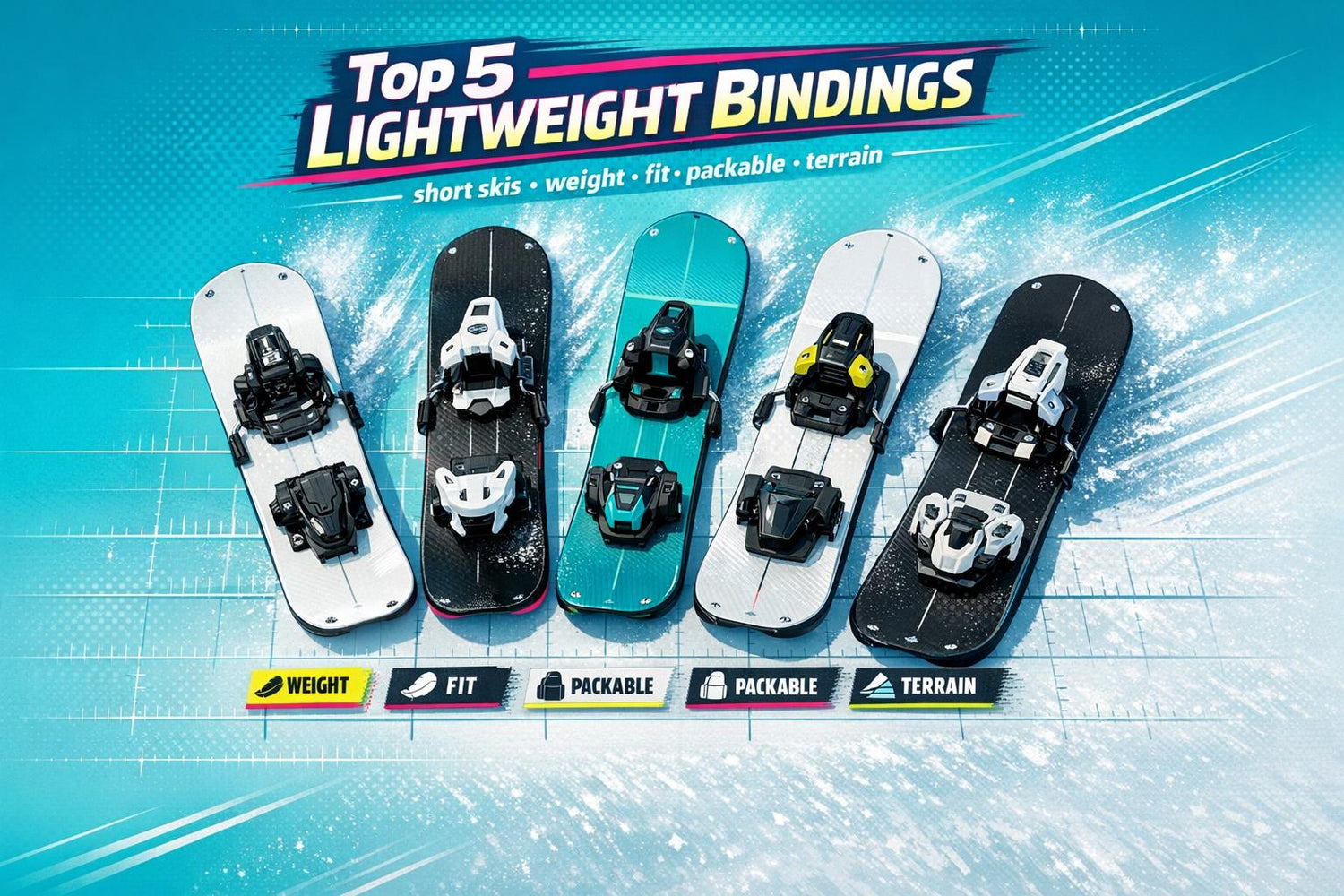
Looking for lightweight bindings that won’t ruin the fun of short skis? You’re in the right place. Short skis like skiblades and skiskates thrive on agility, and the right binding makes all the difference. Here’s the rundown:
- Snowfeet* Starstrap: Lightweight, easy to use, and works with regular winter shoes and snowboard boots. Perfect for short skis (38–50 cm).
- Snowfeet* Adjustable Plate: Designed for ski boots, this tool-free binding is compact and simple to adjust.
- Snowfeet* Powder Setup: Ideal for powder and backcountry, offering flexibility with snowboard boots or ski boots.
- Dynafit Superlite 150: Great for full-length ski touring but not ideal for short skis.
- ATK Crest 10: Lightweight touring binding, but it’s built for tech boots, not short ski setups.
Quick Tip: Snowfeet* bindings stand out for their portability, ease of use, and compatibility with everyday footwear. If you’re into short skis, they’re the way to go. For long tours, Dynafit and ATK are better suited.
Here’s what you need to know about each binding system and why Snowfeet* leads the pack.
Bindings for Short Skis | All You Need to Know
1. Snowfeet* Starstrap Binding System
The Snowfeet* Starstrap is the go-to binding system for short skis. Designed with mobility and ease of use in mind, it delivers a smooth and fun experience on the slopes.
Weight and Compactness
Forget about lugging around heavy equipment. The Starstrap's fiberglass-reinforced base keeps it lightweight while staying tough. Specifically made for short skis between 38 cm and 50 cm (around 15 to 20 inches), it’s compact enough to fit in a regular backpack. As Snowfeet* puts it: "Far more portable – and affordable – than traditional skis or snowboards." This design also makes it easy to pair with various types of boots.
Boot Compatibility
One of the standout features is its flexibility with footwear. You can use waterproof winter shoes or snowboard boots - no need for stiff ski boots. Snowboard boots provide a snug and secure fit across a wide size range. Check out the compatibility details below:
| Footwear Type | Compatible | Size Range (US) |
|---|---|---|
| Snowboard Boots | ✅ Yes | 6 – 14.5 |
| Winter Shoes | ✅ Yes | 6 – 13 |
| Ski Boots | ❌ No | - |
This versatility means you can hit the slopes with gear you likely already own, saving you both hassle and money.
Mobility and Range of Motion
Since you’re not tied down by rigid ski boots, your ankles stay free to move naturally. This flexibility lets you glide with skating-style strides, perform spins, and even ride backward with ease. And because the skis are so short, you don’t have to worry about the tips crossing - making movement even smoother. As Snowfeet* explains, "You are able to move freely as opposed to wearing traditional skis."
Ease of Use and Adjustability
The Starstrap uses a simple clicking strap mechanism to secure your boots quickly and comfortably. One user, Barefoot Nerd, highlighted how easy it is to adjust:
"The clicking motion to tighten both straps is reminiscent of ski boot bindings and extremely forgiving to loosen/tighten for the smallest of adjustments."
If you need to fine-tune the fit for different shoe sizes, all it takes is a screwdriver. With over 50,000 riders worldwide and 90% of 2,297 reviews giving it 5 stars, the Starstrap has earned its reputation as a reliable and user-friendly binding system for short skis.
2. Snowfeet* Adjustable Plate Binding for Skiblades and Skiskates
This binding is crafted specifically for hard-shell ski boots, offering a smooth and aggressive carving experience on skiblades and skiskates. Snowfeet* continues to push boundaries with a design that prioritizes precise boot compatibility and easy adjustments.
Weight and Compactness
Say goodbye to the bulk of traditional alpine bindings. By ditching the heavy release housing, this non-release plate binding becomes incredibly lightweight and portable - small enough to slip into a standard backpack. With fewer moving parts and reduced weight, it’s a practical upgrade over traditional systems.
Boot Compatibility
The binding is designed to fit ski boots ranging from US sizes 4.5 to 14.5, and it adjusts without tools for quick and easy sizing. Here's how it stacks up against a traditional alpine binding:
| Feature | Snowfeet* Plate Binding | Traditional Alpine Binding |
|---|---|---|
| Portability | Fits in a backpack | Needs a large bag or roof rack |
| Boot Compatibility | Works with all standard ski boot sizes | Ski boots only |
| Adjustment | Tool-free, universal fit | Requires tools and DIN setting |
| Release Mechanism | Non-release | Safety release (DIN) |
| Weight | Lightweight | Heavy metal/plastic housing |
This level of adaptability and simplicity makes for a snug fit and boosts your agility on the slopes.
Mobility and Range of Motion
With skis measuring just 44–50 cm (around 17–20 inches), your legs have much more freedom compared to traditional full-length skis. Snowfeet* founder Zbyněk sums it up perfectly:
"In my opinion, Skiskates is the best product for slopes we developed so far. I love how easy they are to ski and skate and how many different kinds of tricks I can perform without much effort and almost no restrictions."
The shorter ski length allows for quick stance changes and smooth transitions between skating strides and carving turns.
Ease of Use and Adjustability
One of the standout features is the tool-free, non-release system. Forget about fiddling with DIN settings or carrying wrenches - just slide the binding into place and lock it. Snowfeet* claims most users get the hang of it in about 5 minutes. However, always attach the safety leashes since the non-release design requires them for fall safety.
3. Snowfeet* Powder Binding Setup for Short Skiboards
If you’re looking for a setup that shines in soft snow and backcountry terrain, the Snowfeet* Powder Binding Setup is worth checking out. Designed to pair with the 99 cm Powder Skiboards, this setup offers a mix of portability and versatility that’s hard to find in traditional backcountry gear. It’s another addition to Snowfeet*’s lightweight lineup, built for all kinds of snow conditions.
Weight and Compactness
These skiboards are made with fiberglass-reinforced construction, keeping them light but durable. The wood-core version weighs around 3.4 lbs, while the fiberglass-core version comes in at about 4.4 lbs. Their compact design means you can easily stash them in a standard backpack - perfect for adventurers on the go.
Boot Compatibility
One of the standout features of this setup is its compatibility with various boots. You can use snowboard boots, standard ski boots, or even sturdy winter hiking boots. The snowboard binding version fits US sizes 6–14.5, while the ski boot version accommodates US sizes 4.5–14.5. Here’s how Snowfeet* describes their binding system:
"At Snowfeet we developed a unique snowboard binding specifically designed for skiboards. They are affordable, easily adjustable to snowboard boots of any size, with an anti-slippery surface for perfect shoe grip."
That anti-slip surface isn’t just a nice touch - it’s super practical, especially when you’re tackling soft snow.
Mobility and Range of Motion
The binding setup includes a four-mode switching system to adapt to different terrains and activities: Walk Mode (free heel), Ski Mode (locked heel), and two Climb Modes (low and high risers for uphill travel). Combined with the 99 cm skiboards, this setup gives you excellent mobility in deep powder, outperforming bulkier backcountry skis when it comes to maneuverability.
Ease of Use and Adjustability
Adjusting the size is simple, with most changes handled tool-free using an intuitive clicking strap mechanism. For finer tweaks, all you need is a basic screwdriver. Pricing starts at USD $690 for the Snowfeet* POWDER Skiblades, while the WALKSKI Backcountry Touring version is available for USD $750.
sbb-itb-17ade95
4. Dynafit Superlite 150 Tech Bindings

The Dynafit Superlite 150 is crafted with full-length ski touring in mind. It’s a standout in the lightweight touring binding category, specifically designed for long uphill treks. However, its features don’t align well with the needs of short skis like skiblades or skiskates.
Weight and Compactness
The Superlite 150 is impressively light, making it a favorite for uphill touring enthusiasts. But here’s the catch: its compact design is tailored for full-length skis, not the shorter, more playful setups of skiblades or skiskates.
Boot Compatibility and Mobility
This binding is built for tech boots with metal pin inserts, which means it’s a no-go for regular winter footwear often paired with short skis. It’s also designed for long-stride skinning, which prioritizes efficiency over the quick, sharp movements that short ski setups excel at. In contrast, Snowfeet* bindings are purpose-built for the nimble, fast-paced action that short ski lovers crave.
Ease of Use and Adjustability
Adjusting the Superlite 150 requires tools and a bit of know-how, making it less user-friendly than the tool-free systems commonly used with short skis. For those who want simplicity and agility, Snowfeet* bindings remain the top choice, leaving traditional touring bindings like the Superlite 150 better suited for their intended purpose: full-length ski touring adventures.
5. ATK Crest 10 Lightweight Touring Bindings
The ATK Crest 10 is a premium touring binding, but its design makes it less ideal for shorter skis. With a price tag ranging from $450 to $550, it’s geared toward serious alpine touring. However, that focus comes with trade-offs for those using shorter ski setups.
Weight and Compactness
Weighing in at 280 grams per binding, the ATK Crest 10 is lightweight compared to other touring bindings. But when it comes to short skis, it falls short of the portability you’d expect. For example, Snowfeet* bindings can fit neatly into a backpack alongside a 44 cm ski setup. The Crest 10, on the other hand, wasn’t designed with that level of compactness in mind, which also affects how well it works with different boots.
Boot Compatibility
Here’s the catch: these bindings are only compatible with Tech boots that have metal pin inserts. That means no regular winter boots, snowboard boots, or casual footwear. If you’re into skiblades or skiskates, this limitation could be a dealbreaker.
Mobility and Range of Motion
The Crest 10 does offer some solid mobility features, like three walking modes and an Elastic Response System, which helps during long uphill climbs. But for short skis, where quick and responsive movement is key, it doesn’t quite deliver the agility you’d need.
Ease of Use and Adjustability
While the binding features a DIN release range of 5–10 and a Cam Release System for adjustments, getting it properly set up requires tools and technical know-how. That’s a stark contrast to Snowfeet* systems, which allow for quick, tool-free adjustments. For short ski fans who value simplicity, this added complexity can be a hassle.
Comparison Table
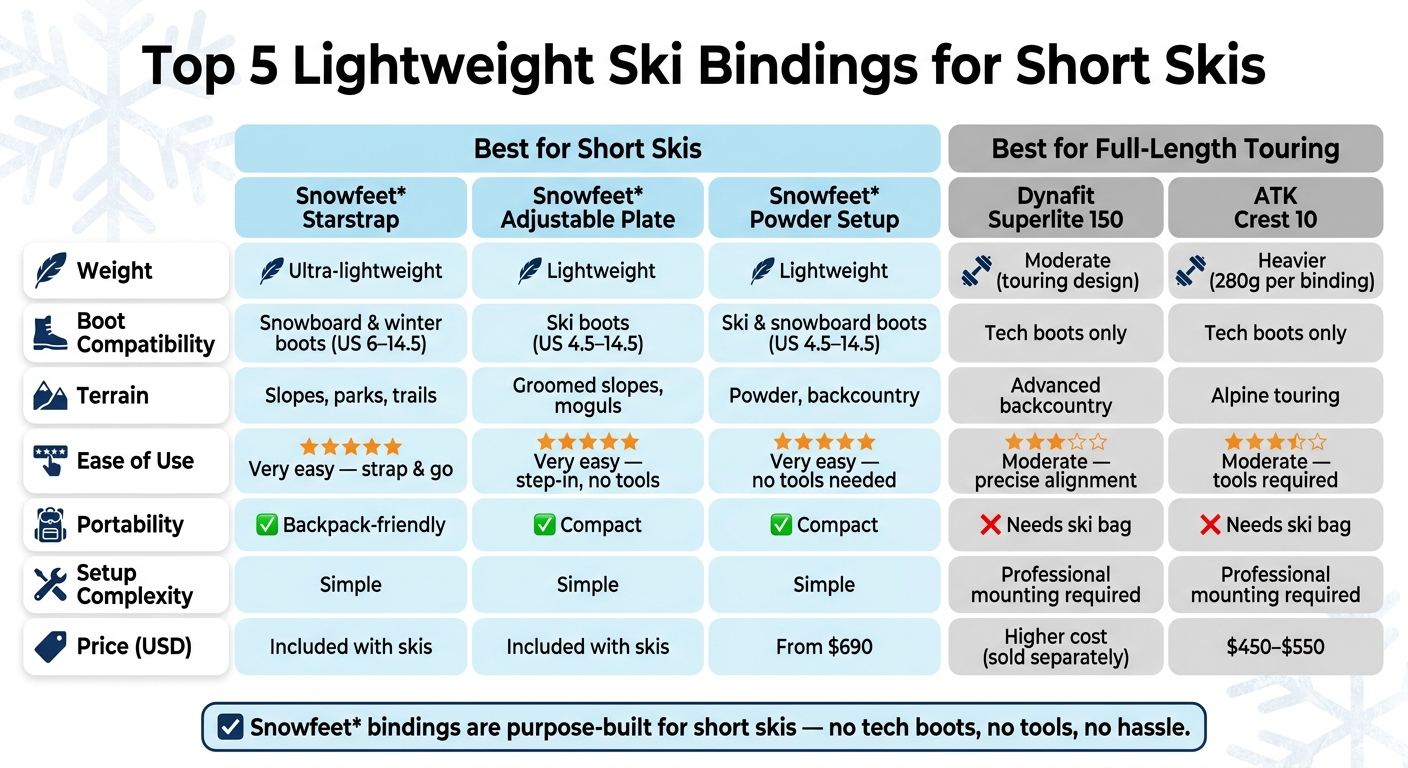
Top 5 Lightweight Ski Bindings for Short Skis: Side-by-Side Comparison
The table below breaks down why Snowfeet* systems stand out compared to traditional touring bindings when it comes to short skis.
| Feature | Snowfeet* Starstrap | Snowfeet* Adjustable Plate | Snowfeet* Powder Setup | Dynafit Superlite 150 | ATK Crest 10 |
|---|---|---|---|---|---|
| Weight | Ultra-lightweight | Lightweight | Lightweight | Moderate weight (touring design) | Heavier (built for durability) |
| Boot Compatibility | Snowboard & winter boots | Ski boots (US 4.5–14.5) | Ski & snowboard boots | Tech boots only | Tech boots only |
| Terrain | Slopes, parks, trails | Groomed slopes, moguls | Powder, backcountry | Advanced backcountry | Alpine touring |
| Ease of Use | Very easy - strap & go | Very easy - step-in, no tools | Very easy - no tools needed | Moderate - requires precise alignment | Moderate - tools required |
| Portability | Backpack-friendly | Compact | Compact | Needs a ski bag | Needs a ski bag |
| Setup Complexity | Simple | Simple | Simple | Needs professional mounting | Needs professional mounting |
| Price (USD) | Included with skis | Included with skis | Included with skis | Higher cost (sold separately) | Higher cost (sold separately) |
This table highlights how Snowfeet* systems are tailor-made for short skis, offering unmatched convenience and versatility. Unlike traditional touring bindings, which are designed for a niche audience, Snowfeet* bindings are compatible with regular ski, snowboard, or winter boots, saving you from the hassle and expense of specialized footwear. Plus, their lightweight and compact design means they’re easy to carry - no bulky ski bags required.
For short ski enthusiasts - whether you’re carving groomed runs, hitting the snow park, or weaving through forest trails - Snowfeet* systems strike the perfect balance of portability, simplicity, and performance. While Dynafit and ATK bindings excel in elite backcountry touring, they cater to a completely different type of skier. Snowfeet* bindings, on the other hand, deliver the control, flexibility, and ease short ski riders need, redefining what’s possible in the U.S. short ski market.
Conclusion
The right binding can make or break your short ski experience. Lightweight bindings are key to keeping short skis, like Snowfeet* Skiblades, nimble and fun. They allow for quick pivots, smooth carving, and an overall playful ride.
Snowfeet* offers binding systems designed specifically for short skis - no modifications from long-ski designs here. The Starstrap is perfect for fast strap-ins with standard winter boots. The Adjustable Plate is ideal if you’re sharing skis or switching between different boot types. And for powder enthusiasts, the Powder Setup provides the extra float needed off-piste. Each option complements the short ski philosophy of agility and adaptability.
For those venturing into serious backcountry touring with full-length skis, models like the Dynafit Superlite 150 and ATK Crest 10 are excellent choices. However, these require tech boots and professional mounting, making them less suited for the quick-turn, lightweight action of short skis.
"These ski blades are a blast to use. Super easy to control, quick to turn, and way more forgiving than traditional skis... they're lightweight and much easier to carry around than full-size skis." - Brad Tolin, Verified User
When choosing bindings, consider where you’ll be skiing, your boots, and the performance you’re after. Snowfeet* combines portability with performance, redefining what’s possible with short skis. Curious to see their full range? Visit snowfeetstore.com for all their models and binding setups, tailored for every skill level.
FAQs
Do Snowfeet* bindings need professional mounting?
Nope, Snowfeet* bindings don’t need professional mounting. Unlike regular ski gear, these bindings are super easy to set up. They come with an adjustable system that lets you attach your boots - whether they’re snowboard boots or ski boots - securely and without any tools. It’s a straightforward, no-fuss design that works for everyone, no matter your skill level.
Are non-release bindings safe for short skis?
Non-release bindings work well and are safe for short skis under 100 cm. Unlike the bulkier release bindings found on traditional skis like Rossignol or Atomic, these bindings are lightweight and offer better control for shorter skis. Snowfeet* models even include safety leashes, which keep the skis secure during falls without adding the extra weight of traditional binding systems.
Which Snowfeet* binding works best with my boots?
The best Snowfeet* binding for you depends on your boots and how you like to ride. If you’re after comfort and flexibility, snowboard bindings are a solid choice - they work well with sturdy winter boots on certain models. For those who prioritize stability and control, ski boot bindings are the way to go.
Snowfeet* offers three binding options to suit different needs:
- Basic: A budget-friendly option that gets the job done without breaking the bank.
- Standard: Built to last, with an extra strap to accommodate larger boots.
- Pro X: The premium choice, offering top-notch durability and easy adjustability for a snug, precise fit.
Pick the one that matches your setup and riding style!











Leave a comment
This site is protected by hCaptcha and the hCaptcha Privacy Policy and Terms of Service apply.