



















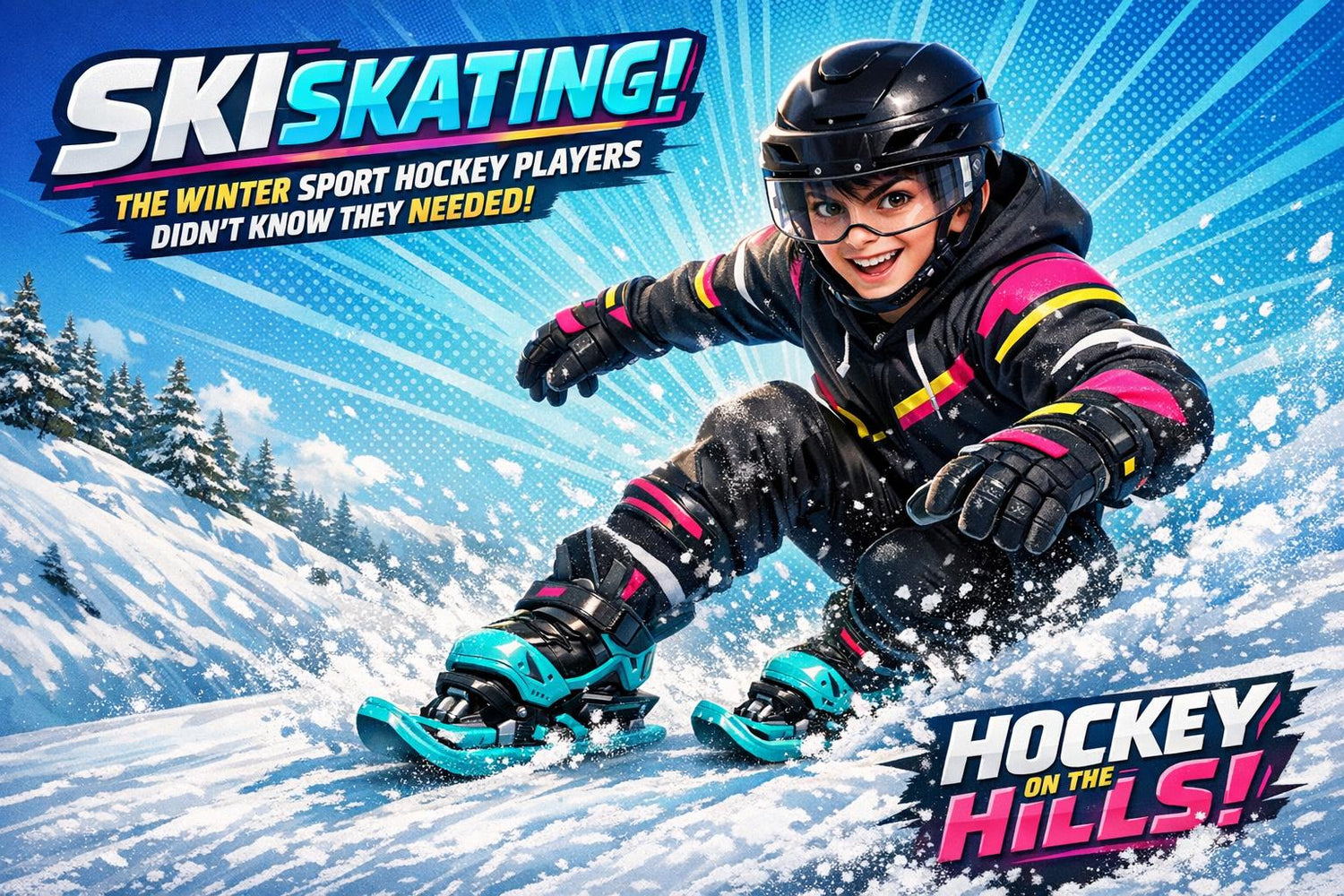
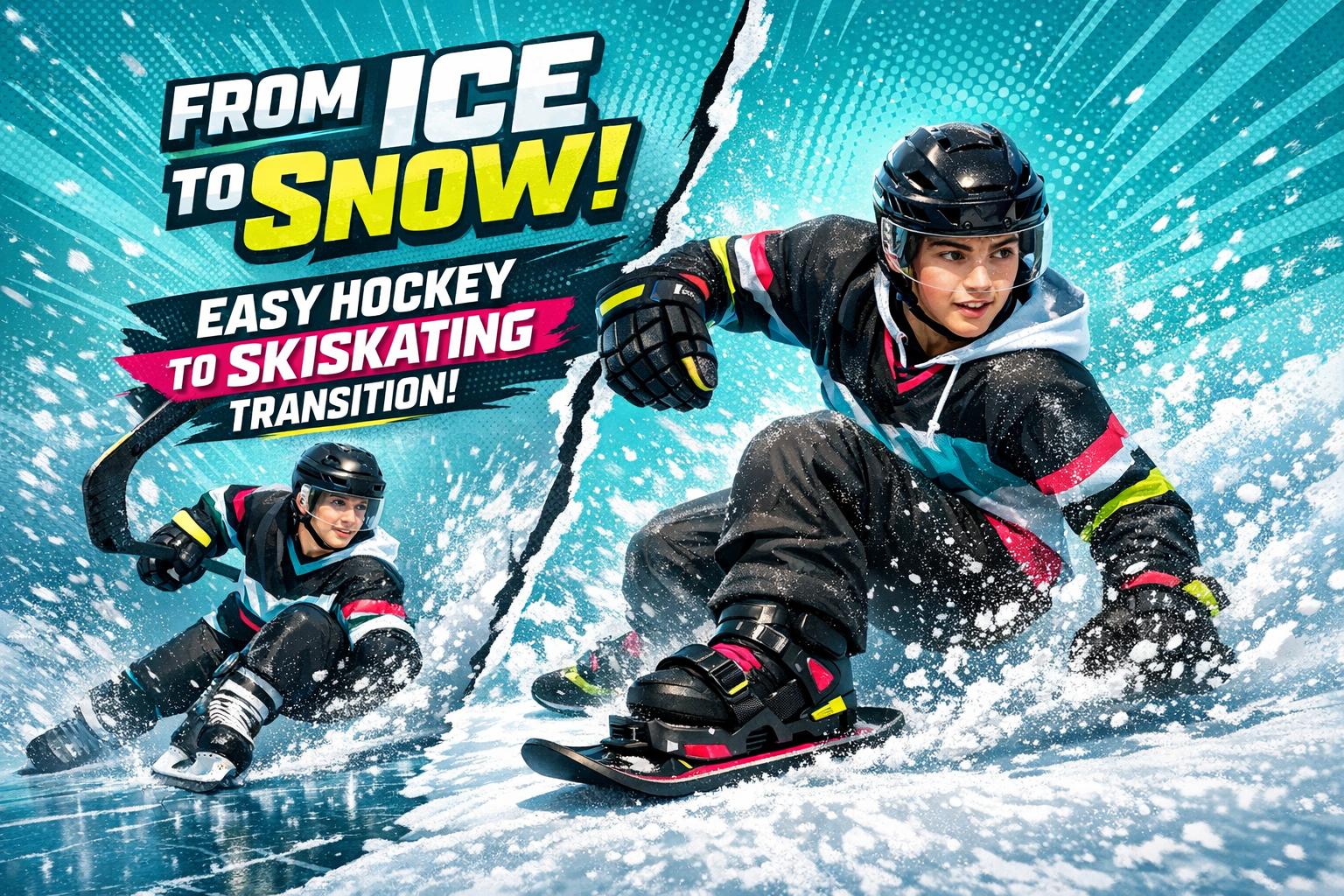
Skiskating is like skating on snow, and if you’re a hockey player, it’s a no-brainer. Using compact gear like Snowfeet Skiskates (just 17 inches long), you can take your ice skills to the slopes with ease. These skates are lightweight, fit in a backpack, and mimic the lateral pushes, sharp stops, and quick turns you already know. Plus, they’re easy to learn - most hockey players are zipping down hills within minutes.
Here’s why it’s worth trying:
- Fast Learning Curve: If you can skate, you can skiskate.
- Portable Gear: Small, lightweight, and no bulky equipment needed.
- Boosts Hockey Skills: Improves balance, agility, and edge control.
- Affordable: Starting at $490, it’s a compact alternative to skis or snowboards.
Whether you’re hitting groomed slopes, backyard hills, or snow parks, skiskating is a fun, practical way to stay active in winter while sharpening your hockey game.
Hockey Player Tries Snowfeet* Skiskates | See What He Thinks | Skiboards | Short Ski | Mini Ski
What Is Skiskating?
Skiskating is a winter sport that combines the movements of ice skating with skiing, allowing you to glide laterally across the snow, much like you would on ice. If you're already familiar with skating, the motion will feel intuitive, offering a new twist on enjoying snowy landscapes.
The sport uses compact skis called skiskates. For example, Snowfeet* Skiskates measure just 44 cm (about 17 inches) long - making them some of the shortest skis available. In contrast, traditional skis typically range from 150 to over 180 cm. This dramatic size difference completely changes how you move on the snow. Let’s dive into how it all works.
How Skiskating Works
The motion is straightforward: push, glide, repeat. Instead of leaning forward like in traditional skiing, your legs follow a skating pattern. Keep your weight centered to avoid catching the tips of your skiskates. To stop, you can perform a hockey stop by pushing the edges sideways and evenly distributing your weight between both feet.
"The best way to start your ride is to skate like a hockey player. Find a flat snowy terrain to get used to the motion." - Snowfeet Team
Most people pick up the basics in less than an hour. The short length of skiskates reduces the risk of crossing tips, and the natural skating motion makes the transition from ice to snow seamless.
Key Features of Snowfeet* Skiskates
Snowfeet* Skiskates are built with a wood core and metal edges, ensuring durability and performance. These handmade skiskates are crafted in Europe using certified sustainable wood and feature tool-free bindings that work with both ski and snowboard boots (sizes 4.5 to 14.5 US or 36 to 49 EU). Plus, their compact size means they fit easily in a standard backpack.
Portability is one of their biggest perks. Forget about lugging around bulky ski bags or dealing with roof racks. Whether you're driving, taking public transit, or storing them in a locker, these skiskates are easy to bring along. They're versatile enough for various terrains, from groomed slopes to small backyard hills.
Snowfeet* Skiskates have received glowing reviews, earning a 5.0 out of 5 rating from 111 reviewers. Users love the quick learning curve and their ability to handle moguls, bumpy terrain, and light powder. They’ve also gained recognition as a finalist at ISPO and received awards from A'design and IDA design competitions.
Why Hockey Players Are Natural Skiskaters
If you’re a hockey player, chances are you’ll feel right at home on skiskates. The skating technique you’ve mastered on the ice translates seamlessly to the snow. The same powerful stride you use to gain speed on the rink works just as well on a snowy slope, and even the hockey stop is just as effective. That familiar athletic stance - feet shoulder-width apart, knees slightly bent, and weight balanced - is key in both sports. It’s almost like skiskating was made for hockey players.
Years of hockey have also honed your edge control. On the ice, you manipulate your blades to turn, pivot, and stop with precision. Snowfeet* Skiskates (measuring 44 cm) come equipped with metal edges, much like traditional skis or snowboards, so you can put those skills to work immediately. Unlike traditional skiing, where you might lean forward and rely on a snowplow stop, skiskating feels more natural for hockey players, letting you stick to movements you already know.
How Hockey Skills Apply to Skiskating
The quick turns, sharp cuts, and fast footwork you’ve perfected in hockey give you a serious edge when it comes to skiskating. Research even confirms that hockey agility directly carries over to skiskating. On skiskates, balance is key - you’ll keep your weight centered over your feet, unlike the forward-leaning stance of downhill skiing. For high-speed turns, you’ll naturally position one foot slightly ahead while leaning your upper body forward, a move that feels second nature if you’ve spent time on the ice.
"You just need to keep your balance, which is natural for those who play ice hockey, ice skate, or use inline skates." - Snowfeet Team
Thanks to this skill set, hockey players tend to pick up skiskating incredibly fast. Many skaters report zipping down hills within minutes and even tackling blue runs on their very first day. The compact design of Snowfeet* Skiskates makes them easy to control, enhancing maneuverability and making the transition from ice to snow feel smooth and exciting. Not only does skiskating sharpen your on-snow agility, but it might even boost your hockey game in the process.
How Skiskating Improves Hockey Performance
Skiskating is a fantastic way to level up your hockey game through targeted cross-training. The compact 44 cm Snowfeet* Skiskates demand precise front-to-back balance since there’s no long ski surface to catch you if you lean too far forward or backward. This constant balancing act works out those stabilizer muscles in your legs and ankles - muscles that are tricky to train in the gym but are crucial for mastering edge control on the ice.
What’s even better? The movements you make on skiskates are almost identical to those on the rink. You’ll use the same lateral push-offs, hold an athletic stance with bent knees and legs shoulder-width apart, and rely on edge-based stops. Practicing these motions builds muscle memory that directly enhances your performance on the ice. Plus, skiskating activates your glutes - a powerhouse muscle group for skating speed. All this balance and muscle engagement translates into sharper agility and better control.
Better Balance and Agility
Snowfeet* Skiskates push you to control your weight distribution with precision, which improves your body awareness and sharpens your edge work. This heightened proprioception makes weight shifts quicker and more efficient during a game.
Thanks to their metal edges, you can even pull off hockey stops on snow, just like you would on the ice. Mastering these stops requires evenly distributing your weight across both feet, which strengthens your lower-body control and stability for when you’re back on the rink.
Faster Turns and Movement
Snowfeet* Skiskates are all about agility. Unlike traditional skis, their compact design lets you make sharp directional changes, quick cuts, and even pull off 360-degree spins with ease.
"Skiskates is the best product for slopes we developed so far. I love how easy they are to ski and skate and how many different kinds of tricks I can perform without much effort and almost no restrictions."
- Zbyněk, Snowfeet* founder
For high-speed turns, you’ll naturally position one foot slightly ahead while keeping your weight centered. This stance helps build the lateral power you need for explosive breakaway speed on the rink. Every quick turn and reaction on skiskates fine-tunes your agility, giving you faster, more controlled movements when it matters most on the ice.
sbb-itb-17ade95
Snowfeet* Skiskates (44 cm) vs. Long Skis and Snowboards
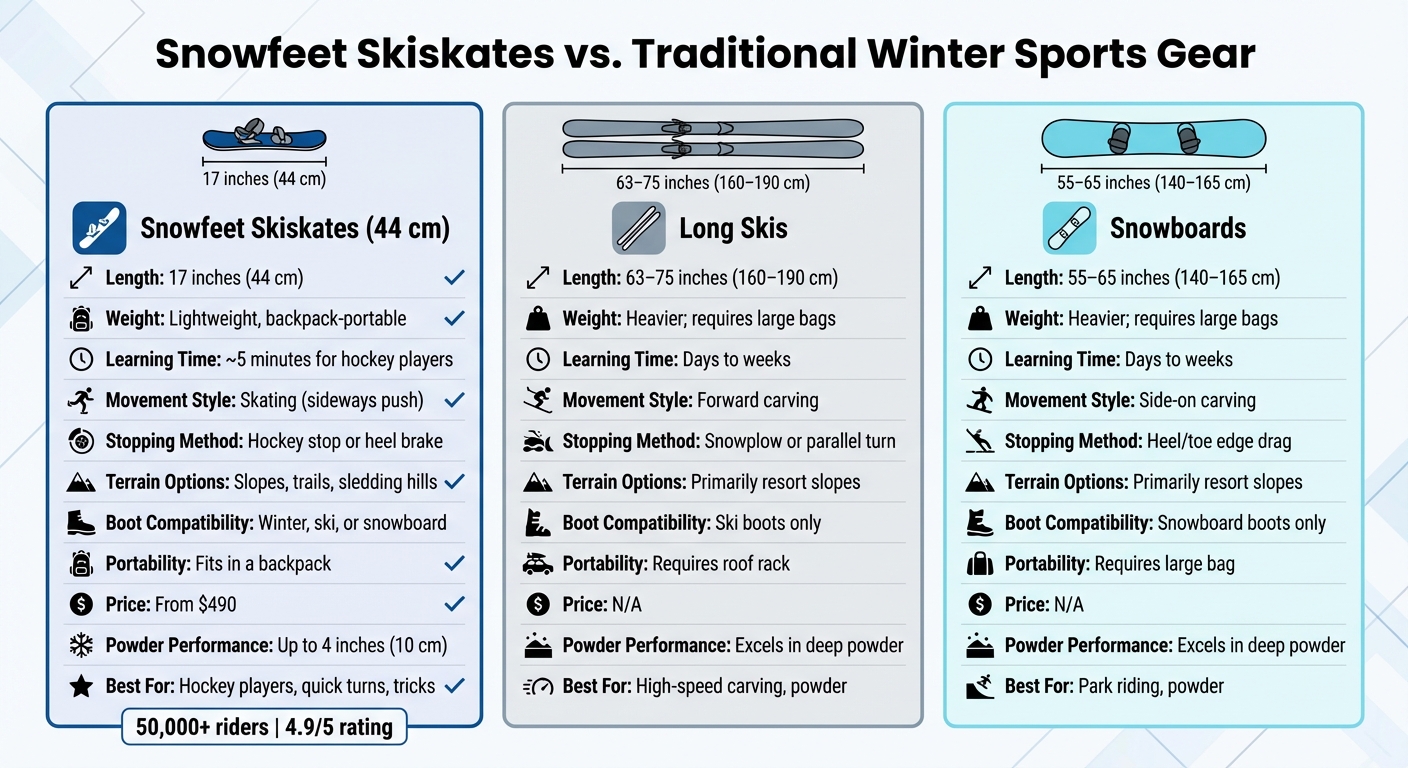
Snowfeet Skiskates vs Traditional Skis and Snowboards Comparison
If you're a hockey player, you know how much the right gear matters. Traditional long skis and snowboards are built for carving and gliding downhill, which is a far cry from the quick, sideways movements of skating. Enter Snowfeet* Skiskates - just 17 inches (44 cm) long. These compact skates ditch the bulk of traditional gear, letting you skate, jump, and twist much like you would on the ice.
Weighing in at just 17 inches and starting at $490, Snowfeet* Skiskates are a game-changer when it comes to portability and price compared to long skis. Unlike skis that often require roof racks, these fit right into a backpack, making them incredibly easy to carry around.
And here's the kicker - hockey players can pick them up in minutes. While traditional skis and snowboards often demand days (or even weeks) of lessons, many users report getting the hang of Snowfeet* in about five minutes. The familiar skating motion makes the learning curve almost nonexistent. You push off sideways and use a hockey stop to brake, making the transition from ice to snow surprisingly smooth. Below, we've broken down how these skiskates stack up against traditional gear.
Feature Comparison Table
| Feature | Snowfeet* Skiskates (44 cm) | Long Skis | Snowboards |
|---|---|---|---|
| Length | 17 inches (44 cm) | 63–75 inches (160–190 cm) | 55–65 inches (140–165 cm) |
| Weight | Lightweight, backpack-portable | Heavier; requires large bags | Heavier; requires large bags |
| Learning Time | ~5 minutes for hockey players | Days to weeks | Days to weeks |
| Movement Style | Skating (sideways push) | Forward carving | Side-on carving |
| Stopping Method | Hockey stop or heel brake | Snowplow or parallel turn | Heel/toe edge drag |
| Terrain Options | Slopes, trails, sledding hills | Primarily resort slopes | Primarily resort slopes |
| Boot Compatibility | Works with winter, ski, or snowboard boots | Ski boots only | Snowboard boots only |
| Portability | Fits in a backpack | Requires roof rack | Requires large bag |
| Price | From $490 | N/A | N/A |
| Powder Performance | Up to 4 inches (10 cm) | Excels in deep powder | Excels in deep powder |
| Best For | Hockey players, quick turns, tricks | High-speed carving, powder | Park riding, powder |
While Snowfeet* Skiskates aren't designed for deep powder - they're best for groomed slopes and can handle up to around 4 inches (10 cm) of fresh snow - they shine in terms of agility and portability. If you're gearing up for waist-deep powder days, traditional skis or snowboards might still be the better choice. But for quick turns, tricks, and that skating-like experience, Snowfeet* Skiskates are in a class of their own.
How to Start Skiskating with Snowfeet*
If you're a hockey player, you're already ahead of the game when it comes to skiskating. Your hockey stride provides a solid base to build on, and using Snowfeet* Skiskates can improve not just your skiskating but also your hockey skills. The shift from ice to snow with Snowfeet* Skiskates (44 cm) feels surprisingly natural, and many hockey players quickly adapt. The trick is recognizing a few key differences and letting muscle memory guide you.
Basic Skiskating Techniques
Begin in your hockey stance: knees bent at about 20–30°, weight centered, and core engaged. This stance helps you maintain balance and prevents tripping or catching the tips of your skiskates.
To move, push your legs sideways - just like your hockey stride - to gain speed. For stopping, you can rely on your hockey stop or use the heel brake. When turning, tilt the skiskates onto their metal edges and lean in the direction you want to go. Use your hips to apply edge pressure, similar to performing crossovers in hockey. Once you've got these basics down, you can start fine-tuning your technique.
How to Learn Faster
Want to speed up your progress? Practice C-cuts to perfect tight-radius turns. Keep your first sessions short - 20 to 30 minutes on gentle, groomed slopes. This helps you build muscle memory without overexerting yourself. Research shows that off-ice agility training can directly improve on-ice performance. For example, a study with U16 hockey players found that off-ice training improved their weave agility by 0.9 seconds over eight weeks.
Before hitting the slopes, adjust your bindings at home while wearing your intended boots. This saves time and ensures a snug fit. Waterproof shoes with strong ankle support are a must - snowboard boots are a great option for stability on ski slopes. Start practicing on flat or gently sloped terrain, repeating movements to reinforce muscle memory. With your hockey experience, your skating motion, edge control, and stopping techniques will carry over almost immediately to snow.
Why Shorter Skis Beat Long Skis
There’s a common misconception that longer skis are always better. But for recreational riders - especially hockey players who thrive on sharp turns and quick reactions - shorter skis like Snowfeet* (just 44 cm long) offer unbeatable control and agility.
The Truth About Ski Length and Stability
Sure, long skis are great for speed on groomed trails, but when it comes to quick turns or tackling mixed terrain, shorter skis shine. Snowfeet* Skiskates, with their 44 cm length and wider base, provide excellent stability while allowing you to maintain a natural, upright posture. Unlike longer skis that force a forward lean, these are designed to keep you comfortable and balanced.
Anna from the Snowfeet* team sums it up perfectly:
"Snowblades are very light and easy to control, so you don't need to put too much pressure on your knees to turn or stop. They are also very forgiving when it comes to making mistakes."
For hockey players, this forgiving design is a game-changer. It means you can lean into sharp turns and directional changes without worrying about straining your knees. This makes every movement feel more responsive and, let’s be honest, a lot more fun. Plus, the added stability lets you confidently explore different terrains with ease.
Portability and Multi-Terrain Use
Traditional skis are bulky and a hassle to transport. Snowfeet* Skiskates, on the other hand, fit right into your backpack . That means you can take them just about anywhere - hiking trails, sledding hills, snow parks, or even your backyard. They’re also compatible with waterproof winter shoes or snowboard boots, so you’re not stuck lugging around extra gear.
With over 50,000 riders rating Snowfeet* 4.9/5, it’s clear these skates are changing the way people enjoy winter sports. For hockey players who value agility, convenience, and versatility, shorter skis like Snowfeet* are the obvious choice.
Conclusion
If you're a hockey player looking to shake up your winter routine or just want a fresh way to enjoy the snow, skiskating with Snowfeet* Skiskates is definitely worth a shot. The movement feels intuitive, and if you already know how to skate, you’re looking at about a 5-minute learning curve. It’s a seamless way to bring your hockey skills to the snow.
But it’s not just about ease of use - skiskating packs a punch when it comes to performance. It boosts balance, agility, and core strength, all of which directly improve your on-ice game. Plus, the compact 44 cm design keeps you stable and responsive, working the same muscle groups you rely on during hockey. With over 50,000 riders and a stellar 4.9/5 rating from more than 5,500 verified reviews, Snowfeet* has clearly made an impression.
Unlike traditional skis, which can be bulky and require special boots and roof racks, Snowfeet* Skiskates are lightweight, portable, and work with your regular waterproof winter or snowboard boots. Toss them in your backpack and you’re good to go - whether you’re hitting groomed slopes, sledding hills, hiking trails, or even your backyard.
"I used to play ice hockey so Skiskates are perfect for me. It's exactly like ice skating on snow." - Giovanni
Whether you’re training off the ice or just looking for a new way to enjoy the winter, Snowfeet* Skiskates bring together portability, performance, and pure fun. They’re a game-changer for hockey players and a great way to rediscover the joy of winter.
FAQs
How can skiskates help hockey players improve their skills?
Skiskates offer hockey players a fun and effective way to sharpen key skills like balance, speed, and maneuverability. With their design encouraging a shoulder-width stance, slightly bent knees, and careful weight distribution, they closely replicate the movements and agility required on the ice. This makes them an awesome training option during the off-season.
What sets skiskates apart from traditional skis or snowboards is their lightweight, compact build. They allow for sharper turns and faster reactions, giving hockey players a chance to boost their performance while enjoying the winter season. Plus, they pack all this into a super fun experience!
Why are Snowfeet Skiskates easier to carry than traditional skis?
Snowfeet Skiskates are all about making winter sports easier to enjoy. At just 17 inches (44 cm) long, they’re much smaller and lighter than traditional skis. This compact size means you can toss them into a backpack or carry them around without breaking a sweat. Forget the trouble of lugging around bulky ski gear - Snowfeet Skiskates give you the freedom to travel light while still offering a thrilling ride on the slopes.
Is skiskating easy to learn for beginners who don't play hockey?
Sure thing! Skiskating is perfect for beginners, even if you’ve never played hockey before. It’s a lot like learning to ski or ice skate - easy to pick up and enjoyable for just about anyone. With a little practice, you’ll be cruising over the snow before you know it!











Leave a comment
This site is protected by hCaptcha and the hCaptcha Privacy Policy and Terms of Service apply.