




















If you're a hockey player, you already have the skills to dominate on snow with Snowfeet Skiskates. These compact, 17-inch "skates for snow" let you use the same moves you’ve perfected on the ice - like hockey stops, backward gliding, and quick turns - without the hassle of long skis or bulky boots. Just strap them onto your winter or snowboard boots, and you’re ready to go. Most skaters pick it up in just five minutes.
Why they’re a game-changer:
- Portable: Toss them in a backpack - no roof racks or oversized bags needed.
- Fast Learning Curve: Hockey players’ balance and edge control translate perfectly.
- Affordable: Starting at $190, they’re much cheaper than full ski setups.
- Agile: Perfect for sharp turns, tight trails, and even tricks like spins and crossovers.
Whether you’re hitting local hills or groomed trails, Snowfeet Skiskates make winter sports simple, fun, and accessible. Ready to skate on snow? Let’s dive into how they work!
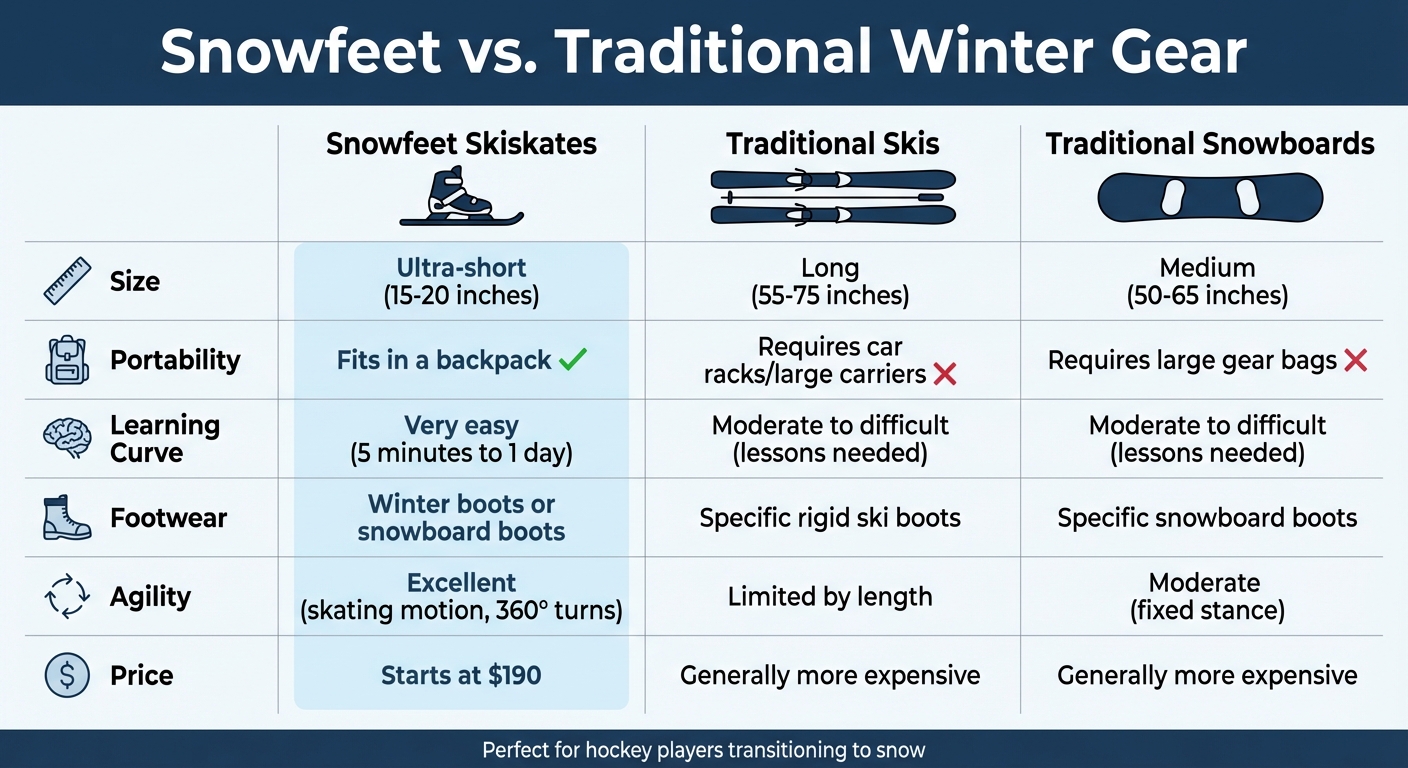
Snowfeet Skiskates vs Traditional Skis and Snowboards Comparison
5 Pro Skating Secrets That Will Make You A Better Hockey Player
Why Hockey Players Learn Skiskating Quickly
If you’re a hockey player, you’ve already got a head start when it comes to mastering Snowfeet* Skiskates. Your ice muscle memory transfers almost seamlessly to snow. Skills like edge control, quick cuts, and crossovers fit naturally with Snowfeet*, which are often described as "skates for snow". Unlike traditional skis, these are designed to feel more like skating, making the transition smoother for anyone already comfortable on the ice.
Edge Control and Balance
Your ability to balance on ice gives you a solid foundation for using Snowfeet* on snow.
Hockey players are pros at edge control. Every quick turn, cutback, or sharp move on the ice depends on mastering the inside and outside edges of your skates. Snowfeet* Skiskates work similarly, with metal edges like those on professional downhill skis. This design allows you to carve turns and stop with a hockey stop - shifting your weight and angling your edges to create friction.
"You stop just like on skis or skates - with a hockey stop or heel brake." - Snowfeet Store
Balance is another area where hockey skills shine. Unlike traditional skiing, which often requires leaning forward, Snowfeet* work best when your weight is centered or slightly back. Their compact size - most models are under 20 inches long - requires the same front-to-back balance you’ve already perfected on the rink. A shoulder-width stance and bent knees will feel second nature, making it easy to adapt to Snowfeet* and enjoy the ride.
Quick Turns and Agility
Hockey players are known for their speed and quick direction changes, and Snowfeet* Skiskates are built for exactly that. At just 17 inches (44 cm) long, these skiskates are far shorter than traditional skis, giving you unmatched maneuverability on tight trails and moguls.
"These felt so familiar to skating but on snow! I instantly picked it up when I first hit the slopes without any difficulty. If you are a casual ice skater or hockey player, these will easily accommodate you." - Jonjon, Verified Customer
This shorter length means you can execute sharp, tight turns that would be nearly impossible on longer skis. Your hockey skills translate directly, making quick adjustments and weaving through narrow spaces feel effortless. Plus, this agility opens the door for advanced techniques like crossovers on snow.
Crossover Techniques for Tricks and Spins
Crossovers, a key part of hockey skating, are just as effective on Snowfeet*. If you’ve already nailed this move on ice, you’ll find it’s a breeze to use the same technique for spins and tricks on snow.
"This trick [spins] is so effortless compared to spinning with long clunky skis." - Snowfeet Team
Crossovers also set you up for advanced tricks like the Grapevine and the Spiral. To avoid catching the tails, shift your weight to your toes and keep your heels slightly lifted. Start practicing on flat, groomed terrain to get a feel for how Snowfeet* respond, then use the momentum from a crossover to transition into spins. Before you know it, your hockey skills will have you pulling off impressive snow tricks, making Snowfeet* a fun and natural extension of your skating experience.
How to Start Using Snowfeet* Skiskates
Getting started with Snowfeet* Skiskates is quick and easy, letting you channel your hockey skills on snow in no time.
Attaching Snowfeet* Skiskates
Snowfeet* Skiskates come with a tool-free binding system that fits boots ranging from US sizes 4.5 to 14.5. Depending on your preference, you can attach them to ski boots, snowboard boots, or sturdy winter boots. If you’re looking for durability and a snug fit, the Pro X bindings are your best bet.
"To avoid hassle on the slopes, take your time and adjust the bindings at the comfort of your home, using appropriate adjustment tools at home." – Snowfeet Team
Set up your bindings at home for a smoother experience on the slopes. For smaller feet, adjust the toe and ankle straps to different holes. If you’re using larger snowboard boots, the extra-long straps included with your Skiskates will come in handy. Snowboard boots, in particular, offer great ankle support, making them a solid choice for hockey players transitioning from ice to snow.
Once your bindings are set, you’re ready to start practicing on flat terrain.
Building Confidence on Flat Snow
Start on flat, groomed snow to get a feel for how the Skiskates respond. You can rely on the same hockey strides and pushes you use on ice. The Skiskates’ compact 44 cm length (about 17 inches) makes balancing feel natural, similar to wearing ice skates.
Keep your stance steady by bending your knees and keeping your feet shoulder-width apart, with one foot slightly ahead for extra stability. To stop, try the hockey stop technique by pushing the edges sideways and distributing your weight evenly across both feet. You can also use the built-in heel brake to slow down while you’re getting the hang of things.
Once you’re comfortable on flat snow, you’ll be ready to take on slopes and even try some tricks.
Moving to Slopes and Tricks
When you’ve mastered flat terrain, it’s time to tackle gentle slopes. The metal edges on Snowfeet* Skiskates function like those on professional downhill skis, letting you carve turns and stop quickly. To carve, tilt the skates onto their edges and shift your body - if you’re a hockey player, this will feel second nature.
The short length of the Skiskates also makes them perfect for tricks. Use crossovers to build momentum, then transition into spins by shifting your weight to your toes while keeping your heels slightly lifted. Start on groomed runs before exploring snow parks or moguls. Your hockey instincts will kick in, making jumps, twists, and even backward riding feel natural after just a few runs.
sbb-itb-17ade95
Snowfeet* Skiskates vs. Traditional Skis and Snowboards
Comparison Table: Snowfeet* vs. Traditional Skis and Snowboards
If you're a hockey player looking to dive into snow sports, the differences between Snowfeet* Skiskates and traditional gear are pretty striking. Here's a quick breakdown:
| Feature | Snowfeet* Skiskates | Traditional Skis | Traditional Snowboards |
|---|---|---|---|
| Size | Ultra-short (15–20 inches) | Long (typically 55–75 inches) | Medium (typically 50–65 inches) |
| Portability | Fits in a backpack | Requires car racks or large carriers | Requires large gear bags |
| Learning Curve | Very easy (5 minutes to 1 day) | Moderate to difficult (lessons needed) | Moderate to difficult (lessons needed) |
| Footwear | Winter boots or snowboard boots | Specific, rigid ski boots | Specific snowboard boots |
| Agility | Excellent (skating motion, 360° turns) | Limited by length | Moderate (fixed stance) |
| Price | Starts at $190 | Generally more expensive | Generally more expensive |
Why Snowfeet* Works Better
The table makes one thing clear: Snowfeet* Skiskates have some serious advantages over traditional skis and snowboards. They’re smaller, easier to carry, quicker to learn, and way more affordable. For hockey players, they’re a game-changer.
Traditional skis might offer stability with their length, but they come with plenty of drawbacks - like their bulk and the steep learning curve. Snowfeet*, on the other hand, flips the script. With their compact 15–20 inch design, they ditch the awkward weight and deliver the kind of freedom and agility hockey players are used to on the ice.
"Far more portable and affordable than traditional skis or snowboards." – Uncrate
Unlike traditional skis, which require stiff, specialized boots and can be tricky to maneuver, Snowfeet* lets you use your own winter or snowboard boots. Plus, their shorter length means you don’t have to worry about crossing your tips - a common rookie mistake with long skis.
Another cool feature? You can skate on flat terrain to pick up speed, something you just can’t do with skis or snowboards. It’s a small detail, but it makes a big difference when you’re out there.
And let’s talk about cost. Traditional ski setups can easily run into the thousands when you factor in skis, boots, bindings, and poles. Snowfeet* Skiskates? They start at just $190 for the 38 cm model, with the premium 44 cm wood core version priced at $490. You’re getting professional-grade metal edges - the same used on downhill skis - without the hefty price tag or the hassle of lugging around bulky equipment.
"These skiblades are so much fun and easy to control. Never going back to regular skis." – Andrew B., Verified User
For hockey players, Snowfeet* feels like a natural extension of your skills. You can jump straight into the action without spending hours - or days - learning how to handle equipment that feels foreign. It’s a seamless transition from ice to snow, making it the perfect choice for anyone who already loves skating.
Tips for Hockey Players Using Snowfeet*
Choosing the Right Snowfeet* Model
If you're a hockey player looking to transition from ice to snow, the 44 cm Skiskates are a great starting point. These are designed to mimic the feel of ice skates, making it easier to tap into your muscle memory. Built with a wood core - the same high-quality construction found in top-tier skis - they deliver a responsive and smooth performance. At $490, they offer solid value for their premium build.
For those wanting to dip their toes in without spending as much, the 38 cm Snowfeet are a solid choice. Starting at $190, they’re compatible with your regular winter boots and provide an affordable way to get started.
Once you’ve mastered the basics and are ready for more speed and steeper slopes, consider upgrading to the 65 cm Skiblades ($550) or the 99 cm model ($590). These longer options handle up to 4 inches of powder with ease while still keeping that skating-inspired agility you love.
After picking the right model, it’s all about keeping your gear in top shape.
Maintenance and Performance
To keep your Snowfeet performing at their best, regular maintenance is key. Applying liquid wax to the base will prevent sticking and improve glide speed on the snow.
The metal edges, made from the same high-grade material used in downhill skis, also need attention. Sharpen them with a stone or take them to a ski shop for tuning, focusing on the base edges to maintain control during turns. After each session, dry the edges thoroughly to avoid rust, and for long-term storage, apply a thin layer of oil to protect the metal.
With proper care, your Snowfeet will stay ready for action across all kinds of snow-covered terrain.
Portability and Accessibility
One of the standout features of Snowfeet for hockey players is how portable they are. Models under 50 cm can easily fit into a standard backpack, eliminating the need for roof racks or bulky ski bags. You can simply toss them in your bag and head out to a nearby sledding hill, hiking trail, or even your backyard for a quick session.
Their compact size also opens up access to narrow trails and forest paths where traditional skis just won’t work.
"Easily one of the best purchases I have ever made to date." – Vanessa, UK
Conclusion
Hockey players can make an easy jump from the rink to the slopes with Snowfeet* Skiskates. The skills you’ve honed on the ice - like edge control, balance, and those quick, sharp turns - translate directly to snow. Forget the usual struggle of learning traditional skis or snowboards; most skaters feel at home on Snowfeet* in just minutes. This smooth transition means you’ll be carving through snow with confidence and enjoying the ride almost immediately.
One of the coolest perks? Snowfeet* are super portable. Suddenly, your neighborhood park or a local hill can transform into your personal snow playground. They pair up with your regular winter or snowboard boots, so you’re ready to tackle forest trails, snow parks, or groomed runs all in one go. The skating motion feels natural, and braking with a hockey stop? It’s as easy as it is on ice.
FAQs
How do Snowfeet Skiskates compare to traditional skis in terms of ease of learning and portability?
Snowfeet Skiskates are all about convenience and portability. At under 20 inches long, they’re way easier to carry around than traditional skis, which usually require bulky bags and take up tons of space. Thanks to their lightweight, skate-like design, you can just toss them in your backpack - no more lugging oversized gear around.
Learning to use Snowfeet Skiskates is also a breeze, especially for beginners. Since they mimic the movements of ice skating, hockey players and skaters will feel right at home. Even if you’re completely new to snow sports, their shorter length and familiar techniques - like balancing and stopping - make picking them up much faster than traditional skis. In short, Snowfeet Skiskates offer a fun and easy way to hit the slopes without the usual hassle.
Can I use regular winter boots with Snowfeet Skiskates, or do I need specific footwear?
Snowfeet Skiskates are designed to work with specific ski boots or similar footwear. Regular winter boots just don’t cut it - they aren’t built to fit the bindings properly and won’t give you the support you need for a safe ride.
To get the most out of your Skiskates, make sure your boots fit securely with the Snowfeet bindings. That way, you can fully enjoy their lightweight, portable design without any hiccups.
How do I maintain my Snowfeet Skiskates to keep them in great shape?
To keep your Snowfeet Skiskates in great shape, there are a few easy maintenance tips to follow. First, apply liquid wax to the base regularly - this keeps them gliding smoothly on the snow. Next, check the edges and sharpen them whenever needed to maintain precise control on your rides. After each session, wipe off any dirt or moisture to prevent rust, and store your skiskates in a cool, dry spot. These quick steps will help ensure your skiskates are ready for plenty of snowy adventures ahead!













Leave a comment
This site is protected by hCaptcha and the hCaptcha Privacy Policy and Terms of Service apply.