





















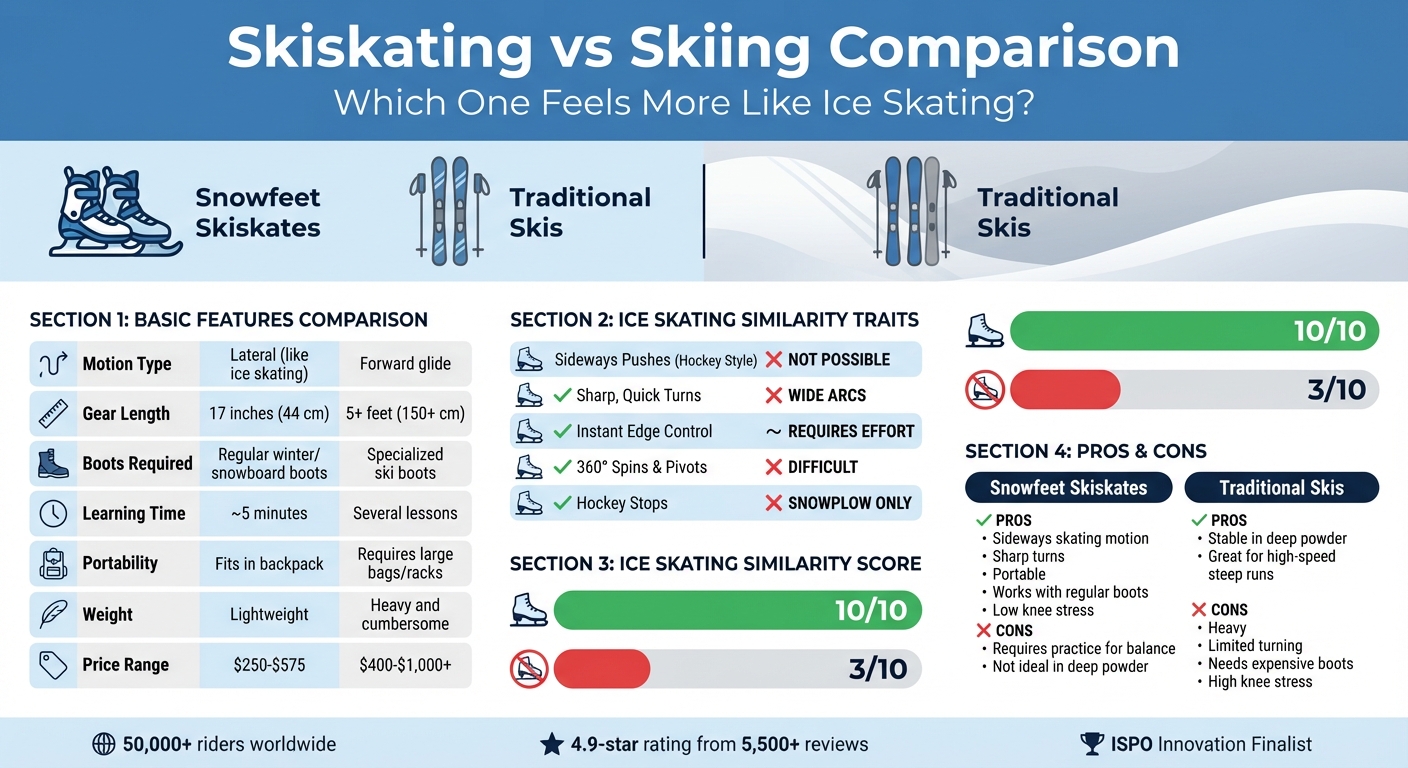
If you’re an ice skater dreaming of gliding on snow, skiskating with Snowfeet* Skiskates might be your answer. Unlike skiing, which focuses on forward motion and long, heavy gear, skiskating mimics ice skating’s quick lateral pushes, sharp turns, and smooth stops. Snowfeet* Skiskates are compact (17 inches), lightweight, and work with your regular winter or snowboard boots - no bulky gear required. They’re easy to learn and perfect for those who love the agility of ice skating but want to hit snowy slopes.
Key Takeaways:
- Skiskating feels like ice skating, with side-to-side movements and hockey-style stops.
- Skiing emphasizes forward motion, wide turns, and uses long, heavy skis.
- Snowfeet* Skiskates are portable, easy to use, and ideal for groomed slopes or packed snow.
Quick Comparison:
| Feature | Snowfeet* Skiskates | Skiing |
|---|---|---|
| Motion | Lateral (like ice skating) | Forward glide |
| Gear Length | 17 inches | 5+ feet |
| Boots Needed | Regular winter/snowboard | Ski boots |
| Learning Curve | ~5 minutes | Several lessons |
| Portability | Fits in a backpack | Requires large bags/racks |
If you’re looking for the closest snow experience to ice skating, Snowfeet* Skiskates win hands down. They’re fun, nimble, and bring the rink to the slopes!
Snowfeet Skiskates vs Traditional Skiing: Complete Comparison Guide
How similar is skiing to skating?
What is Skiskating with Snowfeet* Skiskates?
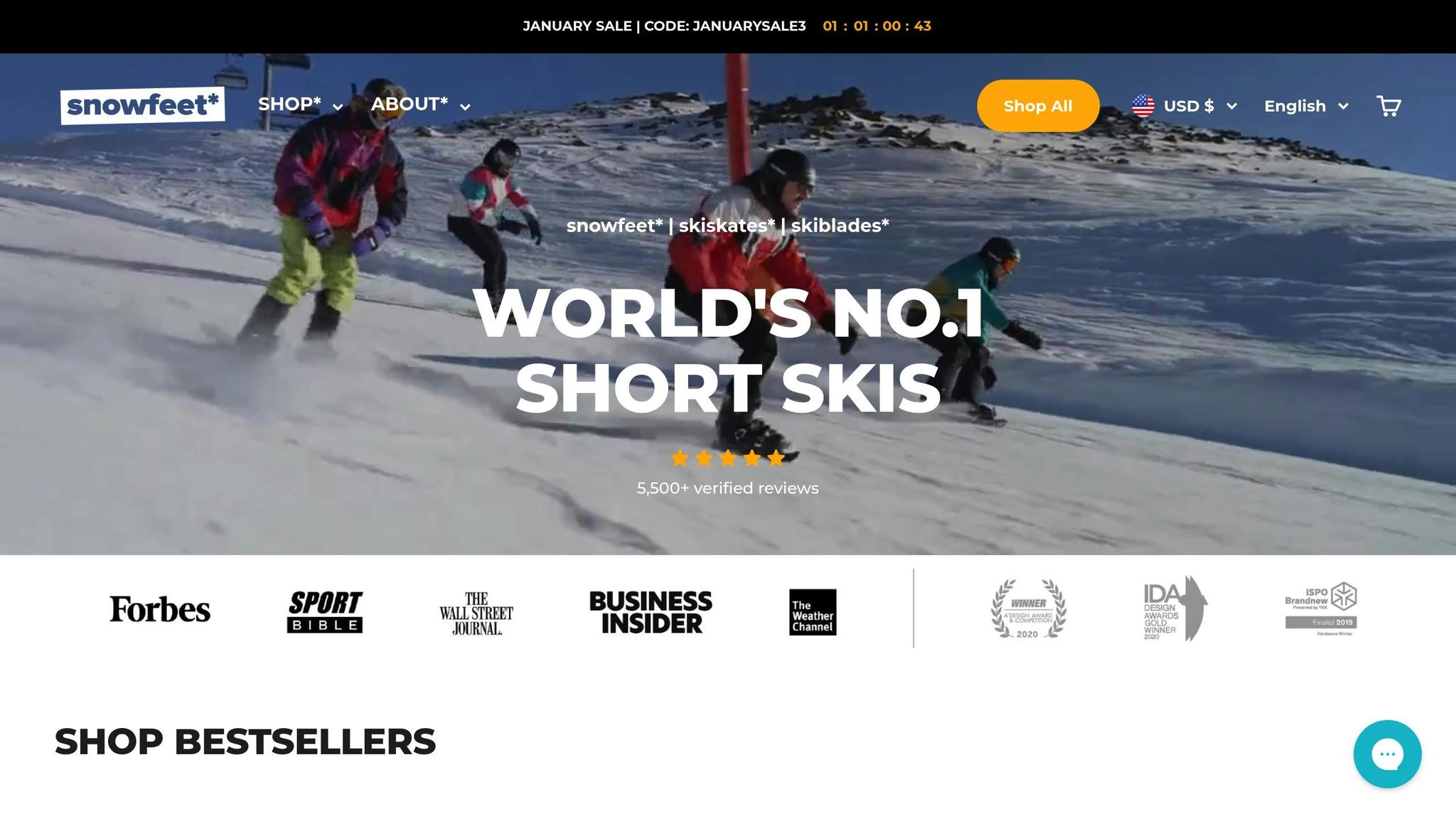
Skiskating combines the thrill of skiing with the smooth, gliding motion of ice skating, creating a unique experience that feels like you're on an ice rink - but on snow. Unlike traditional skiing, which relies on long, forward glides, skiskating focuses on sideways pushes and quick lateral movements, much like the agility required in ice skating. To make this hybrid possible, you need the right gear, and that's where Snowfeet* Skiskates come in.
Snowfeet* Skiskates are designed to bring this concept to life. Measuring just 17.3 inches (44 cm) in length, these skiskates feature a wood core, cap construction, and metal edges for precise control. Compared to the bulky 5-foot length of traditional skis, their compact design feels light and nimble, allowing for sharp turns and quick pivots - perfect for mimicking the movements of ice skating. This sleek setup makes them a game-changer for anyone looking to enjoy the freedom of skating on snow.
Another bonus? Snowfeet* Skiskates work seamlessly with ski or snowboard boots, so you don’t need to worry about heavy, rigid gear. Plus, their compact size means they can easily fit into your backpack, making transportation a breeze - no more lugging around oversized equipment.
To use them, you push sideways like a hockey player, keeping your weight centered or leaning slightly on your heels. Turning is as simple as tilting the skiskates onto their metal edges, and you can stop using either a hockey stop or the built-in heel brake. As Andrew B., a verified user, shared:
"These skiblades are so much fun and easy to control. Never going back to regular skis".
With over 50,000 riders already enjoying Snowfeet* products and a perfect 5.0-star rating from verified reviews, it’s clear that skiskating offers a fresh way to experience the slopes. It captures the effortless glide and agility of ice skating, bringing a whole new dimension to snow sports.
What is Skiing?
Traditional skiing offers a completely different vibe compared to the quick, ice-skating-like feel of Snowfeet* Skiskates. When most people think of skiing, they picture the classic setup: long skis, typically over 170 cm (about 5.6 feet), paired with heavy boots and fixed bindings. This gear is designed for groomed slopes and big, sweeping turns. But let’s be honest - lugging around those long skis isn’t exactly convenient. You’ll probably need a roof rack or an oversized bag to transport them, unlike the compact, backpack-friendly Snowfeet* Skiskates.
Using traditional skis also requires a bit more muscle and technique. Their length and weight mean you need solid physical strength to handle turns and stops effectively. While Snowfeet* Skiskates let you zip around with quick, agile movements, skiing is all about maintaining forward momentum and carving wide arcs down the mountain. It’s less about precision and more about flow.
Learning to ski? Be ready for a challenge. Traditional skiing has a steeper learning curve, and most beginners end up taking lessons to get the hang of balancing and controlling those long skis. Betsy Bothe, a Nordic Ski Instructor at White Pine Nordic Center, puts it this way:
"Classic skiing is more challenging... It's easier to learn how to classic ski, but harder to master".
Then there’s the terrain. Traditional skiing is mostly tied to groomed resort slopes. Sure, there are skis made for deep powder or backcountry adventures, but the standard setup doesn’t have the same flexibility as shorter options like Snowfeet* Skiskates. If you’re dreaming of exploring narrow trails or local hills, traditional skis might feel a bit limiting.
For those chasing the nimble, ice-skating-like experience on snow, traditional skiing can feel like a completely different sport. Its focus on long, flowing movements contrasts sharply with the quick, agile nature of skiskating. It all comes down to what kind of winter adventure you’re after.
Ice Skating Sensations: Comparing Gliding and Turning
Snowfeet* Skiskates bring the thrill of ice skating to the slopes by allowing lateral pushes and quick, sharp turns - something traditional skis just can’t do.
The magic lies in the lateral pushes. With their compact design, Snowfeet* Skiskates let you push sideways, mimicking the smooth rhythm of hockey skating. Traditional skis, on the other hand, are built for forward motion only. At over 150 cm in length, they’re not designed for side-to-side propulsion.
Another standout feature is edge control. Snowfeet* Skiskates have short, responsive edges that react instantly, making carving and adjustments feel effortless. In contrast, traditional skis require more effort to engage their longer edges, which can feel clunky in comparison.
Turning is where the difference really shines. Snowfeet* Skiskates excel with their tight turning radius, enabling spins, pivots, and quick direction changes - even rapid 360° spins. Traditional skis, with their wide arcs, are less suited for tight trails or quick maneuvers. The table below highlights these distinctions.
Comparison Table: Ice Skating-Like Traits
| Trait | Snowfeet* Skiskates | Traditional Skis | Winner & Why |
|---|---|---|---|
| Gliding Motion | Sideways pushes (hockey style) | Forward, linear glide | Snowfeet*: Captures the natural skating push-off. |
| Edge Control | Instant feedback | Stable but requires more effort | Snowfeet*: Short edges allow quicker, easier adjustments. |
| Lateral Pushes | Core to movement | Not possible due to length | Snowfeet*: Only skiskates allow true skating-style propulsion. |
| Turning Radius | Tight and agile | Wide and sweeping | Snowfeet*: Compact design enables spins and quick pivots. |
| Responsiveness | Feels like part of your foot | Can feel heavy or clunky | Snowfeet*: Lightweight and short for maximum agility. |
sbb-itb-17ade95
Equipment Differences: Snowfeet* Skiskates vs Skis
The unique design of Snowfeet* products is what gives them their ice-skating-like feel on snow.
When you compare Snowfeet* Skiskates to traditional skis, the differences are pretty striking. For starters, traditional skis are usually over 150 cm (59 inches) long, while Snowfeet* Skiskates are just 44 cm (17 inches). Snowfeet* Mini Skis are even smaller, available in sizes of 38 cm or 50 cm (15 or 20 inches).
This compact design is a game-changer on the slopes. Snowfeet* products are super portable - you can toss them in a backpack, no need for bulky ski bags or roof racks like you’d need for traditional skis.
Another big difference is the type of boots you can use. Traditional skis require heavy, rigid ski boots, which can be a hassle. Snowfeet* products, on the other hand, are much more flexible. The Mini Skis work with regular waterproof winter boots or snowboard boots. The 44 cm Skiskates are compatible with both ski boots and snowboard boots. As the Snowfeet Team explains:
"Snowfeet* are designed to be used with your regular winter boots so you can always just put them on and go!"
Construction-wise, Snowfeet* products are built differently too. The 44 cm Skiskates have a wood core with cap construction - borrowing high-end ski technology but scaling it down for more agility. Meanwhile, the Mini Skis are made with fiberglass-reinforced material, which keeps them lightweight yet strong. Traditional skis, by comparison, often use wood, foam, or composite cores, which add extra weight and bulk.
Here’s a quick breakdown of their design differences:
Comparison Table: Design Specs
| Feature | Snowfeet* Mini Skis (38/50 cm) | Snowfeet* Skiskates (44 cm) | Traditional Skis |
|---|---|---|---|
| Length | 38 cm or 50 cm (15–20 inches) | 44 cm (17 inches) | 150+ cm (59+ inches) |
| Weight | Ultra-lightweight | Lightweight | Heavy and cumbersome |
| Core Material | Fiberglass reinforced | Wood core (cap construction) | Wood, foam, or composite |
| Boot Compatibility | Winter boots or snowboard boots | Ski boots or snowboard boots | Ski boots only |
| Portability | Fits in a backpack | Highly portable | Requires roof rack or large ski bag |
| Price Range | From $250–$275 | From $575 | $400–$1,000+ |
| Braking System | Heel brake + metal edges | Metal edges (hockey stop) | Metal edges (snowplow/parallel) |
These differences highlight how Snowfeet* products bring something fresh to the slopes - combining convenience with performance in a way traditional skis just can’t match.
Learning Curve: Why Skiskating is Easier to Learn
Traditional skiing can be tough to pick up, but skiskating with Snowfeet* flips the script. With Snowfeet*, most people can get the hang of it in just about 5 minutes. Compare that to traditional skiing, which often takes several professional lessons before you even start to feel confident on the slopes.
One of the reasons for this quick learning curve is the size of the gear. Snowfeet* Mini Skis are only 38–50 cm long, a far cry from the bulky 150+ cm traditional skis. Their compact design makes movement feel more natural, so turning and controlling your speed comes much easier. You’re not stuck wrestling with heavy equipment, which can be a game-changer, especially for beginners.
Another bonus? Minimal gear. Snowfeet* work with your regular winter or snowboard boots - no need for the heavy, expensive boots that come with traditional skiing. As the Snowfeet Team puts it:
"Snowfeet* are designed to be used with your regular winter boots so you can always just put them on and go! It's as simple as that."
This simple setup not only makes learning faster but also gives you the freedom to practice anywhere. Whether it’s a local hill or even your backyard, their portable design means you’re not limited to ski resorts.
And users agree - these things are easy to pick up. Lynn shared, "I found these so easy to turn and control", while Sawyer said, "I picked this up in just two trips."
Performance on Snow: How Snowfeet* Replicates Ice Skating
Snowfeet* bring the sensation of ice skating to the slopes, thanks to their compact design and unique movement. Measuring less than 20 inches long, these skiskates allow for sideways leg pushes - just like a hockey player gliding across the rink. In contrast, traditional skis are designed for forward motion only, making this skating-like movement impossible. This design difference creates a foundation for the sharp, precise turns that Snowfeet* are known for.
When it comes to turning, Snowfeet* shine. By tilting the skates to the edge and shifting your weight, you can carve through snow in a way that feels instinctive for anyone familiar with ice skating. Unlike traditional skis, which require wide arcs and more effort, Snowfeet* let you make quick, sharp cuts. Their metal edges grip the snow much like ice skates grip the rink, enabling smooth carves and even hockey stops.
Control is another area where Snowfeet* stand out. The lightweight, compact design keeps your feet feeling free and agile. If you lose your balance, it’s easy to pick up a foot and recover - something that’s much harder with heavier, bulkier skis. Plus, the reduced weight means less strain on your knees, making them a comfortable option for extended use.
Snowfeet* also adapt well to different snow conditions. They’re at their best on groomed slopes or packed snow, delivering a smooth glide that mirrors the feel of skating. While they can handle light powder, they’re optimized for speed and maneuverability rather than deep snow. Traditional skis might excel in deep powder, but they often feel clunky and restrictive on groomed runs - hardly ideal for someone seeking a skating-like experience.
Here’s a quick comparison to show how Snowfeet* stack up against traditional skis in replicating the feel of ice skating:
Comparison Table: Pros, Cons, and Ice Skating Similarity
| Equipment | Pros | Cons | Ice Skating Similarity Score |
|---|---|---|---|
| Snowfeet Skiskates* | Sideways skating motion, sharp turns, portable, works with regular boots, low knee stress | Requires practice for front-back balance; not great in deep powder | 10/10 |
| Traditional Long Skis | Stable in deep powder, great for high-speed steep runs | Heavy, limited turning, needs pricey boots, high knee stress | 3/10 |
Verdict: Why Snowfeet* Skiskates are the Best Choice for Ice Skating Fans
If you're an ice skating enthusiast, Snowfeet* Skiskates bring the thrill of the rink straight to the slopes. With their smooth gliding and sharp, quick turns, they mimic the hockey-style push and stops that skaters love. This level of precision and agility is something traditional skis just can't match.
The numbers back it up: over 50,000 riders, an impressive 4.9-star rating from more than 5,500 verified reviews, and accolades like the ISPO Innovation Finalist and A'design Award. Snowfeet* Skiskates aren't just gear - they're changing the game in winter sports.
"I used to play ice hockey so Skiskates are perfect for me. It's exactly like ice skating on snow." - Giovanni, Italy
Portability is another win for Snowfeet*. They're compact enough to fit in your backpack and work seamlessly with any winter or snowboard boots. Plus, with a learning curve of just five minutes, you'll be carving turns and gliding down slopes in no time.
While traditional skis might have the edge in deep powder, they can't replicate the ice-skating-like experience that Snowfeet* delivers on groomed runs. These skiskates combine smart design and practicality to create a natural, fluid sensation for skaters transitioning to snow. For anyone looking to bring their love of ice skating to the slopes, Snowfeet* Skiskates are a clear winner.
FAQs
Are Snowfeet Skiskates easier to learn than traditional skis?
Snowfeet Skiskates are a breeze to learn, especially when compared to traditional skis. Thanks to their small size and lightweight build, they feel natural for beginners - particularly if you’ve got some experience with ice skating or inline skating. Most people catch on quickly, making them a fun and easy way to dive into snow sports without needing formal lessons.
On the flip side, traditional skis can be a bit trickier. Their longer length often means a steeper learning curve and more practice to get the hang of things. Snowfeet Skiskates, however, offer a smooth, ice-skating-like glide on snow, making them a great option for anyone who wants to hit the slopes with confidence and minimal hassle.
Can I use Snowfeet Skiskates in deep snow?
Snowfeet Skiskates are perfect for groomed slopes and shine on packed snow or light powder up to around 4 inches (10 cm). Their compact design isn’t suited for deep snow, as staying on top of heavy or deep powder can be tricky. To get the most out of them, stick to well-maintained trails or areas with shallow snow.
What kind of boots work best with Snowfeet Skiskates?
Snowfeet Skiskates work with most winter boots or snowboard boots. The key is to use waterproof boots that offer solid ankle support - this ensures you’ll have a more comfortable and stable ride. Whether you prefer rugged hiking boots or specialized snowboard boots, these skiskates are built to fit securely and deliver a smooth performance on the snow.













Leave a comment
This site is protected by hCaptcha and the hCaptcha Privacy Policy and Terms of Service apply.