



















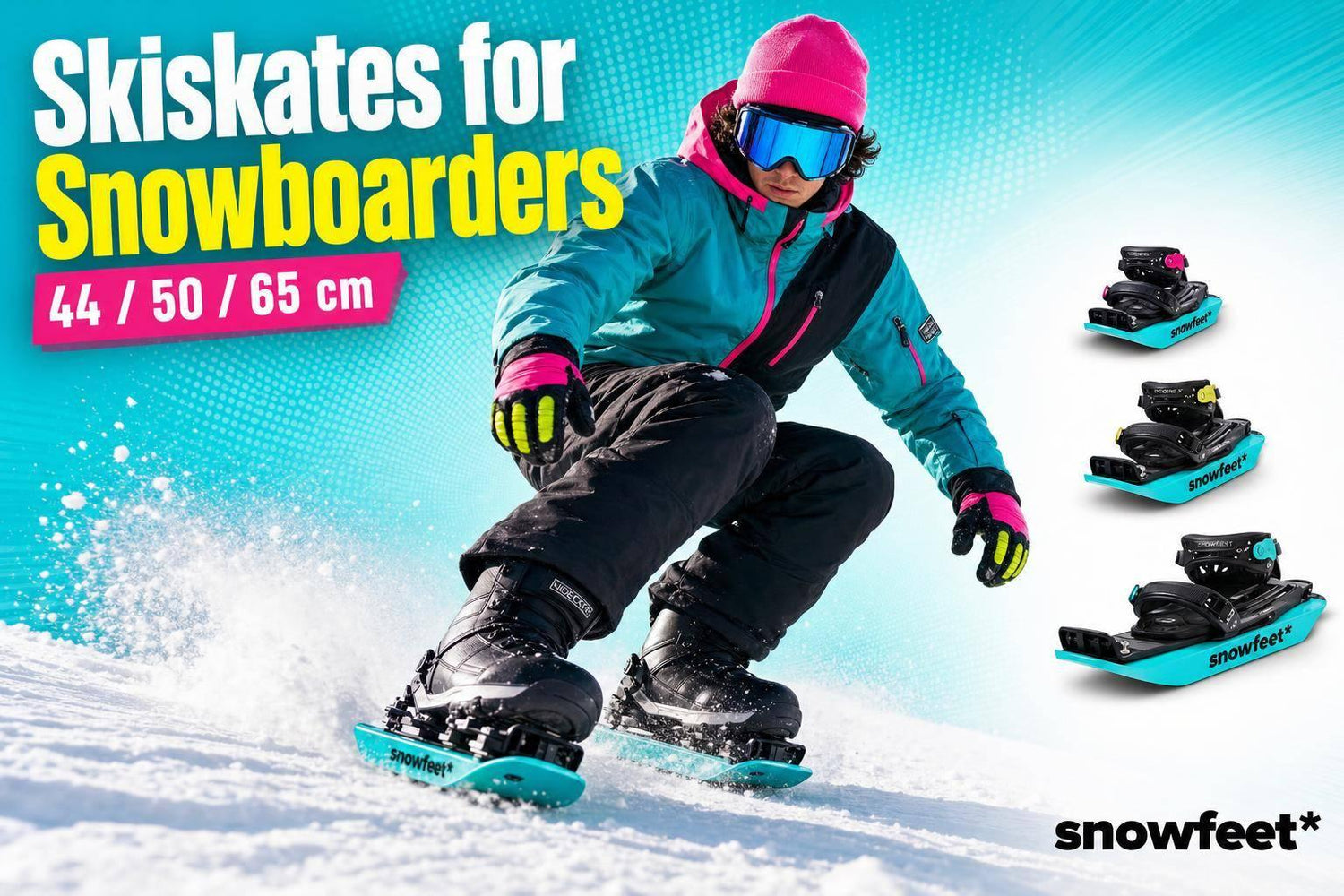
Yes - if you snowboard, there’s a good chance you’ll have fun on skiskates. But there’s one catch: you’ll need to get used to a forward-facing stance and two separate skis under your feet. For most riders, that takes about one session.
Here’s the short version:
- 44 cm skiskates feel loose, playful, and park-friendly
- 50 cm PRO feels like the best starting point for most snowboarders
- 65 cm skiblades feel the smoothest and most stable at speed
- Snowboard still wins for deep powder, big lines, and that full sideways feel
If you like side hits, groomer laps, and messing around on the mountain, skiskates can be a blast. If you live for powder days and fast charging, you may like them more as a second setup than a full switch.
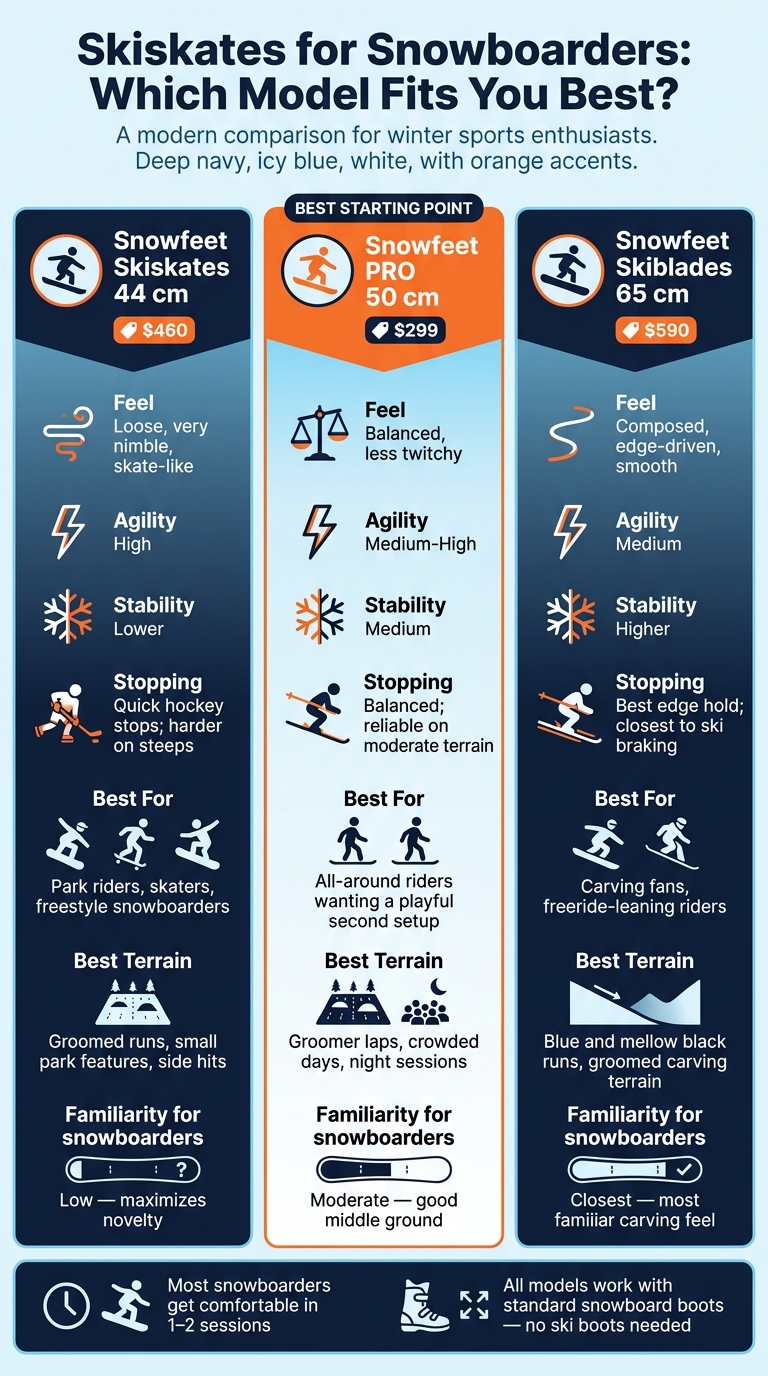
Skiskates for Snowboarders: Which Model Fits You Best?
Snowboarder tries Snowfeet* | Which Snowfeet* Short Ski is the Best? | Snowblades 44, 65, 99 Review
Quick Comparison
| Model | Best Match For | Feel on Snow | Best Use | U.S. Price |
|---|---|---|---|---|
| Snowfeet* Skiskates | Park riders, skaters | Loose and very nimble | Jumps, park laps, short fun runs | $460 |
| Snowfeet PRO | Most snowboarders | Balanced and less twitchy | Resort laps, mixed use | $299 |
| Snowfeet* Skiblades | Carving fans, freeride-leaning riders | Smoother and more planted | Groomers, faster runs | $590 |
What stood out to me most is simple: length changes everything. The jump from 44 cm to 65 cm changes turn feel, stopping feel, and confidence on steeper runs. So if you’re a snowboarder who wants the closest crossover, I’d look at the 65 cm first. If you want a fun extra toy for the hill, the 50 cm makes a lot of sense.
A few fast facts from the article:
- Most snowboarders get comfortable in 1 to 2 sessions
- The biggest change is stopping, since heel-side braking doesn’t carry over
- The 44 cm model feels the most twitchy on firm or steep terrain
- The 65 cm model gives the strongest edge grip of the three
So, no, skiskates don’t feel like a snowboard. But they also don’t feel alien. They sit somewhere between snowboarding, skating, and short skis - and for the right rider, that’s the fun part :)
If you want a quick visual before you buy, these YouTube searches can help:
What Feels Familiar and What Feels Different
For snowboarders, this is the part that matters most: does it feel fun right away, or does it just feel weird?
Most riders notice the split pretty fast. The glide feels familiar. The stance does not. Edge control and carving can click sooner than you'd think, especially on the more stable models. But the stance change? Yeah, that's the big one.
Stance and Foot Position: Sideways Board vs. Forward-Facing Skiskates
On a snowboard, both feet are fixed to one board and set at an angle. On skiskates, each foot stands on its own short ski and points forward. That changes how you balance, start turns, and manage speed.
At first, the separate-foot setup can feel odd. Your feet stop working like one platform. Instead, each leg starts making small moves on its own. It feels closer to skating than snowboarding.
Riders who stay centered and keep their knees soft tend to adjust the fastest. That part matters a lot.
So for most snowboarders, the question isn't whether skiskates feel familiar. It's whether this new stance feels fun enough to make the switch worth trying.
Riding Feel by Model: 44 cm, 50 cm, and 65 cm
Length has a big effect on that first-run feel. Shorter models feel more reactive. Longer ones feel calmer and more planted.
| Model | Riding Feel | Agility | Stability | How Familiar It Feels |
|---|---|---|---|---|
| Snowfeet* Skiskates 44 cm | Very skate-like, nimble | High | Lower | Low - maximizes novelty |
| Snowfeet PRO 50 cm | Balanced, less twitchy | Medium-high | Medium | Moderate - good middle ground |
| Snowfeet* Skiblades 65 cm | Composed, edge-driven | Medium | Higher | Closest - most familiar carving feel |
That puts the Snowfeet* Skiskates 44 cm in the most playful spot. The Snowfeet PRO 50 cm tends to be the easiest move for riders who want a smoother learning curve. And the Snowfeet* Skiblades 65 cm land closest to a snowboarder's comfort zone.
The Snowfeet* Skiskates 44 cm are the most sensitive, so they ask for more active balance. The Snowfeet PRO 50 cm tones down some of that twitchy feel while still keeping things quick and fun. The Snowfeet* Skiblades 65 cm give you more platform underfoot, smoother turn entry, and the closest match to the edge-driven feel many snowboarders already know.
You tend to notice that sensitivity most once you start turning, balancing, and stopping.
sbb-itb-17ade95
Turning, Balance, and Stopping on the First Few Runs
Turning and Edge Control: Quick, Loose, and More Sensitive Than a Board
You still steer with pressure and weight shifts. Riding flat won’t do much for long. The big change is this: skiskates are short, so they pivot with very little effort.
That means small ankle or knee moves can change direction fast. On the 44 cm model, that quick response stands out right away. It can catch you off guard on the first few runs. The 50 cm still turns fast, but it feels a bit calmer underfoot. The Snowfeet* Skiblades 65 cm feel the most settled of the three, with smoother, longer arcs and the strongest edge hold. Out of the group, they feel closest to a ski-style carve.
The other shift is mental as much as physical. You’re not steering one board anymore. Each foot has its own job. So, turns come from both legs working together, not from one platform moving as a unit. That’s the big adjustment early on.
Once that part starts to click, the next things most riders notice are balance and stopping.
Balance and Stopping: What Usually Takes One Session to Adjust
Balance gets simpler once you stop fighting it. Each foot needs its own balance, so staying centered matters a lot. If you lean too far back or too far forward, things can feel sketchy in a hurry. A centered stance over the middle of each foot, with your knees slightly bent and your hands forward, fixes most of that fast.
The hard part usually isn’t skill. It’s the switch from one-board control to two separate skis.
Stopping is where snowboarders feel the biggest difference. Heel-side braking doesn't carry over. You’ll need to use a snowplow to manage speed first, then move into parallel or hockey stops on both skis. Yeah, it can feel clunky for the first several runs. But on easy terrain, most snowboarders settle into it within one session.
| Skiskates 44 cm | PRO 50 cm | Skiblades 65 cm | |
|---|---|---|---|
| Stopping ease | Quick hockey stops; harder on steeps | Balanced; reliable on moderate terrain | Best edge hold; closest to ski braking |
| Steep-slope confidence | Lower - feels twitchier on firm snow | Moderate | Highest - strongest carving grip |
A simple tip: start on easy groomers. Steep slopes can make the 44 cm feel more twitchy than it is, which is a rough intro if you’re still getting your feet under you.
If you want the closest thing to a snowboard-style transition, the Snowfeet* Skiblades 65 cm are the easiest bridge. If you want the loosest, most playful ride, go with the 44 cm. For a lot of riders, that first session tells the whole story pretty fast - either skiskates feel fun right away, or they feel a little too different.
Who Has the Most Fun and Which Model Fits Best
Snowboarders Who Adjust Fastest
After the first few runs, your background matters more than anything else. Riders who already like a quick, loose feel tend to click with these the fastest.
Park riders usually settle in fast. They’re already used to a bit of instability, short base lengths, spins, butters, and awkward landings. That carries over well here. Switch riders also tend to have an easier time because they’re not glued to one strict sideways stance, so the more forward-facing position feels less weird.
Skateboarders often get it right away too. That hip-and-ankle pivot feel on a short deck matches up well with the 44 cm and 50 cm models. Inline skaters and hockey players also pick it up fast. Their centered stance with feet parallel is close to how you stand on skiskates. If you already know how to handle quick balance changes, you’re ahead of the game.
Snowboarders with some ski experience get a nice bonus. They already understand steering each leg on its own, putting pressure on each ski, and facing more downhill. So the mental shift isn’t as big.
High-speed freeriders and carving purists, though? They’re the group most likely to get annoyed. The short running length of the 44 cm and 50 cm models can feel less stable at speed and a bit less predictable in chop. Even the 65 cm Skiblades won’t match the locked-in feel of a full-size board. Best to think of them as a playful second setup, not a snowboard replacement.
Best Uses for Snowfeet* Skiskates 44 cm, PRO 50 cm, and Skiblades 65 cm
That same rider background also helps decide which length will feel right.
| Model | Best For | Best Terrain |
|---|---|---|
| Skiskates 44 cm | Park riders, skaters, freestyle-oriented snowboarders | Groomed runs, small park features, side hits |
| PRO 50 cm | All-around riders wanting a playful second setup | Groomer laps, crowded days, after-lunch laps, night sessions |
| Skiblades 65 cm | Carving fans, freeride-leaning riders, anyone wanting the smoothest transition | Blue and mellow black runs, groomed carving terrain, afternoon chop |
Boot Compatibility, Portability, and Price in the U.S.
Once you know how they ride, the next thing people ask is pretty simple: Will my boots work, and how much is this going to cost?
Here’s the nice part. Unlike a lot of short-ski options, all three models work with standard snowboard boots. No ski boots. No extra gear puzzle. Just less fuss and an easier setup. They’re also easy to pack, which is a big plus if you hate dragging half your garage to the mountain.
U.S. pricing starts at $460 for the Skiskates 44 cm, $299 for the PRO 50 cm, and $590 for the Skiblades 65 cm. For most snowboarders, the PRO 50 cm at $299 is the easiest place to start.
Conclusion: Fun for Most Snowboarders, but Model Choice Matters
After looking at stance, turning, and stopping, the takeaway is pretty simple: most snowboarders will have a good time on skiskates. The big thing is picking the right model, because that changes how fast the ride starts to feel natural.
The 44 cm is the most playful. The 50 cm is the easiest all-around place to start. And the 65 cm feels closest to a snowboard.
A regular snowboard still comes out on top in deep powder, fast riding, and for riders who want a full sideways stance. That’s why the 65 cm is the safest bet for snowboarders who want the smoothest switch.
Here’s the short version:
- Choose the 44 cm or 50 cm for short, playful sessions
- Choose the 65 cm for longer groomer runs and more stability
If you want a second setup, start with the model that matches how close you want the ride to feel to your snowboard. Most snowboarders get comfortable enough to have real fun within one or two sessions. So, if you want the closest snowboard feel, go with 65 cm. If you want the best all-around starting point, pick 50 cm. If you want the loosest, most playful ride, grab the 44 cm.
FAQs
Are skiskates hard for snowboarders to learn?
Usually, no. Snowboarders tend to pick up Snowfeet skiskates fast. The big shift is going from a sideways snowboard stance to facing forward, but your core strength and edge control still come with you.
Using your own snowboard boots helps too. Most riders get the basics down in 5 to 10 minutes. And because skiskates are short and nimble, you skip one of the most annoying beginner issues on skis: crossing your tips.
Which skiskate length feels most like a snowboard?
For snowboarders, the 65 cm Snowfeet Skiblades feel closest to a snowboard. If you want the smoothest move into a ski-style setup, that’s the one to look at.
The 44 cm Skiskates feel more like ice skating or rollerblading. Fun? Absolutely. But the 65 cm Skiblades hit a sweeter middle ground. You get a better mix of agility, stability, carving, and control.
Put simply, they sit right between a snowboard and full-length skis. That makes them a solid pick for riders who want something familiar, but also want to try a different feel on snow.
Can I use my snowboard boots with skiskates?
Yes. Most Snowfeet models, including Skiskates (44 cm) and Skiblades (65 cm), are made to work with snowboard boots, usually in U.S. sizes 6–14.5.
Snowfeet’s custom tool-free bindings match the softer, more flexible feel of snowboard boots. That means you can skip stiff ski boots and stick with something that feels more familiar for carving and tricks. Just make sure you pick the binding version built for snowboard boots.











Leave a comment
This site is protected by hCaptcha and the hCaptcha Privacy Policy and Terms of Service apply.