



















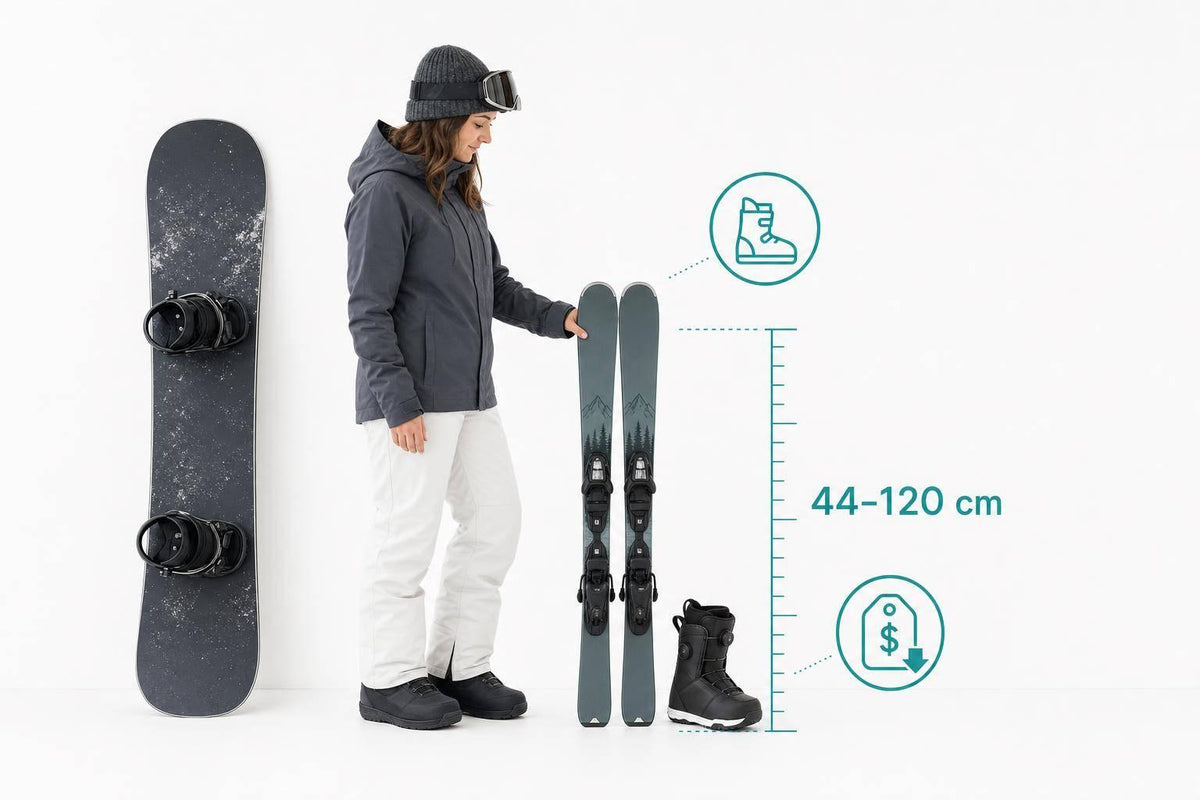
Yes - if you want an easy way to try skiing without buying a full ski setup. From a snowboarder’s point of view, short skis make the first few days less awkward, cost less if you use your snowboard boots, and are more fun on groomers, park laps, and mellow resort runs.
Here’s the short version:
- Short skis are easier to start on than full-length skis
- Snowboard-boot use cuts cost and hassle
- 44 cm to 65 cm feels playful and park-focused
- 99 cm is the best all-around pick for most riders
- 120 cm feels closer to skiing but gives up some of the loose, playful feel
- Full-length skis still win for deep powder, fast carving, and steep terrain
If you’re wondering whether this is worth your money, I’d put it like this: short skis make sense when you want fun first, not max speed. They’re a nice middle step between a snowboard and a full ski setup.
Short Skis vs Full-Length Skis for Snowboarders: Size, Cost & Ride Feel
Snowboarder tries Snowfeet* | Which Snowfeet* Short Ski is the Best? | Snowblades 44, 65, 99 Review
Quick Comparison
| Option | Best For | Main Upside | Main Tradeoff |
|---|---|---|---|
| 44 cm Skiskates | Short groomer laps, park, travel | Tiny, light, easy to move | Low stability at speed |
| 65 cm Skiblades | First-time ski days, casual carving, park | Easy start with more control than 44 cm | Still limited on long fast runs |
| 99 cm Skiblades | Most snowboarders at the resort | Best balance of control, fun, and comfort | Not as calm as longer skis |
| 120 cm Short Skis | Riders who want more ski feel | Better edge hold and more calm on longer runs | Less playful, less park-friendly |
| Full-length skis | Powder, speed, longer carving turns | Best stability and float | More gear, more cost, steeper learning curve |
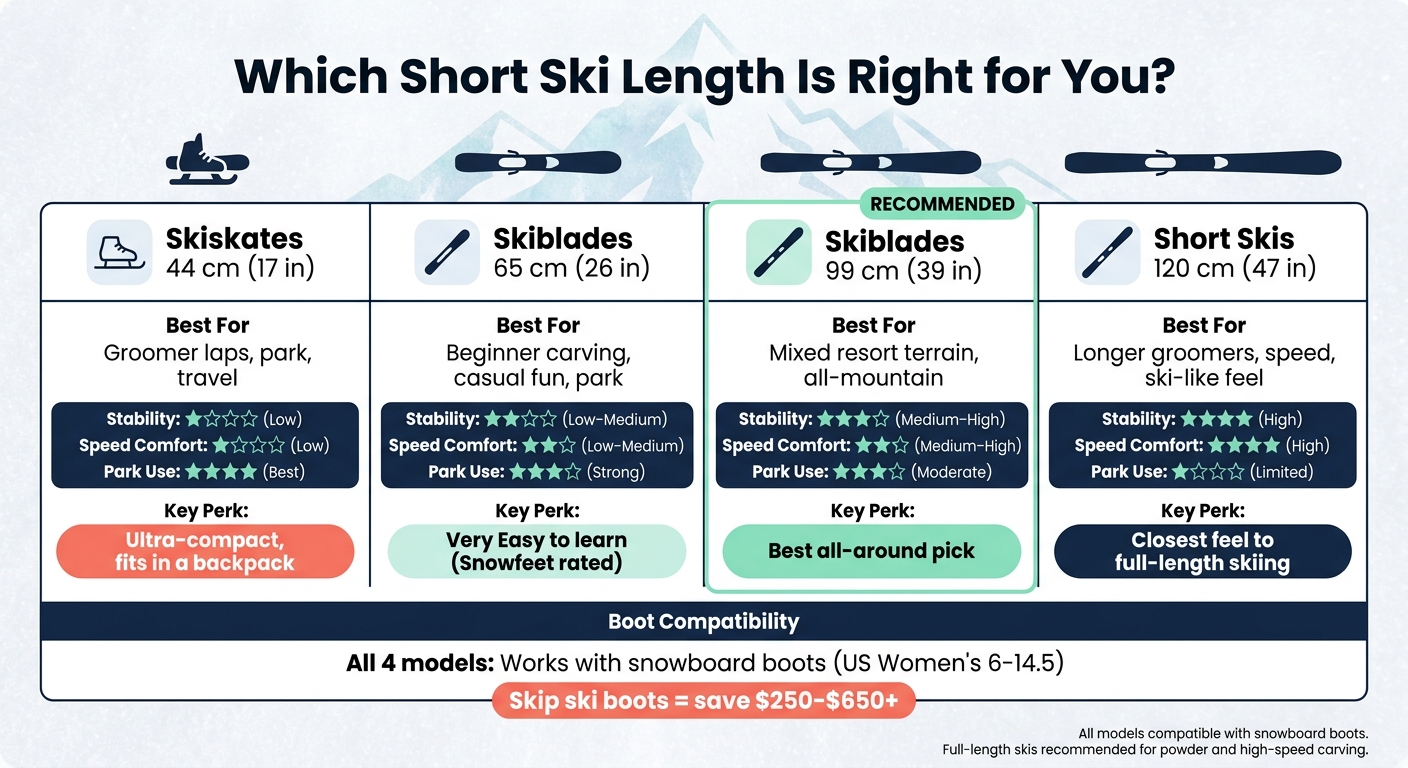
A few numbers stand out. Snowfeet* models in this article run from 44 cm to 120 cm - about 17 in to 47 in. Many setups also work with U.S. women’s boot sizes 6 to 14.5. And skipping ski boots can save about $250 to $650+ in upfront cost. That’s a big deal if you just want to test the waters without turning your closet into a ski shop :)
So, if I were giving the simple shop-floor answer, it’d be this: go 99 cm if you want the safest all-around start. Pick 44 cm or 65 cm if park laps and easy fun matter most. Go 120 cm only if you want something that feels more like skiing than blading.
If you want a quick look at how short skis ride before you buy, these videos help:
- Snowfeet YouTube
- Skiblades basics on YouTube
- Short skis vs skis on YouTube
That’s the whole call in plain English: worth it for easy resort fun, not the top pick for powder days or bombing steep lines.
Short skis vs long skis for snowboarders
Short skis and full-length skis fix different problems. If you already ride a snowboard, the main issue is simple: does the shorter setup feel easier, or does it feel like it holds you back? That’s the whole game here.
This comparison looks at Snowfeet* Skiskates and Skiblades versus full-length skis through a snowboarder’s eyes.
| Factor | Short Skis | Full-Length Skis |
|---|---|---|
| Learning curve / confidence | Gentle - fewer tip-crossing moments | Steeper - more to manage from day one |
| Balance | Forgiving, quick corrections | Punishes small mistakes more |
| Turn initiation | Fast, snappy, responsive | Gradual, requires more commitment |
| Speed stability | Limited at high speeds | Much better on long, fast runs |
| Terrain park | Very approachable | Better for larger features |
| Powder | Workable in light snow | Clearly better in deeper conditions |
Learning curve, balance, and confidence
Short skis are less likely to cross tips, and that cuts out one of the most annoying beginner issues. There’s simply less ski in front of you and behind you. So when your balance drifts, you can fix it with small, fast movements. For a snowboarder, that often feels more natural.
Full-length skis are less forgiving. Small errors tend to get bigger fast. Sit too far back and the tips start to chatter. Tip too far forward and it can feel like the skis want to drag you downhill. Ski instructors see this all the time with snowboarders in their first few days. That backseat stance is a common trap.
That easier first week is a big reason many snowboarders lean toward short skis instead of full-length skis.
Turning, carving, speed, and stability
Short skis react fast. A small shift in weight can start a turn, scrub speed, or help you make a quick direction change on a blue run. That quick feedback feels familiar if you’re used to moving a board under your feet.
Full-length skis take more input. They have more edge on the snow and a longer turning radius, so the turn comes on smoother but slower. Good skiers love that on big carving arcs. A snowboarder, though, may hop on and think, why do these feel so slow to answer me?
Speed is where the trade-off shows up fast. Short skis can get chattery on firm snow once you start pushing harder. They also don’t hold their line as well on long, steep descents. Full-length skis do better here. As speed builds, they stay calmer and hold an edge with more trust.
So, short skis fit relaxed resort laps and quick turning better. Full-length skis make more sense for fast riding and long-radius carving.
Groomers, park, powder, and mixed terrain
On groomers, short skis feel playful and easy to move around. In moguls, the shorter length helps you pivot over bumps and stay in the troughs without feeling like you’re wrestling a pair of fence posts. That’s a nice perk.
In the terrain park, short skis also feel approachable. Their low swing weight helps with jumps, boxes, and spins, especially if freestyle riding already feels like home.
Full-length skis pull ahead in deep powder and steep terrain. More surface area gives you better float, and longer tips help the skis stay up in soft snow instead of diving. Short skis can still handle light powder and soft chop, but they won’t give you that snowboard-like float in deeper snow.
That’s why the next step isn’t just asking whether you want skis at all. It’s figuring out which short length matches the way you like to ride.
sbb-itb-17ade95
Why short skis make sense for women switching from snowboarding
If you already snowboard, short skis can make the switch a lot easier. The big win is simple: you may be able to keep using your snowboard boots.
That matters more than it sounds. For many snowboarders, the main question isn’t just how the skis ride. It’s whether the whole setup feels easy enough to grab and use on a regular weekend.
| Aspect | Short Skis (Snowfeet* Skiskates/Skiblades) | Full-Length Skis (Traditional Setup) |
|---|---|---|
| Boots | Many Snowfeet* short-ski setups work with existing snowboard boots, so you may not need a second boot purchase | Require dedicated ski boots, which are stiffer and add another expense |
| Gear Cost | One compact setup; if you use snowboard boots, you can skip the ski boot cost entirely | A full women's ski setup can run $800–$1,600+ |
| Portability | 44–99 cm models are compact enough for most trunks or back seats | Longer skis are more awkward to transport and may need a ski bag or roof rack |
| Storage | Fits in a closet, under a bed, or a small gear corner | Needs more wall space or dedicated racks |
Using snowboard boots instead of buying ski boots
Most Snowfeet* short-ski setups work with snowboard boots, so you can skip buying ski boots. Snowfeet* bindings are built for shorter skis and snowboard boots, including Snowfeet* Skiskates 44 cm and Skiblades up to 99 cm.
They also fit a broad range of boot sizes, about US women's 6 to 14.5 (EU 38 to 49), so most women won’t have to stress about fit.
That can save a decent chunk of money. In the U.S., midrange women’s ski boots often cost $250 to $650, and high-end models can go past $700. So if you only plan to ski now and then, skipping that extra boot purchase can make short skis the lower-cost path.
There’s also the comfort side of it. Snowboard boots are softer, warmer, and way easier to walk in than ski boots. If you’re taking casual groomer laps or messing around in the terrain park, sticking with the boots you already own can just feel better. No stiff plastic boot shuffle. No extra gear drama. Nice and simple.
Portability, travel, and storage
This is one of those things you don’t think about much until you’re loading the car at 6:30 a.m. :)
The 44 cm Skiskates and 65–99 cm Skiblades fit inside most trunks or back seats without any special setup. That makes spur-of-the-moment resort trips a lot easier.
Short skis also make home storage less of a pain:
- They can fit in a closet
- They can slide under a bed
- They work well in a small gear corner
For apartment living or smaller homes, that’s a big plus. And for busy riders, easier storage and transport often means the gear gets used more. That leads straight to the next step: picking the Snowfeet* length that matches how you want to ride.
Which Snowfeet* length should you choose?
Once you’ve sorted out the setup, length is the next big call.
For most snowboarders, this comes down to one thing: do you want easy, playful fun or more calm at speed? Pick the length based on how you want the ride to feel. Some lengths are better for easy learning. Some give you more control. And some feel closer to skiing.
Here’s the quick breakdown:
| Model | Best Use | Stability | Speed Comfort | Park Use |
|---|---|---|---|---|
| Skiskates 44 cm | Groomer laps, compact easy-to-carry setup | Low | Low | Best |
| Skiblades 65 cm | Beginner carving, park, casual fun | Low–Medium | Low–Medium | Strong |
| Skiblades 99 cm | Mixed resort terrain, all-mountain | Medium–High | Medium–High | Moderate |
| Short Skis 120 cm | Longer groomers, speed, more ski-like feel | High | High | Limited |
44 cm and 65 cm: easiest starts, playful riding, and park laps
Go with these if you want the smoothest jump from a snowboard stance to skis. They’re easy to steer, easy to correct, and a blast on small jumps and side hits. If your main goal is simple fun on groomers without a big learning curve, this is the lane to stay in.
The 65 cm Skiblades make more sense if you want a bit more edge hold and smoother carving. Snowfeet* rates them as Very Easy to learn. For park laps, they stay quick and light, but they give you more control than the 44 cm option.
99 cm and 120 cm: more progression and a more ski-like feel
If 44 cm and 65 cm feel a little too loose, move up to 99 cm. These longer options give up some of that super-playful feel, but in return you get more confidence on full resort runs. They’re a good fit if you want to keep the short-ski vibe while adding more control.
The 99 cm Skiblades are the best middle-ground pick for women who want to progress. They carve more smoothly and stay steady enough for full resort laps. You’ll feel that most on mixed terrain and longer groomer runs.
The 120 cm Short Skis are better for riders who already feel confident and want something closer to standard skis. You get more planted carves, better calm at speed, and more trust on longer runs. That said, they still give up deep-powder float, long-radius carving performance, and high-speed composure compared with standard full-length skis. If you’re not ready to switch to a full ski setup and want a bridge between the two, 120 cm gets you the closest in the Snowfeet* lineup.
Conclusion: When short skis are worth buying and when long skis still win
Here’s the plain answer for snowboarders: short skis are worth buying if your goals line up with what they’re made to do.
If you’re moving from snowboarding to skiing and want an easier start, snowboard-boot compatibility, a setup that fits in your trunk or travel bag, and a fun ride for groomers or park laps, Snowfeet* short skis make a lot of sense.
Long skis still win in a few clear areas. They’re better for high-speed carving, deep powder, and serious all-mountain progression. That’s the trade-off. No magic here - just picking the right tool for the kind of day you want.
For most snowboarders, short skis are a smart buy when you want fun, low-friction days instead of top-end speed and float. They’re a purpose-built option, not some watered-down version of “real” skis.
If you want one clear pick, start here: the 99 cm Skiblades. They’re the safest all-around starting point for most snowboarders - good for full resort runs, playful enough for park laps, and compatible with your snowboard boots. Go with 99 cm if you want the safest all-around start. Step up to 120 cm only if you want more ski-like stability.
FAQs
Can I use my snowboard boots with all Snowfeet* models?
No. Not all Snowfeet* models work with snowboard boots.
The 44 cm Skiskates, 50 cm PRO, and 65 cm Skiblades are made for snowboard boots. Think of those as the snowboard-friendly part of the lineup.
The 120 cm Short Skis usually need ski boots and bindings. Some 99 cm models can use snowboard-boot bindings, but they often come set up for ski boots by default.
So, before you order, check the binding version. That small detail can save you a big headache later :)
Are short skis good enough for a full resort day?
Yes - Snowfeet short skis and skiblades can work well for a full resort day for most casual riders.
One big plus is comfort. When you use them with flexible snowboard boots, they often feel less tiring than stiff ski boots. That can make a long day on the mountain a lot easier on your feet and legs.
They also shine on groomed runs and in terrain parks. They feel nimble, easy to move, and fun for quick turns. If you want more balance for longer laps and mixed terrain, the 99 cm and 120 cm models are the better bet.
That said, let’s keep it honest: if your goal is high-speed carving or riding deep powder, traditional long skis still do that better. Snowfeet are a blast, but they don’t beat long skis in every condition :)
How do I know if 99 cm or 120 cm is better for me?
Choose 99 cm if you want the best all-around balance of stability, portability, and day-to-day ease. It feels calm on groomers and intermediate resort runs, and it can work with your snowboard boots if you go with the snowboard-binding option.
Choose 120 cm if you want something that feels closer to regular skis. You’ll get more stability at speed and better support on steeper terrain, but you’ll give up some nimbleness and portability, and you’ll need to switch to ski boots.











Leave a comment
This site is protected by hCaptcha and the hCaptcha Privacy Policy and Terms of Service apply.