



















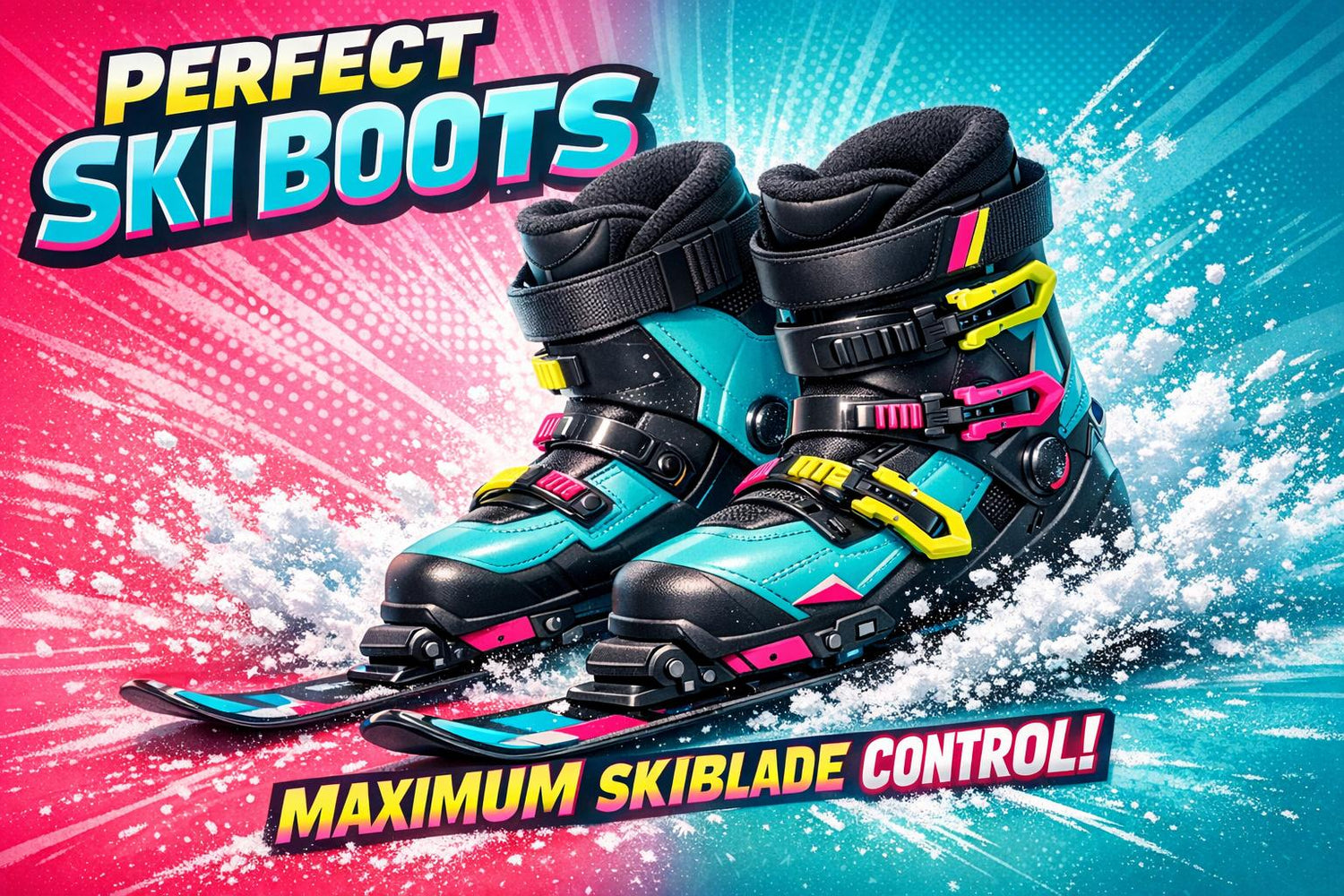
- Fit is everything: A snug boot means better control. Loose boots? Say hello to wobbly turns and sore feet. Measure your feet carefully using Mondopoint sizing, and aim for a tight but comfy fit.
- Boot type matters: Snowfeet skiblades work with Alpine, GripWalk, Touring, or even snowboard boots. Match your boots to your bindings and terrain.
- Flex level counts: Softer boots (80–100 flex) are forgiving for freestyle fun. Stiffer boots (100–120+) give precision for carving and speed.
- Short skis = precise boots: Skiblades demand immediate response. Choose boots that hug your foot and transfer every movement directly to your skis.
Want the best ride? Nail your fit, pick the right flex, and match your boots to your skiblade model. Let’s break it all down below.
Ski Boot Selection Guide for Snowfeet Skiblades: Compatibility, Flex Ratings, and Model Recommendations
Boot Compatibility with Snowfeet* Skiblades
Boot Standards That Work with Snowfeet* Skiblades
Snowfeet* skiblades are designed to work with two main types of bindings - one for ski boots and another for snowboard boots. Picking the right boot for your binding setup is crucial for safety and performance.
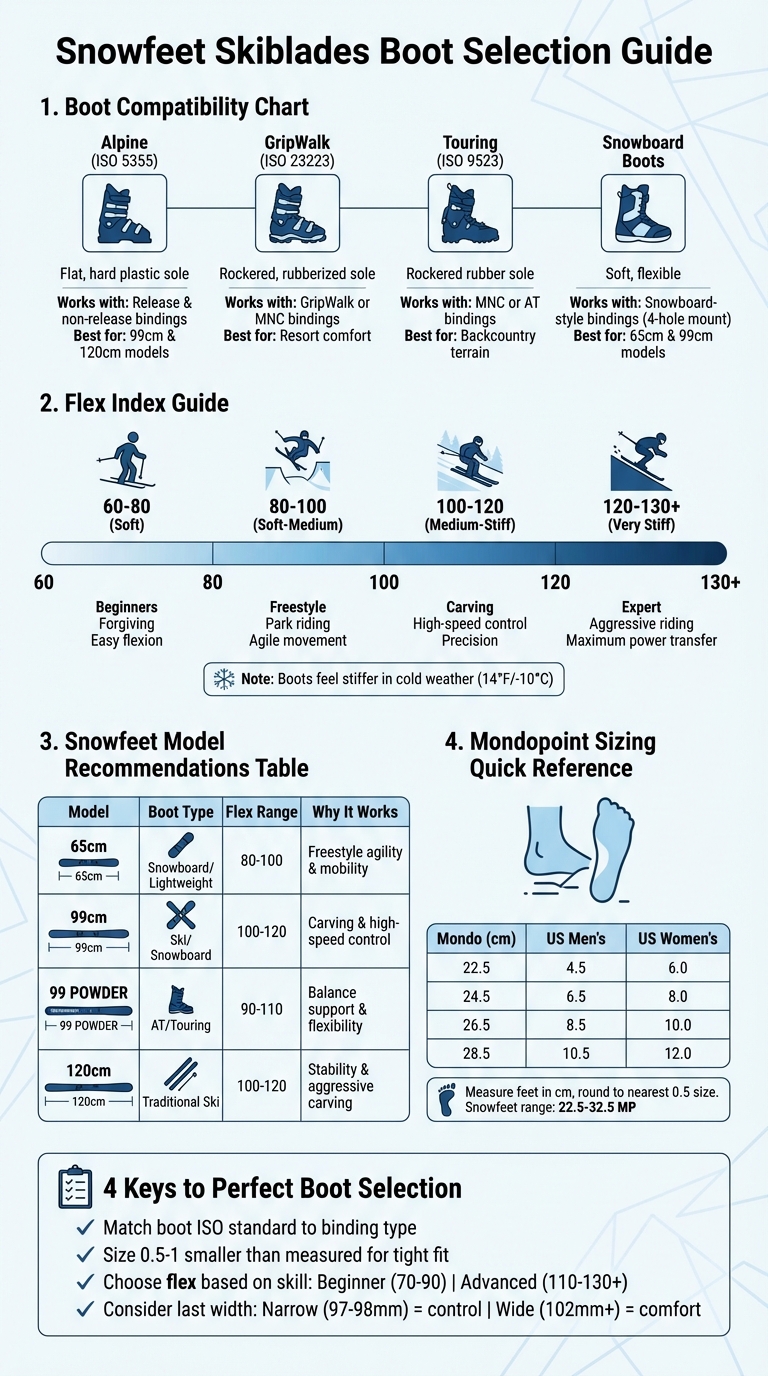
- Alpine (ISO 5355) boots feature a flat, hard plastic sole, which is the standard for most resort ski boots. These work seamlessly with both release and non-release bindings on Snowfeet* skiblades. If you’re using models like the 99 cm or 120 cm versions with release bindings, Alpine boots are your best bet.
- GripWalk (ISO 23223) boots have a rockered, rubberized sole, making them more comfortable for walking around the lodge or parking lot. However, they need bindings marked "GripWalk" or "MNC" (Multi-Norm Certified). Using GripWalk boots with bindings designed only for Alpine soles can be risky because the Anti Friction Device (AFD) under the toe might not function as intended.
- Touring (ISO 9523) boots, built for backcountry adventures, also have rockered rubber soles and are compatible with MNC or Alpine Touring bindings. While these aren’t as common for Snowfeet* skiblades at resorts, they’re a solid choice for sidecountry terrain.
- Snowboard Boots are only compatible with Snowfeet* models featuring snowboard-style bindings. These bindings often use a four-hole mounting system and may include an extra strap for better carving control. Double-check that your Snowfeet* model matches your snowboard boots before purchasing.
"AFDs are responsible for the consistent and safe lateral release of your boot from the binding's toe piece, and not all boots have them." - Erme Catino, Powder Magazine
Make sure to check for the appropriate markings on your boots and bindings to avoid mismatched setups.
How to Check Boot-Binding Compatibility
Getting the right boot-binding match is critical for the control and safety that Snowfeet* skiblades are known for. A proper pairing prevents issues like accidental releases or bindings failing to release when they should.
Start by inspecting your boot sole for markings like ISO 5355 (Alpine) or ISO 23223 (GripWalk). Then, look at your binding's toe piece for logos such as "GW", "MNC", or "WTR" (Walk to Ride). MNC bindings are particularly versatile, as they work with Alpine, GripWalk, WTR, and even some Touring boots.
If you’re using Snowfeet* models with release bindings (like the 99 cm or 120 cm versions), ensure the bindings include an AFD. This device is crucial for proper lateral release during a fall. Without it, you risk either premature releases or the skiblades not ejecting when they should - both scenarios can lead to injuries.
For shorter skiblades (typically under 100 cm) with non-release bindings, compatibility is more flexible. However, safety leashes are a must with these bindings, as they don’t release during a fall. Lastly, confirm that your boot’s Mondopoint size falls within the Snowfeet* range of 22.5–32.5 MP (approximately 4.5–14.5 US / 36–49 EU).
Getting the Right Fit for Control and Comfort
How to Measure Your Feet for Mondo Sizing
Ski boots use Mondopoint sizing, which matches your foot length in centimeters. To measure your feet accurately, grab a piece of paper and tape it to a wall. Stand with your heel against the wall and mark the tip of your longest toe while wearing thin ski socks. Measure both feet and go with the smaller measurement - your foot can elongate slightly under weight, sometimes by up to 1 cm. Make sure to hold your pencil straight up and down when marking to avoid errors.
It’s smart to measure your feet later in the day when they’re naturally at their largest. Since most people have one foot slightly longer than the other, experts suggest sizing your boots to the smaller foot. Why? A boot shell can be stretched for a larger foot, but shrinking an oversized boot is much trickier.
Once you have your measurement in centimeters, round to the nearest half size. For instance, if your foot measures 26.67 cm, you’d choose a 26.5 Mondopoint boot. Modern ski boots are available in half-size increments, making it easier to get a snug fit. To double-check, take the liner out of the boot and slide your bare foot into the shell. With your toes lightly touching the front, there should be about 15–22 mm of space behind your heel for a performance fit, which is ideal for maximum control on skiblades.
| Mondo (cm) | US Men's | US Women's |
|---|---|---|
| 22.5 | 4.5 | 6.0 |
| 23.5 | 5.5 | 7.0 |
| 24.5 | 6.5 | 8.0 |
| 25.5 | 7.5 | 9.0 |
| 26.5 | 8.5 | 10.0 |
| 27.5 | 9.5 | 11.0 |
| 28.5 | 10.5 | 12.0 |
| 29.5 | 11.5 | N/A |
After nailing down your size, keep in mind that the boot’s shape and internal volume are just as important for balancing control and comfort.
Boot Shape: Last Width and Volume
The last width is the measurement (in millimeters) of the widest part of your forefoot. This plays a big role in how much control you’ll have when carving on Snowfeet* skiblades. Narrow lasts (97–98 mm) hug your foot tightly, offering quick response to weight shifts. Wider lasts (102 mm or more) focus more on comfort, giving your foot more room to move.
Boot volume refers to the total interior space, including the heel cup, midfoot, and instep. A boot that’s too tight can cut off circulation - especially for people with high insteps - while too much volume lets your foot slide around, reducing control.
"Regardless of foot size, racers prefer the narrow lasts because that close fit delivers the instant response that they need between boot, binding, and ski." - Brandon Orloski, Backcountry Gearhead
When trying on boots, buckle them up completely. If you have to tighten the buckles all the way down for a snug fit, the boot’s volume is too high. For Snowfeet* skiblades, which require quick edge-to-edge transitions, a narrow to average last (about 97–100 mm) usually offers the best mix of control and comfort. This precise fit is critical for the responsiveness skiblades demand.
Why Skiblades Need a Tighter Fit
Snowfeet* skiblades are shorter and more nimble than traditional skis, meaning even the smallest movement of your foot translates directly to the ski. If your boot is too loose, your foot can move inside the hard shell, causing hot spots, cramping, and a loss of control.
For the best performance, many recommend choosing a boot that’s about 0.5 to 1 size smaller than your measured Mondopoint size. This ensures a snug, secure fit, so every shift in weight transfers instantly to the edges of your skiblades. Unlike traditional skis, which are more forgiving of a looser fit, skiblades rely on precision and responsiveness.
"A properly fitting ski boot means you ski better, plain and simple." - Megan Michelson, Ski Expert
When trying on boots, don’t assess the fit while standing neutrally. Buckle them up and lean forward into an athletic stance, pressing your shins against the boot’s tongue. Your toes should briefly pull away from the front of the boot. Keep in mind that the liner will compress over time, so a snug fit at first is normal. A boot that feels comfy in the store might end up being too loose on the slopes, especially when making quick turns on your Snowfeet* skiblades.
Choosing the Right Flex for Skiblade Control
Flex Index Explained: Soft, Medium, and Stiff Boots
The flex index measures how much resistance a boot shell offers when you lean forward. It’s usually represented by numbers ranging from 60 (soft) to 130+ (very stiff). The higher the number, the stiffer the boot. This resistance is key for transferring your movements to the edges of your Snowfeet* skiblades.
Stiffer boots are great for high-speed precision or navigating challenging terrain because they transfer power more directly. On the other hand, softer boots are more forgiving, making them ideal for beginners. They allow easier knee and ankle flexion, helping absorb small mistakes and maintain balance. If your boots are too stiff for your weight or strength, you’ll struggle to lean forward properly, which can force you into a backseat stance and reduce your control.
"If you feel like you can't get on top of your skis... it may very well be because you're in a boot that's too stiff and you don't have the force to drive your ski boots." - Sam Tischendorf, Professional Bootfitter
It’s also worth noting that boot stiffness changes with temperature. A boot that feels medium in a warm shop can stiffen significantly on a cold day - say, 14°F (-10°C). This makes choosing the right flex even more important for a comfortable and controlled ride with Snowfeet* skiblades.
Flex Recommendations for Snowfeet* Skiblades
Once you’ve got the right fit, picking the correct flex is the next step for mastering control. The ideal flex depends on the Snowfeet* model and how you plan to use it.
For the 65 cm skiblades, a soft-to-medium flex (80–100) is best. This range enhances their quick, skate-like responsiveness and freestyle feel. A softer boot also helps absorb impacts, which is great for park landings.
For the 99 cm and 120 cm models, go for a medium-to-stiff flex (100–120+). These boots provide the leverage needed for carving and maintaining stability at higher speeds. The 99 POWDER model pairs well with a medium flex (90–110), offering enough support for control while still allowing subtle ankle movements, especially in variable snow conditions.
| Snowfeet* Model | Recommended Flex | Why It Works |
|---|---|---|
| 65 cm | 80–100 (Soft-Medium) | Boosts freestyle agility and mobility |
| 99 cm / 120 cm | 100–120 (Medium-Stiff) | Ideal for carving and high-speed control |
| 99 POWDER | 90–110 (Medium) | Balances support and flexibility in snow |
Unlike traditional long skis, which can sometimes forgive loose boot fits, Snowfeet* skiblades require precision. Every small movement in your boots directly affects the skiblades’ response.
How Body Weight and Skill Level Affect Boot Flex
Your weight and skill level are major factors in choosing the right boot flex for skiblades. If you’re heavier, you’ll need stiffer boots to avoid overpowering them. On the flip side, lighter riders might find the same boots perfectly balanced. For example, a lighter expert rider and a heavier intermediate skier might end up using the same flex level.
Beginners typically start with softer boots (60–80 for men, 50–60 for women) because they’re easier to flex and more forgiving of mistakes. Intermediate skiers often move up to medium flex (85–100 for men, 65–80 for women), which offers better responsiveness across different terrains. Advanced and expert skiers usually prefer stiff boots (110–130+ for men, 85–110+ for women) for precise control during aggressive, high-speed runs.
If you’re planning to progress quickly, consider boots at the higher end of your current skill range. This way, you won’t outgrow them after just one season. A simple way to test stiffness is the “living room test”: wear the boots at home for 10–15 minutes. If you can’t easily flex them forward at room temperature, they’ll feel even stiffer on the slopes.
sbb-itb-17ade95
Matching Boots to Snowfeet* Models and Terrain
Boot Recommendations by Snowfeet* Model
Each Snowfeet* model pairs best with specific types of boots to enhance performance and comfort. Let’s break it down:
- The 65 cm model works with basic non-release bindings or specialized snowboard bindings. Lightweight boots are ideal here, offering better maneuverability. For freestyle or park riding, snowboard boots are a solid choice since they provide the lateral support and flexibility you need.
- The 99 cm skiblades are the most adaptable option. They’re compatible with regular release bindings, non-release bindings, or snowboard bindings. If you’re into classic carving, standard ski boots are the way to go. Prefer comfort for all-day riding? Snowboard boots have you covered. For the 99 POWDER model, Alpine Touring (AT) boots with a "walk mode" for uphill ease and a rigid "ski mode" for downhill control are perfect for backcountry adventures.
- The 120 cm skiblades require standard release bindings paired with traditional ski boots. This combo ensures stability and safety, especially for high-speed, aggressive carving.
"If you're used to wearing your ski boots and love the fast aggressive ride, go for the ski bindings." - Snowfeet Team
For models longer than 100 cm, always use releasable bindings and safety leashes. These features help prevent dangerous slide-offs and reduce the risk of injury. Now, let’s look at how boot cuff height and stance can fine-tune your experience on short skis.
Cuff Height and Stance for Short Skis
Short skis like Snowfeet* skiblades demand a different approach compared to traditional long skis. Since they lack the forgiving support of longer skis, boots with high cuffs are crucial for maintaining precise front-to-back balance.
To get the most control, stand upright with your weight centered over the middle and back of your feet. Avoid leaning too far forward, as this can throw off your balance. High cuffs and good lateral support in your boots make it easier to hold this posture. On groomed slopes and hard-packed snow, stiffer boots deliver better edge control and tip pressure. For powder or off-piste terrain, lighter boots with a walk mode offer the agility and freedom of movement you’ll need.
Now that we’ve covered fit and stance, let’s dive into how Snowfeet* boots stack up against traditional ski and snowboard boots.
Snowfeet* vs. Traditional Ski and Snowboard Boots
Snowfeet* skiblades bring a fresh twist to the boot game, offering more flexibility compared to traditional ski or snowboard setups. Traditional ski boots are all about power transfer, while snowboard boots focus on lateral support, flexibility, and comfort for walking.
The real magic of Snowfeet* lies in their versatility. Unlike long skis that require heavy, stiff alpine boots, Snowfeet* models give you options. Want classic carving control? Go with ski boots. Looking for comfort and support for tricks? Snowboard boots are a great pick. And for the smaller models, you can even strap on regular winter shoes for ultimate portability.
Short skis are naturally more responsive and easier to turn or stop than traditional long skis, making them feel more playful. However, they do demand more active balance. Since they’re lighter and easier to handle, you don’t always need the extreme stiffness of race boots to get the job done. This flexibility means you can choose boots that match your Snowfeet* model and your riding style, while still enjoying excellent control.
How to Choose Ski Boots: Fit, Last, Flex, BOA, Types, Men's vs Women's, In-soles, and more | Powder7

Conclusion
Picking the right ski boots for your Snowfeet* Skiblades boils down to four key factors: compatibility, fit, flex, and terrain. First, make sure your boots match the bindings for a secure connection and better control. Use Mondopoint sizing to measure your foot and get that snug, performance-ready fit. This step is crucial for setting the stage to fine-tune the flex to match your riding style.
Flex plays a big role in how your boots perform. If you're a beginner, aim for a flex rating between 70 and 90. Advanced riders, on the other hand, should look for something in the 110 to 130+ range for sharper responsiveness. What makes Snowfeet* stand out is their flexibility - you’re not tied to the heavy, clunky alpine boots. Depending on your model and how you ride, you can go with ski boots for precise carving, snowboard boots for all-day comfort and park tricks, or even regular winter shoes for the mini models.
"Your boots are your only way of translating your body's intentions to your skis, so a precise fit is important for control and performance." – evo Staff
With over 5,500 verified reviews and a stellar 4.9/5 rating, Snowfeet* products bring a level of fun and control that long skis just can’t rival. Their compact design lets you toss them in a backpack, adjust the bindings at home with a screwdriver (no shop visits needed), and hit the same slopes as traditional setups - all while keeping more cash in your wallet.
FAQs
What should I look for when choosing ski boots for Snowfeet skiblades?
To get the most out of your Snowfeet skiblades, there are four key things to keep in mind: compatibility, fit, flex, and support.
First off, Snowfeet skiblades are designed to work with standard alpine ski bindings, which means you can pair them with any alpine ski boots. For the best performance, go for boots that fit snugly. A close fit helps keep your foot stable, giving you better edge control. Just don’t go too tight - comfort matters too! A good tip is to measure your feet carefully and try on boots with ski socks to find the perfect size.
When it comes to flex, the length of your Snowfeet skiblades plays a big role. If you’re using shorter models (like the 65 cm ones), softer-flex boots (rated around 60-80) are a great choice for a playful, easygoing feel. On the other hand, if you’re rocking the longer models (99 cm or 120 cm), medium-stiff boots (100-120 flex) will give you the stability you need. Also, look for boots with an upright cuff angle. This design works well with Snowfeet’s vertical stance, giving you quicker edge control and making it easier to walk compared to traditional ski boots.
By picking boots that fit just right, match the flex requirements of your Snowfeet skiblades, and offer solid support, you’ll have the perfect setup for comfort, control, and fun on the slopes. It’s one of the reasons Snowfeet skiblades stand out as a fun alternative to traditional skis or snowboards.
How does ski boot flex impact control and performance on Snowfeet skiblades?
The flex of a ski boot plays a big role in how it feels and performs, especially when you're using Snowfeet skiblades. For these shorter skiblades, a softer to moderate flex (around 70–100) works best. Why? It gives you the ability to make quick, precise turns and enhances responsiveness - key factors for handling the compact design of Snowfeet skiblades.
On the flip side, a stiffer boot, which might be perfect for traditional skis, can feel restrictive and reduce maneuverability on skiblades. To get the best experience, you’ll want a boot that balances agility and comfort, letting you enjoy smoother rides and sharper control.
Can I use regular winter boots with Snowfeet skiblades, even for shorter models?
Nope, regular winter boots won’t cut it when it comes to using Snowfeet skiblades - even the shorter 65 cm ones. You’ll need ski boots. Why? They’re specifically made to work with Snowfeet bindings, giving you the support, snug fit, and control that make all the difference. The right boots don’t just keep you safe - they let you steer and glide like a pro, making your skiblade adventures way more fun.











Leave a comment
This site is protected by hCaptcha and the hCaptcha Privacy Policy and Terms of Service apply.