



















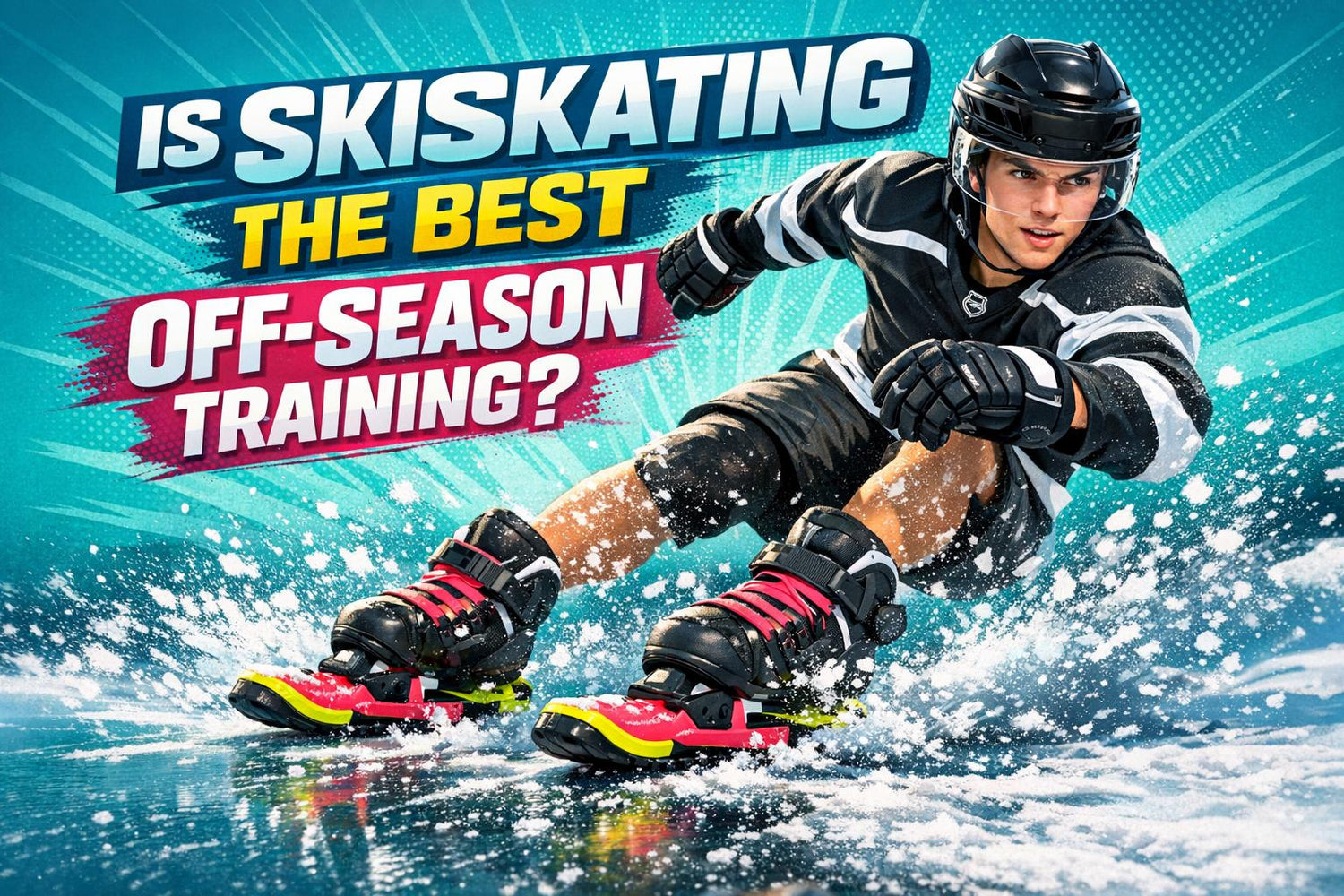
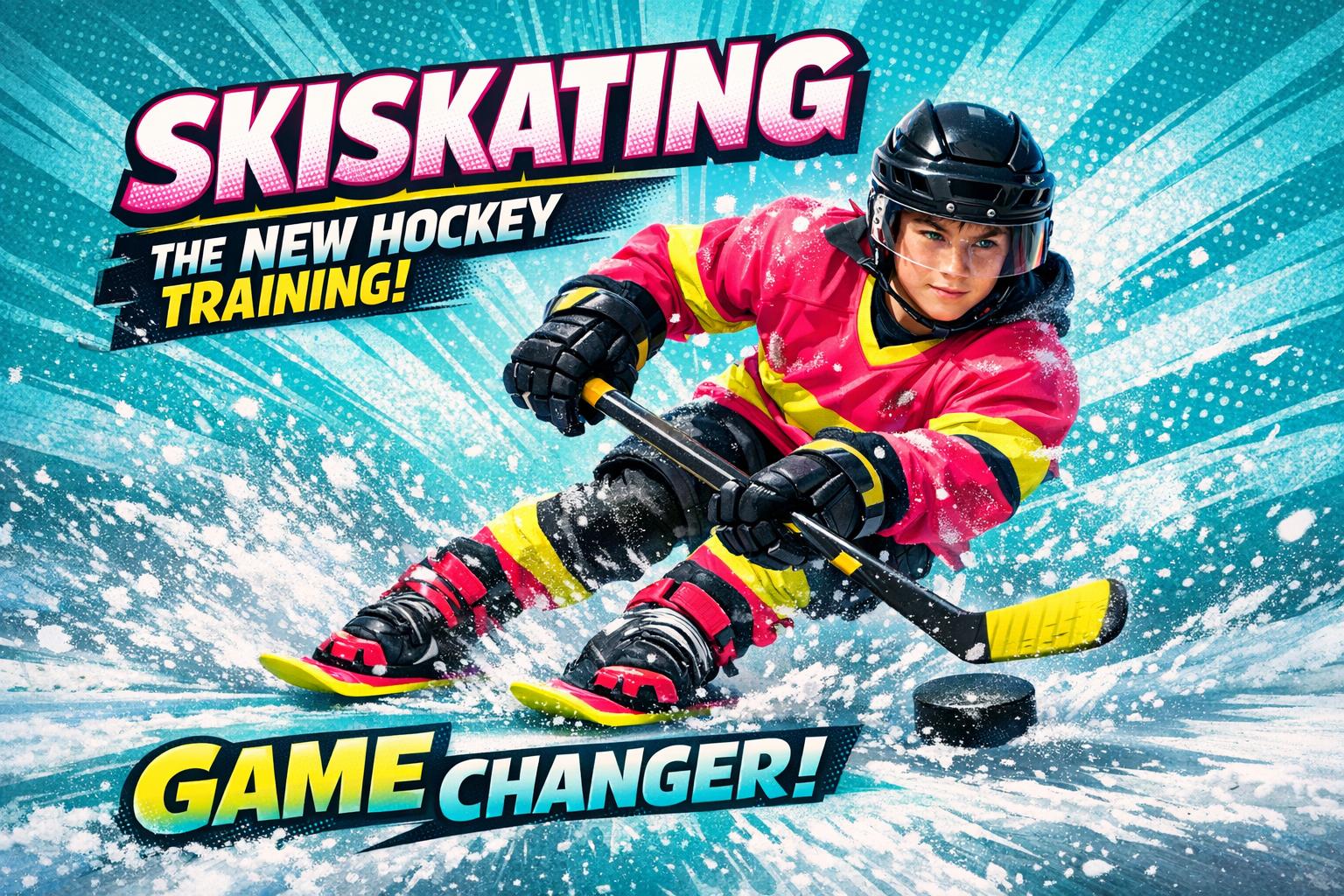
Yes, skiskating could be a great off-season training option for hockey players. Here’s why:
- Mimics Hockey Movements: Skiskates replicate the lateral pushes, balance, and edge work hockey players use on the ice.
- Portable & Easy to Use: Unlike skis or snowboards, skiskates are compact (17 inches) and fit in a backpack. They work with regular winter boots, so no extra gear is needed.
- Builds Strength & Agility: Every stride targets the same muscles as skating - glutes, quads, and hip flexors - while improving balance and coordination.
- Quick to Learn: If you’ve ice-skated or inline skated, you’ll pick it up in minutes.
Snowfeet* Skiskates stand out for their design and versatility. They’re perfect for drills like slaloms or uphill strides, and they work on snowy trails, sledding hills, or even your backyard. With prices starting at $250, they’re a practical tool for hockey players to stay sharp during the off-season.
Bottom Line: Skiskating is an effective, fun way to keep your skating muscles in shape when the rink’s closed.
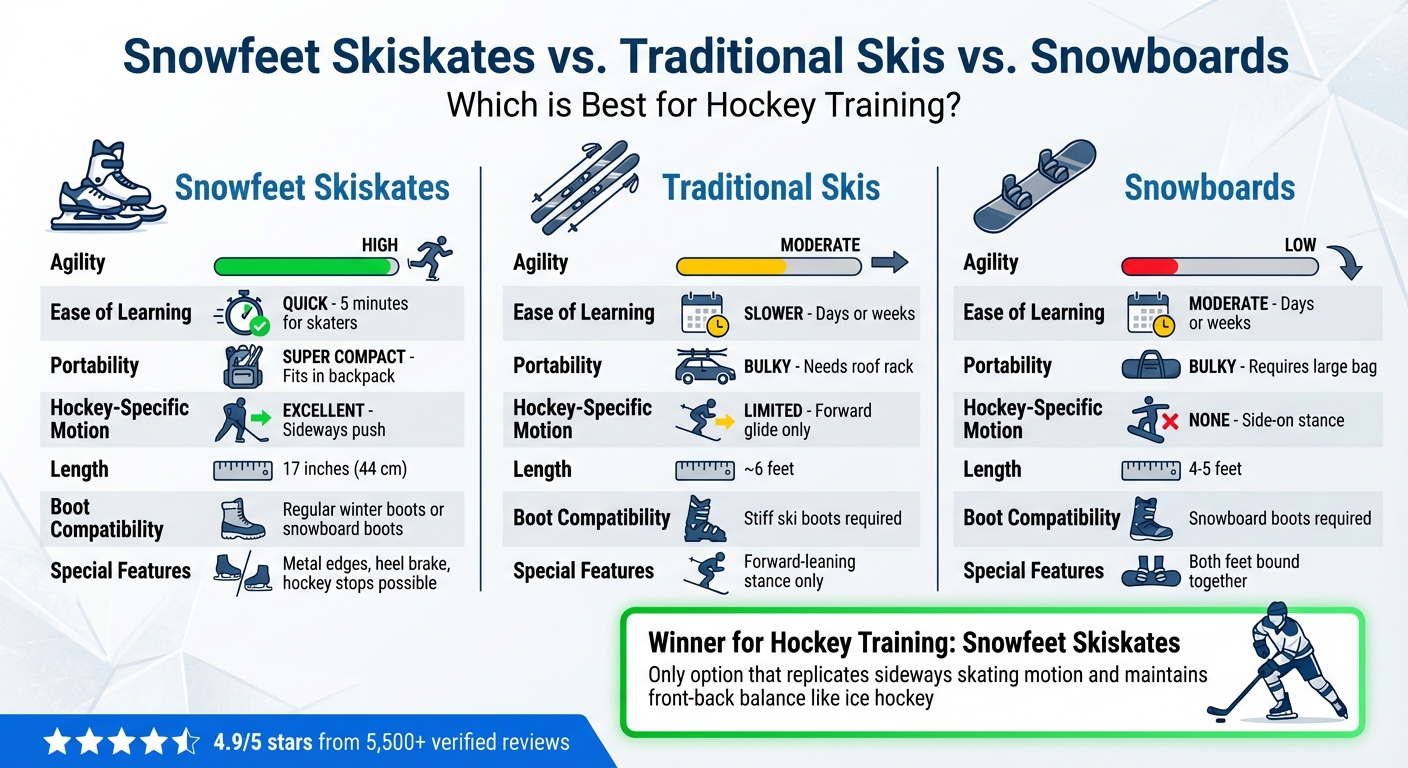
Snowfeet Skiskates vs Traditional Skis and Snowboards Comparison
The First Standard to DOWNHILL SKATING
What is Skiskating?
Skiskating is a winter sport that blends the fluid motion of ice skating with the snowy terrain of skiing. Instead of the long, traditional skis, skiskates are compact - measuring less than 20 inches - offering a whole new way to glide across snow.
If you’ve ever ice-skated or used inline skates, the movements will feel second nature. The best part? You’re not tied to groomed ski slopes. Skiskating works just as well in snow parks, hiking trails, or even your local sledding hill. This versatility makes Snowfeet* Skiskates a perfect tool for off-season hockey training.
Snowfeet* Skiskates: Design and Features
Snowfeet* Skiskates are 17 inches (44 cm) long, striking a balance between the stability of skis and the agility of skates. They come equipped with metal ski edges for carving, a high-quality binding system, and a built-in heel brake for controlling your speed.
One standout feature is their compatibility. You can use them with regular waterproof winter boots or snowboard boots - no need for stiff, traditional ski boots. They fit shoe sizes ranging from 6 to 13 US (38 to 47 EU), making them accessible to a wide audience. Plus, they’re super portable. Unlike skis or snowboards that require roof racks or oversized bags, skiskates can easily fit into a backpack. With over 5,500 verified reviews and an impressive 4.9-star average rating, users often highlight their convenience and ease of use.
Pricing starts at $575 for the Skiskates (44 cm), $275 for the Snowfeet PRO (50 cm), and $250 for the Snowfeet Mini Ski Skates (38 cm). All models are approved for ski resort use, thanks to their metal edges that meet the same standards as regular skis.
This thoughtful design not only makes them portable but also perfect for replicating the skating movements hockey players rely on.
How Skiskating Replicates Hockey Movements
Skiskating mimics the mechanics of hockey skating almost perfectly. With Snowfeet* Skiskates, you’ll use the same sideways pushing motion hockey players rely on to build speed, and you can stop using either a hockey stop or the built-in heel brake. Their shorter length allows for quick turns and precise maneuvers that are nearly impossible with traditional skis.
Balance plays a key role. Unlike traditional skiing, where you lean forward on your toes, skiskating requires you to distribute your weight over the middle or back of your feet. Turning involves tilting the skiskates onto their metal edges and shifting your body weight, much like carving on ice skates.
"You have to keep the front-back balance, so it feels very natural to those who play ice hockey, ice skate, or even use inline skates".
This similarity to on-ice movements helps reinforce muscle memory and balance - both critical for hockey players. In fact, research from Charles University suggests that off-ice agility training, like skiskating, can directly improve on-ice skating performance. And for many users, the learning curve is surprisingly short. Some say you can pick up the basics in just five minutes.
Why Snowfeet* Skiskates Beat Traditional Skis and Snowboards
Let’s break down how Snowfeet* Skiskates stack up against traditional skis and snowboards. Spoiler alert: they’re a game-changer for hockey players and anyone looking for a new way to hit the slopes.
Snowfeet* Skiskates vs. Traditional Skis and Snowboards
Traditional skis lock you into a forward-leaning stance, while snowboards bind both feet, making independent leg movement nearly impossible - something hockey players rely on. Snowfeet* Skiskates, on the other hand, let you skate sideways and maintain that critical front–back balance, just like on the ice.
Here’s a quick comparison:
| Feature | Snowfeet* Skiskates | Traditional Skis | Snowboards |
|---|---|---|---|
| Agility | High | Moderate | Low |
| Ease of Learning | Quick (about 5 minutes for skaters) | Slower (days or weeks) | Moderate (days or weeks) |
| Portability | Super compact (fits in a backpack) | Bulky (needs a roof rack) | Bulky (requires a large bag) |
| Hockey-Specific Motion | Excellent (sideways push) | Limited (forward glide only) | None (side-on stance) |
With Snowfeet* Skiskates, you can pull off hockey stops, sharp turns, and explosive direction changes thanks to their metal edges. Try doing that with 6-foot-long skis - it’s nearly impossible without a ton of practice.
"You are able to move freely as opposed to wearing heavy clunky skis."
- Snowfeet Team
Another win? Snowfeet* Skiskates are so compact they fit in your backpack. Forget lugging around bulky skis or snowboards. You can hit up a sledding hill, a hiking trail, or even your backyard - no ski resort needed. Plus, they work with regular winter boots or snowboard boots, so no stiff, uncomfortable ski boots required.
And that’s just scratching the surface. Beyond their clear edge over traditional gear, Snowfeet* Skiskates are a powerhouse for hockey training.
Benefits of Snowfeet* Skiskates for Hockey Training
Snowfeet* Skiskates don’t just mimic skating motions - they take hockey training to the next level. A study on U16 hockey players found that agility training improved weave agility by 2.9% and reactive agility by 3.1%. The mechanics of skiskating demand the same precise balance and core stability you need on the ice, reinforcing those skills.
These skiskates also deliver a killer lower-body workout. Every sideways push fires up your glutes, quads, and hip flexors - the exact muscles that power your hockey stride. Their short length forces you to stay balanced over the middle or back of your feet, strengthening the stabilizing muscles in your ankles and core. Traditional skis just don’t offer this kind of targeted muscle engagement since they rely on length and forward-leaning stability.
Hockey players pick up Snowfeet* Skiskates fast because the movements feel natural. You’re already used to them from ice skating or inline skating. Compare that to skiing, which can take weeks of lessons to master - and those skills don’t really transfer to hockey.
"You have to keep the front–back balance, so it feels very natural to those who play ice hockey, ice skate, or even use inline skates."
- Snowfeet Team
When the ice is off-limits in the off-season, Snowfeet* Skiskates keep your skating muscles sharp and your muscle memory intact. They don’t just fill the gap - they’re a superior training tool for hockey players looking to stay game-ready.
sbb-itb-17ade95
How to Train with Snowfeet* Skiskates
Drills for Agility and Strength
If you're using Snowfeet* skiskates to level up your hockey training, there are some drills that can really sharpen your agility and build strength. Start on flat, groomed snow with your legs shoulder-width apart, knees slightly bent, and your weight balanced - just like your stance on the ice.
Try slalom drills to improve stability and motor control. The T-Drill is great for building edging power with explosive pushes, while the Speed Skater drill mimics those side-to-side weight shifts you use in hockey. For balance, the Self-Righting Hop Drill is a winner - it helps you stabilize on one gliding foot. You can also work on edge pressure with dynamic drills.
Want to build strength? Try skating uphill with powerful strides or practice the Outside-In Skate Push along a marked line to fine-tune your lateral movements. To stop, use a hockey stop by sliding your edges sideways or rely on the heel brake. For backward skating, shift your weight onto your toes with your heels slightly lifted. These drills mirror the movements you’d make on ice, so they’re perfect for keeping your skills sharp during the off-season.
Where and How Often to Train
Once you’re comfortable with the drills, think about where and how often to train. The beauty of Snowfeet* skiskates is their portability - you can train almost anywhere with a few inches of snow, whether it’s a sledding hill, a park, or even your backyard.
Start with 20 to 30-minute sessions about three times a week. Begin on flat terrain to get the hang of the skiskates, then move on to slopes or forest trails as your confidence grows.
Picking the Right Snowfeet* Model
For hockey-specific training, the 44 cm Skiskates and the 50 cm Snowfeet PRO are your best bets. These models are designed to replicate on-ice movements exceptionally well. The 44 cm Skiskates feature a sustainable wood core and cap construction, handmade in Europe, and boast a perfect 5.0/5 user rating. They feel just like ice skates on snow. On the other hand, the Snowfeet PRO (50 cm) comes with a fiberglass-reinforced core and is priced at $207 (normally $250), making it a solid choice for value and performance.
"I used to play ice hockey so Skiskates are perfect for me. It's exactly like ice skating on snow."
- Giovanni, Italy
For the best experience, pair your skiskates with snowboard boots for comfort and flexibility during tricks. If you prefer a faster, more aggressive ride, go with ski boots for their rigid control. Both the 44 cm and 50 cm models come with adjustable, tool-free bindings that fit most sizes (US 6–13.5 / EU 38–49). If balance is your main focus, the 65 cm Skiblades are an option at $550, but they’re not as effective for replicating hockey movements.
Conclusion: Snowfeet* Skiskates for Off-Season Hockey Training
Snowfeet* Skiskates are a game-changer for off-season hockey training. They bridge the gap between dryland workouts and on-ice performance by mimicking the same mechanics you use on the ice. Unlike skis or snowboards that require entirely different movements, these skiskates let you train in a way that directly translates to better on-ice performance. Research backs this up, showing that off-season training with hockey-specific movements can improve your game when you’re back on the ice.
One standout feature is their portability. Thanks to their compact design, you can train almost anywhere - no need for fancy ski resorts or expensive gear. You don’t even need specialized ski boots; your regular winter or snowboard boots will do just fine. Plus, with over 5,500 verified reviews averaging 4.9 out of 5 stars, it’s clear these skiskates are making an impact for hockey players and skaters alike.
"The improvement in on-ice skating sprint performance when supplemental training progressed in specificity supports the principle of specificity and promotes transfer to a complex sporting movement such as skating." – PubMed Abstract, Journal of Strength and Conditioning Research
Whether you choose the 44 cm Skiskates or the Snowfeet PRO models, both are designed to handle agility drills, edge work, and explosive movements. These skiskates are built to meet the demands of off-season hockey training, helping you stay sharp and ready to hit the ice at full speed when the season returns.
FAQs
How can Snowfeet Skiskates help hockey players train effectively during the off-season?
Snowfeet Skiskates are a fantastic off-season training tool for hockey players because they closely mimic the on-ice skating motion. Their compact 17-inch size encourages a low, forward-leaning stance and side-to-side strides, helping players practice the edge work and stride mechanics that are so important in hockey. Plus, they target key muscle groups like the hips, knees, and ankles, all while keeping those skating-specific movement patterns sharp.
Unlike traditional skis or snowboards, these skiskates are lightweight and strap on like regular shoes. This design lets players perform quick turns, lateral moves, and stop-and-go drills on flat, snowy surfaces. They’re practical, easy to use, and tailored for hockey-specific training. Whether you’re working on explosive starts or mastering tight turns, Snowfeet Skiskates are a great way to stay sharp and build strength during the off-season.
Why are Snowfeet Skiskates better than traditional skis for off-season hockey training?
Snowfeet Skiskates are built to replicate the sharp, lateral movements hockey players rely on during a game. At just 17 inches long, these compact skates allow for quick, edge-to-edge transitions that feel a lot like the agility and stride hockey demands - something you just can’t get with traditional skis. And the best part? They strap right onto your regular winter shoes or snowboard boots, skipping the hassle of clunky ski boots for a more natural experience.
Made from tough fiberglass-reinforced plastic with metal edges, these skiskates offer solid control while staying lightweight and easy to carry. Unlike traditional skis, they’re a breeze to transport, set up, and even use on flat snow surfaces. This makes them perfect for quick drills or versatile training sessions. For hockey players wanting to keep their balance, agility, and lower-body strength sharp during the off-season, Snowfeet Skiskates are a no-brainer.
Can beginners learn skiskating easily without any ice skating experience?
Snowfeet* Skiskates are perfect for beginners - even if you’ve never set foot on an ice rink before. At just 17 inches long, these compact and lightweight skiskates are a breeze to handle compared to bulky skis or snowboards. Plus, they attach right to your regular ski or snowboard boots, so there’s no need to invest in extra gear.
Their short length and low profile give you great control, making it easier to pick up the side-to-side motion. It’s a bit like ice skating, but on snow! This setup helps beginners feel more comfortable and confident, making the learning curve much less steep. In fact, many first-timers, including kids, can start gliding down gentle slopes after just a few minutes of practice. If you’re looking for a fun and easy way to dive into winter sports, Snowfeet* Skiskates are a fantastic choice!











Leave a comment
This site is protected by hCaptcha and the hCaptcha Privacy Policy and Terms of Service apply.