




















Skiskating is like taking your hockey skills to the snow. Instead of ice, you use short skis (under 50 cm) that strap onto winter or snowboard boots. These let you mimic hockey movements like lateral pushes, sharp turns, and hockey stops - but on packed snow. It’s a portable, budget-friendly training tool that helps hockey players stay sharp when ice time is hard to get. You can train on local hills, parks, or trails without needing expensive ski passes or bulky gear.
Why try skiskating?
- Improves skating mechanics off-ice (lateral pushes, edge control).
- Strengthens key muscles (glutes, quads, core).
- Great for short, intense workouts that mimic hockey shifts.
- Easy to carry and use anywhere with snow.
Snowfeet Skiskates (44 cm) are the go-to option for hockey players, offering a close-to-ice experience. They’re compact, easy to learn, and perfect for drills like figure-8s, sprints, and stops. Want to up your game year-round? Skiskating might be your secret weapon.
How Skiskating Works
Skiskating vs. Hockey Skating Movements
Skiskating mirrors hockey skating techniques in ways traditional skiing just can’t. The key movement? That lateral push. You drive off to the side with each stride, just like you would when accelerating from a standstill on ice. As Snowfeet* puts it:
Begin your motion by pushing off to the side like a hockey player.
This side-to-side motion activates the same muscles - hips, glutes, and quads - that hockey players rely on during power skating drills.
Another shared feature is edge control. The metal edges on Snowfeet* Skiskates let you carve turns and switch directions with precision, much like skating on ice. To stop, you use a hockey stop: angle your skates, spread your weight evenly across both feet, and let the edges dig into the snow. Stabilizing your weight is key to pulling this off smoothly.
At just 17 inches (44 cm) long, Snowfeet* Skiskates are about the size of a hockey blade. This small size makes quick pivots, backward skating, and sharp transitions a breeze - things that are tough to pull off with traditional skis, which often measure over 150 cm. This compact design brings hockey-like movement to the slopes, setting up a unique experience.
Snowfeet* Skiskates Features
Snowfeet* Skiskates hold the title as the world’s shortest skis, measuring just 44 cm. Their compact size enhances agility, balance, and coordination - skills that are essential for hockey-style performance. The lightweight build makes moves like edge control, lateral pushes, and quick transitions much easier than with traditional skis.
These skiskates attach directly to ski boots or snowboard boots, giving you the ankle support you need for dynamic movements on the slopes. Unlike traditional skis that often force you into a straight-line path, Snowfeet* Skiskates allow for natural lateral movement, mimicking a hockey stride. Many hockey players and figure skaters report that the balance feels intuitive, letting them perform spins and skate backward almost right away. The metal edges make carving and stopping effortless, and since most ski resorts accept them, you won’t run into issues hitting the slopes. Plus, their small size means you can toss them in a backpack - try doing that with traditional skis!
With over 50,000 riders worldwide and a glowing 4.9/5-star rating from more than 5,500 verified reviews, Snowfeet* Skiskates have clearly made an impact. They were even a finalist at ISPO, the world’s largest sports equipment trade show. Pro skater Logan shared his excitement:
I can rip all of my inline tricks on these! Boxes and jumps and spins are all fresh and new but familiar enough to learn without bailing too much!
Thanks to these features, picking up the basics feels natural and fun.
Basic Techniques and Setup
To make the most of the hockey-inspired mechanics, getting your stance and setup right is crucial. Start with a shoulder-width stance and a slight forward lean to keep stable and replicate the hockey stride. Bend your knees to stay flexible and ready to handle changes in terrain.
Stopping is all about mastering the hockey stop. Angle your skates, engage those metal edges, and you’re good to go. If you’re still getting the hang of it, the integrated heel brake offers a gradual way to slow down until you’re comfortable with the stop. For efficient strides, focus on fully extending your hips, knees, and ankles. Avoid short, choppy steps - keep a deep knee bend for smooth, piston-like leg action, just like on ice.
Choosing the right boots also makes a big difference. For slope control, pair Snowfeet* Skiskates (44 cm) with ski boots or snowboard boots. If you’re planning a casual outing on hiking trails or sledding hills, the smaller Snowfeet (38 cm) can attach directly to winter hiking boots. Always wear protective gear for high-energy sessions, and keep your skiskates in top shape by regularly waxing fiberglass-reinforced models. This keeps them fast and prevents snow from sticking to the base.
How similar is skiing to skating?
Training Benefits for Hockey Players
Snowfeet Skiskates vs Traditional Skis and Snowboards for Hockey Training
Physical Performance Improvements
Using Snowfeet* Skiskates for training can give hockey players a serious edge. The lateral pushing motion strengthens key muscle groups like the glutes, quads, and adductors - muscles that are vital for crossovers, edge control, and quick transitions on the ice. Every stride helps build the muscle memory needed for explosive starts and holding your ground during those intense board battles.
What’s more, Snowfeet* Skiskates challenge your core stability and balance in a unique way. With their compact 44 cm platform, your body has to make constant micro-adjustments, keeping your deep core and stabilizer muscles engaged throughout every turn and stop. Unlike the long, smooth glide of traditional skis, skiskating demands sharp, controlled movements, which translates perfectly to hockey scenarios. Plus, the short, intense downhill bursts mimic the energy of a 20–40 second hockey shift, training your body to handle the burn of lactate buildup and recover quickly - just like during a tough game.
Snowfeet* vs. Skis and Snowboards
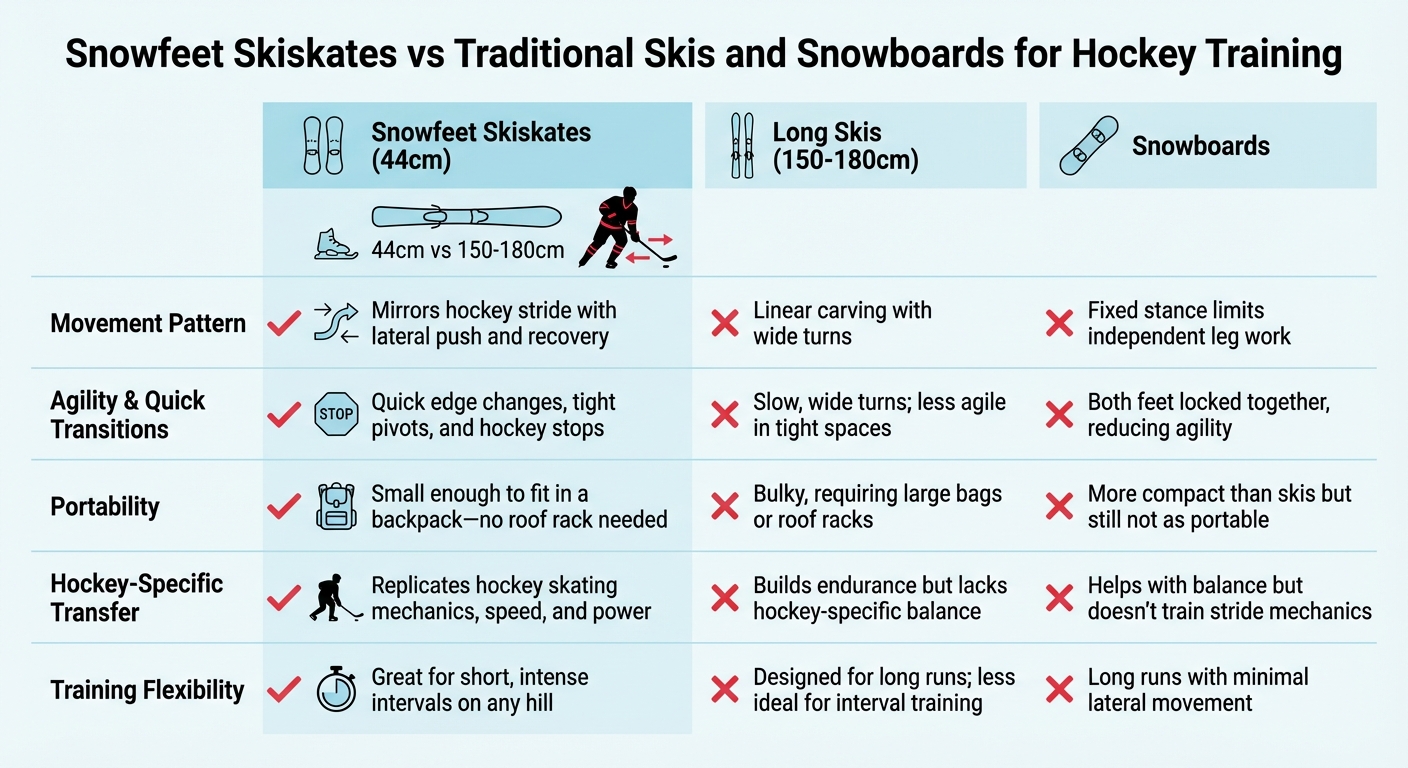
When it comes to hockey-specific training, Snowfeet* Skiskates stand out compared to traditional skis or snowboards. Here's how they stack up:
| Aspect | Snowfeet* Skiskates | Long Skis | Snowboards |
|---|---|---|---|
| Movement Pattern | Mirrors hockey stride with lateral push and recovery | Linear carving with wide turns | Fixed stance limits independent leg work |
| Agility & Quick Transitions | Quick edge changes, tight pivots, and hockey stops | Slow, wide turns; less agile in tight spaces | Both feet locked together, reducing agility |
| Portability | Small enough to fit in a backpack - no roof rack needed | Bulky, requiring large bags or roof racks | More compact than skis but still not as portable |
| Hockey-Specific Transfer | Replicates hockey skating mechanics, speed, and power | Builds endurance but lacks hockey-specific balance | Helps with balance but doesn’t train stride mechanics |
| Training Flexibility | Great for short, intense intervals on any hill | Designed for long runs; less ideal for interval training | Long runs with minimal lateral movement |
The design of Snowfeet* Skiskates keeps your stance and foot positioning almost identical to hockey skates. Staying low, with bent knees and hinged hips, reinforces the alignment and power needed for effective skating on the ice. In contrast, long skis push you into a different posture, and snowboards - where both feet are locked together - don’t allow for the independent leg work that’s crucial for crossovers and one-leg pushes.
And it’s not just about the physical benefits. Skiskating also sharpens your mental game, which is just as important when it comes to hockey.
Mental and Tactical Benefits
Training with Snowfeet* Skiskates isn’t just about building strength and speed - it’s also a mental game-changer. Swapping the rink or gym for snowy hills adds a sense of fun and novelty to your workouts, making them feel less like a grind. This change of scenery can keep you motivated and help you stick to your training routine during the offseason.
As you master the balance challenges and new movements that skiskating throws your way, your confidence grows. And that confidence carries over to the ice, helping you make quicker, sharper decisions in the heat of the game. Drills like weaving through markers, navigating obstacles, or partner exercises where one player closes space on another sharpen your ability to read space and adjust your body positioning. These skills directly translate to in-game scenarios, like defensive angling or maintaining tight gap control, giving you a tactical edge when it matters most.
sbb-itb-17ade95
Snowfeet* Products for Hockey Players
Best Snowfeet* Models for Hockey Training
Snowfeet* has three main models tailored to meet different training needs for hockey players. The Snowfeet Mini Ski Skates (38 cm), priced at $190–$250, are the most compact option. Their small size makes them perfect for agility drills, quick edge changes, and tight turns - ideal for defensive maneuvers. These are especially great for younger players or anyone focusing on improving footwork speed.
Next up, the Snowfeet Skiskates (44 cm), costing $490–$575, are the most versatile. Designed with a wood core, they strike a solid balance between stability and maneuverability, closely mimicking the stride mechanics of hockey skating. They're a favorite for off-season conditioning, crossover practice, and acceleration drills on groomed slopes.
For those looking to push their limits, the Snowfeet PRO (50 cm), priced at $250–$275, offers extended glide and speed. The longer platform allows for powerful, extended pushes, helping build leg strength and endurance. This model is perfect for advanced players working on long shifts or straight-line speed. All three models accommodate US shoe sizes 6–13 and are compatible with both winter boots and snowboard boots.
Snowfeet* vs. Ski and Snowboard Brands
Snowfeet* products stand out when compared to traditional ski and snowboard gear, especially for hockey players. Typical alpine skis are 150–180 cm long, require bulky boots, and often need a trip to a full-scale resort. In contrast, Snowfeet* models are compact and lightweight, making them perfect for quick training sessions on local hills.
The movement patterns with Snowfeet* are far more specific to hockey. Traditional skis focus on long, sweeping turns, and snowboards lock both feet in place, which limits independent leg movement. Snowfeet* models, however, allow for quick lateral motions, hockey stops, and weight transfers - all critical for on-ice performance. As the Snowfeet team explains:
The movement associated with skiskating is closer to skating on snow more than anything else. So if you are a hockey player or an ice skater, you will find it quite easy.
Accessories and Maintenance
To keep your Snowfeet* gear performing at its best, proper maintenance and the right accessories are key. Replacement straps (priced at $20–$40 per set) ensure a snug fit, giving you the locked-in feel of hockey skates and preventing slippage during sharp cuts and stops. Regularly applying liquid wax ($15–$40) to the base helps maintain a smooth glide and prevents snow from sticking - much like sharpening skates before practice.
For icy terrain, metal edge tuners are essential for keeping edges sharp, improving grip, and ensuring precise control. After each session, make sure to wipe the edges dry to avoid rust. For long-term storage, applying a thin layer of oil to the metal can protect it from corrosion. If you're using snowboard boots for more aggressive training, additional straps are available to accommodate larger sizes.
How to Use Skiskating in Training
Offseason and In-Season Training Plans
Skiskating is most effective as an offseason training tool, especially during the summer months (June–August). For younger athletes (ages 8–12), aim for two 20–30 minute sessions per week on gentle hills. These sessions should focus on mastering the basics: gliding, stopping, and maintaining balance. For high school players, step it up to two or three sessions weekly, each lasting 30–45 minutes. Incorporate interval-style hill repeats, lateral cuts, and short bursts of acceleration to mimic on-ice sprinting patterns. College-level and adult players can take it even further with three 30–60 minute sessions weekly, treating skiskating as a form of dryland sprint training to build lower body strength and mental resilience.
Once the hockey season kicks off (October–March), it’s important to scale back the intensity to avoid overtraining. Use skiskating as an occasional supplement - once a week or every other week - with shorter 15–25 minute sessions. These should be scheduled on lighter practice days or non-game days, with at least 24 hours of recovery time before games or heavy practices. Focus on technique, balance, and light conditioning rather than high-intensity drills. Some drills to try include:
- Lateral shuffle and crossover runs on gentle slopes: Great for practicing defensive movements like gap control.
- 5–10 second downhill sprints with controlled stops: Mimics breakaway speed and stopping precision.
- Figure-8 patterns around cones: Helps refine tight turns and edge control.
These exercises not only improve on-ice skills but also reinforce lateral movement and stopping techniques that are crucial for hockey performance.
Once you’ve set your training schedule, picking the right terrain can make all the difference.
Choosing the Right Terrain
For longer intervals and technique work, groomed green and easy blue ski runs are ideal. These provide smooth, consistent surfaces that let you focus on perfecting your form. If you’re looking for a more convenient option, neighborhood sledding hills or city parks are perfect for short sprints, hill repeats, and agility drills - no resort pass required. Beginners or those working on recovery can use backyards or flat, open spaces with packed snow to practice balance and basic strides.
Because Snowfeet* Skiskates are only 44 cm long, they’re perfect for tight spaces where traditional skis (which are usually 140–180 cm long) would be impractical. This makes them a great option for quick turns, stops, and direction changes in smaller urban or suburban areas.
When choosing your terrain, prioritize safety. Stick to gentle or moderate slopes where stopping is easy - think beginner ski runs or small sledding hills. Packed snow works best; avoid deep powder (over 10 cm), bare ice, or any area with obstacles like trees, rocks, fences, or roads. And remember to check local rules to make sure you’re skating in permitted areas.
Once you’ve found the right spot, following safety guidelines is key to staying injury-free and getting the most out of your sessions.
Safety Tips and Common Mistakes
Gear up properly before every session. Wear a certified helmet, gloves, knee and elbow pads, and sturdy winter boots. Many hockey players use their existing protective gear, which works perfectly. Always double-check that your Snowfeet* bindings are securely fastened - tight enough to prevent movement but not so tight that they cut off circulation.
One common mistake to avoid is standing too upright. To maintain proper form, keep your knees and hips flexed and your core engaged. This not only improves skating mechanics but also sharpens your hockey stride, edge control, and overall stance. Another frequent error is jumping into fast runs before mastering stops. Start with flat or gently sloped terrain and gradually work your way up to steeper hills. Skipping protective gear or tackling challenging slopes too soon can lead to accidents, so take it slow and steady.
Because skiskating movements closely resemble ice skating, hockey players often find it easy to transition to this off-ice training method. Begin with shorter sessions to make sure your setup feels comfortable and responsive before diving into more advanced drills.
Conclusion
Using Snowfeet* Skiskates (44 cm) is a smart way for hockey players to stay sharp all year. By practicing lateral pushes, weight shifts, and skating-like strides on snow, you’re reinforcing the same movements that power quicker acceleration, tighter turns, and better edge control on the ice. It’s a sport-specific way to train the exact muscles and mechanics you rely on in every game shift.
Skiskating isn’t just about keeping your skills sharp - it also boosts agility, balance, and lower-body endurance while keeping skating fundamentals fresh. Unlike heavy skis or snowboards, Snowfeet* Skates are small, lightweight, and feel a lot like your ice skates. Toss them in your backpack, head to a nearby park or hill, and get in some quality hockey-specific training without needing a lift ticket or a mountain resort.
To keep things efficient, start with one or two sessions a week during the offseason. Focus on balance, smooth turns, and short bursts on moderate slopes. Once you’re comfortable, ramp it up with drills like lateral shuffles, figure-8s, and hill sprints to simulate game scenarios. These sessions directly enhance your speed and agility on the ice. Plus, they’re a perfect complement to your regular strength and mobility routines.
Whether you’re a young player fine-tuning your stance or a seasoned athlete chasing an edge, Snowfeet* Skiskates are a great tool to add to your training arsenal. Check out the Snowfeet* lineup, from the 38 cm Mini Ski Skates to the performance-focused 44 cm version, and take your hockey game to the next level. Train smart, skate strong, and dominate on the ice.
FAQs
How does skiskating with Snowfeet compare to traditional skiing and snowboarding for hockey training?
Skiskating with Snowfeet Skiskates is a fantastic off-ice training tool for hockey players. Unlike traditional skiing or snowboarding, which require longer gear and entirely different techniques, these compact skates are designed to mimic the movements of skating on ice. At just 44 cm long, they allow for side-to-side pushes, quick edge transitions, and maintaining a low center of gravity - all essential for hockey. Traditional skis and snowboards, on the other hand, focus more on carving and core stability, which don’t quite match the lateral agility and footwork hockey demands.
Another big plus? Snowfeet Skiskates are practical and budget-friendly. With prices starting at $140, they’re a fraction of the cost of typical ski or snowboard equipment, which can easily run into the hundreds. They’re also super lightweight - about 3.5 lbs - making them easy to carry around. The best part is how intuitive they are to use. The stance and techniques closely resemble a hockey player’s posture, so the learning curve is small. For hockey players, skiskating isn’t just a fun way to stay active - it’s an affordable and portable way to sharpen skills and boost agility during the off-season.
How can Snowfeet Skiskates help hockey players train effectively during the offseason?
Snowfeet Skiskates offer hockey players an awesome way to keep their skills sharp during the offseason. These lightweight and portable skiskates are perfect for boosting agility, balance, and core strength, all while delivering a cardio workout that feels a lot like skating on ice. Unlike bulky skis or snowboards, they’re super easy to pick up and way more convenient, making them ideal for quick training sessions.
Their compact design helps players work on weight distribution and stability - key skills that transfer directly to the ice. On top of that, they’re an affordable and fun alternative to traditional winter sports gear, giving players a fresh way to stay in top shape when hitting the rink isn’t an option.
Which Snowfeet model is best for hockey training during the offseason?
Choosing the right Snowfeet model boils down to your training goals, skill level, and personal preferences. If you're a hockey player aiming to boost agility and replicate on-ice movements, the Skiskates (44 cm) are your best bet. These are built for quick edge work, sharp turns, and skating-style techniques - perfect for keeping your skills sharp in the offseason.
For beginners or those focusing on light conditioning, the Mini Skis (38 cm) are a solid choice. They’re lighter, easier to handle, and great for improving balance. On the other hand, if you’re training on varied terrain or need more stability, the PRO model (50 cm) is the way to go. With a larger surface area, it offers better control during longer sessions.
All Snowfeet models are designed to fit U.S. shoe sizes 6–13 and can attach to winter shoes or snowboard boots. Prices range from $140 for the Mini Skis to $330 for the Skiskates, so there’s something for every budget and training style. Pick the model that suits your hockey training needs and make winter workouts both fun and effective!













Leave a comment
This site is protected by hCaptcha and the hCaptcha Privacy Policy and Terms of Service apply.