



















Want to learn skiing without the hassle of lessons or bulky gear? Short skis, like Snowfeet Skiblades, make it possible.
Here’s why they work:
- Quick Learning: Most people pick up the basics in 5 minutes.
- Easy Control: Short skis move naturally with your body, making them beginner-friendly.
- Affordable: Starting at $550, they’re cheaper than traditional setups.
- Portable: Small enough to fit in a backpack - no need for car racks.
Whether you're new to skiing or looking to spice up your skills, short skis offer a fun, lightweight, and practical way to hit the slopes. Ready to skip lessons and start gliding? Let’s dive in!
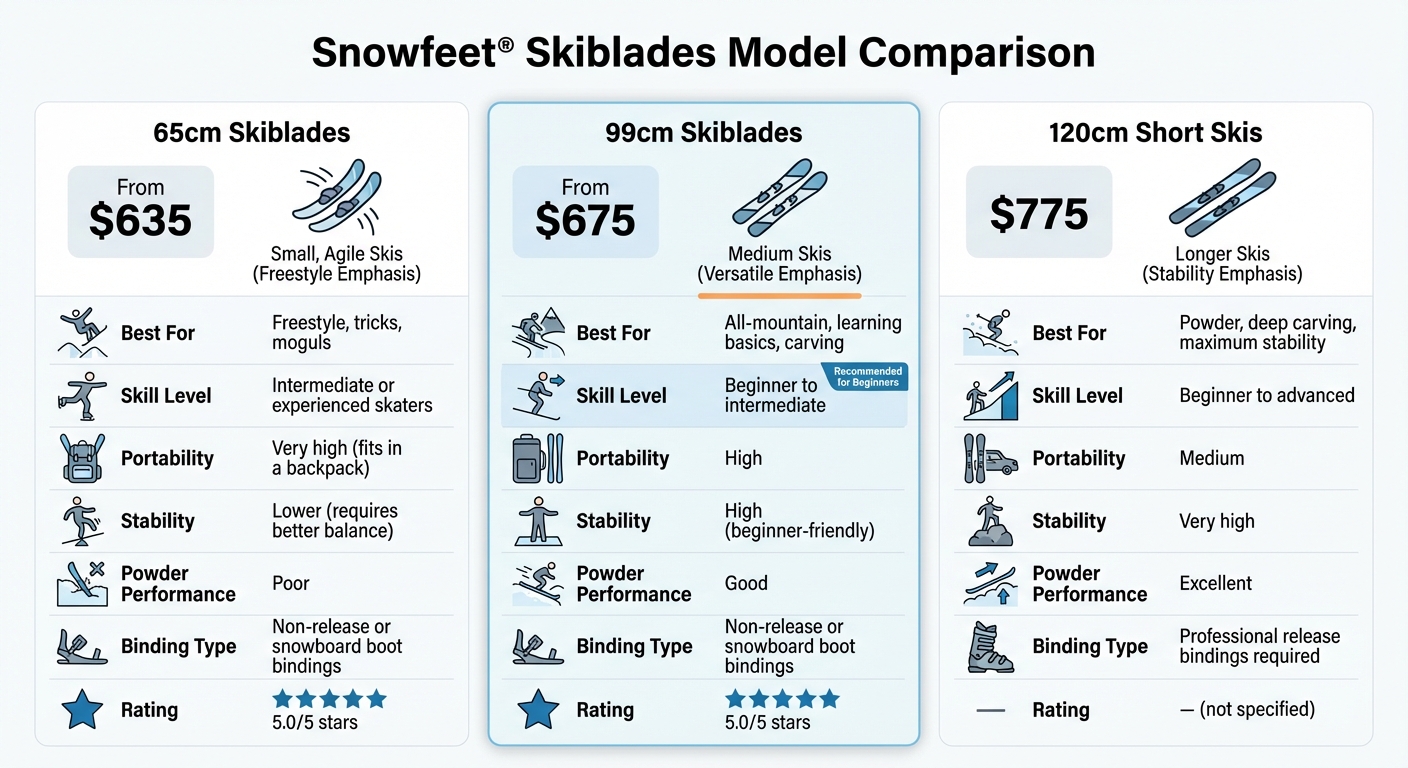
Snowfeet Skiblades Model Comparison: 65cm vs 99cm vs 120cm
Basic Techniques for Short Skis
Body Position and Balance Fundamentals
Getting your stance right is step one. Start with your feet about shoulder-width apart - spreading them too far can make it harder to stay in control. Short skis require a more upright posture compared to traditional skis. Leaning forward like you would on longer skis can throw you off balance. Instead, keep your weight centered over the middle and back of your feet. As the Snowfeet Team puts it:
"Don't lean forward like you would do with skis... instead, stand up straight and place your weight over the middle and back of your feet."
Think of it like a linebacker’s stance: knees bent, ankles flexed, hips loose, and your upper body steady. For extra stability, try staggering your feet slightly, with one foot just ahead of the other. Once you’ve nailed this solid, balanced position, you’re ready to move on to gliding and turning.
How to Start Moving and Make Turns
With your balanced stance locked in, it’s time to get moving and practice turning. On flat terrain, start by pushing off with one foot, gliding, and then alternating to the other. Thanks to their short and responsive design, Snowfeet* Skiblades make this movement feel natural and smooth.
For turning, begin with a wedge shape - push your heels out to form a "V." Shift your weight to the outside ski (the one opposite the direction you want to turn). Once you’re comfortable, you can step up to parallel turns. Keep your skis side-by-side as you turn. Timing is everything here: as you enter the fall line (when your skis point downhill and are easiest to pivot), twist them in the direction you want to go. As you come out of the turn, you’ll feel pressure build up, and that’s when your edges grip the snow to finish the turn.
To stop, spread your weight evenly across both feet and push your edges sideways to create friction. If your Snowfeet* Skiblades have heel brakes, you can also drag your heels for quick speed control. The 65 cm (about 25 in) model is great for sharp, nimble moves, while the 99 cm (about 39 in) model offers more stability for smoother rides.
Building Speed and Handling Different Terrain
Gaining Speed on Groomed Runs
Want to pick up speed on groomed runs? Start with a skating motion and a staggered stance. On flat sections, try a hockey-style push to get moving faster. Keeping one foot slightly ahead of the other helps with stability as you gain momentum.
If you're using fiberglass Snowfeet* models, regular waxing is a must. A coat of liquid wax on the base keeps snow from sticking and ensures a smoother, faster glide. For those chasing serious speed and carving precision, the 99 cm (39 in) or 120 cm (47 in) Snowfeet* Skiblades are a game-changer. They provide more stability and a better glide on groomed runs.
"My first run the skis did shake but soon thereafter by distributing better my weight on my toes - I was flying like never before. Going fast I was in complete control of every move, turns, and stops."
- Daniel Siouffi, Verified Rider
These tips will have you zipping down groomed trails and ready to take on more challenging terrain.
Riding Powder and Backcountry Trails
When it comes to powder and backcountry trails, you’ll need to tweak your technique. Standard Snowfeet* models work well in light powder up to 4 inches (10 cm). But if you're dealing with deeper snow, the 99 cm or 120 cm models are your go-to options to avoid sinking. As the Snowfeet Team puts it:
"Snowfeet* handle light powder up to 10 cm, but for real powder riding go with Snowfeet* Skiblades 99, 120, or 99 Powder."
Short skis like these are best on firm, packed snow. On rough terrain with crusty layers or post holes, you might need to side-step to avoid catching the shorter length on obstacles. Skier cantunamunch shares this insight:
"They're great for having on your pack IF you have a completely packed return path... They're usable-but-not-pleasant on extra firm snow if you are a good skater."
For serious off-trail adventures, check out the 100 cm Walkski Backcountry model, starting at $690. It’s designed for both uphill walking and downhill rides. Unlike traditional setups that require pricey AT boots and bindings, Snowfeet* work with your regular winter or snowboard boots. Plus, their lightweight and portable design makes them a fantastic choice for exploring untouched trails. If you're all about self-guided backcountry fun, these could be your perfect match!
Learning Tricks and Snowpark Skills
Starting with Simple Tricks and Small Jumps
Ready to boost your freestyle game? The snowpark is where Snowfeet* Skiblades really come into their own. Thanks to their nimble design, these skiblades make learning tricks smoother and more fun. Start with a shoulder-width stance, keeping one foot slightly ahead of the other. If you're riding backward (switch), shift your weight onto your toes to keep your heels slightly lifted - it’s all about balance.
Small jumps are a great starting point. The 65 cm (26 in) Snowfeet* Skiblades, priced from $635, are perfect for beginners. Their agility and quick turning make them ideal for learning the basics. If you're aiming for bigger jumps, the 99 cm (39 in) or 120 cm (47 in) models provide extra support for clean landings.
"Short boards allow an unrestricted movement necessary for performing tricks but give you support when landing."
– Snowfeet Team
Keep your gear in top shape by waxing the bases and sharpening the edges with a tuning stone. This helps maintain speed and grip. Stick to groomed slopes while you're getting the hang of things, and steer clear of deep powder or steep terrain until you've nailed the fundamentals. Once small jumps feel easy, challenge yourself with rails and boxes to take your skills up a notch.
Moving to Rails, Boxes, and Advanced Features
Once you've mastered the basics, it's time to tackle rails, boxes, and other advanced features. Snowfeet* Skiblades' short design makes quick transitions and adjustments a breeze - something traditional long skis just can't compete with.
When approaching a rail or box, keep your weight centered over your feet. Avoid spreading your legs too far apart, as this can throw off your balance. The 65 cm twin-tip model is great for switch riding and landing, while the 99 cm and 120 cm models offer added stability for tackling more complex features - all without losing that playful edge.
For even more freedom during tricks, consider swapping traditional ski boots for snowboard bindings. They’re more forgiving, comfortable, and make walking around the park much easier.
Short skis are built for the terrain park. Their lightweight and flexible design allows for the kind of unrestricted movement that helps you improve quickly, unlike the bulkier feel of long skis. With Snowfeet* Skiblades earning stellar ratings between 4.9/5 and 5.0/5 from over 5,500 verified reviews, riders rave about their control and how they transform freestyle riding.
"Practice makes perfect, so don't give up and start over and over again until you're a pro!"
– Snowfeet Team
sbb-itb-17ade95
5 Easy Ski Tricks | That Anyone Can Learn
Picking the Right Snowfeet* Model for Your Goals
Choosing the right Snowfeet* model can make learning and improving on the slopes a lot easier - even without formal lessons. Each model is designed with specific riding styles in mind, so matching the gear to your goals can lead to quicker progress and way more fun out there. Here's a breakdown to help you decide which Snowfeet* Skiblade is the best fit for your needs.
If you're a beginner, the 99 cm and 120 cm models are your go-to options. These lengths offer better stability and are more forgiving, which is exactly what you need when starting out. Models shorter than 90 cm can make balancing tricky, so steer clear of those if you're just getting started. The 99 cm model, starting at $675, is a versatile all-rounder. It handles groomed runs well, is easy to maneuver, and is great for practicing turns and carving.
The 65 cm model is perfect for freestyle and tricks, but it’s not for the faint of heart. Priced from $635, this model is all about quick turns, jumps, and rails - ideal for riders with solid balance and maybe a skating background. If you're into moguls or want to focus on freestyle moves, this is your pick.
For powder days and maximum stability, the 120 cm model is the standout choice. At $775, it feels closest to traditional skis but keeps the fun, playful vibe of short skis. It’s great for stable landings in snowparks and offers excellent float in deep snow. Just keep in mind, this model requires professional release bindings for safety, while the 65 cm and 99 cm versions work with simpler non-release or snowboard boot bindings.
Snowfeet* Model Comparison
| Feature | 65 cm Skiblades | 99 cm Skiblades | 120 cm Short Skis |
|---|---|---|---|
| Price | From $635 | From $675 | $775 |
| Best For | Freestyle, tricks, moguls | All-mountain, learning basics, carving | Powder, deep carving, maximum stability |
| Skill Level | Intermediate or experienced skaters | Beginner to intermediate | Beginner to advanced |
| Portability | Very high (fits in a backpack) | High | Medium |
| Stability | Lower (requires better balance) | High (beginner-friendly) | Very high |
| Powder Performance | Poor | Good | Excellent |
| Binding Type | Non-release or snowboard boot bindings | Non-release or snowboard boot bindings | Professional release bindings required |
| Rating | 5.0/5 stars | 5.0/5 stars | - |
Pick the model that matches your riding style and terrain, and you'll be ready to make the most of your time on the mountain!
Conclusion: Get the Most from Short Skis
Snowfeet* Skiblades make picking up short skiing a breeze - no formal lessons required. Most people can get the hang of it in just about 5 minutes. The key to this quick learning curve? Choosing the right model for your style. If you're just starting out, the 99 cm or 120 cm models are great for stability. On the other hand, if you're into tricks and freestyle moves, the 65 cm model might be your go-to.
Taking care of your gear is just as important. Regular waxing keeps snow from sticking and ensures a smooth glide, especially with fiberglass models. A little maintenance goes a long way in keeping your skis performing well and helping you improve at your own pace.
"Long enough to ski, short enough to skate. Easy to Learn and Use. Strap in and ride - no lessons needed." - Snowfeet Team
With more than 50,000 riders around the world and an impressive 4.9/5 rating from over 5,500 verified reviews, Snowfeet* shows that short skis are perfect for those who want to learn on their own terms.
FAQs
What makes short skis like Snowfeet Skiblades better than traditional skis?
Short skis, like Snowfeet Skiblades, come with some great perks, especially for beginners and casual riders. Their smaller size makes them super easy to handle. With less swing weight and a more natural, upright stance, you’ll find balancing and turning much smoother. Forget the clunky, heavy feeling you might get with longer skis - these are all about simplicity.
Another big plus? They’re portable and hassle-free. Snowfeet Skiblades strap right onto your regular winter boots, so no need to invest in specialized ski boots. They’re lightweight, easy to carry, and small enough to slide into a backpack. Oh, and your wallet will thank you - prices start at around $150, which is a steal compared to the $400+ price tag of traditional ski setups.
And here’s the best part: they’re incredibly beginner-friendly. Thanks to their light and responsive design, you can pick up essential skills like carving and turning in no time. Perfect for anyone who wants to learn quickly and progress independently. If convenience, affordability, and ease of use are what you’re after, Snowfeet Skiblades are a fantastic alternative to traditional skis.
Which Snowfeet model is best for my skill level and riding style?
Choosing the right Snowfeet model comes down to your skill level, riding style, and what feels comfortable for you. Snowfeet offers three lengths to choose from: 65 cm (26 in), 99 cm (39 in), and 120 cm (47 in), each tailored for different kinds of adventures.
- 65 cm (26 in): Perfect for intermediate riders or anyone with a skating background. These shorter skis are super nimble, making them great for tricks and quick, sharp movements.
- 99 cm (39 in): A solid choice for beginners or anyone sticking to groomed runs. They’re stable, forgiving, and easy to control, which makes them ideal for building confidence.
- 120 cm (47 in): Designed for advanced skiers who crave speed, precision, and versatility. These longer skis offer excellent edge control and perform well on varied terrain.
As a rule of thumb, shorter models are better for lighter, more agile riders, while taller or heavier skiers might prefer the stability of longer skis. Snowfeet short skis are lightweight, simple to use, and work with regular ski boots, giving you a fun alternative to traditional skis or snowboards. Their design makes them easy to pick up and a great way to explore the slopes at your own pace.
How do I maintain my Snowfeet Skiblades to keep them performing their best?
To keep your Snowfeet Skiblades performing their best, a little regular maintenance goes a long way. Start by applying wax to the base frequently - this keeps them gliding smoothly on the snow. Sharpen the metal edges every 5–10 rides to maintain solid grip and control. After each session, clean off any dirt or debris from the base, and always store your skiblades in a cool, dry spot to avoid unnecessary wear. Don’t forget to check the bindings now and then to make sure they’re properly adjusted for both safety and performance. Follow these easy tips, and your skiblades will stay in great shape for seasons to come.











Leave a comment
This site is protected by hCaptcha and the hCaptcha Privacy Policy and Terms of Service apply.