



















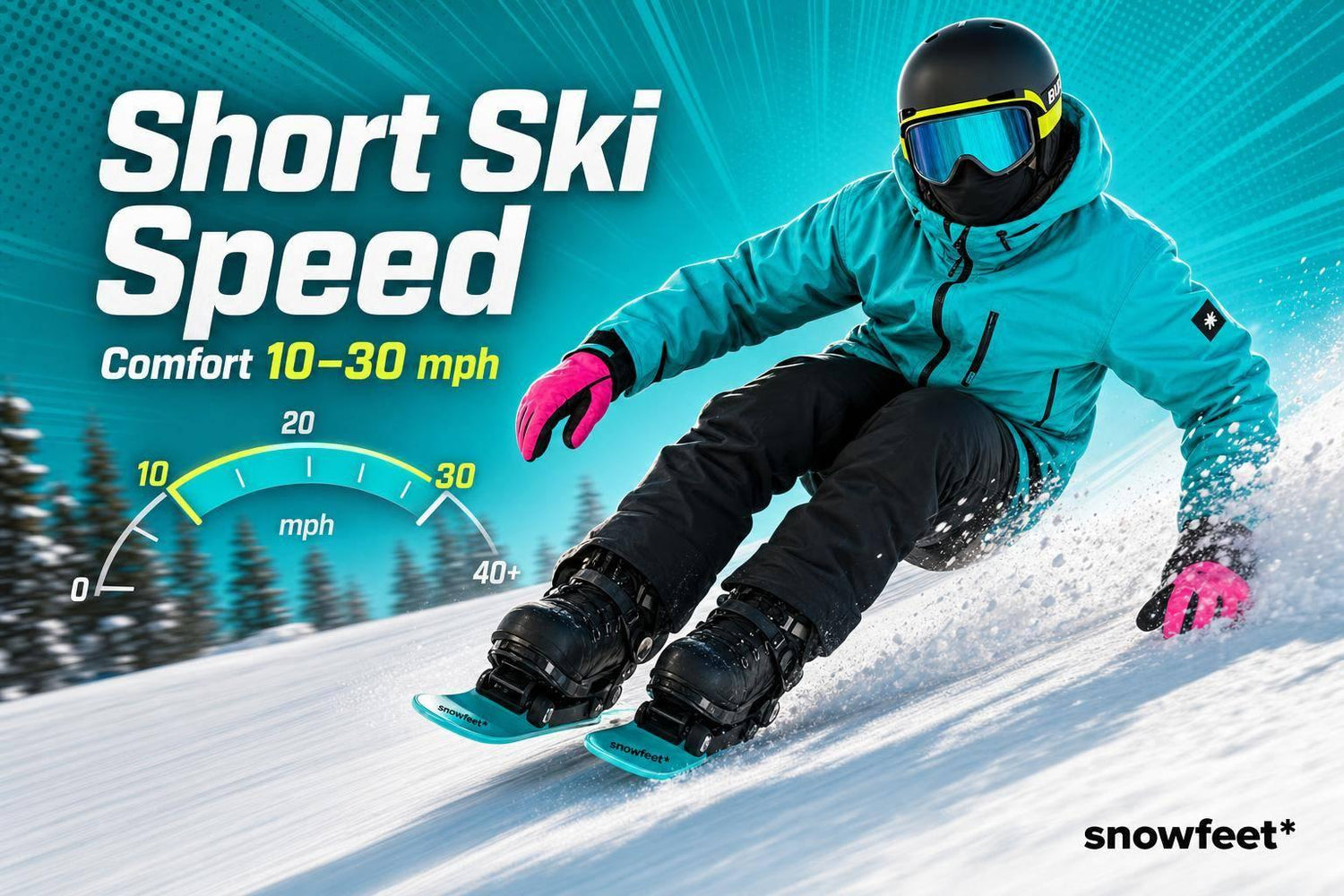
Yes - short skis can feel fast. But for most riders, the sweet spot is about 10–30 mph. On easy runs, many people stay near 10–20 mph. On groomed blue runs, a lot of riders cruise at 15–25 mph. Strong riders on longer short skis can touch 30 mph.
Here’s the simple answer: the shorter the ski, the sooner it starts to feel loose. So if you want tricks, tight turns, and park laps, go short. If you want calmer carving on groomers, go longer.
What I’d keep in mind:
- 44–50 cm: best for playful riding and lower speeds
- 65–99 cm: best all-around range for most riders
- 120–140 cm: best if you care more about speed and edge hold
- Full-length skis: still best for sustained runs above 30–35 mph
A few stats help put this in context:
- Recreational skiers average about 30.0 ± 8.9 mph
- Beginners average about 12.4 mph
- Intermediates average about 20.1 mph
- Advanced recreational riders average about 27.7 mph
So, if you’re asking, “Can I go fast on short skis?” - yes, up to a point. The main limit isn’t raw speed. It’s how stable that speed feels under your feet. And, uh, that matters a lot when the run gets steep or choppy :)
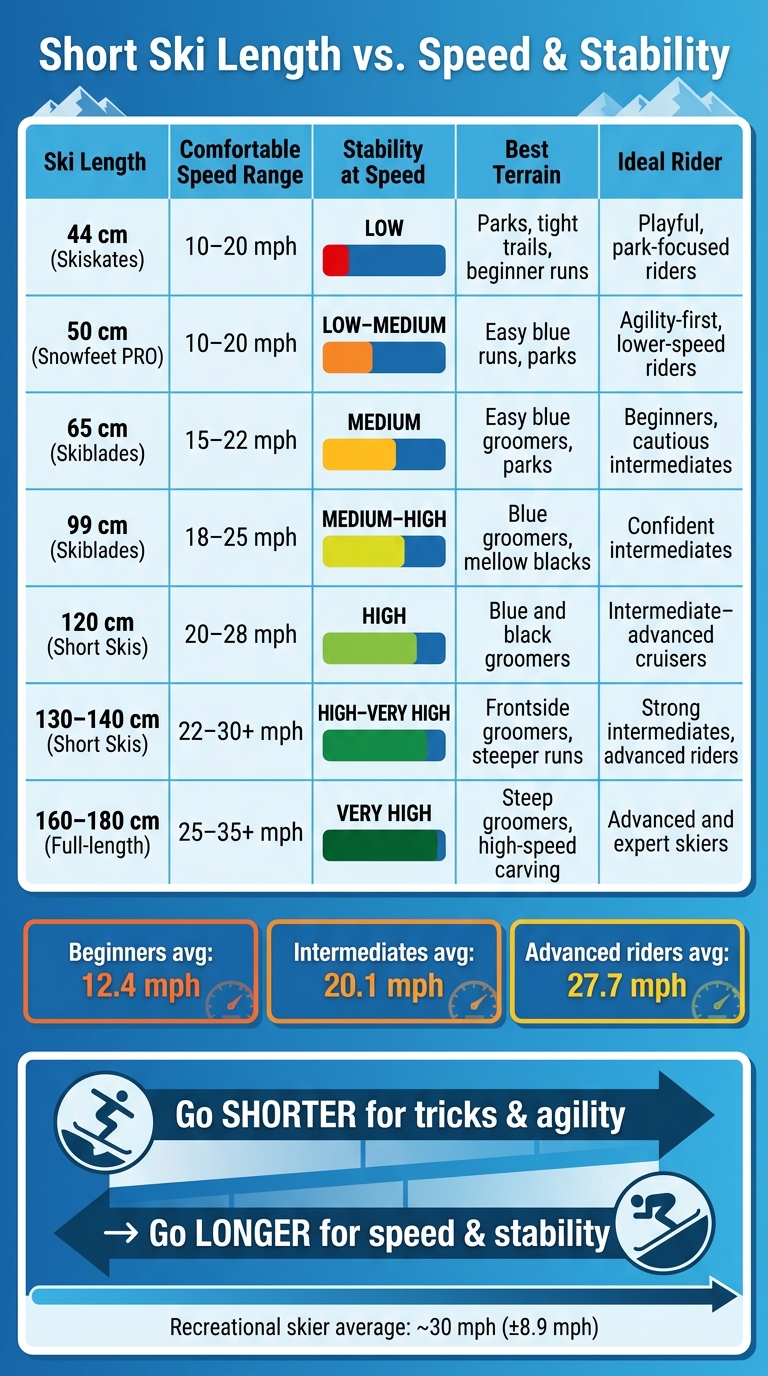
Short Ski Length vs. Speed & Stability Guide
Snowboarder tries Snowfeet* | Which Snowfeet* Short Ski is the Best? | Snowblades 44, 65, 99 Review
Quick Comparison
| Ski length | Usual speed feel | Best for | What I’d expect |
|---|---|---|---|
| 44–50 cm | 10–20 mph | Park, tight spots, mellow slopes | Very nimble, less calm at speed |
| 65–99 cm | 15–25 mph | Blue groomers, mixed resort laps | Best mix of turn shape and control |
| 120–140 cm | 20–30+ mph | Faster groomers, steeper runs | More planted, better edge hold |
| 160–180 cm | 25–35+ mph | High-speed carving | Most calm at top speed |
My take: pick the shortest length that still feels steady at your normal speed. That’s usually where the fun lives.
If you want a quick visual on short skis in action, these help:
How Ski Length Affects Speed and Stability
With that baseline in mind, ski length is the main thing that shifts both speed and control. Length sets the speed ceiling: shorter Snowfeet* feel quicker and looser, while longer models stay calmer as speed climbs.
Short Skis Turn Faster but Reach Their Comfort Limit Sooner
Ultra-short skis like the Snowfeet* Skiskates (44 cm) and Snowfeet* PRO (50 cm) pivot almost at once underfoot. They have low swing weight and move from edge to edge fast. That’s a big part of why they’re such a blast in tight spots, narrow trails, and terrain parks, where quick direction changes matter more than top-end speed.
Once you get above about 15–20 mph, a lot of casual riders start to hit the edge of the usable range. Bumps and ruts can knock these shorter setups around more. Their usual comfort zone sits around 10–20 mph on moderate slopes, though skilled riders can go faster with strong balance and active control.
Longer Snowfeet* Models Hold Speed Better on Groomers
Jumping to 65 cm, 99 cm, or 120 cm makes a clear difference in stability. More edge length helps the ski bite better on harder-packed groomers and feel steadier through turns. On a groomed blue run, someone on the Snowfeet* Skiblades 99 cm can cruise with ease at 18–25 mph, and stronger skiers may get closer to 28–30 mph. The 120–140 cm options start to feel more like the carving behavior of full-length skis on frontside groomers and give speed-focused riders more confidence on faster runs.
Here’s the quick side-by-side look at how each Snowfeet* length changes speed and stability.
Length vs. Speed vs. Stability: Comparison Table
| Length | Comfortable Speed Band | Stability at 20–30 mph | Best Terrain | Ideal Rider |
|---|---|---|---|---|
| 44 cm (Skiskates) | 10–20 mph | Low | Beginner runs, parks, tight trails | Playful, park-focused riders |
| 50 cm (Snowfeet* PRO) | 10–20 mph | Low–Medium | Beginner to easy blue runs, parks | Agility-first, lower-speed riders |
| 65 cm (Skiblades) | 15–22 mph | Medium | Easy blue groomers, parks, side hits | Beginners, cautious intermediates |
| 99 cm (Skiblades) | 18–25 mph | Medium–High | Blue groomers, mellow blacks | Confident intermediates, all-mountain riders |
| 120 cm (Short Skis) | 20–28 mph | High | Blue and black groomers | Intermediate–advanced cruisers |
| 130/140 cm (Short Skis) | 22–30+ mph | High–Very High | Frontside groomers, steeper runs | Strong intermediates, advanced riders |
| Full-length skis (160–180 cm) | 25–35+ mph | Very High | Steep groomers, high-speed carving | Advanced and expert skiers |
Full-length skis still win when the goal is sustained speed above 30–35 mph. They damp vibration better and hold an edge better than any short ski. For most riders, 10–30 mph is the sweet spot, and Snowfeet* is built for that range.
Next comes the other half of the story: slope angle, snow texture, and rider skill.
sbb-itb-17ade95
Snowfeet* Models Compared by Speed
Each Snowfeet* length makes a clear trade: more speed usually means more length, while more agility usually means less length. So the goal isn’t to pick the “fastest” one. It’s to pick the one that fits the speed range and terrain you’ll ride most.
44–50 cm: Snowfeet* Skiskates and PRO for Agile, Lower-Speed Riding
The Snowfeet* Skiskates (44 cm) and Snowfeet* PRO (50 cm) are the quickest-turning picks in the lineup. They shine in the park, in tight spaces, and anywhere you want fast direction changes without much effort.
That short length comes with a trade-off. On a long, icy blue groomer, you get less edge in contact with the snow. That means less grip and a ride that can feel a bit chattery next to longer Snowfeet* models. They’re easy to carry and a blast for playful cruising, but they’re not built for bombing a frontside groomer.
If you want more calm and control on open runs, the 65 cm or 99 cm is the better move.
65–99 cm: The Best Mix of Speed, Carving, and Control
For most U.S. resort riders, the Snowfeet* Skiblades 65 cm and 99 cm sit in the sweet spot. They give you a nice middle ground: more edge hold and more calm than the 44–50 cm models, without feeling long or awkward.
The 65 cm still feels light and quick. It works well in moguls and tight tree runs, but gives you more grip than the shorter options. If you don’t care about top speed and just want something that feels more planted than Skiskates, this one makes a lot of sense.
The 99 cm is the better fit if you want to carve at moderate-to-fast speeds and keep up with people on standard skis on groomers. It feels more sure-footed on blue and black groomers, and that added length helps a lot with stability. If you want one setup for cruising, carving, and family laps, the 99 cm is the one many riders land on.
From there, speed depends on the hill in front of you: slope angle, snow texture, and your skill all play a part.
120–140 cm: The Fastest Snowfeet* Options Before Full-Length Skis
The Snowfeet* Short Skis at 120 cm and 130/140 cm are the best Snowfeet* picks for faster groomer laps and stronger edge hold. If speed matters to you, but you still want something shorter and easier to pack than a standard ski, this is where the lineup starts to feel much more planted.
Here’s the quick breakdown:
| Model | Typical Speed Range | Stability Feel | Best Use | Why It Stands Out |
|---|---|---|---|---|
| Skiskates 44 cm | Lowest | Low | Parks, rail gardens, tight spaces | Immediate edge-to-edge response, maximum agility |
| Snowfeet* PRO 50 cm | Low | Low–Medium | Easy slopes, light park use | Agile and quick in tight terrain |
| Skiblades 65 cm | Low to moderate | Medium | Moguls, tight tree runs | Agile with more edge hold than 44–50 cm |
| Skiblades 99 cm | Moderate | Medium–High | Blue and black groomers, all-mountain laps | Best balance of speed, carving, and stability |
| Short Skis 120 cm | Moderate to fast | High | Blue and black groomers | Strong edge hold, confident on faster runs |
| Short Skis 130/140 cm | Fastest Snowfeet* options | High–Very High | Groomers and steeper runs | Closest to a carving-ski feel in the Snowfeet* lineup |
| Full-length skis 160–180 cm | Fastest overall | Very High | Long black groomers, variable snow, big-mountain terrain | Maximum sustained speed and vibration damping |
Next: the mountain itself - steepness, snow, and skill - decide how fast each length really feels.
What Makes Short Skis Feel Fast or Slow on the Mountain
Ski length sets the upper limit. But the hill decides how close you get to it.
The same short ski can feel smooth on one run and a little wild on the next. That usually comes down to slope angle, snow quality, and how hard you’re pushing it. On mellow terrain, short skis can feel playful and easy. On steeper, rougher snow, that same setup can start to feel busy.
Slope Steepness and Snow Conditions
On a blue groomer, speeds often reach 15–30 mph. That’s the zone where shorter skis can start to buzz and get knocked off line. With less edge touching the snow, they have less grip. So when you hit bumps, ruts, or tracked-out patches, the ski gets deflected more. Longer short skis feel calmer here and hold better on firm snow.
On a black groomer, many recreational riders go past 30 mph. At that point, ultra-short skis can chatter, bounce off tracked snow, and need constant small corrections just to stay on line. Ice and hardpack make this even more clear. The 44–65 cm models lose grip fast on hard snow, while longer short skis give you more bite and a steadier feel. Powder changes the story too. Very short skis don’t float much, so they sink more and naturally keep speed down.
Once the slope changes, skill matters just as much as gear.
Rider Skill and Riding Style
Skill level shapes on-snow speed more than most people think. A peer-reviewed study of skiers and snowboarders at U.S. ski areas found that beginners averaged about 12.4 mph (19.9 km/h), intermediates averaged about 20.1 mph (32.4 km/h), and advanced recreational riders averaged about 27.7 mph (44.5 km/h). So, don’t just go by skill labels. Match ski length to the speed you actually ride.
Beginners who stay under 15 mph usually do best on the 65–99 cm range. That gives enough stability to build confidence without feeling stiff or hard to turn. Very short 44–50 cm Snowfeet* Skiskates can also work for athletic beginners on gentle slopes or small learning areas, but they fit people who already have good balance more than total first-timers.
Intermediates riding in the 15–30 mph range tend to get the best mix from 99–120 cm models. These track better and hold an edge more cleanly, without asking for top-level balance. Advanced riders going 30 mph and beyond will want the 120–140 cm options. That longer contact patch helps the ski stay calmer on steep, fast groomers.
Here’s the key point: skill changes how much speed you can handle, but length changes how stable that speed feels. A relaxed, skidded turn at 20 mph can feel easy. An aggressive carved turn at that same speed asks a lot more from the ski. That’s why 99 cm and up makes more sense for riders who like to dig in and carve hard.
Conditions, Rider Type, and Recommended Snowfeet* Length: Comparison Table
Use the chart below to match your usual conditions to the shortest length that still feels stable.
| Condition | 44–65 cm Feel | 99–140 cm Feel | Stability Notes | Recommended Snowfeet* |
|---|---|---|---|---|
| Green groomer | Agile, fun, easy to turn | Stable, smooth cruising | Both lengths work well on smooth snow | Skiskates 44 cm, PRO 50 cm; Skiblades 65–99 cm for broader beginner/intermediate use |
| Blue groomer | Lively, can vibrate and get knocked around | Smooth, confident carving | 99–120 cm tracks noticeably better | Skiblades 99 cm, Short Skis 120 cm |
| Black groomer | Too demanding for most riders | Manageable with an active stance | 120–140 cm gives the best edge hold in the lineup | Short Skis 120 cm, 130 cm, 140 cm |
| Terrain park | Excellent - quick, light, agile | Good landing stability on larger features | Shorter lengths favor tricks; longer favor landings | Skiskates 44 cm, PRO 50 cm; Skiblades 65–99 cm for more landing stability |
| Variable snow / crud | Gets deflected easily, needs active knees | Smooths out the ride better | Longer short skis absorb chop more effectively | Skiblades 99 cm, Short Skis 120 cm |
| Powder | Sinks easily, limited float | Better support but still not ideal | Still not a substitute for a dedicated powder ski | Short Skis 120–140 cm, with the caveat that deep powder still favors a powder-specific ski |
Conclusion: Which Short Ski Length Is Right for Your Speed Goals?
On real resort runs, short skis are plenty fast for most people. But here’s the catch: length has a big effect on how fast they feel good, not just how fast they can go.
After looking at speed, stability, and terrain, the choice is pretty simple.
Best Length for Park, Cruising, and Faster Groomers
44–50 cm Snowfeet* models are the most agile. They work best for playful riding, tricks, and lower-speed fun.
From there, your best pick comes down to what you want most:
- 65–99 cm is the best all-around range for most riders. It’s stable enough for blue groomers, quick enough for carving, and still easy to control.
- 120–140 cm is the fastest and most stable Snowfeet* range for steeper groomers and higher speeds.
- 160–180 cm full-length skis still come out on top for sustained high-speed carving and steep black groomers.
That said, for most resort riders, Snowfeet* short skis fit resort riding well. They hit a nice middle ground between fun and control.
The rule is simple: go shorter for tricks and tight terrain, longer for speed and stability.
Key Points Before Choosing a Setup
As speed goes up, length matters more. A longer setup tends to feel calmer and more predictable, while a shorter one feels looser and more playful.
A good way to choose? Pick the shortest length that still feels stable at your usual speed. That’s where you’ll get the best mix of control, fun, and confidence.
So, in plain English :)
- Shorter lengths are best for agility
- 65–99 cm is the best all-around pick
- 120–140 cm is for riders who care more about speed
- Full-length skis are best for maximum sustained speed
FAQs
Are short skis safe at high speeds?
Short skis are made for agility, quick turns, and a playful ride, not flat-out top speed. They work well on groomed runs, in terrain parks, and at moderate speeds. But once you start skiing VERY fast, they tend to feel less stable than longer skis.
If speed matters most to you, 120 cm Snowfeet Skiblades are the best pick. They give you the most stability and control in the Snowfeet lineup when you want to ski faster.
What short ski length should I choose?
Choose based on your skill level, terrain, and goals.
If you're new to this or want a calmer, more stable ride, go with the 50 cm PRO. It’s the easier pick when you want to feel in control and keep things smooth.
If you’ve got more time on snow and want fast edge changes, sharp carving, and tricks, the 44 cm Skiskates feel the most nimble.
For terrain parks or all-mountain riding, 65 cm to 120 cm Skiblades are the sweet spot:
- 65 cm: best for tricks
- 99 cm: best for balance
- 99 cm to 120 cm: better for speed and flotation
It’s kind of like picking the right tool for the day. Shorter options feel playful and quick. Longer ones give you more support when the mountain starts asking a bit more from you.
Do short skis work well in powder or ice?
Short skis usually aren’t the best pick for deep powder. The main issue is simple: they have less surface area, so they sink more than standard skis. That’s why they tend to do better on groomed runs and packed snow.
For softer snow, Snowfeet* has a couple of better picks:
- The 99 cm POWDER model has a wider shape and a rockered tip, which helps it stay up in softer snow.
- The 120 cm Short Skis give you more support, which helps with carving.
Once powder gets deeper than 6 inches, standard short models can start to struggle.











Leave a comment
This site is protected by hCaptcha and the hCaptcha Privacy Policy and Terms of Service apply.