



















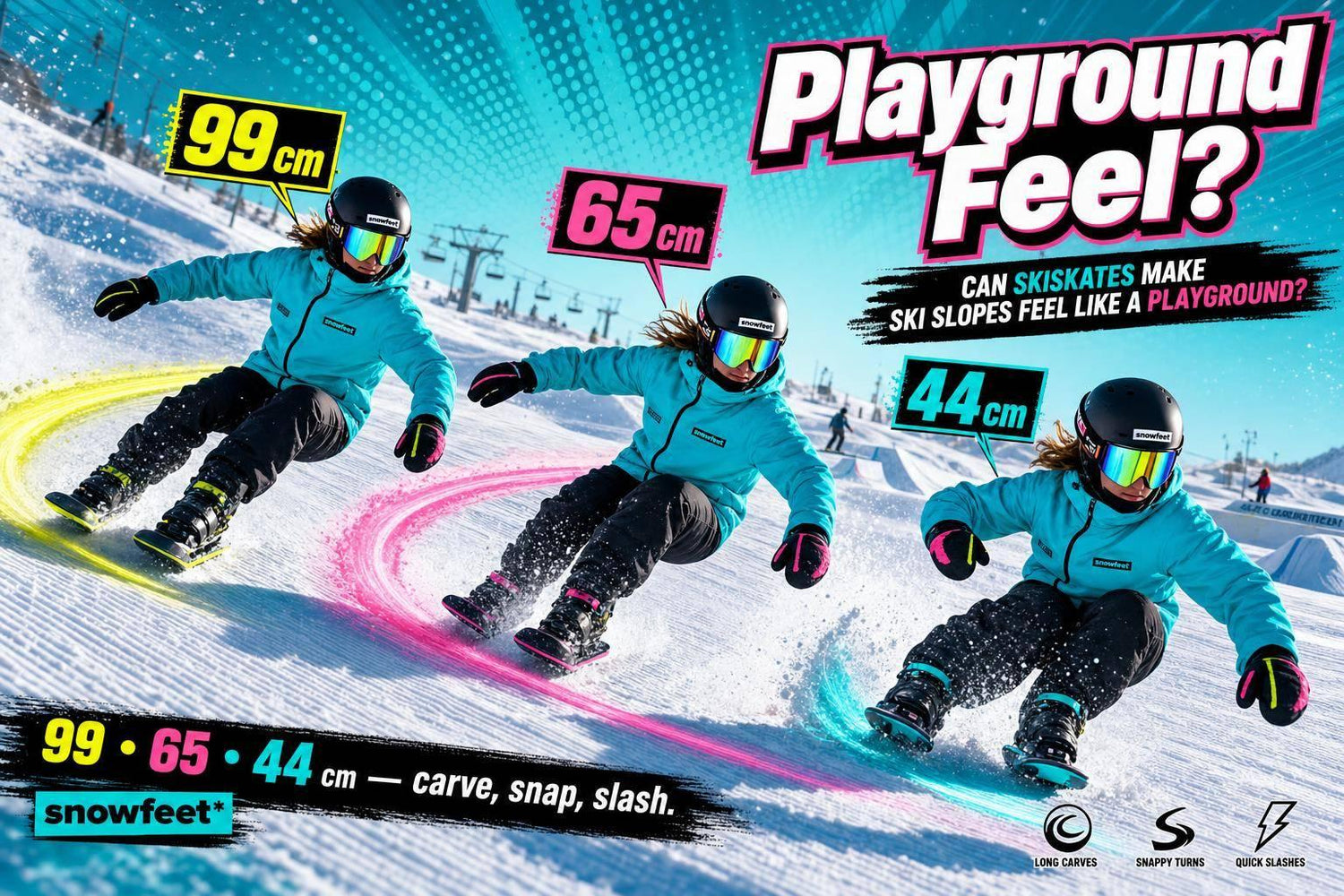
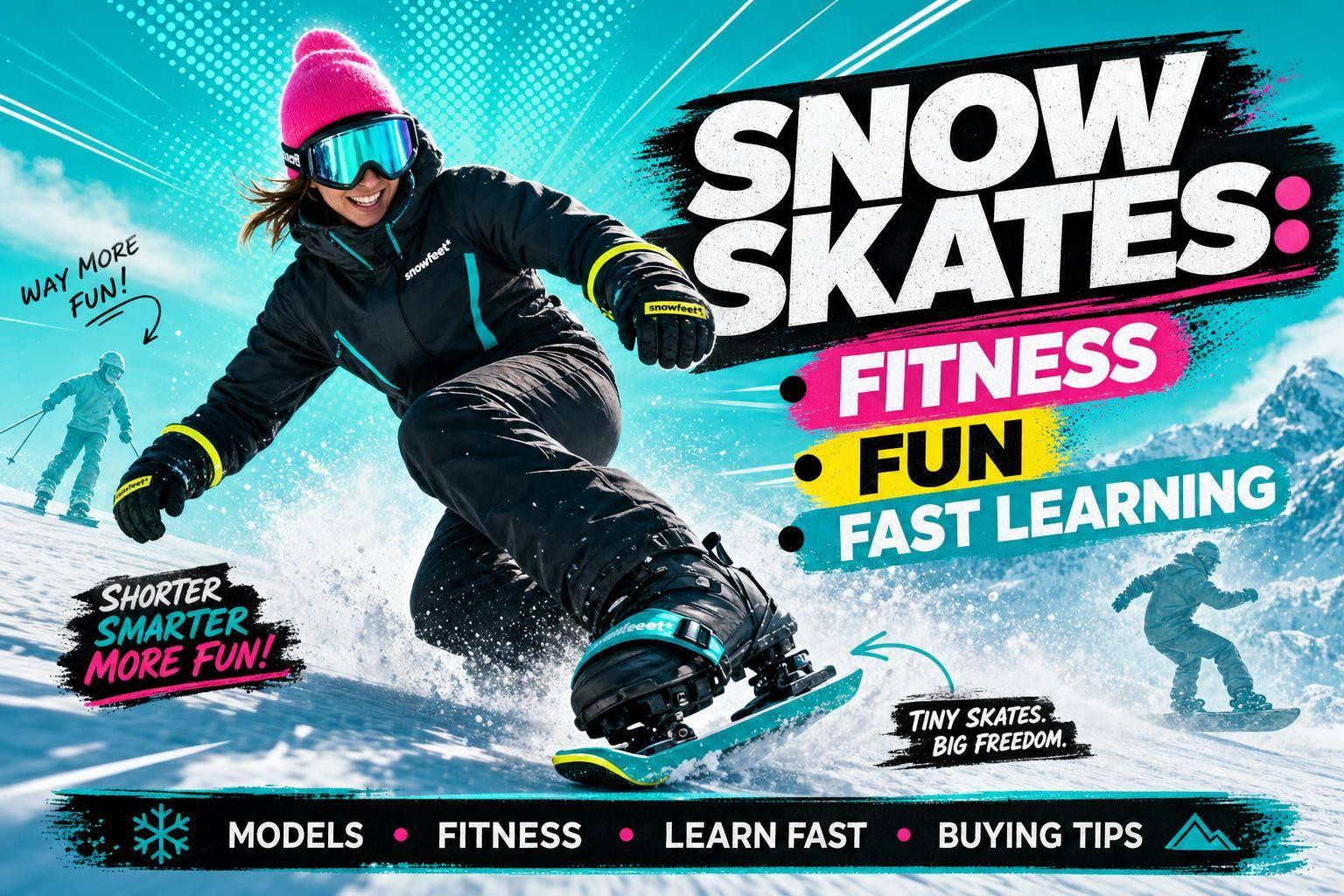
Yes - if you want tight turns, easy jumps, and less gear hassle, skiskates can make resort laps feel a lot more like play than full-length skis or a snowboard.
I’d put it this way: if your day is about blue runs, side hits, park laps, rollers, and weaving through crowds, short gear often feels better. The article’s core point is simple: 44 cm skiskates feel the most like skating, 65 cm skiblades hit the sweet spot for playful all-mountain laps, and 99 cm skiblades give you more calm and support while still feeling short and nimble.
Here’s the short version:
- Long skis and boards are often 140–180 cm, which helps at high speed but can feel bulky in tight spots.
- Short setups make it easier to turn, pivot, hop, and scrub speed without fighting the gear.
- 44 cm works best if you want the most skate-like ride.
- 65 cm is the best middle ground for many adults.
- 99 cm is the safer pick if you want more support on steeper or mixed runs.
- Portability matters too: 44 cm skiskates can fit in a backpack, which is a huge win for travel, parking lots, and condo life.
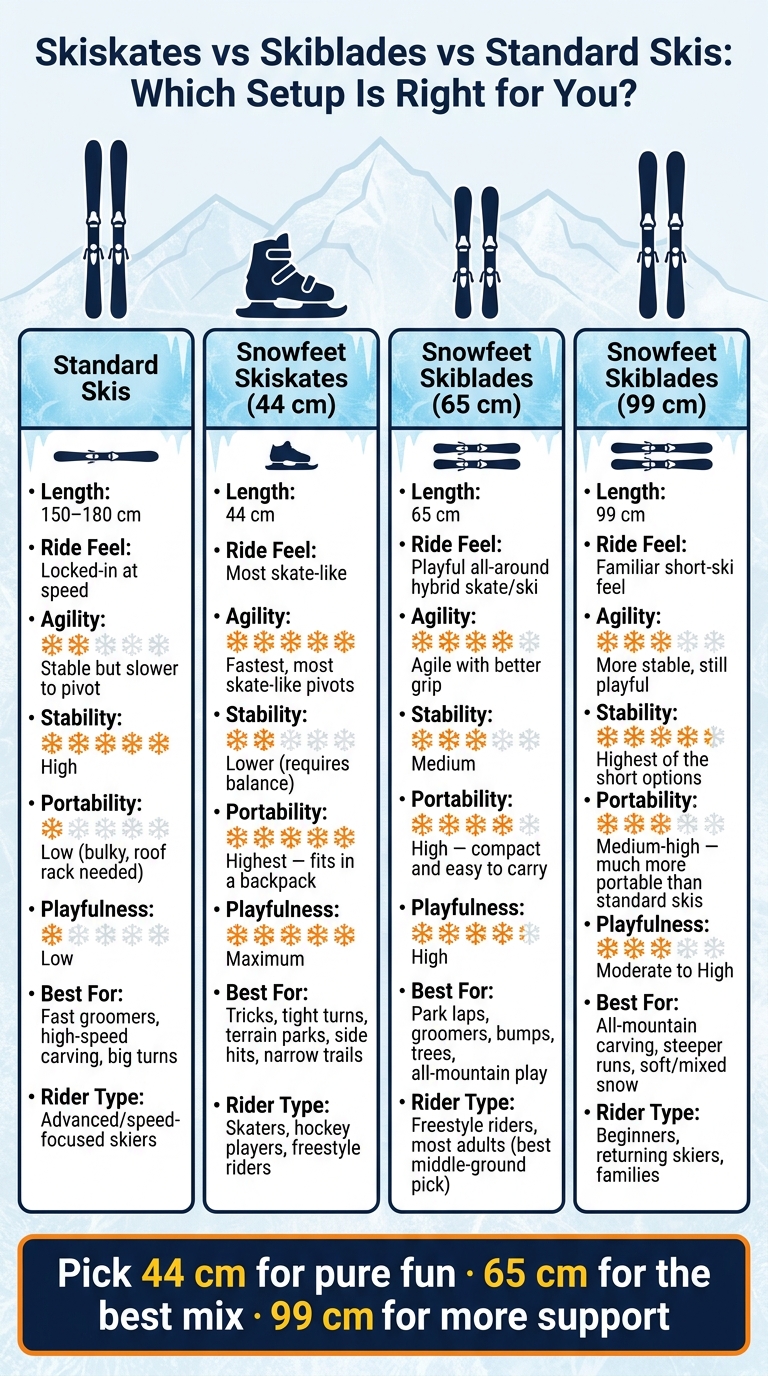
Skiskates vs Skiblades vs Standard Skis: Which Setup Is Right for You?
The Best Skates for Slopes: Snowfeet* 44 CM
Quick Comparison
| Setup | Length | Ride feel | Best use | Stability | Portability |
|---|---|---|---|---|---|
| Standard skis | 150–180 cm | Locked-in at speed | Fast groomers, big turns | High | Low |
| Snowfeet* Skiskates | 44 cm | Most skate-like | Tricks, tight turns, side hits | Lower | Highest |
| Snowfeet* Skiblades | 65 cm | Playful all-around | Park, groomers, bumps | Medium | High |
| Snowfeet* Skiblades | 99 cm | Short-ski feel | Newer riders, steeper runs, mixed snow | Highest of the short options | Medium-high |
A good rule I’d use: pick 44 cm for pure fun, 65 cm for the best mix, and 99 cm if you want more support without going back to full-size gear. Simple, and kind of nice :)
Why Standard Skis and Snowboards Often Limit Playfulness
Standard skis and snowboards are built for speed and stability. That's great if you want to charge. It's not so great if you want a loose, playful day on the mountain.
Long skis make quick turns and freestyle movement harder
Adult downhill skis are commonly 150–180 cm long, and adult snowboards are often 140–165 cm. That extra length helps when you're holding a line at speed. But it also means a bigger turning arc.
In plain English: longer skis and boards need more room and more effort to change direction. So quick turns can feel slower. Less snappy. Less fun.
That shows up fast when you're trying to weave between groups, pop off a roller, or spin in a tight spot. A lot of playful riding happens along the edges of groomers. And that's the exact place where long gear can hook up, catch, or just feel clunky.
When your gear takes a beat too long to respond, the whole day feels less spur-of-the-moment.
Carrying and storing full-size gear is a real hassle
The hassle starts before your boots even touch snow.
Loading full-size skis into an SUV often means stuffing 5- to 6-foot planks across the back seats or tossing them on a roof rack. Roof racks help, sure, but they also mean added cost and more messing around in a cold parking lot. Nobody loves that part.
At home, long gear can be a pain too. If you live in an apartment or a smaller house, ski bags can eat up closet space and crowd the garage. And if you're flying to a destination resort, oversized ski bags can bring extra baggage fees and that awkward airport shuffle through terminals, shuttles, and rideshare pickups.
Less simple setup usually means less spur-of-the-moment riding.
And when the day starts to feel like work, most riders show up with less energy to try new stuff.
The learning curve can kill confidence and creativity
Long skis tend to feel best when they're moving fast. That can nudge riders into speeds that don't feel comfortable, just to get the skis to come alive in a turn.
On a busy Saturday, that's a rough trade. You're trying to go fast enough for the skis to respond while still staying in control around other people. That's stressful. Not playful.
For adults getting back into skiing after a few years away, or for riders who want to mess around with small jumps and spins, full-length gear can feel harsh. A tiny edge catch on a long ski can turn a small mistake into a hard wipeout. Even low-speed features can feel more intimidating.
That shuts down experimentation fast. And that's the whole point of playful riding: trying stuff, laughing it off, and going again.
That gap is exactly where shorter Snowfeet* setups start to feel more like a playground tool than a speed-only tool. That sets up the real question: which shorter Snowfeet* setup makes riding feel more playful without giving up control?
sbb-itb-17ade95
How Snowfeet* Skiskates and Skiblades Make the Mountain Feel Like a Playground
That’s where short Snowfeet* setups change the ride from controlled to playful.
Short length means faster carving, pivoting, and jumps
At 44 cm, the ski sits almost fully under your foot, so turns and pivots feel instant. Long skis take more work to swing around, hop, and redirect. With Snowfeet* Skiskates 44 cm, that work drops fast, and edge-to-edge moves feel quick and natural.
Quick 180s, small hops over rollers, and tight “S” turns on a narrow trail all get easier. There’s less ski to catch in the snow. You also get less torque on your knees and hips when you land or twist. The 65 cm length adds more grip and control while staying very agile. The 99 cm length brings more stability and feels closer to a compact all-mountain ski.
Here’s how the three lengths stack up:
| Setup | Length | Agility | Ease to Learn | Best For | Portability |
|---|---|---|---|---|---|
| Standard skis | 150–180 cm | Stable but slower to pivot | Steeper for beginners | Groomers, high-speed carving | Bulky to carry |
| Snowfeet* Skiskates 44 cm | 44 cm | Fastest, most skate-like | Easy for skaters; quick to learn | Terrain parks, side hits, narrow trails | Fits in a backpack |
| Snowfeet* Skiblades 65 cm | 65 cm | Agile with better grip | Easier than full skis | Groomers, bumps, trees, all-mountain play | Compact; easy to carry |
| Snowfeet* Skiblades 99 cm | 99 cm | More stable, still playful | Familiar to skiers | All-mountain carving, steeper runs, soft snow | Smaller and lighter than standard skis |
So, rider type is the next piece of the puzzle.
Better control at everyday speeds builds rider confidence
Most resort riding happens at moderate speeds, and that’s where shorter gear shines. With Snowfeet* Skiskates and Skiblades, the shorter contact length makes it easier to start and finish turns fast. That means you can control speed with more turns instead of big braking moves. The result is quick, predictable edge control.
And that changes how the mountain feels. Bumps, rollers, and sidebanks stop looking like stuff to avoid. They start looking like features you can use. On 44 cm Skiskates, a row of small rollers can turn into a string of fast hops and pivots. On 65 cm Skiblades, moderate moguls become something you weave through instead of wrestle over.
One rider said:
"Super easy to control, quick to turn, and way more forgiving than traditional skis. They're great for carving and navigating crowded slopes without feeling bulky."
The 99 cm Skiblades carry that same confidence into steeper and more mixed terrain. They give you better float in soft snow or chopped-up afternoon snow, while still letting you dart into trees or pop off a sidebank without locking into a long, sweeping turn.
Compact gear makes spontaneous riding easier
Snowfeet* changes the portability equation: 44 cm Skiskates fit in a backpack, and 65 cm and 99 cm Skiblades are still easy to carry. That makes the whole day feel lighter and less fussy. Less gear to manage. More time to ride :)
Who Benefits Most and Which Snowfeet* Model Fits Best
Now that the ride feel is clear, the next step is simple: match the length to the person and the terrain.
Best model by rider type
The best Snowfeet* length comes down to how you move on snow and what already feels natural.
Skaters and hockey players usually click fastest with the Snowfeet* Skiskates 44 cm. This is the most skate-like, trick-friendly pick. Edge control feels instant, kind of like ice skates or aggressive inline skates.
Freestyle riders who want park laps, side hits, and switch riding will usually lean toward the Snowfeet* Skiblades 65 cm. It’s the most playful all-around choice.
Beginners, returning skiers, and intermediate riders tend to do best on the Snowfeet* Skiblades 99 cm. They’re more forgiving, but you still get that short-ski feel. That matters a lot on green runs and mellow blue terrain.
Families can mix lengths by rider instead of forcing one setup for everyone.
- Adults who want more stability while keeping an eye on kids often do well on 99 cm
- Teens and older kids who already skate or like to mess around on the slopes often stay more engaged on 65 cm or 44 cm
Travelers and weekend visitors should start by looking at the 44 cm Skiskates or 65 cm Skiblades. They’re easier to pack into checked luggage or toss in a car trunk. The 44 cm model is small enough to fit in a backpack.
Best model by terrain and slope type
Terrain changes the story a bit.
The 65 cm length shines most in the park and on side hits. The 99 cm length works best on steeper runs where you want more controlled, playful carving.
On groomed green and blue runs, each size has a clear lane:
- 99 cm gives newer riders the most controlled turns
- 65 cm works well for short carving arcs and quick turns on crowded slopes
- 44 cm feels best for agile, low-speed weaving
How 44 cm, 65 cm, and 99 cm compare in real use
This quick comparison shows where each length fits best on the mountain.
| Feature | 44 cm Skiskates | 65 cm Skiblades | 99 cm Skiblades |
|---|---|---|---|
| Feel | Skating on snow | Hybrid skate/ski | Familiar short-ski feel |
| Best speed range | Moderate | Moderate | High |
| Carving strength | Fast, short-radius | Good all-around | Strong, stable carving |
| Stability | Lower; requires balance | Medium | Highest; most forgiving |
| Portability | Fits in a backpack | Easy to carry | Much more portable than standard skis |
| Playfulness | Maximum | High | Moderate to high |
| Best for | Skaters, hockey players, tricks | Freestyle, park, all-mountain | Beginners, returning skiers |
For most adults, 65 cm is the best middle-ground pick. Go with 99 cm if you want more stability. Pick 44 cm if you want the most skate-like feel. Kind of like choosing between a surfy board, a park ski, or a pair of skates with a snow addiction :)
Conclusion: Are Skiskates Better Than Standard Skis for Playful Riding?
After looking at turn speed, control, and portability, the answer is pretty simple. For playful resort laps, yes - if agility matters more than speed.
If you spend most of your time on groomers, blue runs, small park features, and side hits, Snowfeet* comes out ahead for carving, pivoting, jumping, and playful laps around the resort. It feels more nimble and less locked-in, which is kind of the whole point.
Traditional skis still take the win for high speed, deep powder, and big-mountain stability. But for most day-to-day resort laps, Snowfeet* is the better pick.
Key takeaways for picking the right setup
Here’s the simplest way to choose the right length.
Pick based on your riding style, the terrain you like, and how much portability matters to you. 44 cm Skiskates feel the most skate-like. 65 cm Skiblades hit the freestyle sweet spot. 99 cm Skiblades give you the most stability while still keeping that playful feel.
For riders who want more freedom of movement, fast turns, and gear that’s easy to carry, Snowfeet* is the better fit for playful riding.
FAQs
Are skiskates hard to learn?
Usually not. Skiskates, especially Snowfeet products, tend to be easier to learn than skis or snowboards.
Why? They feel more natural. More like skating, less like wrestling with long gear on your feet.
A lot of riders say they get to the fun part faster: carving, turning, and even small jumps, without as much practice as old-school ski gear. Sure, any new snow sport has a learning curve. That part never goes away.
But Snowfeet skiskates are made to feel approachable from the start, so you can get the hang of them early and enjoy the ride sooner.
Which size should I choose?
Choose based on how you want to ride. Snowfeet Skiskates 44 cm are the best pick if you want a playful, nimble feel with easier carving, turning, and jumping.
If you want more stability and glide, go with Snowfeet Skiblades 65 cm or 99 cm. The 44 cm size works well for beginners or anyone who wants a skate-like, terrain-park feel. The 65 cm and 99 cm options give you more stability while keeping that same fun, agile ride.
Can skiskates handle steeper runs?
Skiskates like Snowfeet are built for agility and fun on all kinds of slopes. But on steeper runs, a lot comes down to your skill level and the terrain under you.
They tend to work best for playful riding, quick turns, and that terrain-park feel. Aggressive, steep descents? That’s usually not where they shine.
So if your goal is slashy, nimble fun, they’re a blast :). If you want to charge hard down steep faces, they’re not the best fit.











Leave a comment
This site is protected by hCaptcha and the hCaptcha Privacy Policy and Terms of Service apply.