




















If I only had time for a few laps after work, I’d skip full-length skis and grab a short setup. Based on this lineup, I’d point most riders to the Snowfeet* 99 cm Skiblades. They hit the sweet spot: more stable than the tiny models, but still short enough to carry, store, and get on snow fast.
Here’s the short version:
- 44 cm Skiskates: best if I want the smallest setup and tight, playful turns
- 65 cm Skiblades: good if I want compact gear with a bit more control
- 99 cm Skiblades: my top pick for most people after groomer laps
- 120 cm Short Skis: best if I want the most ski-like feel and higher-speed calm
Snowfeet* models in this article run from 17 in. to 47 in. (44 cm to 120 cm), and some versions fit U.S. ski boot sizes 4.5–14.5 or snowboard boot sizes 6–14.5. Prices start at $460 and go up to $950. So, the main choice is simple: how small do I want to go before stability starts to drop?
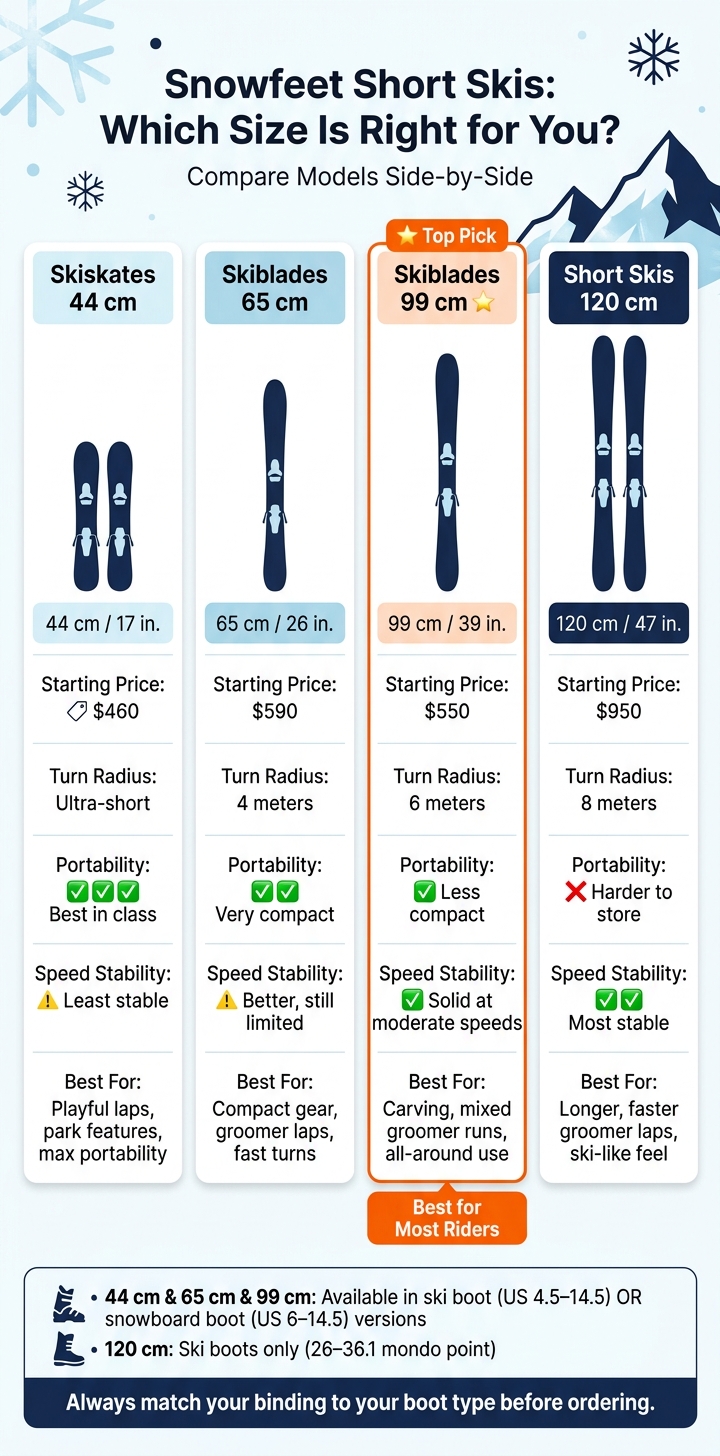
Short Ski Comparison: Snowfeet Models at a Glance
Snowboarder tries Snowfeet* | Which Snowfeet* Short Ski is the Best? | Snowblades 44, 65, 99 Review
Quick Comparison
| Model | Length | Starts at | Best for | Main tradeoff |
|---|---|---|---|---|
| Snowfeet* Skiskates | 17 in. / 44 cm | $460 | Tiny, easy-to-carry setups and park-style laps | Least stable at speed |
| Snowfeet* Skiblades | 26 in. / 65 cm | $590 | Short groomer laps, small hills, fast turns | Still feels nervous when speed climbs |
| Snowfeet* Skiblades | 39 in. / 99 cm | $550 | Best mix of control, carving, and compact size | Less portable than the shortest options |
| Snowfeet* Short Skis | 47 in. / 120 cm | $950 | Most ski-like ride, faster groomer runs | Highest price and harder to stash |
My takeaway: if you want fun, controlled laps without dragging around big skis, this range makes sense. Just match the binding to your boot type first, then pick the shortest model you’ll still feel good skiing on.
1. Snowfeet* Skiskates 44 CM
If you want the most portable pick, start with the 44 cm Skiskates.
At 44 cm (17.3 inches), they’re the smallest Snowfeet* model. That makes them a smart pick for short, easy laps after work when you don’t want to haul a full ski setup.
Portability
These can fit in many backpacks or small gear bags. So you can skip roof racks and ski carriers. That’s a nice little win when you just want to get on the snow, take a few laps, and head home.
Turn Radius
Because they’re so short, Skiskates feel quick and playful on groomed snow. They work well for tight pivots, short laps, and park features. You give up those long, sweeping carves, but in return you get fast, snappy control.
Speed Stability
That quick handling comes with a tradeoff: less stability at higher speeds. They’re best on groomed or hard-packed snow at moderate speed, not for high-speed big-mountain runs.
Boot Compatibility
Skiskates come in both ski-boot and snowboard-boot versions, which is handy if you want to use boots you already own. Before you buy, check the fit and make sure you’ll get enough ankle support. Pricing starts at $460, so they’re more of a niche pick for short sessions.
If you want a bit more stability but still want easy handling, the 65 cm Skiblades are the next step up.
2. Snowfeet* Skiblades 65 CM
The 65 cm Skiblades are the next step up from the 44 cm Skiskates. They’re still short and easy to handle, but they give you more balance on snow. If the 44 cm version feels a bit too twitchy, this is the better pick for groomers and mixed resort laps.
Portability
They’re much easier to carry than full-length skis, which makes quick weekday sessions a lot less of a hassle.
Turn Radius
The 65 cm Skiblades have a 4-meter turning radius. So, they snap from edge to edge fast and feel right at home on groomers, small hills, moguls, and park features.
Speed Stability
At higher speeds, they won’t feel as planted as longer skis. That’s the tradeoff. But that same short length is what makes them nimble and fun for short, playful laps.
Boot Compatibility
You can choose either ski-boot or snowboard-boot bindings, and both fit a broad size range. Before you order, double-check which binding version works with your boots. And if you go with non-release bindings, use a safety leash.
Pricing starts at $590. Go with the 65 cm model if you want tight, playful laps. If you want more stability and still want to keep that quick feel, move up to 99 cm.
sbb-itb-17ade95
3. Snowfeet* Skiblades 99 CM
If the 65 cm model feels a bit twitchy once you pick up speed, the 99 cm Skiblades hit a nice middle ground. You get more calm underfoot, but you still keep that short-ski feel. Snowfeet* positions this model as fast and stable for carving and all-mountain laps. For riders who want a few fast runs after work, that matters a lot. It gives you quick turns without the nervous feel that can come with ultra-short skates.
Portability
At 99 cm / 39 inches, these are still easy to carry around. But on snow, they feel more planted than the 65 cm and 44 cm options.
Turn Radius
The 99 cm model has a 6-meter turning radius. That setup, along with its dimensions and camber shape, helps it make quick, controlled carved turns.
Speed Stability
This longer platform gives you more support and more edge contact. In plain English: it handles faster groomer laps and rougher snow better.
Boot Compatibility
The 99 cm comes with either ski-boot or snowboard-boot bindings, so it fits a wide range of sizes. Just pick the version that matches your boots. Pricing starts at $550.
If you want something that feels even closer to a standard ski, the 120 cm version is the next step up.
4. Snowfeet* Short Skis 120 CM
If the 99 cm model still sounds a bit too short, the 120 cm version is the next move. It gives you more stability without jumping all the way to full-size skis. This is Snowfeet's longest short ski, and it feels the most like a standard ski in the lineup. At the same time, it still stays compact enough for quick after-work laps.
Portability
At 120 cm / 47 inches, this one is not going in a backpack. So, no magic trick there :). It’s less portable than the 44 cm and 65 cm models, but it’s still much easier to carry and store than full-length skis. That added length gives up a bit of convenience, but in return you get better tracking when your laps get faster.
Turn Radius
The 120 cm model has an 8-meter turn radius plus a parabolic shape with camber and tip-and-tail rocker. That setup helps it carve with less effort and stay more forgiving in mixed groomer snow.
Speed Stability
This is the most stable Snowfeet option. Faster groomer laps feel calmer and more planted than they do on the shorter models. For short evening runs, that added stability can matter more than max portability.
Boot Compatibility
The main thing to watch here is boot type. The 120 cm version uses Pro Ski Boot Bindings and fits 26–36.1 mondo point ski boots. It’s made for ski boots only, not regular winter boots.
If you want a snowboard-boot setup, check Snowfeet's current product listings before you buy so you pick the right configuration.
At $950, this is the highest-priced model in the range.
Pros, Cons, and Best Use Cases
For quick after-work laps, shorter models are easier to carry and easier to whip through turns. Longer models feel calmer when you pick up speed. Simple trade-off.
Match the model to the kind of session you want:
| After-work use case | Best model |
|---|---|
| Maximum portability, small hills, playful laps | Snowfeet* Skiskates 44 cm |
| Compact gear with more stability on groomers | Snowfeet* Skiblades 65 cm |
| Carving, mixed groomer runs, moderate park use | Snowfeet* Skiblades 99 cm |
| Longer, faster groomer laps with a ski-like feel | Snowfeet* Short Skis 120 cm |
Here’s the same group broken down by feel on snow, storage, and boot setup:
| Model | Portability | Maneuverability | Speed stability | Park use | Boot setup |
|---|---|---|---|---|---|
| 44 cm Skiskates | ✅ Best in class | ✅ Quickest turns | ⚠️ Least stable | ✅ Small features, quick spins | Ski boots (US 4.5–14.5) or snowboard boots (US 6–14.5) |
| 65 cm Skiblades | ✅ Still very compact | ✅ Fast edge-to-edge | ⚠️ Better than 44 cm, still limited | ✅ Good for smaller park features | Binding version varies by model; match your boot type before ordering. |
| 99 cm Skiblades | ⚠️ Less compact | ✅ Balanced agility | ✅ Solid at moderate speeds | ✅ Best balance of park and groomer | Multiple binding versions; confirm the exact model before ordering. |
| 120 cm Short Skis | ❌ Harder to store | ⚠️ Slower to pivot | ✅ Most stable in the group | ⚠️ Better on open groomers than tight park features | Release ski bindings only |
A few patterns jump out fast:
- 44 cm is the easy grab-and-go pick. Great when you want light gear and quick turns, but it gives up the most when speed climbs.
- 65 cm stays compact while giving you a bit more calm on groomers.
- 99 cm is the middle ground. It handles mixed runs well and doesn’t feel too twitchy.
- 120 cm feels the most like a short ski. Better for open groomers and faster laps, less fun in tight spots.
Boot and binding systems are model-specific, so check the exact version before you buy. That part matters more than people think.
A simple way to choose: pick your boot type first, then go with the shortest model that still feels stable enough for your speed and terrain.
Conclusion
After lining up the options, one thing jumps out: for quick after-work laps, Snowfeet* compact skis make life easier. They’re easier to carry, faster to put on, and simpler to control for a few fun groomer runs.
Long skis still come out on top for all-day speed, deep powder, and big-mountain stability. Snowfeet* fits short, controlled sessions better. That’s why the 99 cm model stands out for most riders.
For most riders, Snowfeet* Skiblades 99 cm are the best all-around pick: agile, stable, and versatile enough for carving, cruising, and small park features. If you want something more playful and portable, the 44 cm Skiskates or 65 cm Skiblades give you quicker turns and easier handling at slower speeds. If you care more about longer arcs and added stability, the 120 cm Short Skis sit at the top of the Snowfeet* lineup while still being shorter and easier to manage than full-length skis.
Before you order, match the binding to your boot type. That part matters. Ski-boot and snowboard-boot versions are different, so start there. Then pick the shortest model that still feels stable for your speed and terrain. These are built for controlled use on groomed resort terrain at moderate speeds.
FAQs
Which length is best for beginners?
For beginners, the 65 cm Snowfeet Skiblades are the best place to start. They hit a sweet spot between control and stability, which makes them easier to use than both the 44 cm Skiskates and long skis.
The 44 cm option is easier to carry and more playful, but it asks for better balance. The 65 cm length gives you more surface area, so turns and stops feel easier. Then, as your confidence grows, 99 cm Skiblades make a solid next step.
Can I use snowboard boots with all models?
Not all of them.
Snowboard boots work with the 44 cm Skiskates, 65 cm Skiblades, and 99 cm Skiblades. But there’s one catch: you need the snowboard-boot binding version, which usually fits US sizes 6–14.5.
The 120 cm models are ski-boot only.
That’s one of the nice things here. Unlike old-school skis, Snowfeet gives you more room to pick a setup that feels comfortable and easy to use.
Are short skis good for icy groomers?
Yes - on groomed runs, they work well. But on ice, length matters.
The 44 cm Skiskates are built more for agility and a playful feel than for strong edge hold at speed. They’re fun, quick, and easy to flick around - but when conditions get icy, that short length can feel a bit twitchy.
If you deal with icy runs a lot, the 99 cm and 120 cm Snowfeet models are the better pick. They give you:
- Better stability
- Better edge grip
- Better tracking
That makes them a stronger fit than ultra-short options when the snow gets firm and slick.













Leave a comment
This site is protected by hCaptcha and the hCaptcha Privacy Policy and Terms of Service apply.