




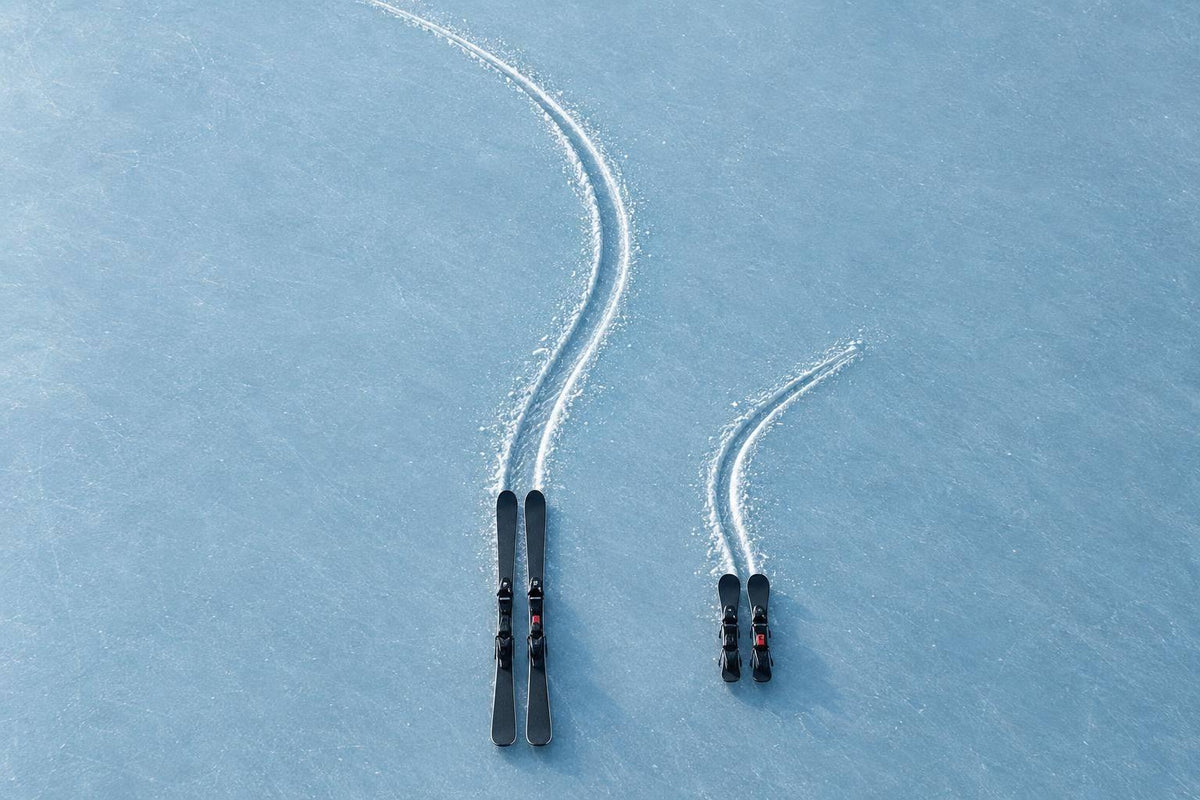
Skiblades can carve on firm snow, but I’d choose long skis for hard ice and fast, long turns. With Snowfeet* Skiblades, I’d keep speeds low, use sharp edges, and build pressure on the outside ski without a sudden push. If grip fades, <u>use a controlled skid instead of forcing a carve</u>.
Here’s how I’d pick a length:
- 65 cm (25.6 inches): Tight turns, easy carrying, and the least support at speed.
- 99 cm (39 inches): My starting pick for casual resort riding and short-to-medium turns.
- 120 cm (47.2 inches): More support and smoother cruising than the two shorter models - not a cure for ice.
Quick Comparison
| Choice | Turn style | Support at speed | Ice tradeoff |
|---|---|---|---|
| 65 cm | Tight turns and pivots | Lowest of the three | Less forgiving of balance errors |
| 99 cm | Short-to-medium turns | Middle of the three | Better for casual turns than long arcs |
| 120 cm | Smoother, longer turns | Highest of the three | More length doesn’t ensure more grip |
| Long skis | Long carved arcs | Usually steadier | Better suited to sustained carving |
My rule: pick length for how you ride, not as a fix for ice. Check edges and bindings before heading out, slow down before slick patches, and choose another run if you can’t stop with room to spare.
These guys tried Snowfeet* Snowblades for the first time | Watch what they think | Short Ski Review
Snowfeet* Skiblades vs. Long Skis on Ice
Snowfeet* turns faster, while long skis offer steadier grip and longer carves. Effective edge is the part of the ski’s edge that touches the snow during a turn.
| Feature | Snowfeet* skiblades | Traditional long skis |
|---|---|---|
| Effective edge length | Shorter contact length; less forgiving when you apply pressure suddenly | Longer contact length spreads pressure over more edge |
| Stability at speed | Need more precise front-to-back balance | Usually steadier at sustained speed |
| Short-turn handling | Compact size suits tight, playful turns | Usually need more room to maneuver |
| Sustained carving | Less forgiving in long, fast arcs | Better suited to smooth, extended carving arcs |
For casual riders who want quick handling, Snowfeet* is the better choice - not for stronger grip on ice. Long skis are better suited to sustained speed and longer carved turns. On ice, that difference can decide whether your edge holds or your skis slide into a skid.
Carving vs. Controlled Skidding
Your tracks show whether your edges held or drifted. A planned skid helps you stay in control. It isn’t always a mistake, especially on steep, crowded, or icy slopes.
| Feature | Carved turn | Controlled skid |
|---|---|---|
| Tracks | Narrow, continuous arc; tip and tail follow nearly the same line | Broad smear or displaced snow |
| Edging input | Edge angle builds smoothly and stays engaged through the turn | Lower edge angle, deliberate pivoting, or both |
| Sideways movement | Very little | Intentional |
| Speed control | Mainly through direction and turn shape | Directly through drift |
What Affects Edge Grip?
A ski’s resistance to twisting helps its edge stay engaged. Without it, the tip or tail can twist away from the snow. Edge contact and how you spread pressure matter, too. A longer ski with dull edges doesn’t automatically grip better.
Edges bite into firm groomed snow more predictably than slick, refrozen ice. On harder snow, sudden pressure can overload a short edge contact area. More speed also asks more of your grip.
Keep your edges sharp, stay centered, and apply pressure smoothly through your outside ski. Keep your speed low enough to stop within the distance you can see.
These grip limits affect the 65, 99, and 120 cm Snowfeet* models in different ways.
Choose Between Snowfeet* 65, 99, and 120 cm Models
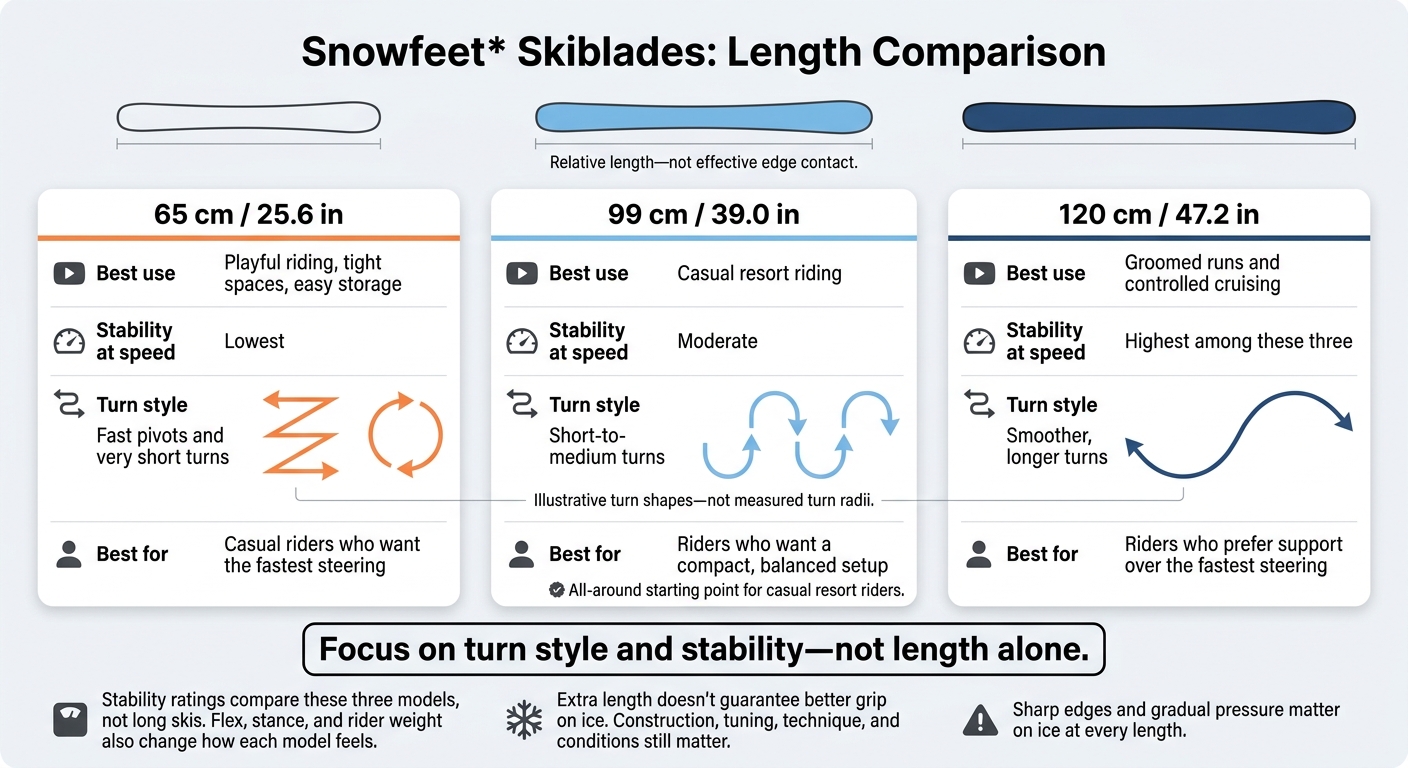
Snowfeet Skiblades: 65 vs. 99 vs. 120 cm
When edge grip is limited on ice, your next choice is length. Focus on turn style and stability - not length alone. Think about how much support you want at speed versus how fast you want to turn.
The stability ratings below compare these three models, not long skis. Flex, stance, and rider weight also change how each model feels.
| Model | Best use | Stability at speed | Turn style | Best for |
|---|---|---|---|---|
| 65 cm / 25.6 in | Playful riding, tight spaces, easy storage | Lowest | Fast pivots and very short turns | Casual riders who want the fastest steering |
| 99 cm / 39.0 in | Casual resort riding | Moderate | Short-to-medium turns | Riders who want a compact, balanced setup |
| 120 cm / 47.2 in | Groomed runs and controlled cruising | Highest among these three | Smoother, longer turns | Riders who prefer support over the fastest steering |
65 cm: Short Turns and Compact Storage
Choose 65 cm for quick steering and easy transport. It’s the easiest model to store and carry. On ice, it suits playful, controlled skids rather than maximum edge hold. It also has the least stability as you pick up speed.
99 cm: A Middle Ground for Casual Resort Riding
The 99 cm model is the best all-around starting point for casual resort riders. On ice, it suits short-to-medium turns rather than long carved arcs.
Check boot compatibility before you order. The Snowfeet* store listing shows ski-boot, pro ski-boot, and snowboard-boot options.
120 cm: More Support for Groomed Runs
Choose 120 cm for smoother cruising, the most support, and the calmest ride of the three. But extra length doesn’t guarantee better grip on ice. Construction, tuning, technique, and conditions still matter, and sharp edges and gradual pressure matter most on ice at every length.
sbb-itb-17ade95
Edge Care and Speed Control on Ice
Once you’ve set the length, your tune and technique determine how well you grip ice. Well-kept edges can mean the difference between a carve and a skid.
Check and Sharpen Your Edges
Before each outing, inspect both edges from tip to tail. Look for dull patches, rust, burrs, nicks, and impact damage. Never slide a bare finger along sharp metal. Check bindings and screws for loose parts or damage, too. Don’t ride with cracked edges or major gouges.
For minor rust or burrs, use a gummy or diamond stone only if you can maintain the original bevel. Follow Snowfeet*’s model-specific guidance. Leave deep damage, extensive sharpening, and repairs you’re unsure about to a ski technician. After sharpening, deburr and polish the edges.
After riding, wipe the edges, bases, bindings, and screws dry. Check for new damage, then store your Skiblades indoors - not in a damp bag. Check their condition after icy outings and service them as needed.
Increase Edge Pressure Gradually at Low Speed
Start on a gentle, wide, uncrowded run with clear visibility and room to stop. Test your turns and stops at low speed before reaching ice. Slow down before the icy patch, then add edge pressure a little at a time. Avoid a sudden, forceful edge set, and don’t wait until you’re on ice to brake.
If the edge won’t hold, switch to a controlled skid. Give other riders extra space, and keep your speed low enough to stop or avoid obstacles. Choose another run if ice, crowds, poor visibility, or doubts about your ability to stop make practice unsafe.
Conclusion: Snowfeet* for Casual Turns, Long Skis for Speed
Snowfeet* Skiblades can carve, but they don’t match long skis on hard ice. Sharp edges and smooth, gradual edging help you make clean arcs on firm groomed snow. On hard ice, a controlled skid is often more useful. Long skis still win for sustained speed and long, stable carves. Length is a tradeoff between agility and stability - not a fix for ice.
For most casual riders, 99 cm is the best all-around starting point. Go with 65 cm for maximum maneuverability or 120 cm for more support on groomed runs. Snowfeet* offers most casual riders the better mix of control, portability, and fun.
Shop the models here: 65 cm - $590; 99 cm - $690; 120 cm - $950.
FAQs
How can I tell if ice is too slick for skiblades?
If your skiblades lose grip or feel twitchy in turns - even with a centered, balanced stance - the ice may be too slick for your setup. Snowfeet Skiblades have metal edges*, but less edge contact means they reach their stability limit sooner than long skis on steep ice at high speeds.
For better grip, keep the side edges sharpened to 87°–88°. Consider the 120 cm (about 47-inch) model for more edge contact and stability.
How does my weight affect skiblade length choice?
Weight matters, but skill level and terrain matter more when choosing skiblade length. Lighter skiers may find the 65 cm (about 26-inch) model suits casual, playful rides on green and blue runs.
Heavier or taller skiers - and those who like faster rides on hardpack - may prefer the 99 cm (about 39-inch) or 120 cm (about 47-inch) models. Their larger surface area and added stability help with control and balance.
How do I safely switch from carving to skidding?
To switch from carving to skidding on Snowfeet Skiblades*, ease off your edge angle and shift your weight so the blades can pivot or slide across the snow. Flatten your ankles slightly to release the edges’ grip and move into a controlled skid.
Skiblades are shorter and more responsive than standard skis, so they pivot with less effort. This move helps you control your speed on crowded runs or in tight, icy spots.












Laisser un commentaire
Ce site est protégé par hCaptcha, et la Politique de confidentialité et les Conditions de service de hCaptcha s’appliquent.