




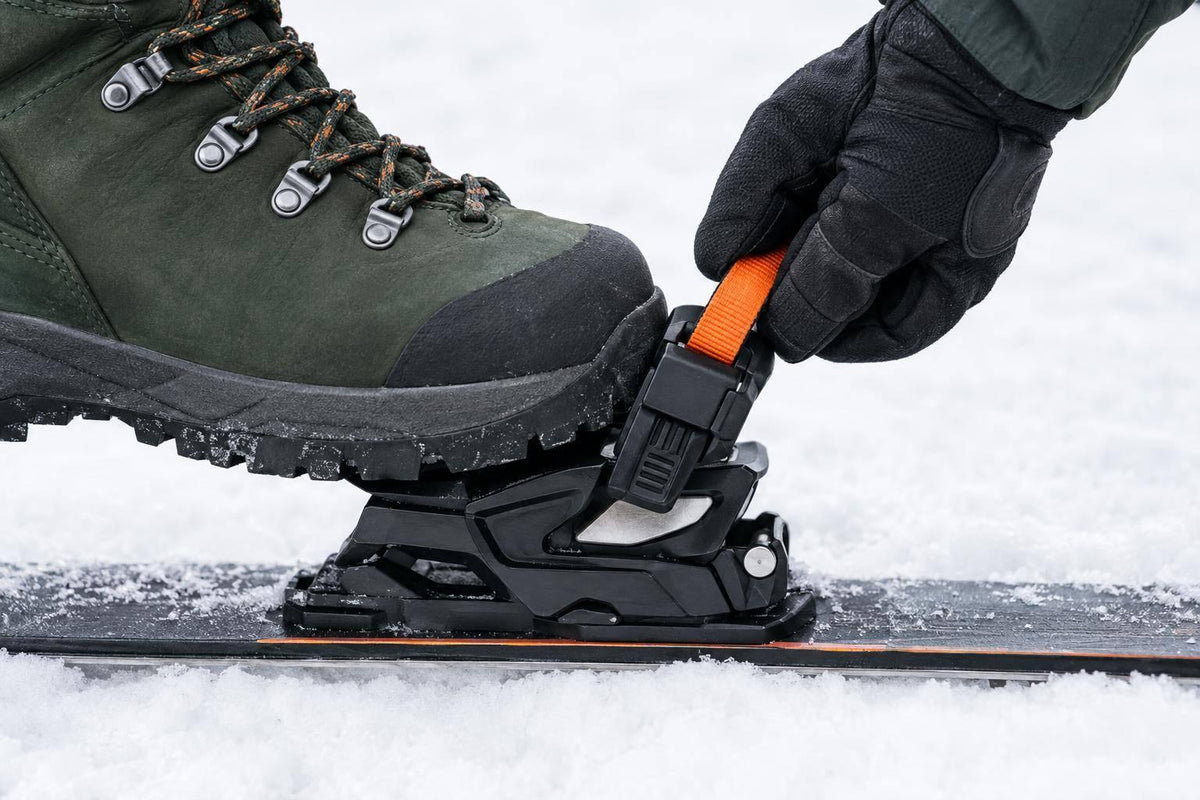
No - standard Snowfeet Skiskates 44 cm (17.3 inches) aren’t built for hiking boots. I’d check the binding label first: use ski boots with ski-boot bindings and snowboard boots with snowboard-boot bindings.
Want to keep your hiking boots? I’d look for a Snowfeet model that explicitly allows them, such as Snowfeet PRO, then check its fit limits.
Here’s my short checklist:
- Match the boot to the binding. Shoe size alone won’t tell you if it works.
- Check fit and support. Your boots should sit flat, stay firm, and resist sole flex and ankle movement.
- Start on flat snow. Try slow glides, turns, and stops. Stop if a heel lifts or a boot shifts.
- Keep approved hiking-boot setups slow and gentle. For slopes, speed, or tricks, use the specified ski or snowboard boots.
My rule: <u>don’t force a fit or modify the bindings</u>. A comfy walking boot isn’t always the right boot for riding.
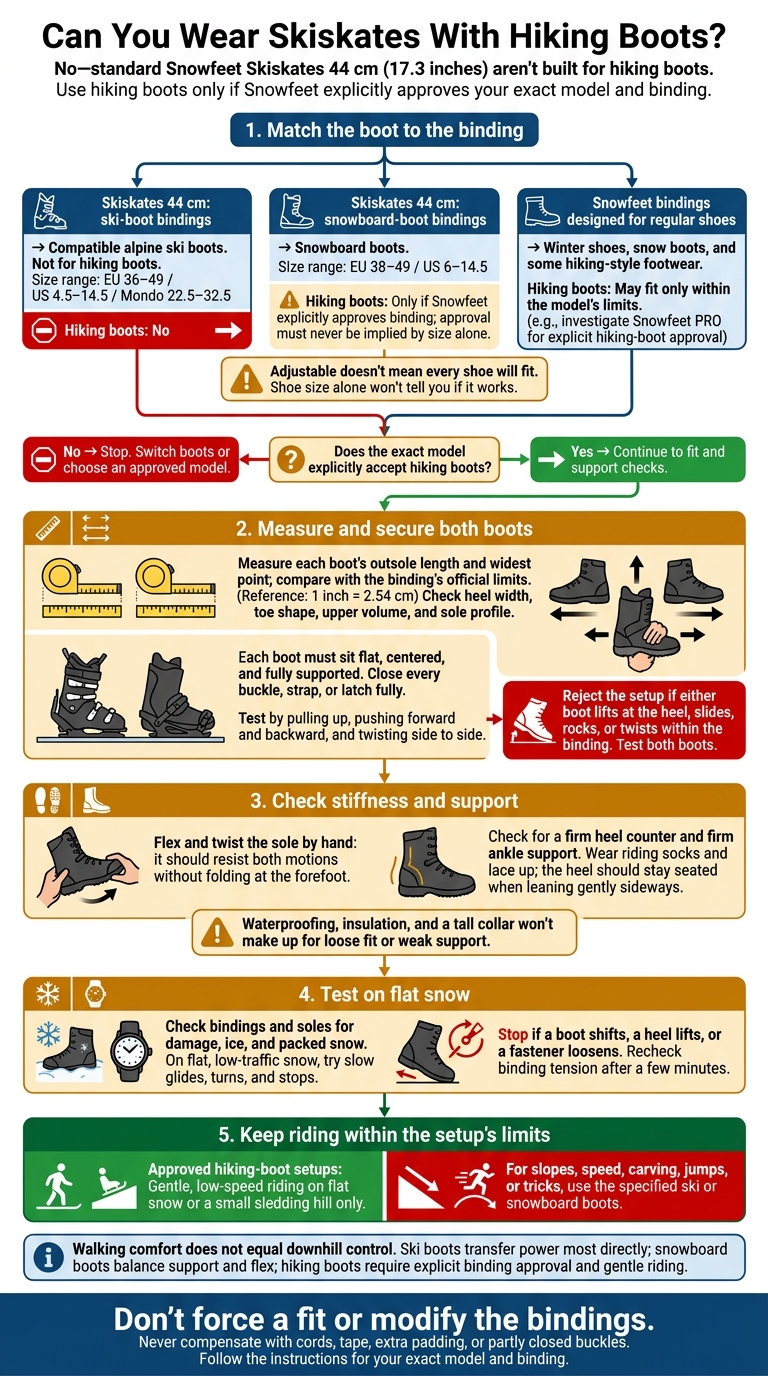
Can You Wear Skiskates With Hiking Boots?
Snowfeet* & Skiskates Complete Guide | All you need to know about Skiskating
Check Your Skiskates Binding Type
Start with the binding label and instructions. Adjustable doesn’t mean every shoe will fit. It means the binding fits a range of boot sizes. If it accepts hiking boots, check that yours fit securely enough to control the skiskate.
| Binding type | Intended footwear | Hiking-boot suitability |
|---|---|---|
| Skiskates 44 cm: ski-boot bindings | Compatible alpine ski boots | Not for hiking boots |
| Skiskates 44 cm: snowboard-boot bindings | Snowboard boots | Only if Snowfeet* explicitly approves that binding |
| Snowfeet* bindings designed for regular shoes | Winter shoes, snow boots, and some hiking-style footwear | May fit only within the model’s limits |
Follow the instructions for your exact binding.
Ski-Boot Bindings Need Compatible Ski Boots
If the binding label says ski boots, stop there: don’t use hiking boots. The ski-boot size range is about EU 36–49 / US 4.5–14.5 / Mondo 22.5–32.5.
These bindings need an alpine ski boot’s rigid shell and binding interface. Hiking boots lack the right shape, stiffness, and secure hold. A matching size alone won’t make them fit safely.
Snowboard-Boot Bindings Need Snowboard Boots
With snowboard-boot bindings, boot shape matters as much as size. Use hiking boots only if Snowfeet* explicitly approves that binding for them. These bindings are built for a snowboard boot’s volume, ankle support, and sole profile.
The snowboard-boot size range is about EU 38–49 / US 6–14.5. If your Snowfeet* binding accepts hiking boots, check your boot length, sole stiffness, and ankle support next.
Check Hiking-Boot Fit and Support
Once you’ve confirmed the binding type, check your boots’ shape and support to see whether the setup will work. Use these checks only after Snowfeet* confirms that your exact model accepts hiking boots.
Measure Your Boots and Check the Fasteners
Measure each boot’s outsole length and widest point in inches and centimeters (1 inch = 2.54 cm). Compare those measurements with the binding’s official limits. Don’t rely on shoe size alone.
Check the heel width, toe shape, upper volume, and sole profile, too. Bulky uppers, narrow heels, rocker soles, and deep lugs can stop the boot from sitting flat.
Each boot must sit flat, centered, and fully supported, with the heel and toe placed as instructed. Close every buckle, strap, or latch fully. Then pull up, push forward and backward, and twist side to side.
Reject the setup if either boot lifts at the heel, slides, rocks, or twists on its own within the binding. Test both boots. Never try to fix a poor fit with cords, tape, extra padding, or partly closed buckles.
Check Sole Stiffness and Ankle Support
Once the fit checks out, test how the boot flexes under load. Flex and twist the sole by hand. It should resist both motions without folding at the forefoot. A soft sole can absorb your movement instead of passing it to the Skiskate, which delays steering.
Look for a firm heel counter - the structure around the heel - and firm ankle support. Put on your riding socks and lace up your boots. Your heel should stay seated when you lean gently sideways.
Weak ankle hold makes steering less precise on snow. High-cut hiking boots help, but they don’t hold your feet or support them as well as ski or snowboard boots. Waterproofing, insulation, and a tall collar won’t make up for a loose fit or weak support.
sbb-itb-17ade95
How Boots Affect Control, Comfort, and Safety
A boot that fits well still needs to work well on snow. Walking comfort does not equal downhill control. On Snowfeet* Skiskates 44 cm (about 17.3 inches), ski boots transfer power most directly. Snowboard boots balance support and flex. Hiking boots work only with bindings that explicitly approve them - and only for gentle riding. Purpose-built ski or snowboard boots are the better choice for sharper control, speed, or tricks.
Choose Boots for Your Riding Conditions
Keep approved hiking-boot setups to gentle, low-speed riding on flat snow or a small sledding hill. The bindings must hold your boots firmly enough to steer. For Skiskates riding on slopes, or for speed, carving, jumps, or tricks, use the specified ski or snowboard boots.
Too much boot flex makes edge pressure harder to predict. It can delay turns, make braking less precise, and throw off your balance.
Warmth matters, too - especially when you’re standing around in cold snow. Tightly compressed insulation or moisture getting in around the tongue can leave hiking boots colder than they feel on a walk.
Once you’ve checked the fit, test your setup on flat snow before heading onto a slope.
Test Your Setup Before Riding Downhill
After confirming that your boots and bindings work together, check the bindings and soles for damage, ice, and packed snow. On flat, low-traffic snow, try a few slow glides, turns, and stops before riding downhill.
Stop if a boot shifts, a heel lifts, or a fastener loosens. Recheck the binding tension after a few minutes.
Conclusion: Match Your Snowfeet* Setup to Your Boots
Once you’ve checked fit and support, match the bindings to your boots: ski boots for ski-boot bindings, snowboard boots for snowboard-boot bindings. Snowfeet* Skiskates 44 cm (about 17.3 inches) are built for those two boot types - not hiking boots by default.
For regular footwear, choose a model built for it. Snowfeet* Mini Ski Skates are the better fit for casual snow play. Before buying or using Skiskates, check the model’s footwear requirements and fit limits.
Don’t modify the bindings to force a fit. Use hiking boots only if the model explicitly approves them. Otherwise, switch boots or choose a Snowfeet* model approved for regular footwear.
FAQs
Can I switch my Skiskates bindings to fit hiking boots?
_No. Snowfeet Skiskates 44 cm have built-in bindings that can’t be swapped._* They come in versions for either ski boots or snowboard boots, so choose the one that matches your boots when you buy. You can’t change the bindings later to fit hiking boots.
For more footwear options, try a model like Snowfeet PRO 50 cm*. Its universal strap-on bindings fit more types of winter footwear.
How can I confirm my hiking boots are approved?
First, check the model and bindings. Snowfeet* Skiskates 44 cm (about 17.3 inches) require ski boots with ski-boot bindings or snowboard boots with snowboard-boot bindings. Hiking or winter boots generally aren’t approved for this model.
Snowfeet* 38 cm (about 15 inches) and PRO 50 cm (about 19.7 inches) allow regular footwear. Make sure your boots have solid ankle support and firm soles. The binding straps should fasten snugly, with no looseness.
When should I switch to ski or snowboard boots?
Switch to ski boots when you move from casual cruising to aggressive carving, high-speed runs, or firm, icy snow. Snowboard boots feel natural for beginners and casual riders and make walking easier. The trade-off? Less precision and edge control.
If your setup feels slow to respond during technical moves, ski boots add stiffness, transfer power more directly, and improve stability. Those gains also help with longer models, like the 65 cm Skiblades (about 25.6 inches).












Laisser un commentaire
Ce site est protégé par hCaptcha, et la Politique de confidentialité et les Conditions de service de hCaptcha s’appliquent.