



















Non — les skis courts ne sont pas toujours plus difficiles sur la glace. Dans la plupart des conditions des stations américaines, ils peuvent sembler plus faciles aux skieurs débutants et occasionnels, car ils tournent rapidement, permettent de ralentir avec moins d’effort et paraissent moins intimidants que des skis de 160 cm et plus.
Voici la version courte :
- Sur des pistes damées fermes : les skis courts sont souvent plus faciles à contrôler
- Sur des pistes raides et glissantes : les skis plus longs maintiennent mieux une trajectoire
- Sur une vraie neige extrêmement dure : presque tous les skis peuvent sembler délicats à maîtriser
- Pour les skis courts : des carres bien affûtées et une position centrée sont très importantes
- Meilleur compromis : les longueurs de 65 cm et 99 cm pour de nombreux skieurs
Ainsi, si vous skiez sur une neige compacte normale — et non sur la glace brillante et traîtresse de la côte Est américaine :) — les skis courts peuvent très bien convenir. Mais lorsque la vitesse, la pente et le caractère glissant augmentent, une plus grande longueur devient utile.
Ce qui compte le plus :
- 44 cm : amusants, souples, mais offrant le moins d’appui sur la glace
- 65 cm : les plus faciles pour de nombreux débutants
- 99 cm : davantage d’accroche et des sensations plus stables
- 120 cm : meilleure tenue des carres dans le groupe des skis courts
- Skis de 160 cm et plus : contact maximal des carres et grande stabilité à vitesse élevée
Un snowboardeur essaie les Snowfeet* | Quels Snowfeet* courts sont les meilleurs ? | Test des snowblades 44, 65 et 99
Comparaison rapide
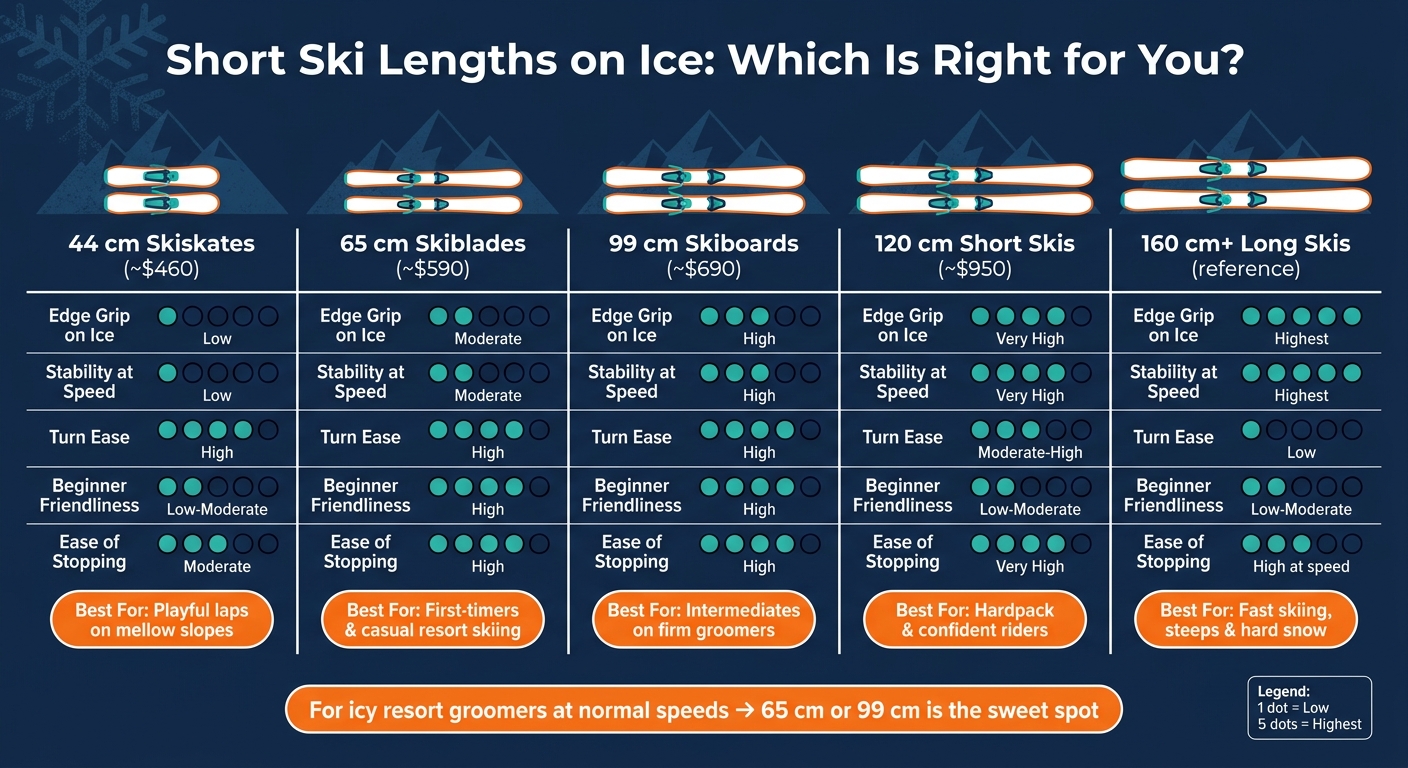
Comparatif des longueurs de skis courts sur glace : accroche, stabilité et utilisation idéale
| Longueur des skis | Accroche sur glace | Stabilité | Facilité des virages | Idéal pour |
|---|---|---|---|---|
| 44 cm | Faible | Faible | Très élevée | Des descentes ludiques sur des pentes douces |
| 65 cm | Moyenne | Moyenne | Élevée | Débutants et ski occasionnel en station |
| 99 cm | Élevée | Élevée | Moyenne à élevée | Skieurs intermédiaires sur pistes damées fermes |
| 120 cm | Très élevée | Très élevée | Moyenne | Journées sur neige compacte et skieurs plus sûrs d’eux |
| 160 cm+ | Maximale | Maximale | Faible | Ski rapide, pentes raides et accroche sur neige dure |
Voici la règle que j’appliquerais : si vous skiez sur des pistes bleues verglacées à vitesse normale en station, choisissez 65 cm ou 99 cm. Si vous êtes souvent sur de la neige compacte, les 120 cm offrent une meilleure accroche sous le pied.
Pourquoi la longueur des skis influe sur l’accroche, l’équilibre et la confiance sur la glace
L’idée essentielle est la longueur de contact de la carre : la longueur de la carre du ski qui touche la neige lorsque vous le mettez sur la carre. Les skis plus longs offrent davantage de contact. Et cela compte.
Un plus grand contact des carres avec la neige répartit votre poids sur une surface plus longue. Cela aide la carre à mordre dans la neige compacte et à maintenir une trajectoire plus régulière dans le virage au lieu de déraper latéralement. Les skis courts ont moins de contact avec les carres, ils pivotent donc rapidement et offrent des sensations plus joueuses. Mais ils dérapent aussi plus vite si vous relâchez la pression sur les carres. Cette différence se voit assez clairement sur les longueurs Snowfeet*, de 44 cm à 120 cm.
Plus de contact des carres contre davantage de maniabilité
Un ski plus long offre davantage de contact de carre et une plateforme plus stable sur la neige. Cette longueur supplémentaire aide à atténuer les petites erreurs d’équilibre et permet au ski de suivre une trajectoire plus prévisible, surtout sur les pistes damées et fermes. Un skiblade de 65 cm est une tout autre affaire. Il réagit presque dès que vous bougez les pieds. C’est amusant dans les virages serrés, mais si l’angle de la carre change ne serait-ce qu’un peu, le ski peut déraper immédiatement.
Les skis plus longs résistent également mieux à la torsion, ce qui permet à une plus grande partie de la carre de rester fermement engagée. Sur neige dure, cela aide toute la carre à travailler plus uniformément. Les skis courts, avec moins de matière et moins de levier, peuvent laisser une partie de la carre décrocher si votre position devient relâchée. La glace ne pardonne pas vraiment ce genre de chose. C’est un peu la version neige d’un arbitre sarcastique.
Quand les skis courts semblent moins stables sur les pentes verglacées
Sur les pistes noires pentues, la gravité exerce davantage de force sur le ski, et une carre plus longue offre une plus grande surface contre laquelle appuyer. À des vitesses plus élevées, ces forces augmentent rapidement, et les skis plus longs gèrent cette énergie avec une sensation plus fluide. Les skis courts peuvent commencer à sembler rebondissants ou nerveux lorsque le rythme s’accélère.
La même chose se produit lorsque vous descendez rapidement tout droit sur une piste damée et ferme. Les skis plus longs suivent les petites bosses et les ondulations de la surface avec moins de perturbations. Les skis courts peuvent être plus facilement déviés et sembler moins stables si vous n’absorbez pas activement le relief avec les jambes.
Quand les skis courts sont plus faciles à contrôler que les skis longs
Sur une piste bleue damée très fréquentée, les skis courts semblent souvent plus faciles à manier. Ils sont rapides, légers et simples à déplacer là où vous le souhaitez.
- Le contrôle de la vitesse est rapide, car il y a moins de ski à faire pivoter
- L’amorce du virage demande très peu d’effort
- Si une ornière ou un autre skieur vous déséquilibre, ils sont plus faciles à ramener sous vous
Pour les personnes qui prennent confiance, cela peut être un énorme avantage. Les skis courts rendent le contrôle de la vitesse et la récupération rapide moins intimidants. L’étape suivante consiste à adapter ce compromis à la bonne longueur Snowfeet*.
sbb-itb-17ade95
Les longueurs Snowfeet* sur glace : 44 cm, 65 cm, 99 cm et 120 cm
Les longueurs Snowfeet* modifient l’accroche, la rapidité des virages et la stabilité sur neige ferme. Et oui, le compromis évolue beaucoup à mesure que le ski s’allonge.
Snowfeet* Skiskates de 44 cm et Skiblades de 65 cm sur neige damée et compacte
Les Skiskates de 44 cm (à partir d’environ 460 $) donnent le plus l’impression de patiner. Sur des pistes bleues douces et damées, ils pivotent rapidement et permettent de contrôler facilement sa vitesse. Cette partie est amusante.
Mais sur les terrains plus pentus ou verglacés, l’instabilité arrive rapidement. La carre courte n’accroche tout simplement pas de manière constante, et même de petites erreurs d’équilibre peuvent se transformer en dérapages. Ils conviennent surtout aux skieurs qui ont déjà de bons réflexes sur les carres et qui apprécient une sensation vive et plus libre.
Passez aux Skiblades de 65 cm (à partir d’environ 590 $) et vous bénéficiez immédiatement d’une meilleure accroche des carres. Cette longueur supplémentaire aide le ski à mordre lorsque vous le mettez sur la carre, notamment dans les virages dérapés et les arrêts hockey sur neige dure. La sensation nerveuse des 44 cm se transforme en une sensation plus rassurante et plus facile à maîtriser.
Pour les débutants et les skieurs intermédiaires confrontés aux journées verglacées habituelles en station, les 65 cm offrent un excellent compromis : ils sont faciles à tourner, tout en offrant suffisamment d’accroche des carres pour vous aider à garder le contrôle.
Avec leurs longueurs de 99 cm et 120 cm, les Snowfeet* commencent à garder une trajectoire davantage comme des skis.
Snowfeet* de 99 cm et 120 cm pour une meilleure tenue des carres sur les pistes damées verglacées
Les modèles de 99 cm (à partir d’environ 690 $) se rapprochent davantage d’un ski all-mountain compact. La carre plus longue entre dans le virage de manière plus fluide, ce qui réduit cette sensation de pivot et de dérapage que l’on ressent avec les longueurs plus courtes. Sur des pistes damées verglacées à vitesse modérée, les 99 cm suivent une trajectoire plus droite et restent mieux sur leur ligne. C’est donc un excellent choix pour les skieurs intermédiaires qui veulent carver plutôt que principalement déraper.
Les skis courts de 120 cm (à partir d’environ 950 $) sont la meilleure option de la gamme pour les conditions verglacées. Sur une neige damée regelée le matin ou des pistes raclées, les 120 cm se rapprochent davantage des sensations d’un ski classique. Ils gardent leur carre tout au long du virage au lieu de déraper sur la surface et gèrent les vitesses modérées ainsi que les petites variations de terrain avec plus de sérénité que les modèles plus courts.
Si vous êtes régulièrement confronté à des départs verglacés, mais que vous ne voulez pas de skis pleine longueur, c’est le modèle qui inspire généralement le plus confiance sous les pieds.
Tableau comparatif : longueurs Snowfeet* et skis longs sur la glace
| Longueur | Accroche des carres | Stabilité à grande vitesse | Facilité de virage | Facilité d’arrêt | Facilité pour les débutants |
|---|---|---|---|---|---|
| Skiskates de 44 cm | Faible | Faible | Très élevée | Modérée | Faible à modérée |
| Skiblades de 65 cm | Modérée | Modérée | Élevée | Élevée | Maximale |
| Skiboards de 99 cm | Élevée | Élevée | Modérée à élevée | Très élevée | Élevée |
| Skis courts de 120 cm | Très élevée | Très élevée | Modérée | Très élevée | Élevée |
| Skis longs (160 cm et plus) | Maximale | Maximale | Faible | Élevée à grande vitesse | Faible à modérée |
Une fois la bonne longueur choisie, des carres bien affûtées et une position équilibrée jouent un rôle essentiel dans l’efficacité sur la glace.
Comment skier en toute sécurité sur des skis courts sur une neige verglacée
Pourquoi des carres bien affûtées sont encore plus importantes sur les skis courts
Une fois la longueur choisie, les deux éléments essentiels suivants sont le réglage et la position. Sur la glace, les skis courts révèlent rapidement des carres émoussées. Plus rapidement que les skis longs. C’est pourquoi l’affûtage des carres est si important ici.
Gardez les carres bien affûtées et propres. Si elles sont émoussées, les skis courts peuvent perdre rapidement leur accroche sur neige dure. Si la carre semble rugueuse ou inefficace, affûtez-la. C’est aussi simple que ça.
Garder l’équilibre, s’arrêter et tourner sur une neige dure
L’erreur la plus courante ? Se pencher en arrière.
Oui, cela semble naturel lorsque la neige devient glissante. Mais cela produit l’effet inverse de celui recherché. Cela soulage la pression sur les carres et fait déraper les talons. Sur neige glacée, un équilibre centré est encore plus important, car les skis courts réagissent rapidement aux moindres mouvements du corps.
Une bonne position ressemble à ceci :
- Poids centré au-dessus de l’avant des pieds
- Légère flexion des chevilles et des genoux
- Mains en avant
- Buste orienté vers le bas de la piste
- Épaules au-dessus des genoux, genoux au-dessus des orteils
Si vous devez vous arrêter, faites-le progressivement. Une dérive latérale contrôlée, un chasse-neige ou un arrêt parallèle dérapé est généralement plus sûr que de jeter les skis sur le côté au dernier moment. Les skis courts réagissent rapidement : leur laisser un instant pour accrocher rend l’arrêt beaucoup plus prévisible.
Pour tourner, commencez par vos pieds, pas par vos épaules. Inclinez d’abord, puis tournez. Cela aide les carres à rester engagées au lieu de forcer un pivot qui dérape simplement sur la surface. Une fois le virage amorcé, augmentez progressivement la pression sur le ski extérieur et accentuez l’angle de carre au milieu de la courbe.
Sur de la vraie glace, une légère dérive contrôlée est souvent plus facile à gérer qu’une prise de carre complète. Inclinez le ski, laissez-le accrocher, puis redressez-vous légèrement à mi-parcours du virage afin que le talon dérape juste un peu en travers de la ligne de pente. Cela permet de réduire la vitesse sans perdre toute l’adhérence. Terminez ensuite le virage en travers de la piste avant d’entamer le suivant.
Quel modèle Snowfeet* convient à votre terrain et à votre niveau
Choisir la bonne longueur en fonction de votre style de glisse compte autant que la technique sur neige dure. Le tableau ci-dessous vous aide à adapter l’accroche des carres et la stabilité à votre terrain.
| Type de skieur | Meilleure longueur | Pourquoi |
|---|---|---|
| Skieur joueur, pentes douces | Skiskates de 44 cm (~460 $) | Pivots rapides, sensation de glisse comme en patinage ; pas adaptés à la glace pentue |
| Débutant, descentes occasionnelles sur pistes damées | Skiblades de 65 cm (~590 $) | Faciles à tourner, suffisamment d’accroche pour des vitesses modérées |
| Skieur intermédiaire confirmé, utilisation polyvalente en station | Skiblades de 99 cm (~690 $) | Meilleure accroche des carres sur les pistes bleues plus pentues et les pistes damées bien fermes |
| Skieur plus lourd ou plus expérimenté, ski fréquent sur neige compacte | Skis courts de 120 cm (~950 $) | Stabilité et adhérence maximales ; sensation la plus proche des skis traditionnels |
C’est précisément pour cette raison que choisir la bonne longueur Snowfeet* est essentiel lors des journées glacées en station.
Conclusion : choisir les skis courts adaptés aux journées glacées en station
Après l’affûtage des carres et la position, la longueur est le dernier facteur qui modifie la sensation des skis courts sur la glace.
Voici le point essentiel : les skis courts ne sont pas automatiquement moins performants sur la glace. Les skis plus longs gardent l’avantage sur les pistes pentues et glissantes, car une plus grande longueur de carre en contact avec la neige offre généralement davantage de stabilité et d’adhérence. Mais soyons honnêtes : la plupart des skieurs occasionnels ne s’attaquent pas à une glace digne d’une course. Ils skient sur des pistes damées bien fermes et une neige compacte classique en station.
Le choix est donc assez simple : choisissez la longueur de vos skis en fonction de l’importance que vous accordez à l’accroche ou à l’agilité.
Sur les pistes damées verglacées, les modèles Snowfeet* 65 cm et 99 cm sont les plus faciles à contrôler :
- 65 cm : le plus facile à faire pivoter
- 99 cm : offre une meilleure accroche des carres
- 120 cm : offre le plus de stabilité
- 44 cm : à éviter sur la glace, sauf si vous recherchez l’option la plus ludique et la moins stable
Choisissez une longueur adaptée à votre terrain et à votre vitesse, et vous aurez plus de facilité à garder le contrôle lors des journées verglacées en station.
FAQ
Les skis courts sont-ils sûrs sur les pentes verglacées pour les débutants ?
Les skis courts et les snowblades sont généralement un choix sûr pour les débutants sur les pistes damées des stations. La raison principale est simple : ils sont plus faciles à contrôler et à faire tourner que les skis longs classiques.
Cela dit, ce ne sont pas les meilleurs équipements pour les terrains verglacés ou escarpés. Même avec des carres métalliques, les skis plus courts offrent moins de surface de contact avec la neige. Cela peut entraîner une stabilité moindre lorsque vous rencontrez des plaques dures et glissantes.
Pour les débutants, les modèles Snowfeet* de 65 cm, 99 cm et 120 cm semblent généralement plus stables et plus indulgents que l’option de 44 cm. Voyez les choses ainsi : un peu plus de longueur vous donne un peu plus de marge d’erreur, ce qui n’est jamais une mauvaise chose lorsque vous commencez encore à prendre vos marques sur les skis :)
Comment savoir si je dois choisir 65 cm, 99 cm ou 120 cm ?
Tout dépend de votre niveau et de votre façon de skier :
- 65 cm : idéal pour les débutants, les figures et les virages serrés et rapides
- 99 cm : le meilleur équilibre entre agilité et stabilité
- 120 cm : idéal pour les skieurs confirmés qui veulent plus de stabilité à vitesse élevée, une meilleure portance dans la poudreuse et des sensations plus proches du ski classique
Choisissez la longueur adaptée à votre style et au type de terrain sur lequel vous skiez le plus souvent.
Les skis courts ont-ils besoin de carres plus affûtées que les skis longs ?
Non. Les carres bien affûtées sont importantes sur les skis courts comme sur les skis longs, surtout lorsque vous faites des virages coupés ou skiez sur la glace.
La longueur des skis ne change rien à cela. Des carres propres, lisses et sans bavures vous aident à garder le contrôle et à rester stable.
Les skis courts semblent plus rapides et plus faciles à faire tourner, c’est certain. Mais ils ont toujours besoin de bonnes carres métalliques pour accrocher sur une neige dure et verglacée et vous maintenir stable.
Articles de blog associés
- Inconvénients des skis plus courts : quels compromis faut-il accepter ?
- Quels sont les meilleurs skis si je déteste les conditions verglacées ? (Accent sur l’accroche des carres)
- Les skis courts sont-ils plus faciles à faire tourner ? (Test réel)
- Les skis courts en valent-ils la peine pour les skieurs plus âgés ? Un regard honnête











Laisser un commentaire
Ce site est protégé par hCaptcha, et la Politique de confidentialité et les Conditions de service de hCaptcha s’appliquent.