




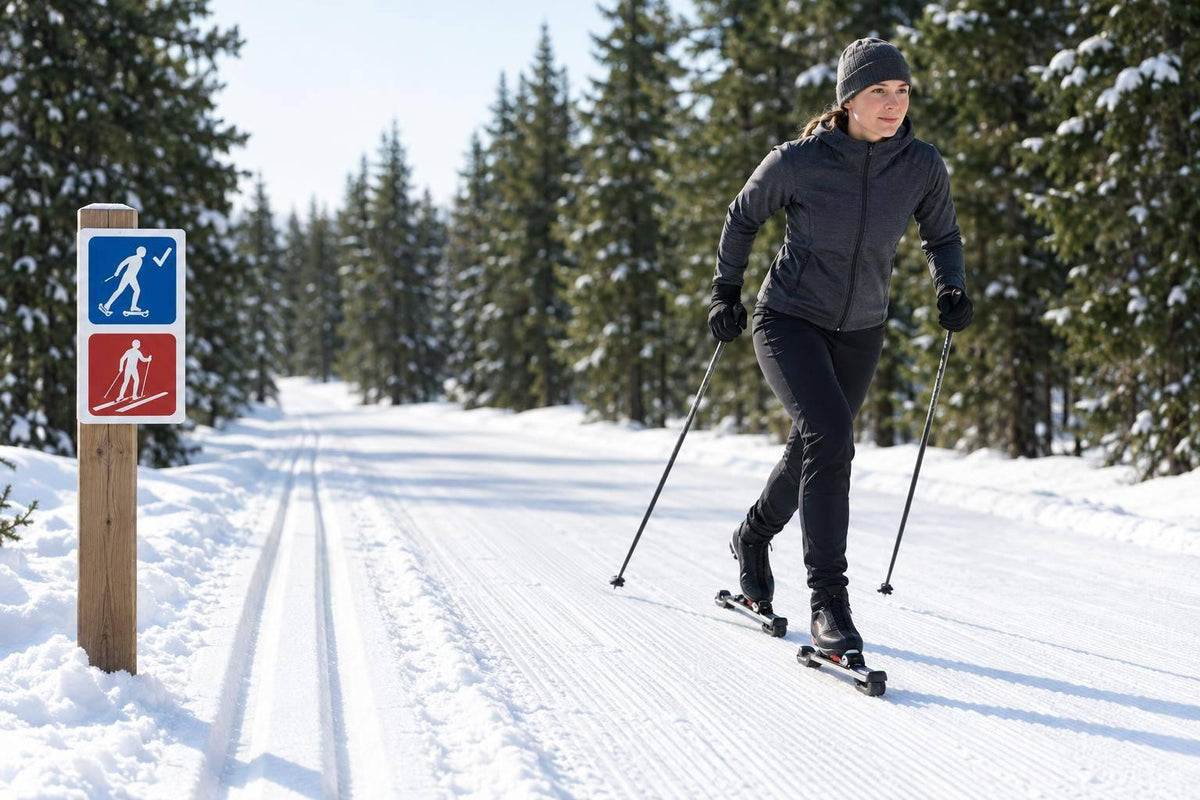
Yes - you can use 44 cm (17.3-inch) Skiskates on groomed skating lanes if the trail operator allows them. My advice: check the rules first, choose firm snow, and keep your first outing short. <u>Stay out of classic tracks.</u>
Here’s how I’d choose your gear and plan your trip:
- Short laps and easy turns: Pick 44 cm Skiskates with the right ski or snowboard boots - not regular winter shoes.
- More glide on longer laps: Consider 90 cm (35.4-inch) Snowfeet* NORDIC skis for skate-style use, not classic tracks. Check their boot requirements.
- Long-distance trips: Choose standard Nordic skis.
- Safe trail use: Practice stopping before tackling hills, leave room for other skiers, and follow posted lane rules and closures. Poles won’t do the braking for you. :)
I’d skip soft snow and steep descents on Skiskates. Small gear is easy to carry, but control matters more than what fits in your bag.
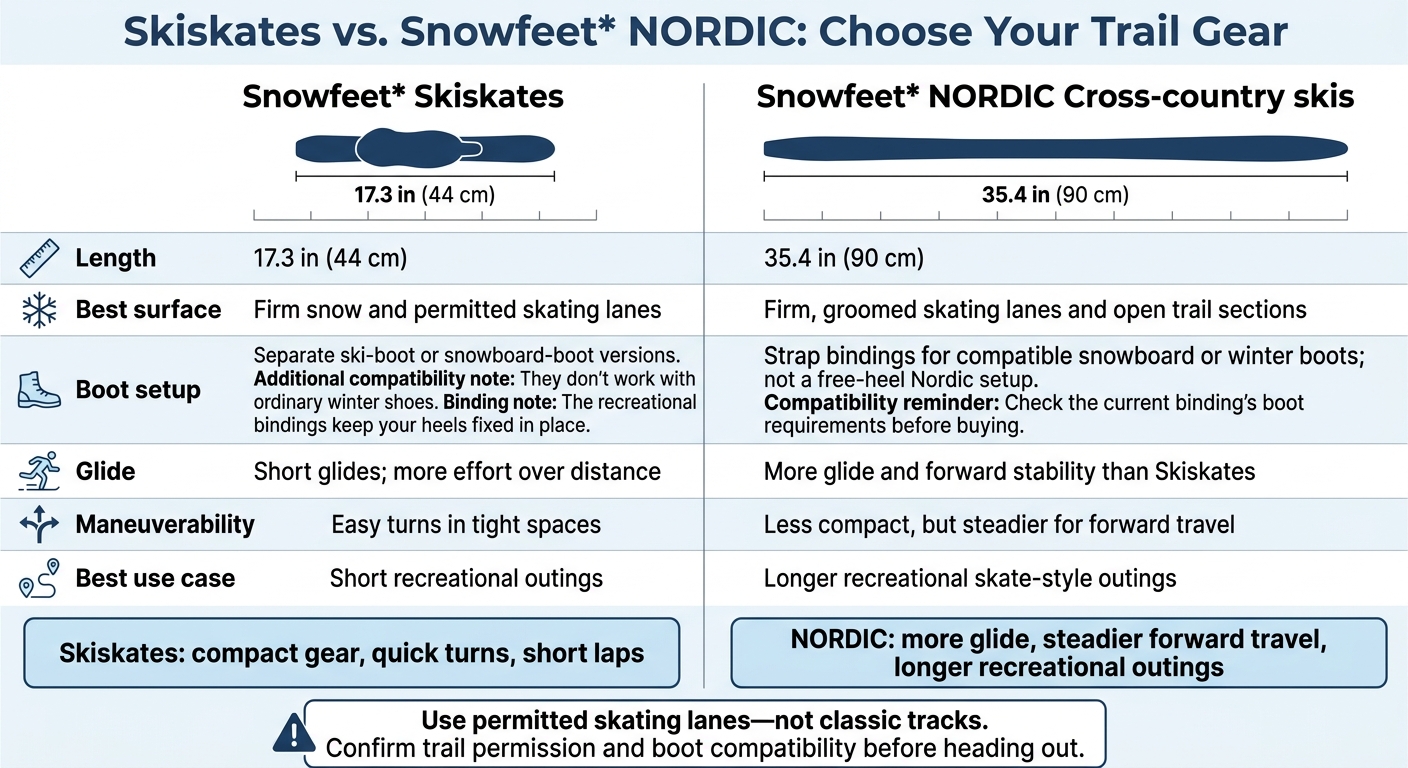
Skiskates vs. Snowfeet* NORDIC: Choose Your Trail Gear
Snowfeet* & Skiskates Complete Guide | All you need to know about Skiskating
Where Do 44 cm Skiskates Work Best?
44 cm Skiskates work best on short, firm, groomed runs where skating is allowed. At 44 cm (about 17.3 inches), Snowfeet* Skiskates are small and easy to carry. They’re handy for short outings, but their short length means less glide on longer routes.
Firm Snow and Short Routes
Choose firm, smooth snow with enough room for skating pushes. Narrow paths or crowded stretches still call for strong speed control.
On soft snow, they don’t glide as well, so you’ll need to push more often than you would on purpose-built Nordic skis. They’re better suited to short sessions for fun than to covering distance.
Boot and Binding Compatibility
The 44 cm Skiskates come in alpine-boot and snowboard-boot versions. Unlike the original Snowfeet* model, they don’t work with ordinary winter shoes.
Their bindings put control ahead of Nordic-style kick-and-glide efficiency. Systems such as NNN or SNS, by contrast, use lightweight boots and bindings designed for touring.
That tradeoff makes Snowfeet* NORDIC 90 cm skis a better fit for longer skate-style outings.
How to Use Skiskates Safely on Shared Trails
Practice Slowing and Stopping
If Skiskates are allowed on the lane, control comes first. Start on flat, open snow, away from people and obstacles. Glide at walking speed and practice turns in both directions. Try a shallow wedge stop where the snow allows it, and step out only at very low speed. Snowfeet* also describes a hockey-style stop and a heel brake for slowing down. Skiskates don’t stop like longer Nordic skis, so familiar moves may feel different.
Try a gentle slope only when you can stop without falling or swerving into someone else’s path. Slow down before the slope gets steeper, leave extra space behind other skiers, and skip hills that lack a clear stopping area. Poles can’t replace braking skills. These limits make Skiskates a better fit for short, controlled outings than long-distance touring.
Stay Out of Tracks and Share the Lane
Once you can stop with confidence, follow the same posted lane rules as other skiers. That includes rules for direction, speed, passing, and yielding. Keep right where required, announce passes using the local convention, and pass only when you can see ahead and have enough room. If someone passes you, hold a steady line. Move aside only when it’s safe.
Use the skating lane, not the classic tracks. Before you stop, check for approaching traffic and move to the trail edge, outside the lane. Keep your Skiskates and poles clear of traffic. Don’t stop at blind corners, narrow bridges, intersections, or hill bottoms. Give downhill skiers room as required by the operator’s right-of-way rules.
Respect closures, grooming vehicles, and instructions to let new snow set. A lane permit doesn’t override closures or grooming restrictions.
sbb-itb-17ade95
Skiskates vs. Snowfeet* NORDIC Skis
If the trail allows skiskates, your choice comes down to agility or glide. Match your gear to your route length and boots. Skiskates are compact and easy to turn. NORDIC skis offer more glide and steadier forward travel.
Here’s how they compare.
| Product | Length | Best surface | Boot setup | Glide | Maneuverability | Best use case |
|---|---|---|---|---|---|---|
| Snowfeet* Skiskates | 17.3 in (44 cm) | Firm snow and permitted skating lanes | Separate ski-boot or snowboard-boot versions | Short glides; more effort over distance | Easy turns in tight spaces | Short recreational outings |
| Snowfeet* NORDIC Cross-country skis | 35.4 in (90 cm) | Firm, groomed skating lanes and open trail sections | Strap bindings for compatible snowboard or winter boots; not a free-heel Nordic setup | More glide and forward stability than Skiskates | Less compact, but steadier for forward travel | Longer recreational skate-style outings |
Skiskates for Short Recreational Outings
Skiskates make sense when easy carrying matters more than mileage. Choose the 17.3-inch (44 cm) model for quick turns and short laps if you already own compatible boots. Metal edges grip firm snow. The recreational bindings keep your heels fixed in place.
NORDIC for Longer Skate-Style Outings
The 35.4-inch (90 cm) NORDIC offers more glide and stability than the 17.3-inch (44 cm) Skiskates. It’s the better Snowfeet* option when you want to cover more ground rather than keep your gear as compact as possible. Check the current binding’s boot requirements before buying.
Use NORDIC for longer recreational skate-style outings on firm, groomed lanes where permitted - not for classic tracks.
Conclusion: Choose Gear for Your Trail and Route
Match your gear to the trail and the length of your route. Choose 44 cm (17.3 in) Snowfeet* Skiskates for short, controlled laps on permitted, groomed skating lanes - not classic tracks. Choose 90 cm (35.4 in) Snowfeet* NORDIC for longer skate-style outings where glide and stability matter more.
Standard Nordic skis still win for distance. Snowfeet* is the better compact choice for short, casual outings. But softer snow and steeper terrain change the picture. The 44 cm design’s small surface area means less float and stability in soft or deep snow. Longer routes and steep descents also expose Skiskates’ braking limits.
Before taking Skiskates onto a cross-country trail, confirm trail permission, boot compatibility, firm grooming, and your ability to brake with control.
FAQs
How do I check whether a trail allows Skiskates?
Check the trailhead’s posted rules or the managing organization’s website to see if Skiskates or other short skis are allowed. Rules differ by trail, so check that your gear is permitted before you head out - even if you use Snowfeet* NORDIC skis.
At the trailhead, look for the Cross-Country Responsibility Code. It explains how to share the trail with others. Follow local rules to help keep everyone safe and respect fellow trail users.
How can I tell if I’m ready for trail skating?
You’re likely ready for trail skating if you’re comfortable with a skating-style stride - much like ice skating or rollerblading - and want a low-stress way to enjoy the snow.
Snowfeet NORDIC (90 cm, about 35 inches) skis* are shorter and lighter than standard cross-country skis, so they’re a good fit for beginners. They’re ideal for casual, 20–60-minute outings on groomed park loops, golf courses, or flat, packed trails where easy turns matter more than speed.
When should I switch to Snowfeet* NORDIC skis?
Switch to _Snowfeet NORDIC (90 cm)_* for short, skate-style cross-country outings on groomed, hard-packed snow. They work best on flat terrain or gentle hills, giving you steadier tracking and more glide - but a little less playfulness than very short skiskates.
For all-day distances, race pace, or deep or soft snow, full-length cross-country skis are the better choice.












Hinterlassen Sie einen Kommentar
Diese Website ist durch hCaptcha geschützt und es gelten die allgemeinen Geschäftsbedingungen und Datenschutzbestimmungen von hCaptcha.