



















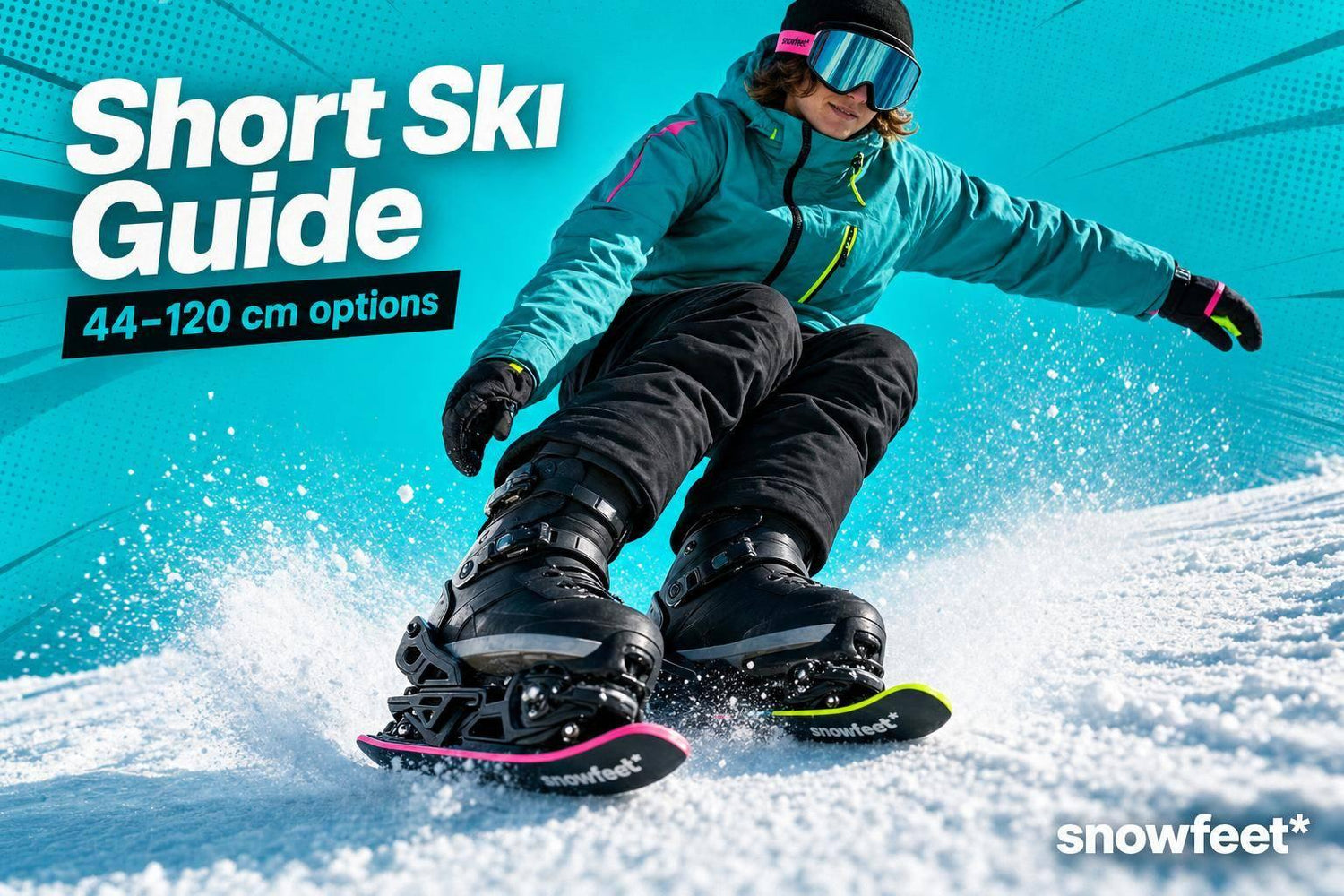
If you want the short answer: go 99 cm for one-ski fun, 65 cm for park laps, 44–50 cm for travel, and 120 cm if you want the closest thing to a normal ski.
I’d sum up the whole 2026 market like this: the old Bigfoot idea didn’t die. It just got split into 44 cm, 50 cm, 65 cm, 99 cm, POWDER 99 cm, and 120 cm options. That matters because a 44 cm setup rides nothing like a 120 cm ski, even though both sit in the same short-ski camp.
Here’s the fast read:
- 44 cm Skiskates: most compact, most twitchy, best for mellow fun
- 50 cm PRO: easy grab-and-go pick, fits many winter or snowboard boots
- 65 cm Skiblades: park-focused, tight turns, more ski feel
- 99 cm Skiblades: best all-around choice for most riders
- 99 cm POWDER: same length, more float in soft snow
- 120 cm Short Skis: calmest Snowfeet option, closest to standard skis
- Vintage Bigfoots: fun retro gear, but used-only and hit-or-miss
- Standard adult skis: still best for speed, ice, and deep snow
A few numbers jump out. Standard adult skis usually run about 155–185 cm. Old Bigfoots were about 60–70 cm. That means some of today’s short-ski options are still 60% to 75% shorter than a normal adult ski. That’s why they’re so easy to turn, stash, and toss in a car.
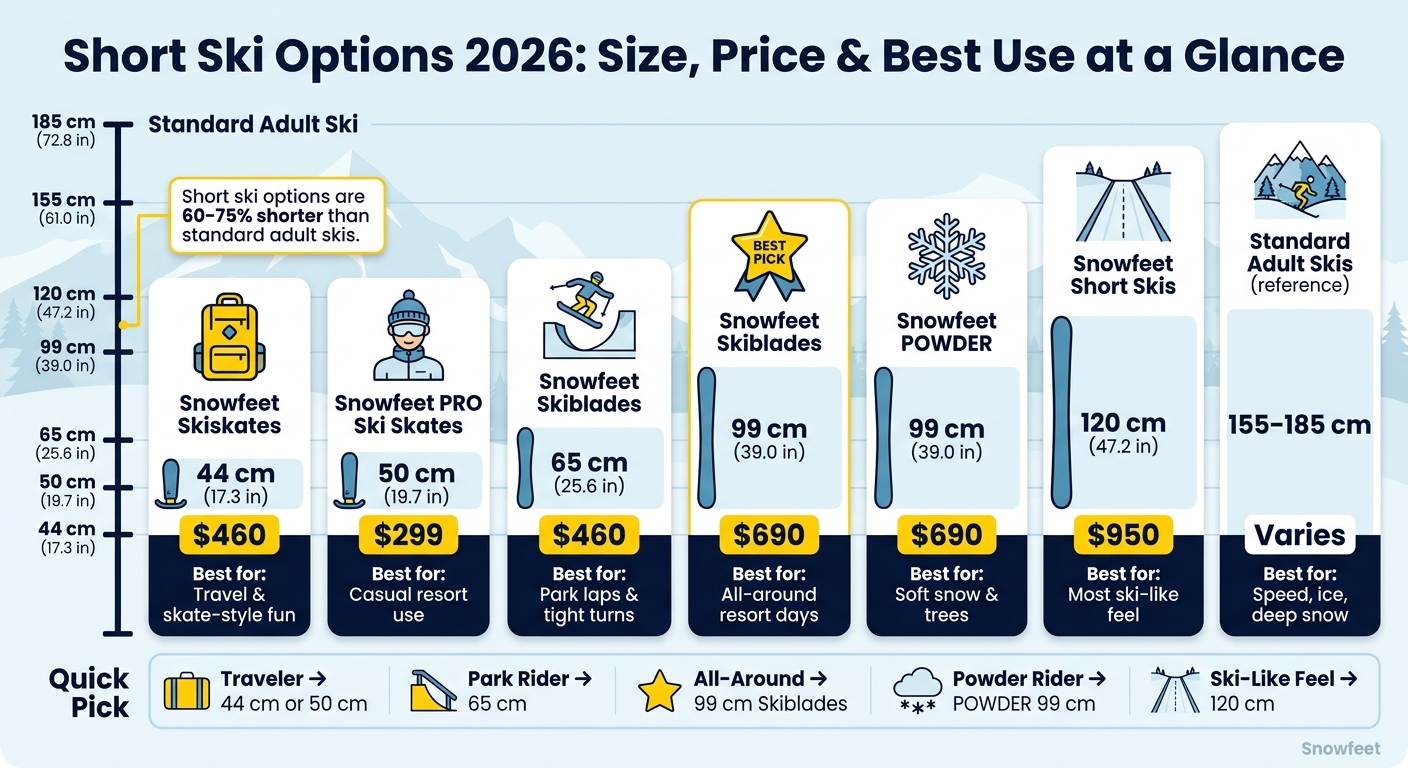
Short Ski Options 2026: Size, Price & Best Use at a Glance
Snowboarder tries Snowfeet* | Which Snowfeet* Short Ski is the Best? | Snowblades 44, 65, 99 Review
Quick Comparison
| Option | Length | Best Use | Boot Setup | Main Trade-Off | Starting Price |
|---|---|---|---|---|---|
| Snowfeet Skiskates | 44 cm / 17.3 in | Travel, playful laps | Ski or snowboard boots | Low stability at speed | $460 |
| Snowfeet PRO Ski Skates | 50 cm / 19.7 in | Casual resort use, local hills | Many winter or snowboard boots | Not for steep, fast riding | $299 |
| Snowfeet Skiblades | 65 cm / 25.6 in | Park, moguls, tight turns | Ski or snowboard boots | Chatters on longer fast runs | $460 |
| Snowfeet Skiblades | 99 cm / 39.0 in | Mixed resort days | Ski boots | Less calm than full skis | $690 |
| Snowfeet POWDER | 99 cm / 39.0 in | Soft snow, trees | Ski or snowboard boots | Less bite on ice | $690 |
| Snowfeet Short Skis | 120 cm / 47.2 in | Groomers, casual all-mountain use | Ski boots | Less playful than shorter picks | $950 |
| Vintage Bigfoot-style skis | 60–70 cm | Retro fun on groomers | Varies by model | Old bindings, used-only | Varies |
| Standard adult skis | 155–185 cm | Full-mountain skiing | Ski boots | Bulky and harder to haul | Varies |
So, if you’re asking me what most people should buy, I’d point first to the 99 cm Skiblades. If you want a ski that still feels playful but doesn’t feel like a squirrel on espresso, that’s the middle ground :) If you want pure pack-and-go fun, look at 44 cm or 50 cm. If you still want that short-ski idea but with more calm underfoot, 120 cm is the move.
If you want a quick visual before you buy, these videos help:
- Short ski / skiblade overview on YouTube
- Snowfeet skiskates videos on YouTube
- Skiblades vs skis on YouTube
Bottom line: I’d treat short skis as the fun-first pick. They’re easier to carry, easier to store, and easier to throw sideways on a mellow hill. But if you live for icy blacks, high speed, or deep storm days, full-length skis still win.
1. Snowfeet* Skiskates 44 cm (17.3 in)
At 44 cm (17.3 in), Skiskates are the shortest Snowfeet* model. They feel the most like skates on snow. If you liked the old Bigfoot concept, this is the closest modern version: super short, easy to turn, and built more for fun than flat-out speed.
If you want the purest, most compact take on that style, start here.
Length and Stability
The ultra-short length makes fast pivots and tight moves feel natural. That’s the big draw. But there’s a trade-off: stability drops once speed picks up. So, these aren’t meant for bombing groomers.
Most riders need a short adjustment period before the feel starts to make sense. The sweet spot is short, centered movements, not long carving turns.
Boot Compatibility
Skiskates 44 cm come in versions for ski boots or snowboard boots. That gives riders more setup choice, which is nice.
And unlike the old plastic Snowfeet mini ski skates made for regular winter shoes, these use:
- a wood core
- cap construction
- steel edges
- a sintered base
- a durable topsheet
So, yes, they’re tiny. But they’re built like actual ski gear, not a toy.
Terrain Fit
That skate-like ride works best in places where control matters more than float. Think:
- groomed runs
- terrain parks
- packed local hills
In deep powder, the short platform doesn’t give you much float. No surprise there. You’re riding a very small footprint on snow.
Portability and Price
Portability is one of the biggest perks. Skiskates fit in a backpack, travel easily, and store under a bed or in a closet. That’s a huge plus if you don’t want another bulky piece of gear taking over your garage :)
Choose this model if portability and quick, playful riding matter more to you than speed or powder performance. They start at $460.
Next: the PRO 50 cm, which keeps that compact feel but leans a bit more casual and approachable.
2. Snowfeet* PRO Ski Skates 50 cm (19.7 in)
The Snowfeet* PRO Ski Skates are 50 cm (19.7 in) long. That puts them in a nice middle spot. If the 44 cm Skiskates feel a bit too twitchy, but 65 cm starts to feel more like a short ski, the PRO lands right between them.
Here’s the simple version: the 44 cm model is the most nimble, the 50 cm PRO is the easiest for casual grab-and-go use, and 65 cm leans more toward a ski-like ride.
Length and Stability
That extra 6 cm gives you a bit more stability, but the PRO still keeps that small, easy-to-handle feel. It’s built more for fun resort laps than hard carving or bombing down the hill.
If you care more about easy control than top speed, this is the sweet spot.
Boot Compatibility
The PRO uses adjustable bindings that fit most winter boots or snowboard boots in U.S. sizes 6–13 (EU 38–47), so a lot of riders can use boots they already have. Bulky U.S. size 12–13 snowboard boots may not fit some binding versions.
It also comes with metal edges and a heel brake, which is pretty rare in this size range. That means better stopping power and better edge hold than many plastic snowskates.
Terrain Fit
These work best on:
- Groomed runs
- Beginner slopes
- Playful resort cruising
They’re not the top pick for deep powder or long, fast descents. That’s where longer skis pull away. But for a normal day of relaxed laps at a local hill or resort, the PRO makes a lot of sense.
Portability and Price
One of the best parts? They’re easy to toss in a car trunk or tuck into a closet. So if you like weekend trips or quick after-work sessions, they’re easy to bring along without a fuss.
The PRO Ski Skates start at $299.
If you want more ski-like control and more speed, the 65 cm Skiblades are the next step.
3. Snowfeet* Skiblades 65 cm (25.6 in)
At 65 cm (25.6 in), these Skiblades are the first Snowfeet* model that feels plainly more like a ski. You get more edge on the snow, better stability, and smoother carving than with the 50 cm PRO. This is where the old Bigfoot idea starts to feel modern. It sits right between the ultra-short 44/50 cm skate-style models and the more planted 99/120 cm skis. If you want the middle ground between mini skis and short skis, this is it.
Length and Stability
With a 4 m turning radius and an 11 / 9.5 / 11 cm profile, these are built for quick, snappy turns, not big, sweeping arcs. The twin-tip shape also makes riding switch easier, which gives them more use in the park than old Bigfoot-style skis.
Boot Compatibility
Snowfeet* sells both ski-boot and snowboard-boot versions, and both use tool-free adjustable bindings. The fit range is broad:
- Ski boots: about EU 36–49 (US 4.5–14.5)
- Snowboard boots: about EU 38–49 (US 6–14.5)
That makes the 65 cm model easy to share between riders with different boots.
Terrain Fit
These work best on groomers, terrain parks, moguls, and smaller local hills. Their short length also helps in tight spots where full-length skis can feel clunky. If you want more stability at higher speed or better float in deeper snow, the 99 cm or 120 cm models make more sense.
Portability and Price
At 65 cm, they’re still easy to pack, carry, and store. Travel is a lot less of a hassle than with full-length skis, but on snow they feel much more ski-like than the shorter models. Snowfeet* lists them from $460.
Next up, the 99 cm Skiblades bring a bigger platform, more stability, and more speed.
4. Snowfeet* Skiblades 99 cm (39.0 in)
The 99 cm (39.0 in) Skiblades are a clear step up from the 65 cm model. You still get that short, playful feel, but with more ski under your feet. On snow, that means they feel calmer, smoother, and more planted. This is where that Bigfoot-style fun starts to blend with the steadier feel of a short ski. Put simply, this is the first Snowfeet* model here that starts to act like a true short ski.
Length and Stability
That extra length makes a big difference. You get better edge hold on hard snow, more control as speed picks up, and smoother carving through turns. If you want a short ski that still feels steady, but not big and awkward, this is the sweet spot.
Boot Compatibility
Snowfeet* sells the 99 cm Skiblades with two binding choices:
- Simple ski boot bindings (non-release), which fit about US men's sizes 4.5–14.5 and standard alpine ski boots
- Pro ski boot bindings (release bindings), sized around Mondopoint 26–36.5, for riders who want a releasable safety option
Terrain Fit
Snowfeet* presents the 99 cm model as its best all-around pick for riders who want one short ski for groomers, park laps, and mixed resort days. And yeah, that tracks. It has the broadest all-around use in this group, covering groomed runs, moguls, terrain parks, light powder, and narrow trails.
If deep powder is your main focus, though, this one isn’t the top match. The 99 cm POWDER version makes more sense for softer snow.
For riders who spend more time in powder, the POWDER 99 keeps the same length with more float.
Portability and Price
At 99 cm, these are still much easier to travel with than 150–180 cm skis. They’re simpler to pack, easier to carry, and a lot less annoying in the parking lot or lodge. Snowfeet* lists the 99 cm Skiblades from $690.
5. Snowfeet* POWDER 99 cm (39.0 in)
If the standard 99 cm feels a bit narrow in soft snow, the POWDER version fixes that. It keeps the same 99 cm length, but adds a wider platform for more float. In plain English: you stay higher in fresh snow and don’t sink as much.
Length and Stability
At 99 cm, this ski still has that quick, snappy feel people like in a short ski. The wider shape helps it float better in powder and feel more settled in chopped-up snow. The twin-tip shape also helps when the terrain gets mixed. So if your day includes soft snow, crud, and a few odd patches here and there, this one handles it better than the regular 99 cm.
Boot Compatibility
It works with ski-boot or snowboard-boot bindings. But for resort riding, ski boots with proper bindings are the safer call. That setup gives you better control and a more secure feel.
Terrain Fit
This model works well in:
- Soft snow
- Packed powder
- Trees
- Mixed resort conditions
That said, for steep powder lines and high-speed riding, a longer ski still has the edge. Short skis are fun. Physics still wins :)
Portability and Price
It’s still much easier to travel with than full-length skis. Snowfeet* lists the POWDER 99 starting at $690, which is the same entry price as the standard 99 cm Skiblades. That makes the wider, powder-focused design a smart pick for anyone who spends a lot of time in soft snow.
If you want more stability on firmer snow, the 120 cm Short Skis are the next step.
sbb-itb-17ade95
6. Snowfeet* Short Skis 120 cm (47.2 in)
At 120 cm, this is Snowfeet*'s most ski-like short ski. It gives up a bit of the snap and quick moves you get from the 99 cm Skiblades, but in return you get more calm, more edge hold, and a steadier ride. So if the shorter models feel a little too playful, this is the more serious pick.
Length and Stability
The shape does a lot of the work here. You get a parabolic design, a 7.8 cm waist, metal edges, a graphite base, and camber with tip-and-tail rocker. Put that together and the ski feels more planted on firm snow than the shorter Snowfeet* models. Snowfeet* lists an 8 m turn radius.
Boot Compatibility
It fits Mondopoint 26–36.1 boots, which makes it the most ski-like and resort-ready Snowfeet* option in this group.
Terrain Fit
This one makes sense for:
- groomers
- park laps
- narrow trails
- casual all-mountain runs
Deep powder? Not its thing. High-speed charging? Full-length skis still take that round.
Portability and Price
At $950, it costs more than the shorter Snowfeet* models. Still, it's much easier to pack, carry, and travel with than full-length skis.
Next, compare this modern 120 cm format with vintage Bigfoot-style short skis.
7. Vintage Bigfoot-Style Short Skis
Kneissl's Bigfoot was the original cult hit in the short-ski world. These days, it mostly lives on as secondhand collector gear. If you want a starting point for today’s short-ski comeback, Bigfoot is it. But Snowfeet takes that same idea and turns it into something modern you can still use without the used-gear gamble.
Length and Stability
Original Bigfoots felt fast and playful on groomers. That said, they weren’t as steady at higher speeds as modern Snowfeet options, most of all the 120 cm model.
Boot Compatibility
Some vintage Bigfoot models came with non-standard bindings that could take shoes or sturdy boots. Sounds fun, right? The catch is that fit can vary a lot based on the model and its condition.
Terrain Fit
Vintage Bigfoots were mainly built for groomed runs. They don’t offer the same range as modern Snowfeet short skis when you move across mixed resort terrain.
Portability and Price
Vintage Bigfoot skis are small and easy to carry. That part still holds up. On today’s secondhand market, prices are all over the map and depend on condition, bindings, and rarity. That’s the trade: you get old gear with an unknown history. A new Snowfeet model gives you modern build quality and fresh bindings instead.
| Criterion | Vintage Bigfoot | Snowfeet* Modern Short Skis |
|---|---|---|
| Age | Late 1980s–early 1990s | 2020s |
| Boot compatibility | Some models used shoes or ski boots | Winter shoes, snowboard boots, or ski boots depending on the model |
| Terrain | Groomed runs mainly | Groomed runs, park laps, powder, and more depending on model |
| Buy type | Used only | Brand-new |
For most riders, Snowfeet comes out ahead. You get modern construction, more model options, and a much easier buying process than digging through used Bigfoot listings. Vintage Bigfoot still has its place, but it makes the most sense for collectors. Next, compare that short-ski baseline with full-length adult skis.
8. Standard Adult Skis (Reference Baseline)
Standard adult skis are the baseline here. They make it easy to see the trade-off: what short skis give up in speed and stability, and what they get back in portability. Most adult skis fall in the 155–185 cm range, with the right size based on your height, skill, and the terrain you ride. Next to that benchmark, Bigfoot-style short skis stand out for easy carrying and quick, snappy turns.
Length and Stability
Longer skis feel calmer at speed because they give you more effective edge, most of all on groomers and in rough or mixed snow. The catch? They’re slower to pivot and less nimble in tight spots. It’s a bit like driving a long truck instead of a compact car. You get more composure, but less zip.
Boot Compatibility
Standard adult skis use traditional alpine bindings and ski boots. That setup is familiar and proven. Still, it also means you’re locked into regular ski footwear, which adds cost and bulk.
Terrain Fit
Waist width matters a lot.
- 65–85 mm works best for groomers
- 85–100 mm fits most all-mountain days
- 100–120 mm helps with powder float
That range is a big reason standard skis stay the go-to full-mountain option.
Portability and Price
This is where standard skis take the hit. They’re long, bulky, and awkward to haul around or stash in a small space. And the bill adds up fast once you stack on the full kit: skis, bindings, boots, poles, tuning, and a bag.
| Criterion | Standard Adult Skis |
|---|---|
| Typical length | 155–185 cm (61–73 in) |
| Best terrain | Groomers, steeps, moguls, powder, terrain parks, full-mountain use |
| Boot type | Traditional alpine ski boots required |
| Portability | Low - bulky and heavy |
| Total setup cost | High - skis, boots, bindings, poles, tuning, bag |
| Best for | Speed confidence, all-mountain versatility |
Standard adult skis are the right tool when downhill performance and full-mountain range matter most. That trade-off sets up the decision guide below.
Which Short Ski Fits Your Riding Style: A Practical Decision Guide
Now that you've seen the model-by-model breakdown, here's the quick way to sort it out.
The modern take on the Bigfoot idea comes down to choice. Instead of one fixed short-ski length, you now have a full range: skates, blades, powder-focused models, and short skis. That's the big shift in 2026. You can pick a length that matches how you actually ride, not just what happens to be on the rack.
Here’s the simple match by terrain, speed, and packability:
- 44–50 cm: best for travel and skater-style fun
- 65 cm: best for park laps
- 99 cm: best for all-around use
- 99 cm POWDER: best for soft snow
- 120 cm: best for the most ski-like feel
A few practical notes matter here. Skiskates 44 cm fit in a standard checked bag, so you can skip the oversize ski-bag headache. In 6–10 inches of fresh snow, the POWDER 99 rides higher than narrower models. On the flip side, longer skis still do a better job at speed, edge grip, and icy steeps. That’s why short skis tend to make the most sense as a casual everyday setup or a playful second setup.
Use the table below for the fastest side-by-side match.
| Rider Type | Recommended Model | Typical Terrain | Boot Type | Best For | Trade-Off |
|---|---|---|---|---|---|
| Beginner | Skiblades 99 cm | Green/blue groomers, small hills | Alpine ski boots | Stable for new riders | Less top-end carving precision than standard skis |
| Park rider | Skiblades 65 cm | Terrain parks, rails, boxes | Alpine ski boots | Best for spins and presses | Can chatter on long, fast runs |
| Casual resort skier | Short Skis 120 cm | Groomed blues and blacks | Alpine ski boots | Most ski-like short option | Less ultra-playful than shorter blades |
| Traveler | Skiskates 44 cm or PRO 50 cm | Mellow groomers, local hills | Winter shoes or snowboard boots | Easy to travel with | Limited on steep or icy terrain |
| Soft-snow rider | POWDER 99 cm | Off-piste, trees, soft snow days | Alpine ski boots | Better float in deeper snow | Less grip on hard, icy surfaces |
| All-mountain / advanced | Standard adult skis (reference) | Steeps, icy terrain, full mountain | Alpine ski boots | Best stability and speed | Bulky, expensive, low portability |
The PRO 50 cm lands right between Skiskates and blades. It gives you more control than 44 cm, while still being easy to pack. Kind of the sweet spot if you want travel-friendly gear without going full mini-ski chaos.
If you're still on the fence, use this rule of thumb: go with the shortest model you feel comfortable on. Shorter skis are more agile and easier to carry around. Longer skis feel more stable and more forgiving when the terrain gets mixed. That should make the final pick a lot easier.
Pros and Cons
Use this as the final filter after the decision guide above.
Use this table for a fast side-by-side check.
| Item | Biggest Pros | Biggest Cons | Best Fit |
|---|---|---|---|
| Skiskates 44 cm (17.3 in) | Extreme packability, works with winter or snowboard boots, highest maneuverability at low speeds | Too twitchy at moderate-plus speeds, lacks float in deeper snow | Local hill laps, skate-like riding, travel-friendly casual riding |
| PRO 50 cm (19.7 in) | More stable than 44 cm, still highly packable, compatible with winter or snowboard boots | Not built for speed or steep terrain, limited powder float | Portable casual use, occasional resort visits |
| Skiblades 65 cm (25.6 in) | Playful and quick in terrain parks, works with ski or snowboard boots, better edge hold than shorter models | Chatters on long fast runs, not suited for deep powder | Park laps, small-to-medium hills, beginner progression |
| Skiblades 99 cm (39.0 in) | Balanced maneuverability and speed stability, solid edge hold on groomed blues, versatile across terrain types | Falls short of full-length skis at high speeds, limited in very deep snow | All-around groomer use, moderate-speed resort days |
| POWDER 99 cm (39.0 in) | Better float in soft snow, surfy feel on powder days, quick turning | Reduced edge precision on ice and hardpack | Soft-snow resort laps, off-piste side hits, occasional powder days |
| Short Skis 120 cm (47.2 in) | Most ski-like feel in the lineup, improved speed stability and edge hold, handles mixed groomer terrain well | Less packable than shorter models, less playful than blades | Intermediates wanting a more standard ski feel in a shorter package |
| Vintage Bigfoot-style short skis | Easier to maneuver than long skis, nostalgic, approachable | Outdated binding and safety design, less refined than modern models | Retro novelty, casual slope fun |
| Standard adult skis (reference) | Best speed, grip, and powder performance | Least packable, harder to learn, less playful in tight spaces | Standard downhill skiing, all-mountain performance, high-speed carving |
If you already know your terrain and speed preference, this summary should make the choice pretty clear.
Here’s the plain-English version: shorter Snowfeet* models give you boot freedom and easy packing, but you give up speed control and float. Go longer, and you get more of that ski feel back, but they’re less handy to carry and stash. Standard long skis still come out on top for ice, speed, and deep powder. Snowfeet* stands out for portability, ease of use, and casual resort riding.
The conclusion below turns those trade-offs into the simplest pick by rider type.
Conclusion
After stacking these options side by side, the choice comes down to three things: portability, control, and speed. Modern short skis now come in a practical spread of lengths for 2026 riders, built for how people ski today and for day-to-day resort use. And the size tiers line up pretty neatly with different riding styles.
If you want the shortest setup possible, the 44 cm and 50 cm models make the most sense. For most other buyers, the main call is in the 65 cm to 120 cm range.
Here’s the simple version:
- Snowfeet* Skiskates 44 cm or PRO Ski Skates 50 cm are the best starting point for beginners, travelers, and anyone skiing local hills or wanting gear that fits in a trunk.
- Skiblades 65 cm or 99 cm work best for park riders and playful intermediates.
- Short Skis 120 cm are the better pick if you want a more ski-like feel in a shorter package.
- POWDER 99 cm is the better fit for softer or mixed snow.
Vintage Bigfoot-style skis are more of a collector item now. The practical next step from that idea is Snowfeet*.
Short skis handle most casual resort use well, but long skis still come out on top for speed, grip, and deep snow. For most casual riders, Snowfeet* is the smarter 2026 pick.
FAQs
Are short skis harder to learn than regular skis?
No. Short skis are generally easier to learn on than regular skis.
Compared with standard skis, Snowfeet short skis and skiblades are lighter, smaller, and easier to control. They also help with balance and make turns feel smoother. So the basics tend to click faster, and the whole learning process feels less intimidating - and a lot more fun :)
Which short ski length is best for beginners?
For beginners, the best short ski length comes down to what kind of ride you want and how confident you feel on snow.
- 38 cm Mini Ski Skates: best for total beginners who want casual fun on small local hills or even backyard snow.
- 50 cm Snowfeet PRO: a nice middle ground with solid stability and easy handling.
- 44 cm Skiskates: the best pick if you want more of a skating-style feel and control that’s simpler than old-school skis.
Can I use my snowboard boots with Snowfeet*?
Yes. Snowfeet* has tool-free bindings that hold snowboard boots in place, so you get a more comfortable, flexible option than stiff ski boots.
This setup works with Snowfeet* models under 100 cm, including:
- 44 cm Skiskates
- 65 cm Skiblades
- 99 cm Skiblades
The 120 cm models are different. They use standard release ski bindings and aren’t made for snowboard boots.











Hinterlassen Sie einen Kommentar
Diese Website ist durch hCaptcha geschützt und es gelten die allgemeinen Geschäftsbedingungen und Datenschutzbestimmungen von hCaptcha.