



















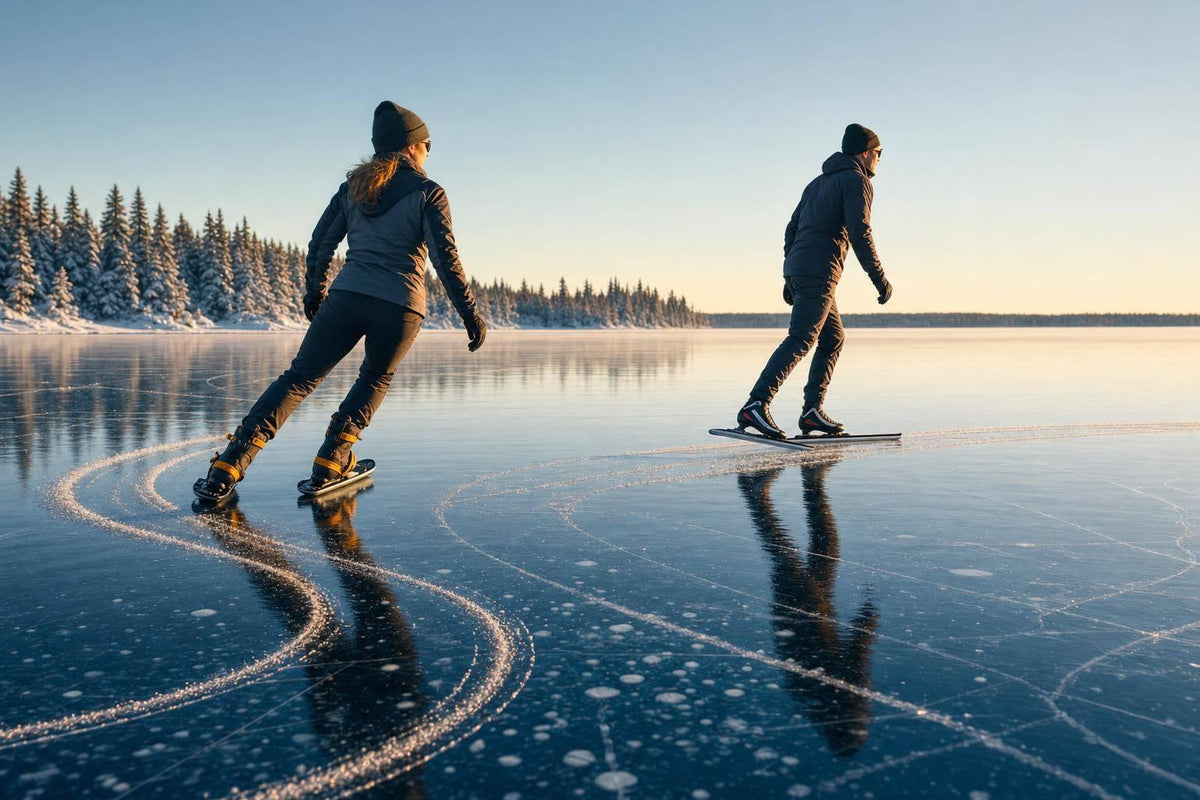
If I had to make this simple: for most people, the best pick is the 44 cm Snowfeet* Skiskates. They hit the sweet spot between balance, turning, and pack size. If you want the smallest setup, go with the 38 cm Mini. If you want more glide on open lake ice, look at the 50 cm PRO or 90 cm NORDIC.
Lake ice is a different beast than rink ice. You can hit cracks, frozen slush, windblown snow, and rough patches in one session. So, I’d focus on four things first:
- Stability on uneven ice
- Turning at low speed
- Boot fit and binding type
- Pack size for getting to and from the lake
I’d also keep one safety number front and center: U.S. guidance often calls for at least 4 inches of clear, solid ice for walking and skating. That’s the part that matters most.
Here’s the short version:
- Best all-around: Snowfeet* Skiskates 44 cm
- Best for kids and light travel: Snowfeet* 38 cm Mini
- Best step-up for adults: Snowfeet* PRO 50 cm
- Best for long glides on open ice: Snowfeet* NORDIC 90 cm
- Less ideal for pure lake skating: 65 cm Skiblades and Bigfoot-style short skis
- Best distance tool, but with XC boot limits: Nordic skating blades
Snowfeet* Review: Are Skiskates Worth It? | Mini Ski | Skates for Snow | Skating Ski | Short Ski
Quick Comparison
| Option | Best For | Main Upside | Main Downside | Boot Setup |
|---|---|---|---|---|
| Snowfeet* 38 cm Mini | Kids, beginners, travel | Small and easy to carry | Less stable at speed | Winter or snowboard boots |
| Snowfeet* Skiskates 44 cm | Most riders | Best mix of control and balance | Not built for long-distance glide | Ski boots or snowboard boots |
| Snowfeet* PRO 50 cm | Adults who want more glide | More stable than short models | Less nimble in tight moves | Winter or snowboard boots |
| Snowfeet* NORDIC 90 cm | Open-lake touring | Smooth glide and straight tracking | Bigger turning arc | Winter boots or NNN XC boots |
| Snowfeet* Skiblades 65 cm | Skiers crossing over | More ski-like feel | Less skate-like on flat ice | Ski boots or snowboard boots |
| Bigfoot-style short skis | People who own resort gear | Solid platform | Bulky and less smooth on flat lake ice | Usually ski boots |
| Nordic skating blades | Distance skating | Top glide on clear ice | XC boots needed | XC ski boots |
So, if you want the no-fuss answer, I’d say this: pick the 44 cm for most use, the 38 cm if pack size matters most, and the 90 cm if you plan to cover distance. Everything else depends on how far you want to glide, how rough the ice gets, and what boots you already own :)
1. Snowfeet* Skiskates 44 cm
At 44 cm, or about 17 in, Snowfeet* Skiskates hit a nice middle ground. They feel more stable on flat ice than the 38 cm Mini Ski Skates, but they still pivot and stop a bit faster than the 50 cm PRO.
Their wood core and cap build give them the kind of flex and edge hold people usually like in skis. On hard ice, that means steady grip when you push off, turn, or slam on the brakes. And the user ratings are strong: Judge.me gives the ski boot model a 4.96/5 and the snowboard boot model a 5.00/5.
Fit is pretty simple:
- The ski-boot version fits EU 36–49, which is US 4.5–14.5
- The snowboard-boot version fits EU 38–49, which is US 6–14.5
The bindings adjust without tools, so swapping between users is easy. If you ride in snowboard boots, you can use your own pair too.
There’s one catch, and it matters. Like other Snowfeet* short skis, the 44 cm Skiskates do best on firm, hard-packed surfaces. Soft snow and slush aren’t their thing.
Portability is a big plus. At 17 in, they can fit in a backpack, which makes them easy to carry to a remote lake or toss in the car without a second thought. Pricing starts at about $460.
If pack size matters more than stability, the 38 cm Mini Ski Skates go even smaller, though you give up a bit of balance.
2. Snowfeet* 38 cm Mini Ski Skates
At 38 cm (about 15 in), these are the smallest Snowfeet* model and the easiest to manage at slow speeds. That matters a lot on flat lake ice, where control beats speed most of the time.
The fiberglass-reinforced build and metal ski edges help them hold well on firm ice. In plain English: they feel easier to steer when you want to slow down, make a shallow turn, or switch direction fast. The short shape also makes it less likely that you'll catch a tip, which can be more of a hassle with longer blades.
There is a trade-off, though. Because they're shorter, you get less edge contact and less surface area than with the 44 cm Skiskates or 50 cm PRO. That means a bit less fore-aft stability and a bit less grip once speeds climb. On a frozen lake at relaxed speeds, that usually isn't a major issue.
Boot fit is pretty simple:
- The adult version fits US sizes 6–13 (EU 38–47)
- There's also a Mini Kids model for smaller feet in the EU 27–38 range
Both versions use adjustable bindings that attach to regular winter boots or snowboard boots, so you don't need ski boots. If you're riding on ice, a stiff, waterproof winter boot with good ankle support is the better pick. Soft boots can let your foot move inside the binding, and that can make control feel loose or awkward.
Where the 38 cm size stands out most is portability. They slide into a backpack or small duffel with no drama. You can walk to the lake in your regular boots, strap them on at the shore, and take them off when you're done.
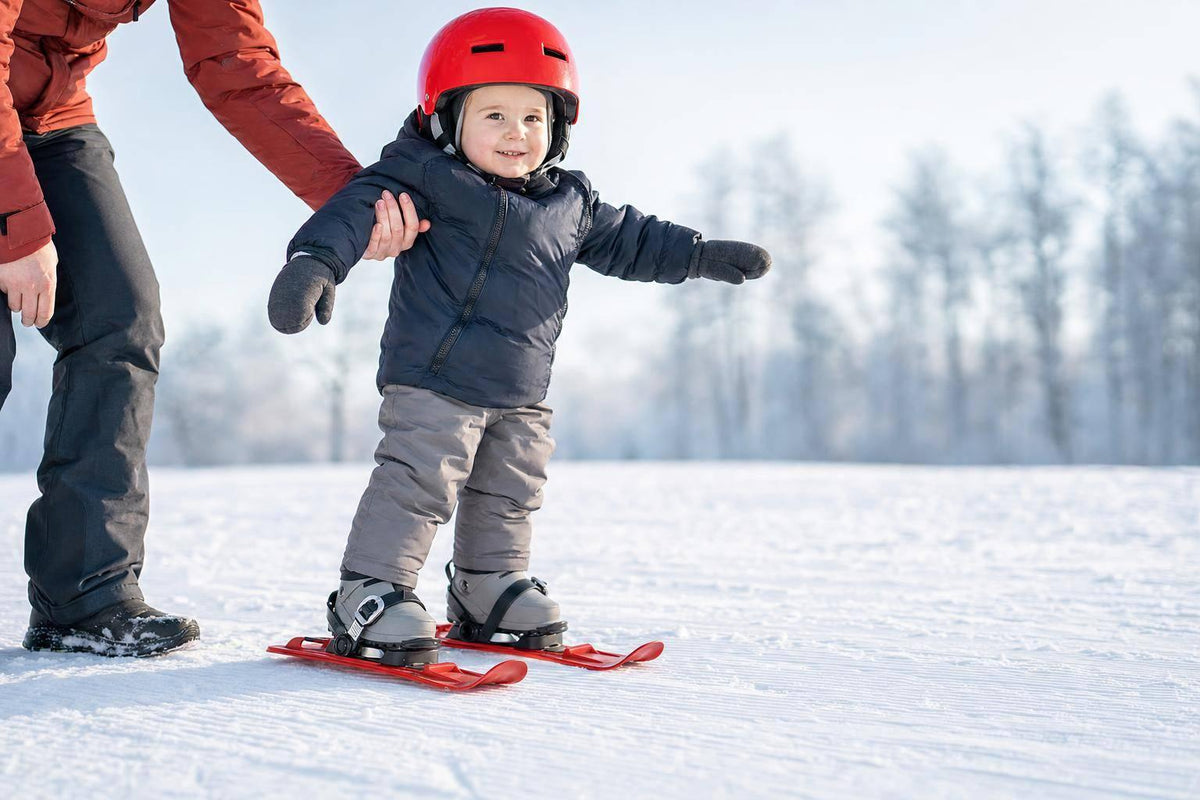
These make the most sense for kids, beginners, and casual travelers who want a simple way to have fun on a frozen lake without buying a full ski setup. If you want more stability and longer glides, the 50 cm PRO is the next move.
3. Snowfeet* PRO 50 cm
At 50 cm (~19.7 in), the Snowfeet* PRO lands right between the compact 38 cm mini skates and the longer Skiblades. That extra length gives you more surface contact on the ice and spreads your weight more evenly. The result? Less wobble and less tip-diving on flat lake ice.
The PRO also uses taller tips and a narrower waist. In plain terms, turns come on more smoothly and feel easier to manage. On a frozen lake, that means cleaner arcs and easier side-to-side turns than the shorter 38 cm model. Its wider platform and longer contact patch make it the steadiest short Snowfeet* option so far. You still get the easy handling of the 38 cm, but with a steadier feel on flat ice.
It fits US men's 6–13 (EU 38–47) and straps onto winter or snowboard boots. A stiff, waterproof boot gives the best control, and it also makes sharing simple for adults in that size range.
At 0.9 lb per pair, it's easy to toss in a bag and bring along.
Best for adult beginners and casual skaters who want more stability than the 38 cm without losing that easy-to-pack feel. If you want more glide on cleaner ice, step up to the 90 cm NORDIC.
4. Snowfeet* NORDIC Cross-country 90 cm
At 90 cm (about 35.4 in), the Snowfeet* NORDIC is the longest pick in this group. That extra length makes a big difference on open ice. You get smoother glide, steadier tracking, and a more settled feel on longer lake tours.
Compared with the 50 cm PRO, the NORDIC gives up fast, snappy turns for a calmer ride. That’s the deal here: less quick edge-to-edge movement, more straight-line comfort.
The wood-core build gives it a nice mix of durability and lively flex, while still staying short enough to carry without a fuss. On flat lake ice, it feels stable and controlled. That makes it a better fit for open stretches than busy shorelines or tight, twisty turns. It won’t pivot as fast as the compact Skiskates, but that slower turning is the trade-off for smoother, straighter travel when distance matters more than agility.
You can get it with two binding setups:
- Universal bindings for any winter boot in US sizes 6–13 (EU 38–47)
- PRO XC bindings with Rottefella NNN for standard cross-country ski boots
The universal setup is the easy, no-fuss option if you want to use regular winter boots. The PRO XC version fits cross-country ski boots, which makes more sense if that’s already your setup.
The NORDIC has a 4.2/5 rating based on 12 reviews.
Best for beginners and casual lake tourers who want stability, simple boot choices, and easy transport. The 65 cm Skiblades land in the middle between the NORDIC and the shorter skates, with a more playful feel but less touring stability.
sbb-itb-17ade95
5. Snowfeet* Skiblades 65 cm
At 65 cm (about 26 in), these Skiblades sit closer to short skis than pure skates on ice.
That matters on a lake. Their 4 m turn radius and carving shape are built for carved turns, so they don’t feel as easy on flat ice as shorter Skiskates or the more stable NORDIC. If you want fast little pivots and that loose, skate-like feel, this isn’t the first model most people would grab.
One nice plus: boot choice. They work with ski boots (US 4.5–14.5) or snowboard boots (US 6–14.5), which is handy if you already own one of those setups and want to keep things simple. You’re not locked into a single boot type, and that can save both hassle and cash. Still, the extra length pushes them toward carving more than quick moves on ice.
They’re also less suited to long, steady glides across open lake ice. Price starts at about $590, which puts them in the premium crossover camp. Think of the 65 cm version as the in-between option before moving into the more classic short-ski and blade picks below.
6. Bigfoot-Style Short Skis
Bigfoot-style short skis land somewhere between playful skiboards and true skating gear. They’re usually 60–80 cm long, with a wider shape built more for fun turns than calm, straight tracking on flat ice.
That wider platform can feel steady in softer turns. But on a flat frozen lake, these skis often get a bit twitchy when you’re trying to glide in a straight line. That’s the spot where the shorter Snowfeet* options often do better.
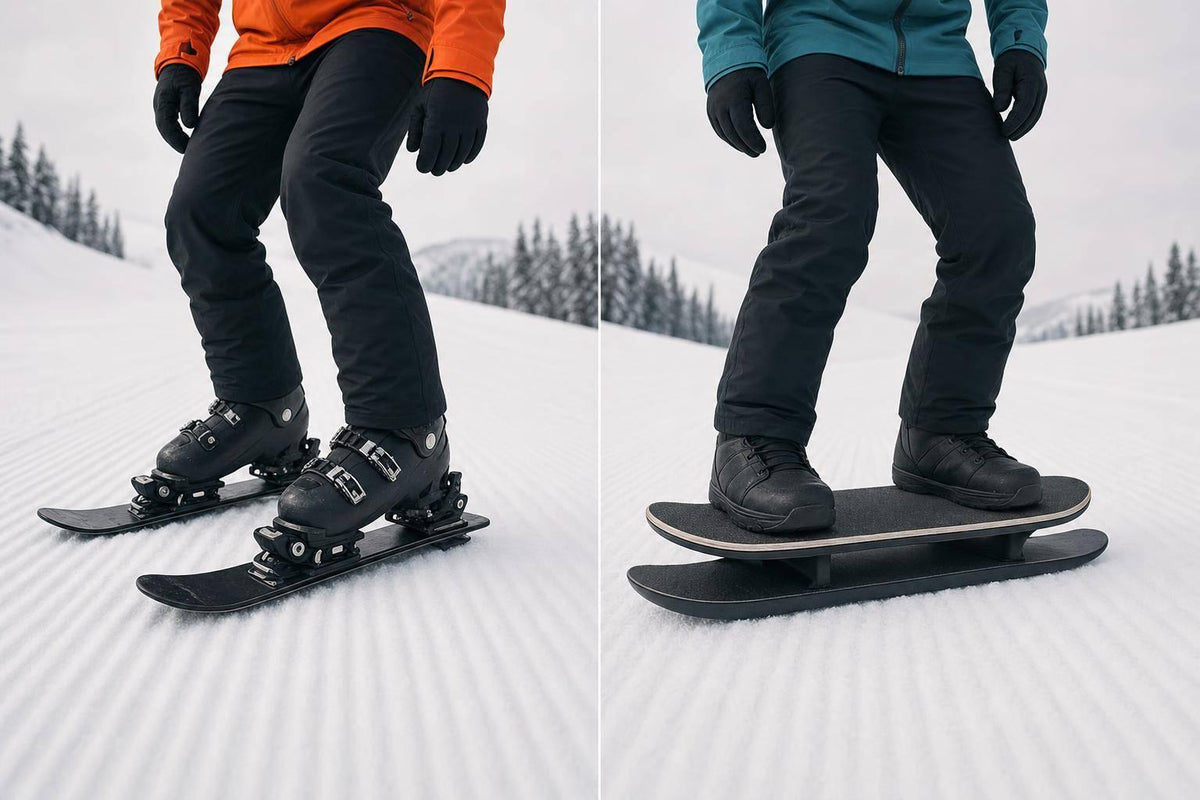
There’s also the boot issue. Classic Bigfoot bindings usually need ski boots, while Snowfeet* models use adjustable bindings that fit many boot sizes. So if you’re heading out in regular winter boots, Bigfoot-style skis can be a hassle.
They also take up more room and aren’t as easy to carry to the lake as Snowfeet* mini skates. If you’re walking to a frozen lake or trying to pack light, that extra bulk starts to matter.
If you want something that feels more like a blade and is geared more toward skating, Nordic skating blades are the closer fit.
7. Nordic Skating Blades
If you want the most classic frozen-lake setup, Nordic skating blades are the benchmark. They’re the go-to pick for long, steady lake tours: flat steel blades mounted on a platform with cross-country ski bindings, made for gliding over long distances.
On rough or uneven ice, Nordic blades are more stable than Snowfeet* short skis. They deal with cracks and bumps better than shorter options.
The trade-off shows up when you turn. Nordic blades are built for straight glide and big, sweeping turns. Snowfeet* short skis do better with tight pivots and fast direction changes.
Boot fit is pretty simple. Nordic blades need cross-country ski boots, while Snowfeet* works with regular winter boots or snowboard boots.
As for packing, Nordic blades are flat and narrow. Snowfeet* is shorter, but the bindings make it chunkier.
Here’s the quick side-by-side:
| Criteria | Nordic Skating Blades | Snowfeet* Short Skis |
|---|---|---|
| Stability on lake ice | Very high - longer blades handle cracks and bumps well | Good on smooth ice; more sensitive to rough patches |
| Turning | Wide arcs and strong straight-line glide | Tight turns, quick pivots, more playful |
| Boot compatibility | Requires XC ski boots | Fits regular winter or snowboard boots |
| Pack size | Slim and long; packs flat along a bag | Shorter but bulkier due to binding hardware |
| Best for | Long lake tours and distance skating | Short sessions, beginners, and mixed snow/ice |
How Each Option Compares: Stability, Turning, Boot Fit, and Pack Size
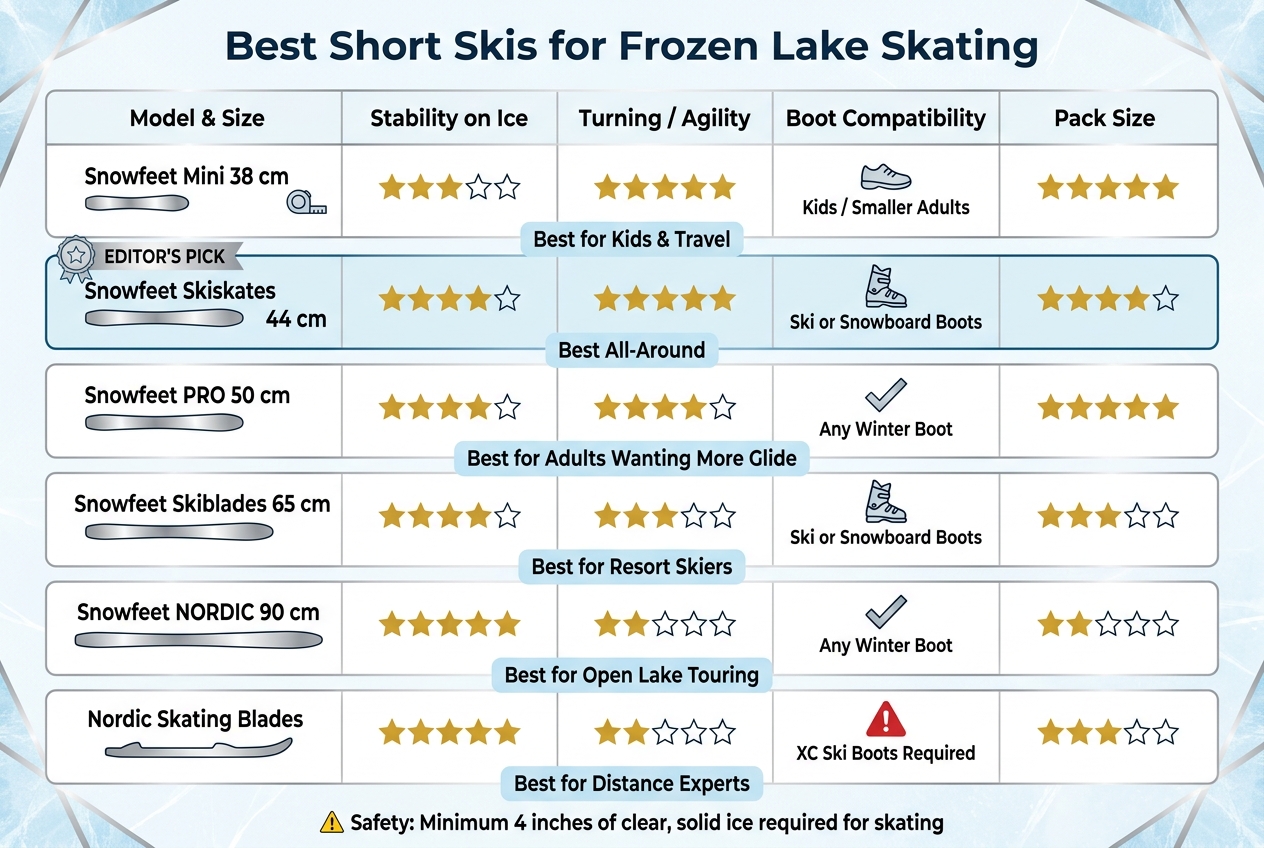
Best Short Skis for Frozen Lake Skating: Side-by-Side Comparison
Once you get past the model-by-model details, the choice boils down to four simple trade-offs: stability, turning, boot fit, and pack size.
Stability mostly comes down to length. Longer gear tracks better on open ice and feels calmer at speed. That makes the NORDIC 90 cm the most stable option here. On the other end, the 38 cm Mini is the least stable, but it’s also the easiest for kids and smaller riders to handle.
Turning works the opposite way. Shorter gear changes direction faster. The 38 cm and 44 cm models are the quickest to pivot, while the NORDIC 90 cm leans more toward straight-line glide than tight, snappy turns.
Boot compatibility is one area where Snowfeet* stands out compared with Nordic skating blades. The PRO 50 cm and NORDIC 90 cm work with regular winter boots in US 6–13 / EU 38–47. The Skiskates 44 cm come in two binding versions: one for ski boots and one for snowboard boots, so you can use the setup you already have. The 38 cm Mini fits about EU 27–38, which makes it a good match for kids and smaller adults. By contrast, Nordic skating blades need cross-country ski boots, and that can be a sticking point for casual riders.
Pack size is pretty simple too. Shorter models are easier to carry and stash in a bag. The 38 cm Mini is the easiest to pack, while the NORDIC 90 cm takes up the most space.
Quick comparison:
| Model | Stability on Ice | Turning / Agility | Boot Compatibility | Pack Size |
|---|---|---|---|---|
| Snowfeet* 38 cm Mini | ★★★☆☆ | ★★★★★ | ★★★☆☆ (kids / smaller adults) | ★★★★★ |
| Snowfeet* Skiskates 44 cm | ★★★★☆ | ★★★★★ | ★★★★☆ (ski or snowboard boots) | ★★★★☆ |
| Snowfeet* PRO 50 cm | ★★★★☆ | ★★★★☆ | ★★★★★ (any winter boot) | ★★★★☆ |
| Snowfeet* Skiblades 65 cm | ★★★★☆ | ★★★☆☆ | ★★★★☆ | ★★★☆☆ |
| Snowfeet* NORDIC 90 cm | ★★★★★ | ★★☆☆☆ | ★★★★★ (any winter boot) | ★★☆☆☆ |
| Nordic Skating Blades | ★★★★★ | ★★☆☆☆ | ★★☆☆☆ (XC boots required) | ★★★☆☆ |
If you want the short version, match the model to how you ride:
| Rider Profile | Best-Fit Model |
|---|---|
| Beginners | Snowfeet* Skiskates 44 cm |
| Skaters (athletic, glide-focused) | Snowfeet* NORDIC 90 cm |
| Snowboarders | Snowfeet* Skiskates 44 cm |
| Kids and teens | Snowfeet* 38 cm Mini |
| Casual winter travelers | Snowfeet* 38 cm Mini |
Pros and Cons
Use this quick summary to narrow down the best setup for your lake. If you’ve already looked at the model-by-model notes, this is the fast compare-and-pick version. The big thing to watch is the trade-off: stability, turning, boot fit, or pack size.
| Option | Main Strengths on Lake Ice | Key Limitations | Best Rider Match |
|---|---|---|---|
| Snowfeet* Skiskates 44 cm | Quick, agile turns; easy to control; available in ski-boot or snowboard-boot versions | Less glide for long-distance crossing; can feel twitchy at high speed on open ice | Beginners and snowboarders |
| Snowfeet* 38 cm Mini Ski Skates | Ultra-portable; forgiving at slow speeds; light enough for kids to lift easily | Limited straight-line stability; not ideal for covering long distances | Kids, beginners, casual travelers |
| Snowfeet* PRO 50 cm | Better glide than shorter models; smoother tracking on open ice; works with regular winter boots | Not as responsive as 38 cm for tight turns; less suited for long-distance touring | Adults wanting more glide without losing agility |
| Snowfeet* NORDIC Cross-country 90 cm | Excellent straight-line glide; strong tracking on smooth black ice; works with regular winter boots | Large turning radius; less practical in tight lake areas; bulkier to carry | Riders covering large, open lakes |
| Snowfeet* Skiblades 65 cm | Solid stability; handles mixed snow-and-ice patches near shore | Less ideal for pure lake skating; less nimble for quick direction changes | Riders transitioning from resort skiing |
| Bigfoot-Style Short Skis | Wide platform helps on rough or uneven ice | Less efficient on open ice; heavier builds make longer sessions more tiring | Riders already owning resort gear |
| Nordic Skating Blades | Outstanding glide and speed on smooth, open ice | Require cross-country ski boots; harder to stop and turn | Experienced Nordic skaters focused on distance |
One quick reality check: all of these do best on firm, hard ice. Once slush or soft snow shows up, control drops fast. That’s when even fun gear can start to feel like pushing a shopping cart through mashed potatoes :)
Conclusion
After looking at stability, turning, boot fit, and pack size, the simplest call is this: the 38 cm Mini Ski Skates are the best pick for beginners and kids, while the 44 cm Skiskates are the best all-around choice for most riders.
If you want more glide and plan to stay out longer, the pick shifts with distance. Go with the PRO 50 cm for more glide, choose the NORDIC 90 cm for true lake touring, and skip the 65 cm Skiblades for pure lake skating.
Once you’ve chosen your model, check the ice. U.S. safety guidance recommends at least 4 inches of clear, solid ice for walking and recreational skating. Also check the forecast. A warm spell or even a few days above freezing can change ice quality fast. The right short skis can make frozen-lake skating a blast, but only if the ice is safe.
FAQs
Which Snowfeet* size is best for rough lake ice?
For rough lake ice, the Snowfeet NORDIC 90 cm* is the best pick. The extra length helps a lot with stability and tracking when the surface gets messy - think ruts, wind crust, and frozen footprints.
The 44 cm Skiskates and 50 cm PRO work well on mixed ice and light snow. But when you're out on a natural lake, where conditions can change fast and the surface can feel a bit wild, the NORDIC 90 cm handles it better than the shorter, more skate-focused models.
Can I use regular winter boots with these?
Yes - most Snowfeet models work with regular winter boots, which makes them a handy pick for casual lake skating.
The 38 cm and 50 cm PRO models are made to strap onto standard waterproof winter boots or snowboard boots. That means you don’t need a full ski setup just to get out on the ice, which is nice :)
The main exception is the 44 cm Skiskates. Those are built for ski or snowboard boots, not regular winter boots.
If you plan to use regular winter boots, go with boots that have:
- Firm soles
- Good ankle support
Soft, flimsy boots can feel loose or wobbly, and that’s no fun when you’re trying to stay steady on the ice.
Are short skis or Nordic blades better for distance?
No. For covering miles on smooth natural ice, Nordic skates are the better pick. Their long touring blades let you glide farther with each push, so you use less energy over long distances.
The Snowfeet NORDIC 90 cm tracks and glides better than shorter skiskates. But it still isn’t as efficient as full-length cross-country skis when distance is the goal. For long tours on smooth ice, go with dedicated Nordic skates. On snow-covered lakes, full-length cross-country skis are the better fit.











Hinterlassen Sie einen Kommentar
Diese Website ist durch hCaptcha geschützt und es gelten die allgemeinen Geschäftsbedingungen und Datenschutzbestimmungen von hCaptcha.