




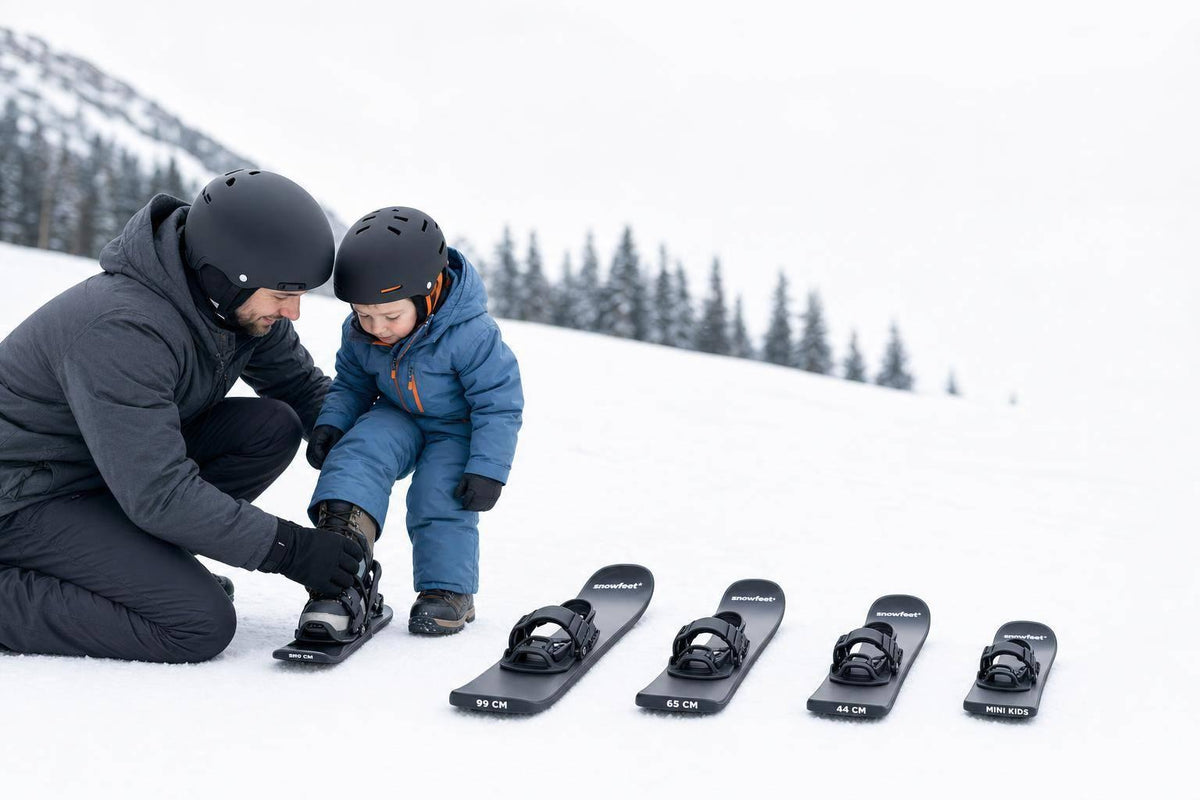
If I had to give one short answer, it’s this: for most dads teaching a kid on green runs, the Snowfeet* Skiblades 99 cm are the best pick. They give me the best mix of low-speed balance, easy turns, and less twitchy handling than the smaller options.
Here’s the short version:
- Best overall: Snowfeet* Skiblades 99 cm - best mix of control and steadiness
- Best for staying right next to your kid: Snowfeet* Skiblades 65 cm - easier to pivot in tight spots
- Best for the smallest pack size: Snowfeet* Skiskates 44 cm - light at about 3.5 lbs
- Best for small kids: Snowfeet* MINI KIDS - works with some winter shoes, starts at $250
A few things stood out to me fast:
- Shorter skis are often easier to carry, turn, and shuffle through lift lines
- The trade-off is simple: the shorter you go, the less stable they feel
- Boot setup matters a lot:
- 65 cm / 99 cm Skiblades: ski boots or snowboard boots
- 44 cm Skiskates: ski or snowboard boots
- MINI KIDS: winter shoes or some snowboard boots
- Price starts at $250 for MINI KIDS and goes up to $690 for the 99 cm Skiblades
- Helmets still matter. The article points to guidance from the American Academy of Pediatrics that kids and adult caregivers should wear a fitted snow-sports helmet
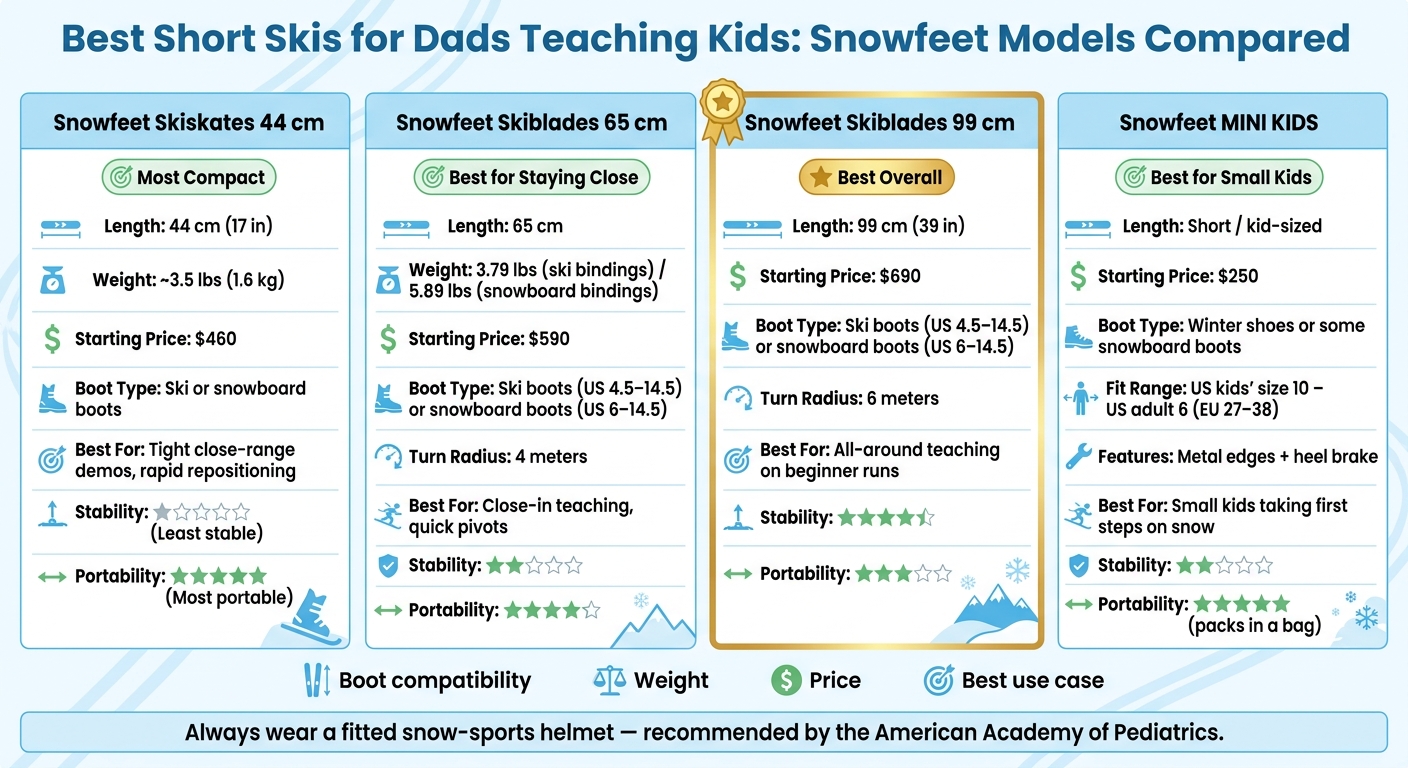
Short Ski Comparison for Dads Teaching Kids: Snowfeet Models at a Glance
Snowboarder tries Snowfeet* | Which Snowfeet* Short Ski is the Best? | Snowblades 44, 65, 99 Review
Quick Comparison
| Model | Length | Start Price | Best Use | Main Trade-off |
|---|---|---|---|---|
| Snowfeet* Skiblades | 65 cm | From $590 | Close-in teaching | Less calm at speed |
| Snowfeet* Skiblades | 99 cm | From $690 | Best all-around teaching pick | Not as nimble in tight stop-start moments |
| Snowfeet* Skiskates | 44 cm | From $460 | Tiny, light setup for slow practice | Least stable |
| Snowfeet* MINI KIDS | - | $250 | Small kids learning first moves | Less carryover to standard ski skills |
So, if you want one plain answer, I’d go 99 cm for most dads, 65 cm if you stay glued to your kid’s side, and MINI KIDS if the child is the one wearing the gear. Nice and simple :)
1. Snowfeet* Skiblades 65 cm
At 65 cm, these Skiblades are built for tight control next to a beginner. They’re the most nimble pick if you want to stay close and react fast. The listed 4-meter turn radius helps you change direction fast without big, sweeping turns. And the 11 cm tip, 9.5 cm waist, 11 cm tail, plus the camber shape, are set up for quick, controlled turns and easier carving.
You can get them with ski-boot bindings for US men's sizes 4.5–14.5 or snowboard-boot bindings for US sizes 6–14.5. Pick the version that fits the boots you already own. One thing to note: these need ski or snowboard boots, not winter shoes. The maker describes them as simple non-release bindings, so check the fit with care and follow the setup instructions and local resort rules.
The listed pair weight is about 3.79 lbs with ski bindings or 5.89 lbs with snowboard bindings. So, they make the most sense for dads who already ski or ride in proper boots. If you want the fastest, least-fussy setup for a family day, that trade-off is worth thinking about.
For teaching, stick to a wide, gentle beginner slope where you can stay beside the child or a bit downhill from them. These work well for wedge turns and slow-speed control on easy terrain. This is the easiest setup for shadowing a beginner at slow speed. That said, stopping still comes down to your edge control, slope angle, snow conditions, speed, and how much runout you have. Practice your stops first before you coach a child.
For dads who want a compact, responsive setup for close-range teaching, the 65 cm Skiblades are a practical pick. If you’d like more stability and less twitchiness, the 99 cm Skiblades are the next step up.
2. Snowfeet* Skiblades 99 cm
At 99 cm (39 inches), these sit right in the sweet spot. Not too short, not too long. That extra length gives you more stability at slow speeds, which helps a lot when you're skiing next to your child or showing them how to turn. If the 65 cm version feels a bit too jumpy, this is the better fit.
The listed 6-meter turning radius still lets you make quick, snappy turns on beginner terrain. So you get a nice mix: easy control, but without that twitchy feel some very short skis can have. They’re also wide enough to feel steady on groomed snow, which makes it easier to pivot, stay close to your kid, and move through a narrow learning lane without feeling clunky.
For speed control, use a snowplow for a gradual brake. If you need to stop faster, turn across the slope. Short skis still come down to edge control, slope angle, snow conditions, and plain old practice.
When it comes to bindings, pick the setup that matches your boots:
- Ski-boot bindings: US 4.5–14.5
- Snowboard-boot bindings: US 6–14.5
These bindings are not made for regular insulated winter boots.
Portability is another nice perk. At 99 cm, they’re much easier to carry and store than standard adult skis, but they’re not as tiny as the 65 cm Skiblades or the 44 cm Skiskates. For a dad who wants one short ski for teaching and easy beginner runs, the 99 cm Skiblades are the best all-around pick. If you want something even smaller and easier to manage, the 44 cm Skiskates are next in line.
sbb-itb-17ade95
3. Snowfeet* Skiskates 44 cm
If the 65 cm and 99 cm Skiblades still sound a bit long, the 44 cm Skiskates are the smallest step down. They’re just 44 cm (about 17 inches) long, and the pair weighs about 3.5 lbs (1.6 kg).
That super short length changes the feel in a big way. These are the easiest Snowfeet* model to pivot in tight spots. If you’re a dad teaching on a beginner slope, that can be a huge plus. You can turn fast, stay close to your child, and make small direction changes without big, sweeping arcs.
The trade-off is simple: less length means less stability. Compared with the 65 cm and 99 cm Skiblades, the 44 cm Skiskates feel more twitchy, especially on firm snow. Small movements can have a bigger effect, which is great when you want quick control, but not so great if you want a calm, cruisy ride.
So, these make the most sense for very slow, controlled practice runs where staying close matters more than smooth all-day skiing. They’re the lightest and most compact option in the lineup, but also the least stable.
A smart move? Start on a gentle slope first. Spend a little time getting used to gliding, turning, and stopping before you try teaching on a full run. That small warm-up can save a lot of wobble and a few “whoa, not that way” moments :)
If you want more kid-specific sizing, the MINI KIDS model is the next comparison.
4. Snowfeet* MINI KIDS
If you're teaching a smaller child on mellow beginner terrain, Snowfeet* MINI KIDS is the kid-focused pick in the lineup. It fits US kids' size 10 through US adult 6 (EU 27–38, or about 17–23 cm foot length).
One big plus: no ski boots needed. MINI KIDS attach to regular waterproof winter shoes or some snowboard boots. On a family ski day, that can save a lot of hassle. Just be picky about the shoe. It should have firm ankle support. If the shoe is soft or loose, it can move inside the binding and make steering harder.
MINI KIDS come with metal edges and a heel brake, but stopping isn't automatic. Kids need time to learn it. Start on flat ground first. Keep your child's weight centered over both feet, then practice using the heel brake before heading onto steeper terrain. Give them lots of space to slow down. A long runout is your friend here.
The short length also helps small kids turn more easily in beginner zones. A simple drill works well:
- Glide a short distance
- Turn across the slope
- Stop
- Repeat
That little glide-turn-stop pattern keeps things simple and helps build comfort without throwing too much at them at once.
Another nice perk: they pack in a bag. That's a lot easier than hauling full ski gear across the parking lot with snacks, gloves, and one missing mitten :) Pricing can change by listing, so it's best to check the official Snowfeet* store for the latest price.
This setup is best for gentle practice. It's not the right tool for steep slopes, deep snow, or fast cruising.
| Factor | Snowfeet* MINI KIDS | Traditional Children's Skis |
|---|---|---|
| Footwear needed | Winter shoes or some snowboard boots | Dedicated ski boots required |
| Portability | Packs in a bag | Larger and bulkier; usually need a ski bag or rack |
| Stopping method | Heel brake + metal edges; takes practice | Snowplow; easier to teach systematically |
| Best terrain | Gentle beginner slopes | Varied terrain and formal ski instruction settings |
| Fit range | US kids' size 10–US adult 6 (EU 27–38) | Sized by height and weight, with a broader range |
Next, I'll break down the trade-offs across all four models.
Pros, Cons, and Trade-Offs by Model
Each model fits a different teaching job. The table makes the match-up simple.
| Model | Best teaching situation | Main limitation |
|---|---|---|
| Skiblades 65 cm | Best for tight, close-in teaching | Limited high-speed stability; not suited for powder or long carved turns |
| Skiblades 99 cm | Best for steadier teaching on longer beginner runs | Slower to pivot in tight stop-start teaching; still not a match for full-length skis at speed |
| Skiskates 44 cm | Best for very close-range instruction, rapid repositioning, low-speed demonstrations | Least stable at higher speed; poor powder performance; less room to practice standard ski edging |
| MINI KIDS | Gentler entry for small kids; less conventional ski-learning value | Can feel unstable when speed picks up; poor powder performance |
Here’s the plain-English version.
Skiblades 65 cm work best when you need to stay close and move fast in short bursts. They’re great for tight teaching spaces and quick corrections. The trade-off? They’re too short for calm cruising, higher speeds, powder, or long carved turns.
Skiblades 99 cm give you more stability, which helps on longer beginner runs. They feel steadier than the 65 cm model, but you give up some quickness. In stop-start teaching, they take a bit more effort to pivot.
Skiskates 44 cm shine when you’re doing very close-range instruction, quick repositioning, or slow demos. They’re nimble, almost like the pocketknife of the bunch. But once speed picks up, they’re the least stable. They also struggle in powder and don’t leave much room to practice standard ski edging.
MINI KIDS are a softer starting point for small kids. That can make first days on snow feel less intimidating. Still, they offer less carryover to standard ski technique, and they can feel shaky once speed builds.
A few things stay the same no matter which short model you pick:
- Long skis still do better at speed, in powder, and during long carved turns.
- For teaching a beginner on groomed terrain, Snowfeet* is easier to handle and often feels less intimidating.
So, the pick comes down to a few simple things: how close you want to ski, how much stability you want, and whether your kid is the one you’re teaching or the one you’re cruising next to.
Final Recommendation
Bottom line from the trade-offs above: Best overall: Snowfeet* Skiblades 99 cm. It gives you the best mix of stability and quick turns for teaching on beginner terrain. If you want a more nimble feel, go with the 65 cm model.
Best for close-in teaching: The Skiblades 65 cm. This is the better pick if you stay right next to your kid during first turns and stops and want fast pivots.
Best for portability: If packability matters more than all-day stability, the 44 cm Skiskates are the compact choice. They pack small, so they’re handy for travel too.
Best for small kids: The Snowfeet* MINI KIDS are made for smaller kids. That’s the right call when the child is the rider, not the dad. Use the same size range listed above (US kids' size 10–US adult 6, EU 27–38).
Practice stopping on a gentle slope first, and stay on beginner terrain until both of you feel comfortable.
FAQs
How do I choose between 65 cm and 99 cm skiblades?
Choose based on your child’s skill level and the kind of terrain they’re set to ride. The 65 cm Skiblades work best for younger beginners, often ages 6–10, who are starting out on green runs. They’re more forgiving, playful, and easier to turn than longer options.
The 99 cm Skiblades are a better fit for older kids who feel more sure of themselves on snow and are ready for longer green runs and easy blue trails. They feel more stable, give kids better edge control, and handle speed a bit better.
Are short skis easier for teaching than regular skis?
Yes. Short skis are usually easier to teach with than regular, full-length skis. Their smaller size means there’s less chance of crossing tips. And because they’re lighter, with less swing weight, they’re easier to turn, stop, and control.
For beginner lessons, Snowfeet short skis work especially well in slow, controlled settings. They tend to feel more natural and less bulky, which can help kids build confidence faster.
Can I use regular winter boots with Snowfeet*?
Yes - many Snowfeet* models work with regular winter boots. That’s a big shift from standard skis, which need stiff ski boots.
Models like MINI KIDS, 38 cm Mini Ski Skates, and 44 cm Skiskates are made for sturdy, waterproof winter boots or snowboard boots. Nice and simple.
For longer options like 99 cm Skiblades, standard ski boots are the better pick. They give you better edge control and more precise turns.











Hinterlassen Sie einen Kommentar
Diese Website ist durch hCaptcha geschützt und es gelten die allgemeinen Geschäftsbedingungen und Datenschutzbestimmungen von hCaptcha.