



















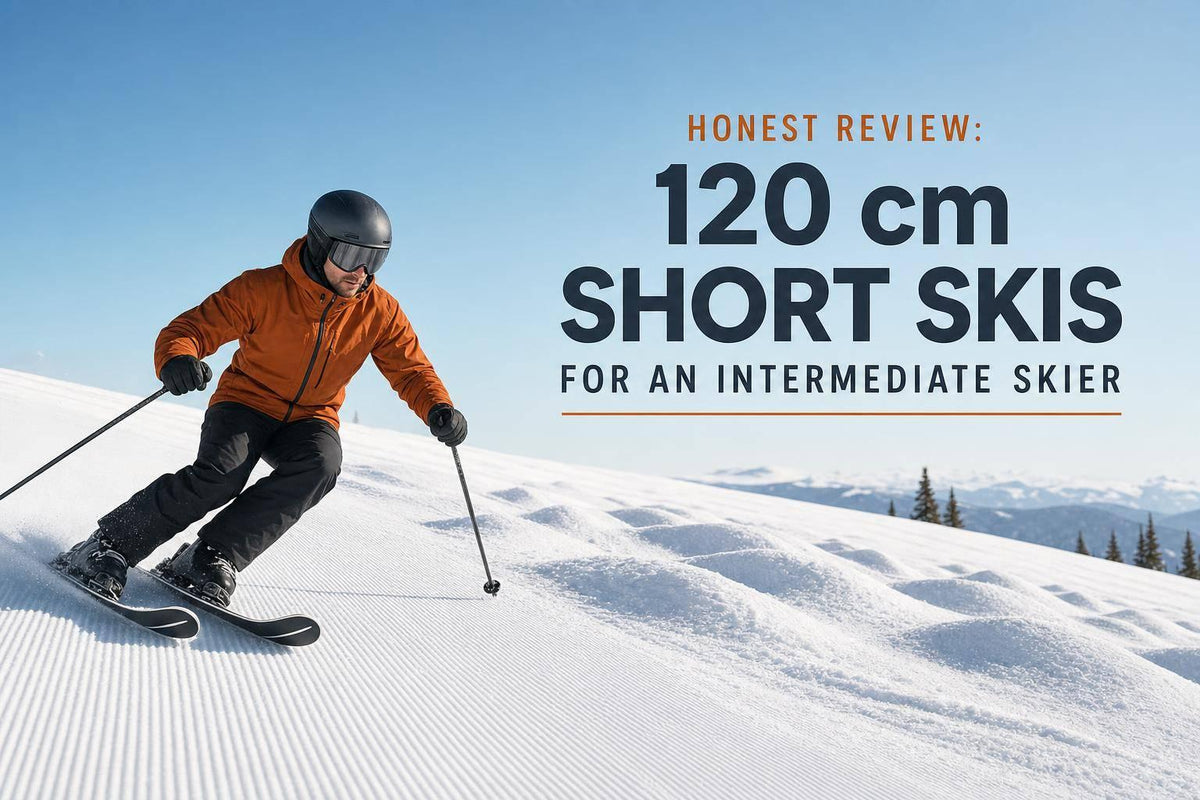
My short take: if I ski mostly groomed blues, easier blacks, and small bumps at about 20–30 mph, 120 cm short skis hit a sweet spot between tiny skiblades and full-length skis.
Here’s the plain-English version:
- 120 cm short skis are easier for me to turn than 165–175 cm skis
- They feel best on groomers, short turns, traffic, and small moguls
- They start to feel less calm when I ski faster, hit steeper runs, or get into deeper soft snow
- Compared with 65–99 cm skiblades, the 120 cm length gives me more support and a higher speed limit
- The big catch is price: $950 is a lot if I only want a fun side setup
So, if I want a compact ski that still feels close to a normal resort ski, 120 cm makes sense. If I care most about speed, steep terrain, or powder, I’d stay with longer skis. If I want max play at slow speeds, I’d look at shorter skiblades.
Snowfeet* Short Skis | Snowblades Skiboards 120 cm
Quick Comparison
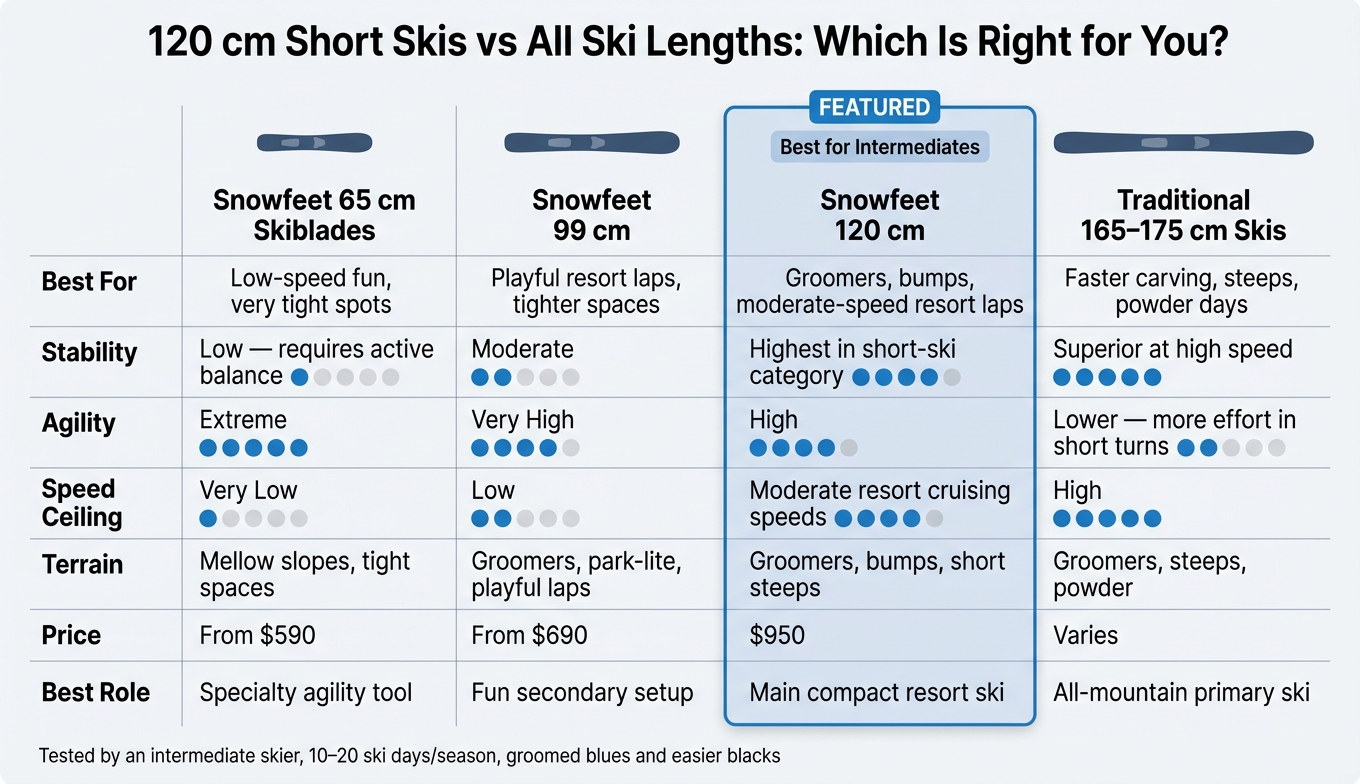
120 cm Short Skis vs All Ski Lengths: Side-by-Side Comparison
| Setup | Best For | Main Upside | Main Downside | Price |
|---|---|---|---|---|
| Snowfeet* 120 cm | Groomers, bumps, moderate-speed resort laps | Easy turn shape, lighter feel, more stable than shorter skiblades | Less calm at speed, weak in deeper soft snow | $950 |
| Snowfeet* 99 cm | Playful resort laps, tighter spaces | More nimble feel | Lower speed limit | From $690 |
| Snowfeet* 65 cm | Low-speed fun, very tight spots | Small size, easy to carry | Needs more balance, least stable | From $590 |
| 165–175 cm skis | Faster carving, steeps, powder days | Better grip, float, and calm feel | More work in bumps and tight areas | Varies |
A few numbers stood out to me:
- Test skier level: intermediate
- Ski days per season: 10–20
- Boot flex used: 90–110
- Snow range: 20°F to 35°F
- Snowfeet* 120 cm weight: 7.87 lb per pair
- User rating mentioned: about 3.8/5
Bottom line: I’d pick 120 cm short skis if I want a fun, compact resort setup for normal days on piste. I wouldn’t pick them as my first choice for bombing fast groomers or hunting soft snow all day.
If that sounds like your skiing, this review will help you sort out whether the trade-off is worth $950.
How 120 cm Short Skis Perform for an Intermediate Skier
Groomers, Short Carving Turns, and Moderate Speed
During this test, the 120 cm skis felt best on groomed blue runs and small bumps, especially on firm morning snow and chopped-up afternoon laps. The first thing that stands out is how easy they are to turn. Compared with a 165–175 cm ski, turn initiation takes less effort. Shift pressure, and the ski responds right away. Edge-to-edge moves feel quick and sharp.
That’s the fun part.
The catch is that the narrow waist and short contact length leave less room for sloppy form on firm or icy snow. If you stay centered and keep steady pressure, the skis carve cleanly. If your stance gets lazy, the ski tells on you fast. It’s honest, maybe a little rude, but helpful. That quick feedback can help build better habits, though it asks for more focus than a longer, more forgiving ski. And when the snow gets uneven, that fast response starts to pay off.
Bumps, Short Runs, and Frontside Use
In small moguls and rough snow near the sides of blue runs, the 120 cm length has a clear edge. The ski slips into bump troughs with less fuss, pivots fast, and avoids that awkward crossed-up feeling that can happen on a longer ski. The low swing weight matters too, especially after a few laps when your legs start sending little complaints.
For short frontside runs, the whole feel changes. A slope you’d usually ski in big, lazy arcs on a 170 cm setup turns into a string of quick, controlled turns. Lifts are easier to load and unload. Tight traffic feels less annoying. Busy slopes feel more manageable. And each run takes a bit less out of you.
The downside shows up when you stop cruising and start pushing the pace.
Speed Ceiling, Steeps, and Soft-Snow Limits
At higher speeds, the same quick, easy feel becomes the main weakness. The skis pass more vibration up through your feet, especially on firmer afternoon snow. Chatter shows up sooner. Instead of locking into a line and staying calm, the ski needs steady little corrections.
On steeper terrain, the 120 cm length still works if you want short, tight turns to keep speed in check. But it doesn’t give the same calm feel as a longer ski when you want to stretch the turn shape and ski with more flow.
Soft snow off-trail is another limit. The short platform doesn’t have the float or weight to move through deeper piles as smoothly. Tips can get knocked around by uneven snow, which creates a bouncy, deflected feel instead of the more planted ride you get from a longer all-mountain ski.
| Condition | 120 cm Short Skis | 165–175 cm All-Mountain Skis |
|---|---|---|
| Small bumps and moguls | Very good - light, easy to pivot | Moderate - heavier, harder to redirect |
| High speed on groomers | Limited - chatter appears sooner | Strong - planted and composed |
| Steep terrain | Manageable with short, controlled turns | Better - more edge grip and stability |
| Deep powder / soft off-trail | Limited float, tips can dive | Superior float and tracking |
sbb-itb-17ade95
Pros, Cons, and Trade-Offs vs Other Ski Lengths
After you get a feel for how they ski, the next step is simple: where does 120 cm make sense, and where does a longer or shorter ski fit better?
120 cm Short Skis vs Traditional 165–175 cm Skis
For intermediate skiers, 120 cm skis give up some high-speed calm in exchange for easier turning and less leg burn. That’s the heart of the trade-off. And for most buyers, the big stuff isn’t just ride feel. It’s things like how tired you get, how easy they are to carry, and where you’ll use them most.
| Feature | 120 cm Short Skis | Traditional 165–175 cm Skis |
|---|---|---|
| Maneuverability | Easier to pivot; quick edge-to-edge | Slower to redirect; more effort in short turns |
| Turn radius | Short, quick carving turns | Longer turns; better for high-speed carving |
| Stability at speed | Good at moderate speed; less stable as speed rises | More composed and planted at higher speeds |
| Bumps and moguls | Very manageable; light and easy to redirect | Heavier and harder to thread through tight lines |
| Powder / soft snow | Limited float; workable in light soft snow | Better float and confidence in deeper snow |
| Portability | Compact, lighter, easier to carry | Bulky, heavier, harder to transport |
| Learning curve | More forgiving; builds confidence faster | More demanding, especially at low speeds |
Put plainly, 120 cm skis are easier to handle in tight spots and less tiring over a full day. Longer skis still win when speed picks up or the snow gets deeper. So, if your day looks like groomers, bumps, and lots of short turns, the shorter setup makes a lot of sense. If you want to open it up and ski fast, the 165–175 cm range still has the edge.
That trade-off shifts again when you stack 120 cm up against the shorter Snowfeet* options.
120 cm vs 99 cm, 65 cm, and Typical Snowblades
If you want one compact resort ski, 120 cm is the most practical pick. More length gives you more stability. Less length gives you more play. Pretty simple, right?
The 120 cm sits right in the middle. It has enough stability for lap after lap at the resort, but it still feels quick in bumps, crowded runs, and tighter sections. The 99 cm and 65 cm Snowfeet* models feel more playful, sure, but they give up stability and speed range to do it. Typical snowblades from brands like Salomon, Bigfoot, or ODR lean more toward tricks and quick moves on mellow slopes, which makes them less suited to all-day resort skiing.
| Feature | Snowfeet* 120 cm | Snowfeet* 99 cm | Snowfeet* 65 cm | Typical Snowblade |
|---|---|---|---|---|
| Stability | Highest in the short-ski category | Moderate | Low; requires active balance | Moderate |
| Agility | High | Very high | Extreme | High |
| Speed ceiling | Moderate resort cruising speeds | Lower | Very low | Low |
| Terrain versatility | Groomers, bumps, short steeps | Groomers, park-lite, playful laps | Mellow slopes, tight spaces | Mellow slopes, small parks |
| Best role | Main ski | Fun secondary setup | Specialty agility tool | Occasional use |
| Core material | Certified sustainable wood | Wood | Wood | Often foam or fiberglass composite |
Here’s the short version: 120 cm is the middle lane. Not the twitchiest. Not the most speed-hungry. Just the one that works for the most people, in the most resort situations, without turning the day into a balancing act or a quad workout.
That’s why the next thing to look at is price, and whether the performance lines up with what you’re paying for.
Snowfeet* Short Skis 120 cm: Honest Value Review
Build Quality, Bindings, and Boot Compatibility
Once you get past how they ride, the next thing that matters is simple: do the build and price match what you get?
The Snowfeet* 120 cm skis are handmade with a certified sustainable wood core, metal edges, graphite bases, and a camber-plus-rocker profile. That setup makes sense on snow. Metal edges help with grip on hardpack. Graphite bases help the skis glide and hold up over time. At 7.87 lb per pair, they also feel light on your feet next to a standard ski setup.
The Pro Ski Boot Bindings fit standard ski boots in the 26–36.1 MP range. Before you hit “buy,” check your boot sole length. It’s a small step, but yeah, it can save you a big headache later.
Why Snowfeet* Works Well for Casual Resort Riders
For a casual resort skier, value isn’t about flashy specs. It’s about whether a ski feels good to use again and again.
That’s where the 120 cm model makes a lot of sense. It fits a normal intermediate resort day without asking you to deal with a full-length ski setup. The short length makes quick turns easier, and the parabolic sidecut does a lot of the carving work for you. So instead of fighting the ski all day, you can just ski. That lower-effort feel matters, especially when your legs start talking back after lunch :)
Is $950 Worth It for an Intermediate Skier?
At $950, the Snowfeet* 120 cm sits at the top end of the short-ski price range. The 65 cm Skiblades start at $590, and the 99 cm model starts at $690. So, you’re paying more for the longer, more ski-like feel.
For an intermediate skier who wants something compact and easy to handle, that price can make sense. But it’s not a slam dunk for everyone. Third-party feedback is mixed, with Amazon ratings at around 3.8 out of 5, and some users say they feel more like specialty gear for casual riders than something built for advanced skiers.
So, the price works best if you want short skis that feel closer to regular skis, but still stay light, compact, and less demanding.
Who Should Buy 120 cm Short Skis and Final Verdict
Best Skill Level and Terrain Match
After testing them on groomers, bumps, and moderate-speed runs, the call is pretty simple. The 120 cm short ski makes the most sense for intermediate skiers who spend most of their time on groomed blue runs and easier black runs. It gives you enough edge hold for firm groomers, but without the extra bulk of a full-length ski.
From there, it comes down to one thing: do you want more stability or more agility?
When to Choose 120 cm, Shorter Skiblades, or Long Skis
The easiest way to pick is to look at the terrain and speed you ski most often.
| Your Priority | Best Choice |
|---|---|
| Groomers, moderate speed, carving | Snowfeet* 120 cm short skis |
| Tight spaces, portability, low-speed play | Snowfeet* 65–99 cm skiblades |
| Speed, steeps, powder | Traditional 165–175 cm long skis |
Final Takeaway
The Snowfeet* 120 cm lands in a useful middle zone for intermediate resort skiers. You do give up some high-speed stability, and deep snow isn’t its strong suit. Then there’s the $950 price tag, which isn’t small.
Still, if most of your ski days are spent on groomed runs at moderate speeds, the easy handling and quick, nimble feel make a strong case for it. For casual riders in this group, Snowfeet* will likely be the better match.
FAQs
Are 120 cm short skis good for progressing intermediates?
Yes - 120 cm short skis can be a smart pick for progressing intermediates, especially on groomers and moderate-speed resort terrain.
Snowfeet*’s 120 cm model is its most stable and most ski-like short option. That means you get more confidence as speed picks up, plus better edge control than you’d get with the shorter models.
That said, there’s a trade-off. It’s not the best fit for very high speeds or deep powder, where longer skis still tend to do a better job.
Can 120 cm short skis replace regular resort skis?
Yes - for a lot of casual resort skiers, 120 cm short skis can stand in for regular skis and still feel fun, easy to handle, and less like a wrestling match.
Here’s the trade-off. They won’t give you the same calm feel at high speed, and they’re not built for deep powder the way 150–190 cm standard skis are. But on groomers, bumps, and small resort features, they’re often easier to turn, easier to control, and way less annoying to carry around.
If you want the option in this category that feels closest to normal skis, Snowfeet* 120 cm models offer the most stability and the most ski-like ride.
What boot size fits Snowfeet* 120 cm short skis?
Snowfeet* 120 cm short skis are built for standard ski boots and come with Pro Ski Boot Bindings that fit 26 to 36.1 Mondopoint.
One quick heads-up: they don’t work with snowboard boots.
Before you buy, check your boot’s Mondopoint size to make sure it fits the bindings the right way. It’s a small step, but it can save you a lot of hassle on the snow :)











Hinterlassen Sie einen Kommentar
Diese Website ist durch hCaptcha geschützt und es gelten die allgemeinen Geschäftsbedingungen und Datenschutzbestimmungen von hCaptcha.