



















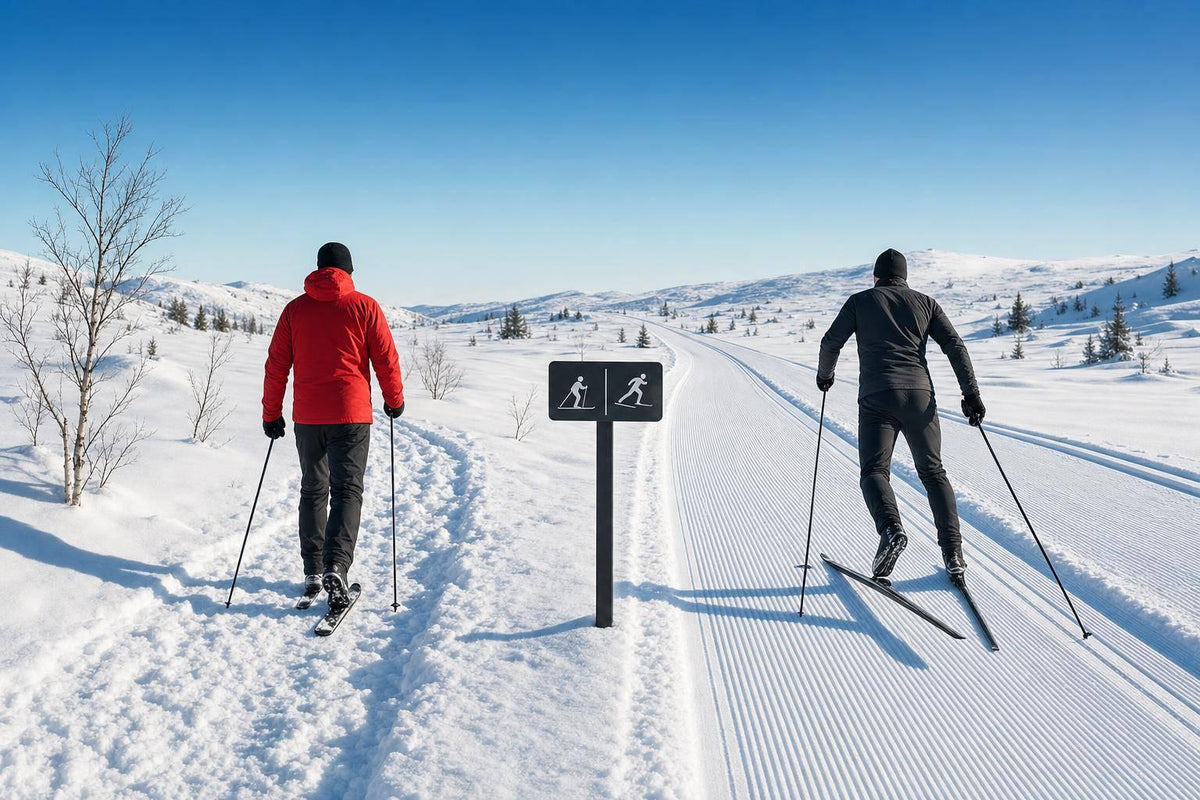
If you want easy winter touring on mixed snow, I’d pick WALKSKI. If you want more glide and a stronger workout on packed trails, I’d pick NORDIC. That’s the short answer.
Here’s the simple breakdown:
- WALKSKI is better for forest roads, rolling trails, cabin routes, and uneven snow
- NORDIC is better for groomed loops, packed paths, and skating-style movement
- WALKSKI costs $595
- NORDIC starts at $450 in the overview, though the article also lists about $329.90 later, so pricing looks mixed
- Both are much shorter than full-length cross-country skis, which often run 160–180 cm and can cost $2,200+ with boots, bindings, and skins
- Both are small enough to fit in a car trunk, which is nice if you don’t want your hallway turning into a ski rack :)
If I boil it down even more:
- Choose WALKSKI for control, easy learning, and mixed conditions
- Choose NORDIC for speed, cardio, and firm snow
This Nordic Ski Can Be Attached to Any Winter Shoes | Snowfeet Cross-country Skate Skis | 90 cm
Quick Comparison
| Model | Best for | Snow type | Feel | Learning curve | Boot fit | Size | Price |
|---|---|---|---|---|---|---|---|
| WALKSKI | Touring and casual winter outings | Mixed, packed, and uneven snow | More stable and relaxed | Short | Winter, hiking, snowboard, or ski boots, US 6–14.5 | 39 in / 100 cm | $595 |
| NORDIC | Groomed-trail fitness and glide | Firm, groomed, packed snow | Faster and more nimble | Medium | Winter boots, US 6–13; XC boot option on Pro XC | 35 in / 90 cm | $450 / about $329.90 |
What stood out to me most is this: WALKSKI is the safer bet for mixed snow, while NORDIC works best when the surface stays smooth and packed. The gap isn’t small. One feels more like a winter hike with glide. The other feels more like skating with your heart rate climbing into the 400–600 calories per hour range.
So, if your day on snow looks calm, casual, and a bit messy underfoot, go WALKSKI. If it looks like groomed corduroy and you want your legs to file a complaint, go NORDIC.
If you want a quick look at how short ski setups ride, these YouTube searches can help:
My take: buy for the snow you ride most, not the snow you wish you had. That rule saves money, time, and a lot of awkward parking-lot regret.
Snowfeet* WALKSKI Backcountry Touring 100 cm
Where WALKSKI works best: terrain and use cases
WALKSKI is built for ungroomed winter travel. Think forest roads, rolling trails, cabin runs, and fresh snow. It does better in powder, packed trails, and uneven ground than groomed-track skis. That’s a big part of the appeal: when the route changes on you mid-trip, WALKSKI doesn’t feel out of its depth.
The four-mode binding helps a lot here. Walk mode keeps your heel free for flat sections. Ski mode locks it down for descents. Climb 1 and Climb 2 add riser positions for uphill stretches, and the included removable climbing skins help with grip on slick ascents. In plain English: you can move from flats to climbs to descents without feeling like your gear is fighting you.
How WALKSKI feels to ride: stability, control, and honest trade-offs
Snowfeet* says the 100 cm shape gives you a balance of mobility and stability. You feel that most when conditions get messy - soft patches, uneven drifts, and narrow trails. It’s less about charging hard and more about staying in control without much fuss. Most riders get comfortable on it fast.
That’s why WALKSKI makes more sense for riders who want things simple, not fast. If you’re chasing top-end glide, this isn’t that ski. If you want something calm, easy, and forgiving, it starts to make a lot of sense.
Who should pick WALKSKI
WALKSKI fits beginners, hikers, and casual winter explorers who want to get outside without a complicated setup. The universal binding works with standard winter, hiking, snowboard, and ski boots in US sizes 6–14.5, which is nice because most people won’t need to buy extra gear just to get started.
Patrick Brosseau from Burlington captured the appeal well:
"I'm new to skiing but enjoy snowshoeing so the Snowfeet Backcountry Touring Skis were a no-brainer for me. Very versatile and a lot of fun!"
Choose WALKSKI for winter exploring, mixed snow, and easy touring. If you start wanting more glide and more of a workout, NORDIC is the next model to look at.
sbb-itb-17ade95
Snowfeet* NORDIC Cross-country 90 cm
Where NORDIC works best: terrain and use cases
If WALKSKI leans toward touring, NORDIC leans toward skating. It’s made for firm, groomed snow and a skating-style stride. So while WALKSKI handles mixed terrain and easy cruising, NORDIC feels best when the snow is packed and the pace picks up.
This is where it shines:
- Groomed trails
- Corduroy tracks
- Packed golf-course loops
- Winter paths
- City parks and other packed paths
In plain English, NORDIC is for people who want that skating-like motion without dealing with long cross-country skis. It feels right at home on snow that’s smooth, packed, and ready to roll.
At 90 cm, it’s also easy to live with. You can toss it in a car trunk or slide it into a travel bag without playing luggage Tetris. The universal bindings work with regular winter shoes in US sizes 6–13. And if you already own cross-country boots, there’s a Pro XC version with Rottefella NNN bindings.
How NORDIC feels to ride: speed, agility, and honest trade-offs
NORDIC is shorter than WALKSKI, and you feel that right away. On firm snow, it’s faster to react and more nimble. The motion feels closer to ice skating than old-school cross-country skiing, which is part of the fun.
It’s not just about feel, either. A typical session burns about 400–600 calories per hour. So yeah, it can turn a winter outing into a solid cardio session.
That said, there’s no free lunch. NORDIC gives up some of WALKSKI’s easy stability in exchange for speed and a stronger workout. On groomed corduroy, it feels smooth and flowing. But once the snow gets deeper, choppy, or loose, things get less forgiving fast.
That means NORDIC asks more from you. Better balance helps. Better coordination helps too. If your routes change a lot, or the snow is a mixed bag, WALKSKI will likely feel easier and less fussy.
Who should pick NORDIC
NORDIC makes sense if you want speed, cardio, and groomed-trail fun. It’s a strong fit for skaters, runners, former skiers, and travelers who want compact gear for winter workouts.
At about $329.90, it gives you a speed-first setup that’s still easy to carry and pack. That’s the main appeal here: faster, more fitness-focused performance on groomed snow. And that’s the gap that shows up most clearly in the side-by-side comparison below.
WALKSKI vs NORDIC: side-by-side comparison
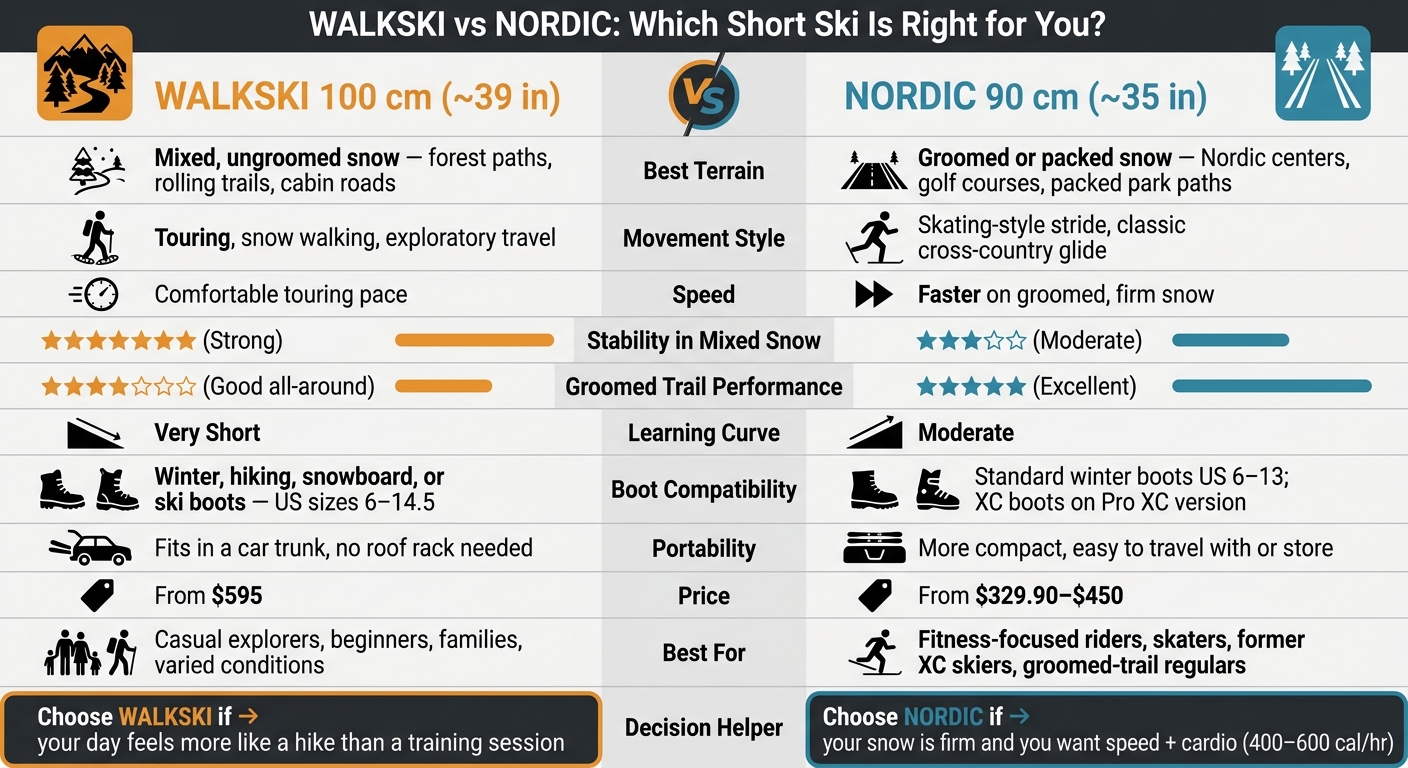
WALKSKI vs NORDIC: Side-by-Side Comparison Chart
Comparison table: terrain, speed, stability, technique, and portability
Here’s the simple version: WALKSKI does better in mixed snow, while NORDIC shines on firm, groomed snow.
| WALKSKI 100 cm (~39 in) | NORDIC 90 cm (~35 in) | |
|---|---|---|
| Best terrain | Mixed, ungroomed snow - forest paths, rolling trails, cabin roads, and packed backcountry routes | Groomed or packed snow - Nordic centers, golf courses with winter-groomed tracks, packed park paths |
| Primary movement | Touring, snow walking, exploratory travel | Skating-style stride, classic cross-country glide |
| Speed | Comfortable touring pace | Faster on groomed, firm snow |
| Stability in mixed snow | Strong - tracks better in choppy or softer conditions | Moderate - best on consistent, predictable surfaces |
| Groomed-trail performance | Good all-around option; less glide efficiency than NORDIC | Excellent - designed for exactly this |
| Learning curve | Very short - walking and balance cover most of the learning curve | Moderate - best for skaters, rollerbladers, and former XC skiers |
| Portability | High - fits in a car trunk, straps to a pack, no roof rack needed | More compact; easy to travel with or store in small spaces |
| Boot compatibility | Winter boots, snowboard boots, or ski boots | Standard winter boots; XC boots improve performance in the Pro XC version |
| Price | From $595 | From $450 |
| Best rider type | Casual explorer, beginner, traveler, family outings in varied conditions | Fitness-focused rider, regular groomed-trail skier, skaters or former XC skiers |
If you want a ski that feels more relaxed and forgiving when the snow gets messy, WALKSKI is the better pick. If your usual day means packed trails and you want more glide, NORDIC has the edge.
When long skis still win - and why Snowfeet* fits most riders better
There are still a few places where long skis beat short ones. No point pretending otherwise.
They still make more sense for:
- Deep powder backcountry tours where extra flotation matters
- Race-level skate training, where full-length skate skis hold speed better
- Multi-hour traverses over rolling terrain, where longer skis spread weight across more surface area
But let’s be honest: most U.S. riders aren’t doing that stuff.
A lot of cross-country skiers now go for short outings close to home, usually 2–3 hours and 2–7 miles. Winter sports also have a big casual crowd, with many people getting out fewer than 50 days a year. For a quick loop at a local Nordic center or a spur-of-the-moment lap through a snowy park, full-length skis can feel like overkill. More storage. More awkward carrying. Often extra racks. It’s a bit like bringing a ladder when all you need is a step stool.
That’s where both WALKSKI and NORDIC make a lot of sense. They fit in a car trunk. They work with boots you may already have. Setup stays simple, which means you spend less time fiddling around in the parking lot and more time on snow.
As Snowfeet* puts it:
"Very short learning curve, easy to use. Extremely responsive, lightweight on your feet, and easy to ski as opposed to cumbersome long backcountry skis."
For casual winter outings, that trade-off is the whole appeal.
Final verdict: pick the model that matches how you move on snow
The easiest way to choose is to look at where you’ll ride most of the time, not the dream day in your head. Keep it simple: think about terrain, speed, and technique.
Choose WALKSKI for winter exploring, easier technique, and varied snow
WALKSKI makes the most sense if your usual winter day feels more like a hike than a training session. It’s built for moving through mixed terrain without asking you to master cross-country form first.
With walk, ski, low-climb, and high-climb modes, WALKSKI handles:
- Flats
- Climbs
- Descents
That range makes it a strong match for beginners who want more control on mixed snow and a setup that feels forgiving instead of twitchy.
Brad Tolin said it well:
"These ski blades are a blast to use. Super easy to control, quick to turn, and way more forgiving than traditional skis."
Choose NORDIC for workouts, glide, and groomed-trail fun
If your snow is firm and you want more speed, go with NORDIC. NORDIC is the better fit when you have groomed or packed snow and want a faster, more workout-focused ride.
If you already skate, rollerblade, or come from a cross-country background, the motion will click pretty fast. It rewards rhythm and push. So the feel is closer to cardio than a laid-back walk. And its compact size makes it easy to pack, stash, and bring along on short notice.
Choose NORDIC for groomed, steady routes. Choose WALKSKI for mixed, changing snow.
FAQs
Which model is easier for complete beginners?
Both are beginner-friendly and feel a lot less intimidating than long, old-school skis. Since they’re shorter, they’re easier to turn, easier to control, and easier to get back under you if you get a little wobbly.
Choose NORDIC 90 cm for groomed, flat, or rolling skate-style paths. Choose WALKSKI 100 cm for casual backcountry touring and if you want to use your existing winter or snowboard boots.
Can I use regular winter boots with both models?
Yes - both models can work with regular winter boots.
Here’s the simple breakdown:
- Snowfeet WALKSKI 100 cm* fits winter boots, snowboard boots, or ski boots in US sizes 6–14.5
- Snowfeet NORDIC 90 cm* with the universal binding fits regular winter shoes and snowboard boots in US sizes 6–13
- Snowfeet NORDIC Pro XC* is different. It requires cross-country ski boots with a Rottefella NNN binding
If you’re using regular winter boots, go with boots that have firm ankle support. That extra hold makes a big difference out on the snow :)
What if I ride groomed trails and mixed snow?
If you split your time between groomed trails and mixed snow, Snowfeet WALKSKI 100 cm* is the better pick.
NORDIC 90 cm works best on groomed lanes and firm, packed surfaces. Snowfeet WALKSKI 100 cm*, on the other hand, gives you more range. It comes with climbing skins and a four-position free-heel binding, which makes it a good fit for groomed paths, rolling terrain, and light off-trail use.











Leave a comment
This site is protected by hCaptcha and the hCaptcha Privacy Policy and Terms of Service apply.