



















Skiing doesn’t have to be a hassle. Imagine ditching those long, bulky skis for something lighter, easier to carry, and more fun to use. That’s exactly what short skis, like Snowfeet’s Skiblades and Mini Ski Skates, offer. These compact skis (15–47 inches long) are shaking up the slopes, making skiing simpler and more enjoyable for beginners and seasoned skiers alike.
Here’s why skiers are making the switch:
- Easier to control: Short skis are agile and require less effort to turn, making them great for tight trails and quick maneuvers.
- Light and portable: No more roof racks or heavy gear - these skis fit in a backpack.
- Beginner-friendly: Master the basics faster without the intimidation of long skis.
- Versatile: Perfect for groomed runs, terrain parks, and even light powder.
Snowfeet’s lineup starts at $250, with options for every skill level and terrain. Whether you’re tired of lugging heavy skis or just looking for a smoother ride, short skis might be what you need. Keep reading to see how they work and why they’re gaining popularity.
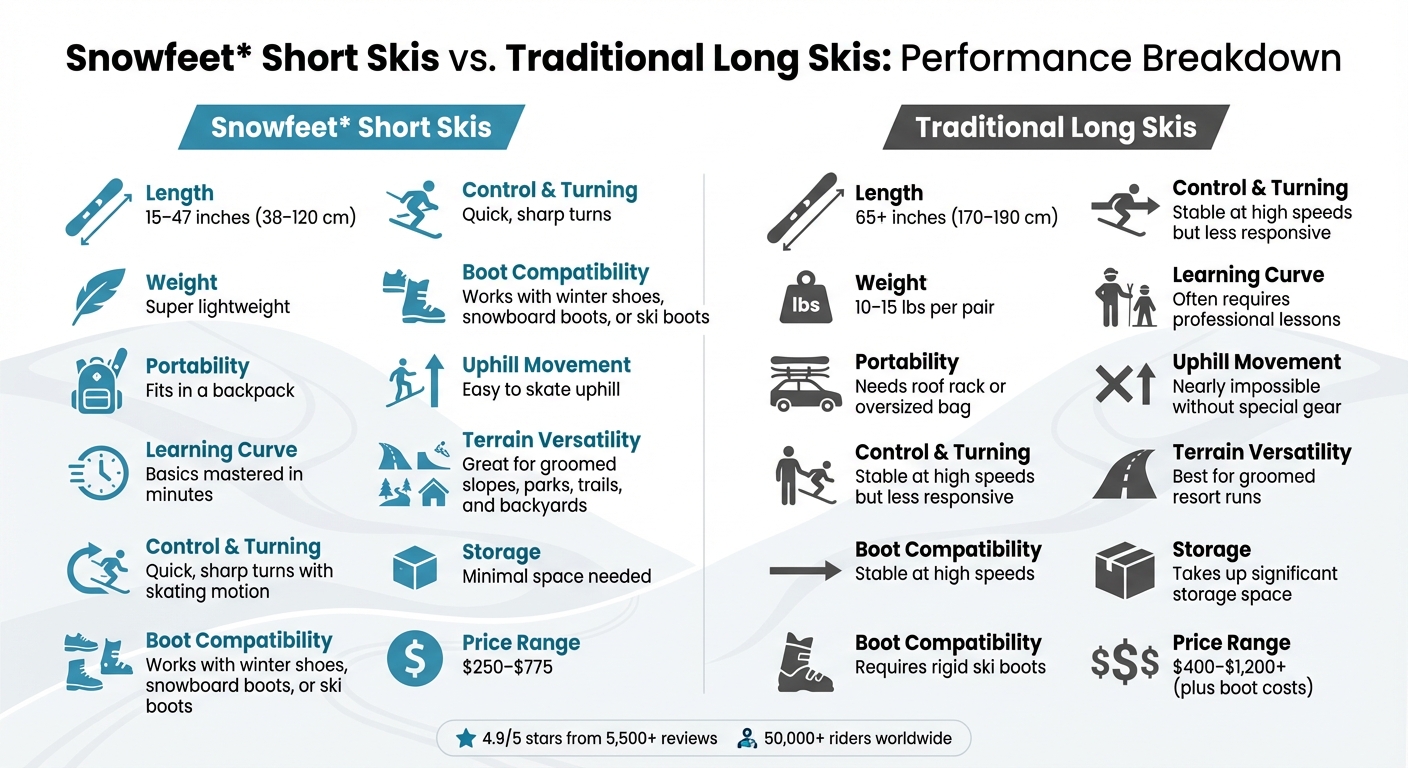
Snowfeet Short Skis vs Traditional Long Skis Comparison
Short Skis vs. Long Skis
Problems with Traditional Long Skis
Traditional long skis, typically 5–6 feet in length, come with a set of challenges that can make your day on the mountain more complicated than it needs to be.
Hard to Control and Turn
Long skis demand more effort to maneuver. You need to apply significant knee pressure to initiate turns, which makes quick, sharp movements tricky - especially on crowded slopes or technical terrain. The Snowfeet Team puts it best:
"Short skis are easier to carve and to turn than long skis, since you don't need to put too much pressure on your knees to actually tilt the skis on their edge."
The added length also slows down response time. So, tackling moguls or navigating narrow runs can feel more like a workout than a fun day on the mountain.
Heavy and Hard to Carry
Long skis aren’t just tough to use - they’re also a hassle to transport. They’re heavy, often requiring roof racks, and carrying them through parking lots or storing them at home can feel like a chore. Sophia Kane, an avid skier, shared her frustration:
"I hate getting stuck on a hill in skis because they're so long and bulky."
Their weight doesn’t just make them hard to carry - it also adds strain on your feet and legs, making every step around the resort more exhausting.
Difficult for Beginners to Learn
If you’re new to skiing, traditional long skis can feel overwhelming. Their size makes it harder to control and master basic techniques like the hockey stop or smooth turns. The Snowfeet Team highlights why this can be such a struggle for beginners:
"With their small size, they are much easier to control, making them perfect for those who are still developing their skiing skills."
These challenges highlight why many skiers are looking for alternatives that make the sport more accessible and enjoyable.
How Snowfeet* Short Skis Fix These Problems
Snowfeet* short skis step in to solve the pain points of traditional long skis, offering a smoother, more enjoyable experience on the slopes. Here's how they tackle the challenges we discussed earlier.
Better Control and Faster Turns
Thanks to their compact design, Snowfeet* short skis deliver a level of responsiveness that long skis just can’t match. With lengths ranging from 38 cm Mini Ski Skates to 99 cm Skiblades, they’re a far cry from the 67-75 inches (170-190 cm) of traditional skis. This shorter length makes it easier to pivot, carve, and stop, while reducing strain on your knees. The Snowfeet Team sums it up best:
"Short skis allow you to move with much more ease, they are easy to control and such fun to use. They are lighter than regular skis and their short length allows you to move more freely."
Whether you’re navigating moguls, weaving through trees, or tackling crowded slopes, these skis turn tricky spots into fun challenges. The freedom of movement they offer feels natural, doing away with the awkward techniques often needed for longer skis.
Light and Easy to Carry
Forget about roof racks and oversized ski bags. Snowfeet* short skis are so compact they fit easily into a standard backpack. Starting at just $250 for the 38 cm Mini Ski Skates and $675 for the 99 cm Skiblades, they’re not just affordable - they’re incredibly portable.
Nathan F., a Snowfeet* enthusiast, puts it simply:
"Absolute game-changer! They're light, fast, and incredibly fun to ride."
Made with fiberglass-reinforced polyamide or wood cores, they’re lightweight yet durable. This means less fatigue on your feet and legs, letting you enjoy a full day on the mountain. Plus, many models pair with regular waterproof winter boots or snowboard boots, sparing you from those clunky, heavy ski boots.
Versatile Across Snow and Terrain
Snowfeet* short skis aren’t limited to groomed runs - they’re ready for all kinds of snowy adventures. From ski resorts and snow parks to hiking trails, sledding hills, or even your backyard, they perform beautifully. They’re best on groomed snow but can handle light powder up to 4 inches deep. For deeper powder or backcountry terrain, the 99 cm models and POWDER series are up to the task.
Sophia Kane shares her experience:
"I hate getting stuck on a hill in skis because they're so long and bulky. Since these are shorter, you can just skate right up."
This versatility lets you move naturally across different terrains without the rigid techniques required by long skis. It’s no wonder skiers who give Snowfeet* a try often find it hard to go back to traditional gear.
Snowfeet* vs. Traditional Long Skis: Performance Breakdown
When you stack Snowfeet* short skis against traditional long skis, the differences jump right out at you. Big-name brands like Rossignol, Salomon, and K2 have long ruled the slopes with skis that typically measure over 65 inches (170–190 cm). Snowfeet*, on the other hand, flips the script with its compact options, ranging from just 15 inches (38 cm Mini Ski Skates) to a max of 47 inches (120 cm Snowfeet Short Skis). This isn't just a size difference - it's a whole new way to experience skiing.
Traditional long skis are all about speed and stability, designed for wide-open slopes and advanced skiers chasing adrenaline. But let’s face it: for most recreational skiers hitting groomed runs, snow parks, or local hills, those long, heavy skis can feel more like a chore than a thrill. Snowfeet* steps in with a fresh take, addressing these challenges in a way that makes skiing more accessible and, frankly, more fun.
By cutting down on weight and length, Snowfeet* short skis make skiing feel almost effortless. You get quicker turns, smoother control, and the kind of natural movement that feels intuitive - no wrestling with bulky gear. Thanks to their skate-inspired design, they even handle flat terrain and small inclines with ease. To make the comparison crystal clear, here’s a side-by-side breakdown:
Feature Comparison Table
| Feature | Snowfeet* Short Skis | Traditional Long Skis |
|---|---|---|
| Length | 15–47 inches (38–120 cm) | 65+ inches (170–190 cm) |
| Weight | Super lightweight | 10–15 lbs per pair |
| Portability | Fits in a backpack | Needs a roof rack or oversized bag |
| Learning Curve | Basics mastered in minutes | Often requires professional lessons |
| Control & Turning | Quick, sharp turns with a skating motion | Stable at high speeds but less responsive |
| Boot Compatibility | Works with winter shoes, snowboard boots, or ski boots | Requires rigid ski boots |
| Uphill Movement | Easy to skate uphill | Nearly impossible without special gear |
| Terrain Versatility | Great for groomed slopes, parks, trails, and even backyards | Best for groomed resort runs |
| Storage | Minimal space needed | Takes up significant storage space |
| Price Range | $250–$775 | $400–$1,200+ (plus boot costs) |
Of course, numbers only tell part of the story. On the slopes, the difference is undeniable. With over 50,000 riders and a glowing 4.9/5 star rating from more than 5,500 verified reviews, Snowfeet* has made an impression. For recreational skiers who prioritize agility and fun over top-end speed, the choice is pretty clear.
sbb-itb-17ade95
Why Skiers Made the Switch to Snowfeet*
More Fun and Freedom on the Slopes
With a stellar 4.9/5 rating from over 5,500 reviews, it’s clear that Snowfeet* is shaking up the skiing world. Just ask Brandon Stanley - he got his wife to try the Snowfeet 50 CM Ski Skates**, and she hit the slopes with a fresh spark of excitement.
Sophia Kane found herself ditching the awkward shuffle that comes with traditional skis. Instead, Snowfeet* allowed her to skate effortlessly up small hills, turning flat terrain into a playground. This kind of flexibility changes how you move on the mountain, freeing you from the clunky limitations of traditional ski gear.
Then there’s Daniel Siouffi, who tried the longer Snowfeet Short Skis (120 CM)** and described the experience as "flying like never before" while feeling "in complete control of every move". Many users talk about the pure joy of gliding more naturally on the slopes. For seasoned skiers, it’s a game-changer. For beginners, it makes learning feel almost effortless.
Easy for Beginners and Experienced Skiers
Snowfeet* is designed to be forgiving, helping beginners go from zero to intermediate in just one day. Meanwhile, experienced skiers rave about how easy it is to navigate tight tree runs, moguls, and terrain parks. One user summed it up perfectly:
"These skiblades are so much fun and easy to control. Never going back to regular skis".
What makes Snowfeet* so appealing is its versatility. Whether you’re new to skiing or have years of experience, the reduced strain and added control make every run smoother and more enjoyable. It’s no wonder recreational skiers are increasingly swapping out their traditional long skis for Snowfeet*.
Which Snowfeet* Model to Choose
Picking the right Snowfeet* model comes down to your riding style and preferences. The lineup offers options ranging from ultra-compact ski skates (just 44 cm) to high-performance short skis that stretch up to 120 cm. Here’s a quick guide to help you decide.
Mini Ski Skates and PRO: Perfect for Beginners
If you’re new to skiing, the Mini Ski Skates ($250) and PRO ($275) are great starting points. At just 44 cm long, they’re compact enough to fit in a backpack, making them super convenient. Their small size helps beginners build confidence quickly. These models are designed for riders weighing up to 200 lbs and pair easily with standard ski boots.
Skiblades and Short Skis: For Advanced Riders
For those with more experience, the Skiblades ($635–$675) and Short Skis ($775) are the way to go. Ranging from 65 cm to 120 cm, they’re built to handle everything from tight moguls to terrain parks. They’re suitable for riders up to 250 lbs and require regular edge tuning - especially if you’re tackling icy conditions often found on the East Coast. The 120 cm option offers extra stability at higher speeds while still being nimble enough for quick turns.
Snowfeet POWDER: Built for Deep Snow Adventures
If you’re heading off the beaten path or into deep powder, the Snowfeet POWDER ($675) is your best bet. At 99 cm, it’s specially designed for off-piste adventures and handles powder over 4 inches with ease. Unlike the shorter models, which are better suited for groomed slopes and lighter powder (up to 4 inches), the POWDER floats effortlessly in deep snow. It’s also built to support heavy backcountry loads and works with touring bindings for uphill skinning, making it perfect for exploring beyond the resort boundaries.
Conclusion
For decades, traditional long skis have ruled the slopes, but they come with their fair share of challenges - they’re heavy, tricky to control, and a hassle to transport. Enter Snowfeet* short skis, which tackle these issues head-on. With their lightweight design, easy handling, and unmatched portability, they offer a smoother learning curve that can take you from beginner to intermediate in just a single day. Whether you're weaving through moguls, floating on powder, or simply craving more freedom on the slopes, short skis bring something fresh to the table that long skis just can’t.
Here’s the proof: over 50,000 riders worldwide have embraced short skis, and they’ve earned a stellar 4.9 out of 5-star rating from more than 5,500 verified reviews. As one rider, Andrew B., shared:
"These skiblades are so much fun and easy to control. Never going back to regular skis".
Their compact size doesn’t just make them easier to carry - it simplifies your entire day on the mountain.
With models priced between $250 and $675, there’s a pair for every style and budget. Short skis don’t just make skiing easier - they make it more enjoyable, turning every run into an effortless adventure.
Discover the thrill, freedom, and control that over 50,000 skiers have already found with Snowfeet*.
FAQs
Why do many skiers prefer short skis over traditional long skis?
Short skis bring a whole new level of agility and ease to the slopes. With their compact size - usually between 15 and 47 inches - they’re a breeze to maneuver. This means you can make quick, tight turns with way less effort. For beginners, this translates to faster learning. For seasoned skiers, it means more playful and precise control. And let’s not forget, their lightweight design helps cut down on fatigue, so you can enjoy longer, more comfortable days on the mountain.
Another big plus? Short skis are super portable and budget-friendly. Many models are small enough to stash in a backpack, making them easy to carry or store. On top of that, they often come with a smaller price tag compared to traditional long skis, making them a great pick for anyone watching their wallet. Whether you’re carving up icy groomers or hitting freestyle terrain, short skis offer a fun, easy-to-use, and hassle-free alternative to their longer counterparts.
Can short skis handle different types of snow and terrain?
Short skis, like Snowfeet* Skiblades, are a great option for skiers who love versatility. They shine on groomed slopes, in terrain parks, and on compact snow. Thanks to their lightweight build and easy handling, they’re perfect for quick turns, pulling off tricks, and weaving through tighter spots.
That said, they’re not the best pick for deep powder. In those conditions, longer skis provide better float and stability, making them a more practical choice.
For most skiing conditions, though, short skis are a fun, portable, and easy-to-control option that works well for skiers of all experience levels.
Do short skis make it easier for beginners to learn skiing?
Short skis, like Snowfeet Skiblades, are a game-changer for beginners. They make learning to ski way less intimidating by simplifying the basics - turning, stopping, and balancing. Thanks to their compact size (anywhere from 17 to 47 inches) and lightweight design, these skis are incredibly easy to handle. They’re super responsive, which means new skiers can pick up essential skills in just a few hours instead of spending weeks trying to figure it out. Unlike traditional skis that can feel clunky and overwhelming, short skis are much more approachable and help build confidence quickly.
Another huge perk? You don’t need pricey, specialized ski boots. Regular winter boots or snowboard boots work just fine, making it a more affordable option for beginners. While a traditional ski setup can cost $400 or more, short skis typically range from $150 to $650 - so you can save some serious cash. Plus, they’re portable and straightforward to use, which makes the whole learning experience more fun and less exhausting. With Snowfeet’s short skis, you can skip the steep learning curve and dive straight into enjoying the slopes.













Leave a comment
This site is protected by hCaptcha and the hCaptcha Privacy Policy and Terms of Service apply.