




















Short skis are taking over the slopes in 2026. Why? They’re lighter, easier to handle, and way more convenient than long skis. Whether you’re a beginner, a casual skier, or just someone tired of lugging around bulky gear, short skis - like those from Snowfeet* - are changing the game.
Here’s the quick breakdown:
- Short skis: Easier to turn, less strain on your body, and perfect for tight spaces like trees or moguls. Plus, they’re compact enough to fit in a backpack.
- Long skis: Great for high-speed stability and deep powder but heavy, harder to maneuver, and a hassle to transport.
Snowfeet* is leading this shift with gear ranging from 38 cm mini ski skates to 120 cm short skis. Their products work with regular winter boots, making skiing more accessible and affordable. And they’re not just skis - they’ve also introduced skiskating, a fun, skate-like snow sport.
For most skiers, short skis are the better choice. They’re simple to use, save you energy, and make the slopes more enjoyable. Let’s dive into why this trend is here to stay.
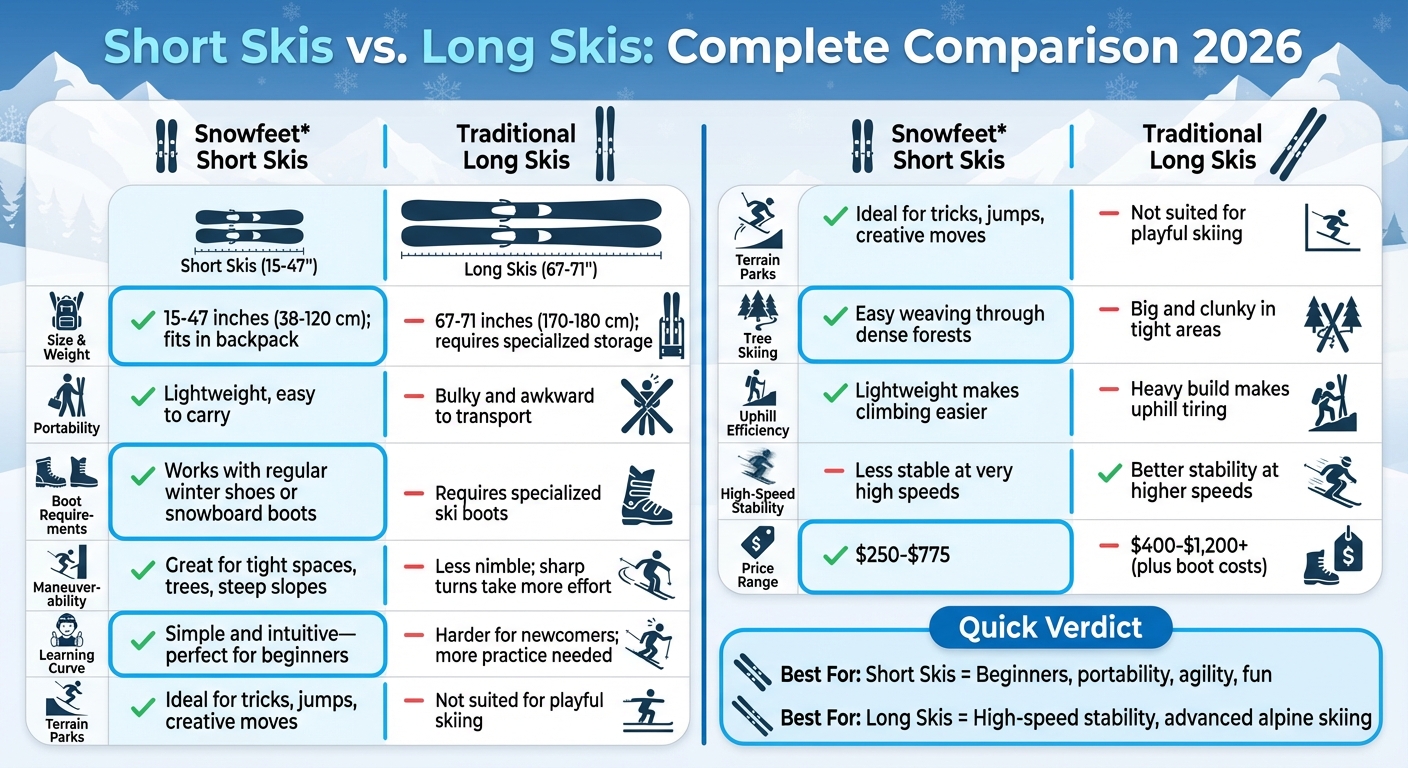
Short Skis vs Long Skis Comparison Chart 2026
Short Skis vs. Long Skis
Snowfeet* Short Skis and Skates: Compact and Easy to Use
Snowfeet* has built its entire product line around a simple idea: skiing shouldn't mean lugging around a mountain of gear. Their lineup includes everything from 38 cm mini ski skates to 120 cm short skis - compact enough to fit in a backpack or small storage space. Unlike traditional setups from brands like Rossignol or K2, Snowfeet* keeps things lightweight and easy to manage. With over 50,000 riders worldwide, they’ve shown that smaller gear doesn’t mean sacrificing performance. These compact designs not only make transportation a breeze but also deliver impressive performance on the slopes.
Key Features of Snowfeet* Products
One of the best things about Snowfeet* gear is that you can use it with your regular winter shoes or snowboard boots (sizes 6–13 US / 38–47 EU). That means you don’t have to shell out extra cash for ski boots. Compare this to traditional systems from brands like Salomon or Atomic, which often require a hefty investment in additional gear before you even get started.
Each Snowfeet* model is made with fiberglass-reinforced material, metal ski edges, and a built-in heel brake for reliable stopping control. These skis are lightweight but tough, designed to handle groomed runs and even terrain parks. Their shorter length makes them super agile and easy to maneuver. Plus, getting on and off a chairlift is a breeze. As Chan Saelee, a lifelong snowboarder who tested Snowfeet*, put it:
"Getting on and off the chairlift with Snowfeet* was simple and stress-free - way easier than snowboarding or skiing."
This user-friendly design also makes learning to ski feel much more natural.
Why Short Skis Are Easier for Beginners
Snowfeet* products are perfect for beginners thanks to their manageable size and forgiving design. The smaller skis offer more control and reduce the risks that come with learning. For instance, the 38 cm Carbon Fiber Edition is specifically designed for first-timers. With 2,239 reviews and a 90% positive rating, many users mention feeling confident on their very first try.
The design includes a wider waist for better stability and a soft flex that helps prevent catching an edge, which means fewer falls and a smoother learning experience compared to traditional long skis.
Pricing starts at $170 for mini ski skates and goes up to $560 for skiblades. And since you don’t need to buy separate ski boots, Snowfeet* offers not just performance but some serious savings, too [4].
Long Skis: Outdated Beliefs About Stability and Speed
The Stability Myth Explained
For years, the ski world clung to the idea that longer skis, with their larger surface area, meant better stability - especially on steep runs or in deep powder. Brands like Rossignol, K2, and Atomic built entire product lines around this belief. But here's the thing: this idea works best for expert skiers who know how to handle heavier, less nimble gear.
For most skiers - especially beginners and intermediates - long skis can be more of a hassle than a help. Sure, a 180 cm ski might feel steady when you're zipping down a straight, groomed slope at high speeds. But let’s be honest, most of us spend our time weaving through turns on varied terrain. In those everyday conditions, shorter skis are way easier to control.
And then there’s the elephant in the room: ski technology has moved on. Modern designs, like rocker profiles and advanced materials, have completely changed the game. Snowfeet* has taken full advantage of these advancements, creating short skis that offer incredible grip and control without the bulk. The old idea that you need long skis for stability? It’s starting to feel like a relic of the past, especially as we hit 2026. For the average skier, long skis often feel more like a burden than a benefit.
Drawbacks of Long Skis for Modern Skiers
Let’s dig into why long skis aren’t all they’re cracked up to be - and how Snowfeet* short skis solve those issues. First off, transporting long skis is a pain. Trying to fit a pair of 170 cm skis into a compact car or a crowded lodge? Not fun. Snowfeet* skiblades, on the other hand, come in lengths of 65 cm or 99 cm and can easily slide into a regular backpack. Problem solved.
Then there’s the physical effort. Long skis demand more muscle to maneuver, especially in tight spots like moguls. That extra effort can make learning harder for beginners. Ski writer Kimberly Beekman sums it up perfectly:
"Experts and more aggressive skiers may want a longer ski than beginners or intermediates for better stability at higher speeds".
Translation? If you’re not an expert bombing down black diamonds, you’re probably using gear that’s overkill for your needs.
Lastly, long skis can limit where you go. They’re awkward in terrain parks, exhausting in moguls, and a hassle for quick uphill treks in the backcountry. Snowfeet* products, by contrast, are lightweight, easy to handle, and perfect for the dynamic demands of modern skiing. It’s no wonder more and more skiers are turning to Snowfeet* for a versatile and fun experience on the slopes.
Direct Comparison: Snowfeet* vs. Long Skis
Comparison Table: Snowfeet* vs. Long Skis
When deciding between Snowfeet* short skis and traditional long skis, here’s how they stack up:
| Factor | Snowfeet* Short Skis | Traditional Long Skis |
|---|---|---|
| Size & Weight | 15–47 inches (38–120 cm); compact enough to fit in a backpack | 67–71 inches (170–180 cm); bulkier and require specialized storage |
| Portability | Lightweight and easy to carry, even on chairlifts or through crowded ski lines | Bulky and awkward; tough to transport in small cars or crowded lodges |
| Boot Requirements | Works with regular winter shoes or snowboard boots - no special boots needed | Requires pricey, specialized ski boots that add extra weight |
| Maneuverability | Great for tight spaces, navigating trees, and steep slopes | Less nimble; sharp turns take more effort |
| Learning Curve | Simple and intuitive - perfect for beginners | Harder for newcomers; takes more practice to master |
| Terrain Parks | Ideal for tricks, jumps, and creative moves | Not as suited for playful skiing or park features |
| Tree Skiing | Compact size makes weaving through dense forests a breeze | Big and clunky in tight wooded areas |
| Uphill Efficiency | Lightweight design makes climbing easier | Heavy build makes uphill travel more tiring |
| High-Speed Stability | Less stable at very high speeds | Built for better stability at higher speeds |
| Price Range | Around $250–$775 depending on the model | Typically $400–$1,200 or more - plus the cost of specialized boots |
Snowfeet* short skis shine in portability, ease of use, and versatility, making them a favorite for skiers seeking a lightweight, fun, and beginner-friendly option. While traditional long skis might still be the go-to for high-speed stability and advanced alpine skiing, Snowfeet* offer a fresh, compact alternative for those who value agility and convenience.
sbb-itb-17ade95
2026 Ski Trends: Why Skiers Choose Short Skis
Survey Data: What Skiers Value Most
These days, recreational skiers are leaning toward gear that prioritizes fun, ease of use, and maneuverability over the traditional perks of long skis. Let’s face it - most skiers aren’t training for the Olympics or tackling untouched backcountry slopes. They just want a setup that makes their weekend on the mountain enjoyable without leaving them completely wiped out.
One big advantage of short skis? The learning curve is much easier. Beginners can jump from rookie to intermediate in just a day, finishing their runs energized instead of totally drained. Survey results back this up, with Snowfeet* products earning top marks for delivering a smooth, struggle-free experience for newcomers.
"For the purpose of recreational skiing, short skis are a better choice. They are easier to pack and carry around, you can use your preferred footwear and finally, they are easy to ride, so you will not finish all drained up." - Snowfeet Team
Sure, long skis have their place - they’re great for stability at high speeds and gripping hard-packed snow. But unless you’re racing or tackling deep powder, those benefits don’t mean much. For most skiers, long skis just feel bulky and heavy. Short skis, on the other hand, bring agility to the table. They make quick turns a breeze and can even boost speed in certain situations, like on slalom courses.
This shift toward agility and fun has naturally paved the way for Snowfeet* to lead the charge in the growing skiskating trend.
Skiskating: A New Snow Sport
Snowfeet* is shaking things up with skiskating, a fresh snow sport that feels more like skating on snow than traditional skiing. Their ultra-short models, like the 44 cm Skiskates (rated 5.0) and 38 cm Mini Ski Skates (rated 4.9), are drawing in skiers who want a playful, dynamic alternative to the usual gear from brands like Rossignol or K2.
The compact design of Snowfeet* products makes them perfect for terrain parks, weaving through tight trees, or pulling off creative tricks. Freestyle fans and casual riders alike are loving the freedom these products offer. By blending elements of traditional skiing with modern snow sports, Snowfeet* has carved out a niche as the go-to brand for accessible, versatile winter gear. With prices ranging from $170 for the Mini Ski Skates to $560 for the 99 cm Skiblades, Snowfeet* delivers a fresh take on fun and innovation for the slopes.
Snowfeet* Models for Every Skier
Mini Ski Skates and Skiskates: Perfect for Beginners and Casual Skiers
If you're just starting out or want something super portable, the Mini Ski Skates (38 cm) and Skiskates (44 cm) are fantastic options. The Mini Ski Skates, priced at $250, are small enough to toss in a bag and way more convenient than lugging around traditional skis. Plus, they work with your regular winter boots - no need for special gear.
The Skiskates (44 cm), starting at $575, step things up with a wood core, giving you a sturdy, agile ride. Both models are great for learning the basics without wearing yourself out, unlike the heavy, clunky feel of full-length skis. They're all about keeping things light and fun on the slopes.
When you're ready to take your skiing to the next level, Snowfeet* has options designed for more advanced performance.
Skiblades and 120 cm Short Skis: Built for Advanced Skiers
Feeling confident and ready for a challenge? Check out Snowfeet's 65 cm and 99 cm Skiblades, priced at $635 and $675. These shorter skis are all about precision and control, making them ideal for tight turns and tricky terrain like moguls or tree runs. Their compact size makes them incredibly responsive and easy to edge, thanks to their shorter sidecut radii.
For those who want a bit more length without the bulk, the 120 cm Short Skis ($775) are Snowfeet's longest offering. They provide the perfect mix of stability and control, even at higher speeds, without the heft of traditional skis. With a lower swing weight, these skis make navigating moguls and demanding terrain a breeze - something that heavier, full-length skis from brands like Atomic or Head often struggle with.
These models highlight why so many skiers are swapping out their long skis for Snowfeet*. They're lighter, easier to handle, and deliver the performance you need for all kinds of adventures on the mountain.
Conclusion: Snowfeet* Leads 2026 Skiing Trends
Short skis are changing the game for modern skiing. With over 50,000 riders worldwide and an impressive 4.9 out of 5-star rating, Snowfeet* shows that compact, agile equipment can bring a whole new level of fun and freedom. Unlike the bulkier, traditional long skis from brands like Atomic or Head, Snowfeet* offers a fresh approach. Whether you're weaving through tight trees, hitting the terrain park, or just starting out, their models - ranging from 38 cm to 120 cm - deliver the versatility and performance today’s skiers are looking for.
The old belief that "longer is better" doesn’t hold up anymore. Over the years, ski lengths have steadily decreased, and for good reason. Shorter skis are easier to handle, more maneuverable, and way more convenient to carry around. Their compact size makes traveling with them a breeze.
Snowfeet* takes these benefits to the next level. They pair perfectly with your regular winter boots or snowboard boots - no need to endure those stiff, uncomfortable plastic ski boots. Plus, thanks to their durable metal ski edges, they’re accepted at most ski resorts and built to last through seasons of use.
If you’re ready to rethink skiing, Snowfeet* delivers lightweight, responsive, and thrilling performance. With options for every skill level and budget, Snowfeet* is your ticket to a smarter, more exciting way to hit the slopes. Step into the future of skiing with Snowfeet* - because lighter and faster just feels better.
FAQs
Why are short skis a better choice for beginners?
Short skis are a popular pick for beginners, and it’s easy to see why - they’re easier to handle. Their smaller size makes turning smoother and stopping quicker, helping new skiers gain confidence as they learn the ropes.
Another big plus? Short skis are light and easy to maneuver, so they don’t take as much effort to control. This makes them a great choice for practicing basic skills without feeling overwhelmed or exhausted. If you’re just starting out, short skis can make learning the essentials feel a lot more fun and approachable.
Can I use Snowfeet products with regular winter boots?
You can absolutely pair Snowfeet with regular winter boots, provided your boots offer solid ankle support and are waterproof. This makes Snowfeet a flexible choice for those who’d rather skip investing in specialized ski boots. Just strap them on, and you’re all set to glide down the slopes effortlessly!
Why are Snowfeet short skis easier to transport than traditional skis?
Snowfeet short skis are a game-changer when it comes to portability. Unlike traditional skis that can stretch over 5 feet and demand bulky carriers or roof racks, these compact skis easily slip into a backpack or small bag. Whether you're driving, flying, or hopping on public transit to hit the slopes, their lightweight design makes traveling a breeze.
Because they’re so small and easy to carry, you can say goodbye to the hassle of hauling heavy gear around. This means less stress and more time to actually enjoy your trip. If you’re all about keeping things simple and convenient, Snowfeet short skis are a no-brainer.













Leave a comment
This site is protected by hCaptcha and the hCaptcha Privacy Policy and Terms of Service apply.