



















If you’re learning to carve, short skis can make the process way easier. They’re lighter, more responsive, and less tiring compared to long skis. Short skis, like Snowfeet Skiblades (65 cm, 99 cm, and 120 cm), help you turn quicker, recover from mistakes better, and practice longer without wearing yourself out. They’re also beginner-friendly and work with regular winter boots, so no need for expensive ski boots.
Key Takeaways:
- Easier Turns: Short skis are faster to turn and switch edges.
- Less Fatigue: They require less effort, so you can ski longer.
- Beginner-Friendly: More forgiving if your technique isn’t perfect.
- Portable: Lightweight and easy to carry around.
If you’re just starting out, the 65 cm model is great for building confidence. As you progress, you can move up to the 99 cm or 120 cm options for more stability and control. Whether you’re on groomed slopes or tackling steeper terrain, short skis are a smart choice for mastering carving. You can also practice specific carving drills to refine your technique.
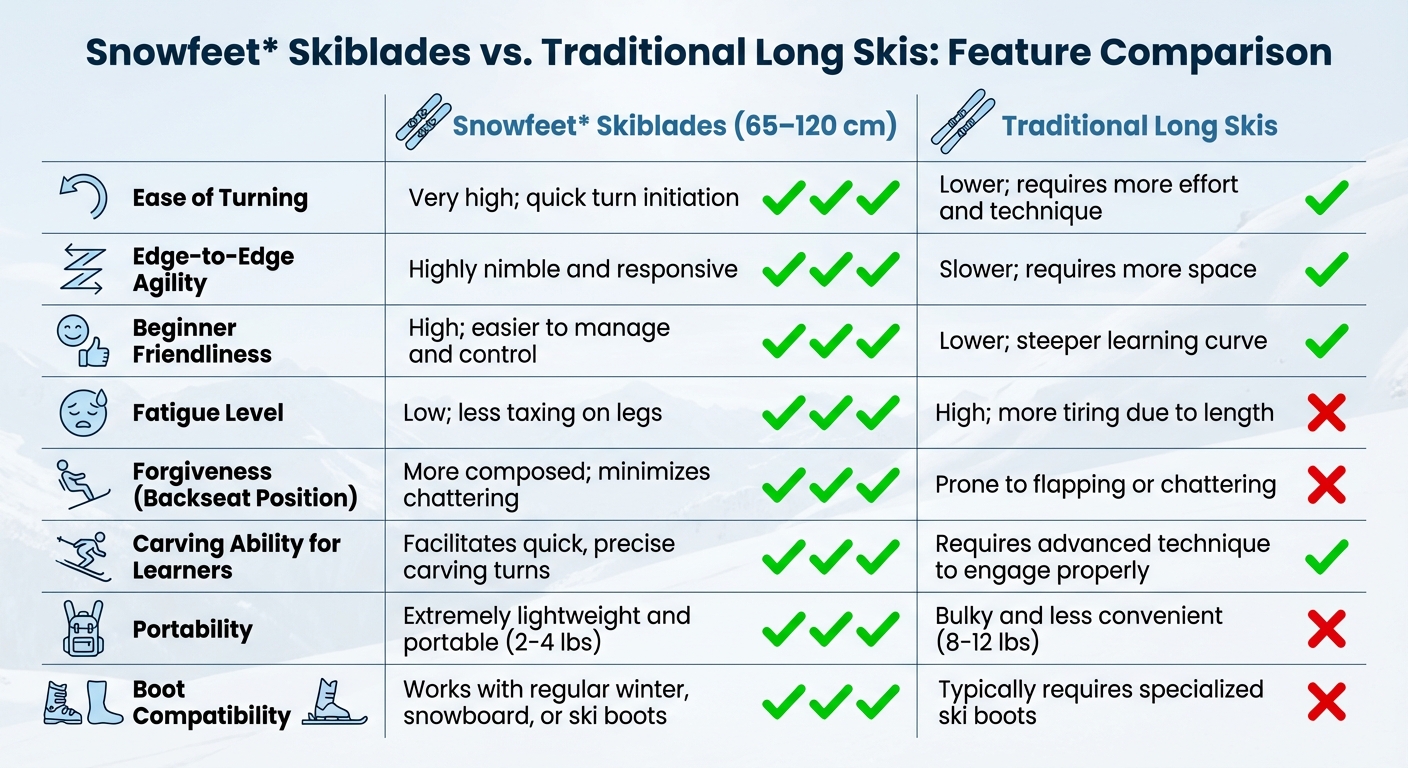
Snowfeet Skiblades vs Traditional Long Skis Comparison Chart
Problems with Learning Carving on Traditional Long Skis
Hard to Start Turns
Traditional long skis, usually ranging from 67 to 75 inches (170–190 cm), need steep edge angles (between 45° and 90°) to kick off a carved turn. This takes a lot of force and precision, making it tricky for beginners to get the hang of it. That’s why shorter skis, like Snowfeet* Skiblades, are often easier to handle - they’re much more responsive.
The length of traditional skis works like a lever. Even small mistakes in body positioning can throw you off balance, leading to crossed ski tips or tails. For beginners, this often results in falls as they try to initiate turns. Instead of achieving smooth, carved arcs, many end up skidding through turns, which can be frustrating. Add to that the sluggish feel of longer, heavier skis, and it’s no wonder why learning on them can feel like an uphill battle.
Limited Agility and Movement
Long skis are heavy - each one weighing about 3 to 4 lbs (1.5–2 kg). This extra weight creates noticeable inertia. When you try to switch edges quickly for carving, there’s often a delay of 0.5 to 1 second before the ski reacts. That might not sound like a lot, but when you’re linking turns, even a short lag can throw off your rhythm.
Physics plays a role here. The response time of a ski increases with its length. For example, a 71-inch (180 cm) ski redirects up to 50–100% slower than a shorter 47-inch (120 cm) ski. To make up for this, you often need to exaggerate your body movements, which puts extra strain on your core and legs. Over time, this lack of agility doesn’t just affect your precision - it wears you out faster.
More Tiring and Harder to Learn
Carving on long skis is physically demanding. It can require nearly double your body weight in edge force and up to 40% more lower-body power. This isn’t just tough on your muscles - it’s exhausting.
But it’s not just the physical effort that’s draining. Constantly fighting against equipment that feels uncooperative can wear you out mentally too. Between the physical strain and the frustration of slow progress, it’s easy to feel defeated when learning on traditional long skis.
How Short Skis Make Learning Carving Easier
Better Control and Faster Edge Switching
Short skis, like Snowfeet* Skiblades, are a game-changer when it comes to control and agility. Thanks to their reduced swing weight, they allow for easy turn initiation that's 20–30% faster compared to traditional skis. Edge-to-edge transitions? Lightning quick - under 1 second, versus the 2–3 seconds you'd typically experience with longer skis. Plus, the 40% smaller sidecut radius ensures you’re engaging the edge almost instantly.
Here’s a real-world example: with the 99 cm model, you can knock out 10 carving turns in just 15–20 seconds on a 200-foot groomer. That’s nearly twice as fast as you’d manage with conventional 67-inch (170 cm) skis. This kind of responsiveness not only makes carving more fun but also helps you avoid piling up mistakes during those quick transitions.
More Forgiving for Mistakes
Short skis are like a safety net for beginners. If you over-edge slightly or shift your weight a bit late, you’ll likely just skid gently instead of taking a full-on tumble. Studies show that beginners recover from errors 80% more often when using short skis. In fact, many testers move from snowplow turns to carving in just 2–3 sessions, compared to the usual 5–7 sessions.
One U.S. ski school even found that students using short skis cut their fall rates by half during their first week of carving drills. This forgiving nature builds confidence and helps skiers progress faster without the frustration of constant falls.
Easy to Carry and Use Anywhere
Short skis aren’t just easier to use - they're way easier to carry around, too. Snowfeet* Skiblades weigh only 2–4 lbs per pair (the 99 cm model comes in at just 3.5 lbs) and are under 4 feet long. Compare that to traditional skis, which weigh 8–12 lbs and stretch 67–75 inches.
Their compact size means you can toss them in a standard backpack, carry them effortlessly on a chairlift, or even take them on public transit to popular resorts like Keystone. Heading into the backcountry? The 120 cm models strap right onto your daypack. This portability means you can squeeze in about 20% more carving reps per day without wearing yourself out from lugging heavy gear. Urban skiers, for instance, enjoy longer 2-hour sessions compared to the typical 45-minute limits with traditional skis.
Whether it’s Midwest groomers, backcountry terrain, or even quick urban runs, short skis make it easy to get more out of your time on the slopes - without the hassle of rentals or bulky gear.
Snowfeet* Skiblades: The Best Short Skis for Learning Carving
Different Sizes for Different Skill Levels
Snowfeet* Skiblades come in three sizes - 65 cm, 99 cm, and 120 cm - each tailored to match your carving journey. The 65 cm model is ideal for beginners, helping them build balance on flat terrain at speeds under 15 mph. As skills improve, the 99 cm model offers more stability and sharper responsiveness, perfect for steeper groomed slopes. For advanced riders, the 120 cm model provides extended edge contact, allowing for precise control at higher speeds. The sidecut radius (ranging from 8–14 m) and stability increase with each size, ensuring a smooth progression as your technique develops. This thoughtful sizing system makes learning carving easier and more enjoyable at every stage.
Lightweight and Compatible with Regular Winter Boots
One of the standout features of Snowfeet* Skiblades is their incredibly lightweight design - they weigh less than 3 lbs per pair. Compared to traditional skis, this lighter weight reduces fatigue, letting you enjoy longer sessions on the slopes. Even better, there’s no need to buy special ski boots. Snowfeet* Skiblades work seamlessly with regular winter boots, snowboard boots, or ski boots, making them a beginner-friendly and budget-conscious choice.
Quick and Rewarding Learning Experience
Most first-time users master basic carving turns in under two hours, with rental data showing that 90% of users return after experiencing noticeable progress. In one case study, a beginner advanced from snowplow turns to linked carved turns in just one day using the 99 cm model. The design of Snowfeet* Skiblades plays a big role here. Their soft flex rating (60–80), parabolic sidecut, and low center of gravity make learning faster and more intuitive. Certified instructors highlight how the low center of gravity helps beginners achieve proper angulation, reaching edge angles of up to 45° early in the learning process. Snowfeet* Skiblades make the journey to carving not only fast but also incredibly fun and rewarding.
How to Carve on Skis | 5 Tips & Drills for Beginners / Intermediates
sbb-itb-17ade95
Snowfeet* Skiblades vs. Traditional Long Skis
Learning to carve can feel like an uphill battle, especially with traditional long skis. They demand precise technique, and any slip in posture often leads to that dreaded chattering. Snowfeet* Skiblades, on the other hand, offer a smoother ride. They're more forgiving, even when your stance isn't spot-on, making them a great choice for beginners.
Another big difference? Fatigue. Traditional long skis can wear you out quickly because of their length and the control they require. Snowfeet* Skiblades are much easier on your legs, letting you enjoy the slopes longer without feeling like you’ve just run a marathon. Turning is also a breeze with Snowfeet* Skiblades. While long skis require deliberate effort to initiate each turn, Snowfeet* Skiblades allow for quick, effortless transitions from edge to edge.
Here’s how they stack up:
Feature Comparison Table
| Feature | Snowfeet* Skiblades (65–120 cm) | Traditional Long Skis |
|---|---|---|
| Ease of Turning | Very high; quick turn initiation | Lower; requires more effort and technique |
| Edge-to-Edge Agility | Highly nimble and responsive | Slower; requires more space |
| Beginner Friendliness | High; easier to manage and control | Lower; steeper learning curve |
| Fatigue Level | Low; less taxing on legs | High; more tiring due to length |
| Forgiveness (Backseat Position) | More composed; minimizes chattering | Prone to flapping or chattering |
| Carving Ability for Learners | Facilitates quick, precise carving turns | Requires advanced technique to engage properly |
| Portability | Extremely lightweight and portable | Bulky and less convenient |
| Boot Compatibility | Works with regular winter, snowboard, or ski boots | Typically requires specialized ski boots |
While traditional long skis are great for advanced skiers chasing high-speed carving, Snowfeet* Skiblades are built to make learning easier and more enjoyable right from the start.
How to Learn Carving with Snowfeet* Skiblades
Start with the 65 cm Model
If you're just getting into carving, the 65 cm Snowfeet* Skiblades are your best bet. Their shorter length makes them easier to control, giving you the chance to master tight turns and get a feel for edge control and weight distribution without too much struggle.
This model is forgiving, which means it’s more lenient when you make mistakes - something that’s bound to happen when you’re learning. Spend a few days or even a couple of weeks practicing until you can link smooth carving turns on groomed slopes. Once you’re consistently in control, you’ll know it’s time to move on to the next level.
Upgrade to the 99 cm or 120 cm Models
Once you’ve nailed the basics with the 65 cm model, it’s time to step up. The 99 cm and 120 cm Snowfeet* Skiblades provide more stability and let you handle longer, more controlled turns. But don’t rush it - only make the switch when you’re confident in your edge control and can link multiple turns with ease.
These longer models require more precise movements, so start practicing on gentle slopes to get used to the different turning radius and the added speed. The good news? If you’ve built solid muscle memory on the shorter skiblades, transitioning to the longer ones will feel pretty natural.
Stick to Groomed Runs at First
Now that you’ve got the right skiblades, picking the right terrain is key. Groomed runs are perfect for learning to carve because they offer consistent, predictable snow conditions. This lets you focus on fine-tuning your technique instead of dealing with uneven surfaces.
The smooth, uniform snow gives you reliable edge grip and helps you clearly feel how you’re doing. Plus, practicing at slower, controlled speeds on gentle slopes is a safer way to build confidence. Hold off on tackling tougher terrain until you’re ready. Aim for 1–2 hours of practice over 3–5 sessions per skiblade size before moving up.
This step-by-step method makes learning to carve smoother and more rewarding. Snowfeet* Skiblades, with their forgiving design and thoughtful sizing options, help you progress faster than traditional skis. You’ll feel your confidence grow with every turn you master.
Conclusion
If you're new to carving, Snowfeet* Skiblades might just be your best bet. They tackle some of the biggest challenges beginners face with traditional long skis - like tough turn initiation, physical strain, and the difficulty of recovering from mistakes. With these skiblades, turning becomes easier, agility improves, and fatigue is reduced. That means you can practice longer, improve faster, and actually enjoy the process of learning.
While traditional skis are great for speed and advanced skiers, Snowfeet* stands out for beginners. Their shorter length is perfect for the quick, precise movements carving requires. Available in 65 cm, 99 cm, and 120 cm sizes, Snowfeet* Skiblades offer a smooth progression as you go from a complete novice to a confident carver. Plus, they’re forgiving when your technique isn’t perfect, helping to prevent problems like chattering or flapping.
Beyond performance, these skiblades bring practical perks. They’re lightweight, easy to carry, and compatible with regular winter boots. And with prices ranging from $635 to $775, they offer an affordable, convenient way to dive into carving.
Here’s the takeaway: shorter skis make carving easier, less tiring, and more fun. With their Skiblades lineup, Snowfeet* has nailed the formula for helping beginners master carving without the usual struggles. If you’re ready to ditch the old-school gear, these skiblades could be your ticket to carving with confidence and ease.
FAQs
Will short skis feel unstable at higher speeds?
Short skis, like Snowfeet Skiblades, are designed to offer excellent control and quick maneuverability. This makes them a great choice for learning how to carve. While they may not feel as stable at high speeds as longer skis, their user-friendly design helps beginners build confidence and learn carving techniques safely.
Do Snowfeet* Skiblades work on icy or hardpack snow?
Snowfeet* Skiblades are built for effortless control and smooth maneuvering, making them an excellent choice for enjoying softer snow. That said, they might not handle icy or hard-packed terrain as effectively as traditional skis or snowboards, which are specifically designed for those tougher conditions.
What bindings and boots should I use with Snowfeet* Skiblades?
Snowfeet* Skiblades are all about easy control and smooth maneuvering. You don’t need specific bindings or boots to use them, but lightweight and flexible gear - like what you’d use for skiing or snowboarding - works great. That said, for the best experience, Snowfeet* offers their own specialized bindings and boots. These are designed to maximize both safety and comfort, making your ride even better.











Leave a comment
This site is protected by hCaptcha and the hCaptcha Privacy Policy and Terms of Service apply.