



















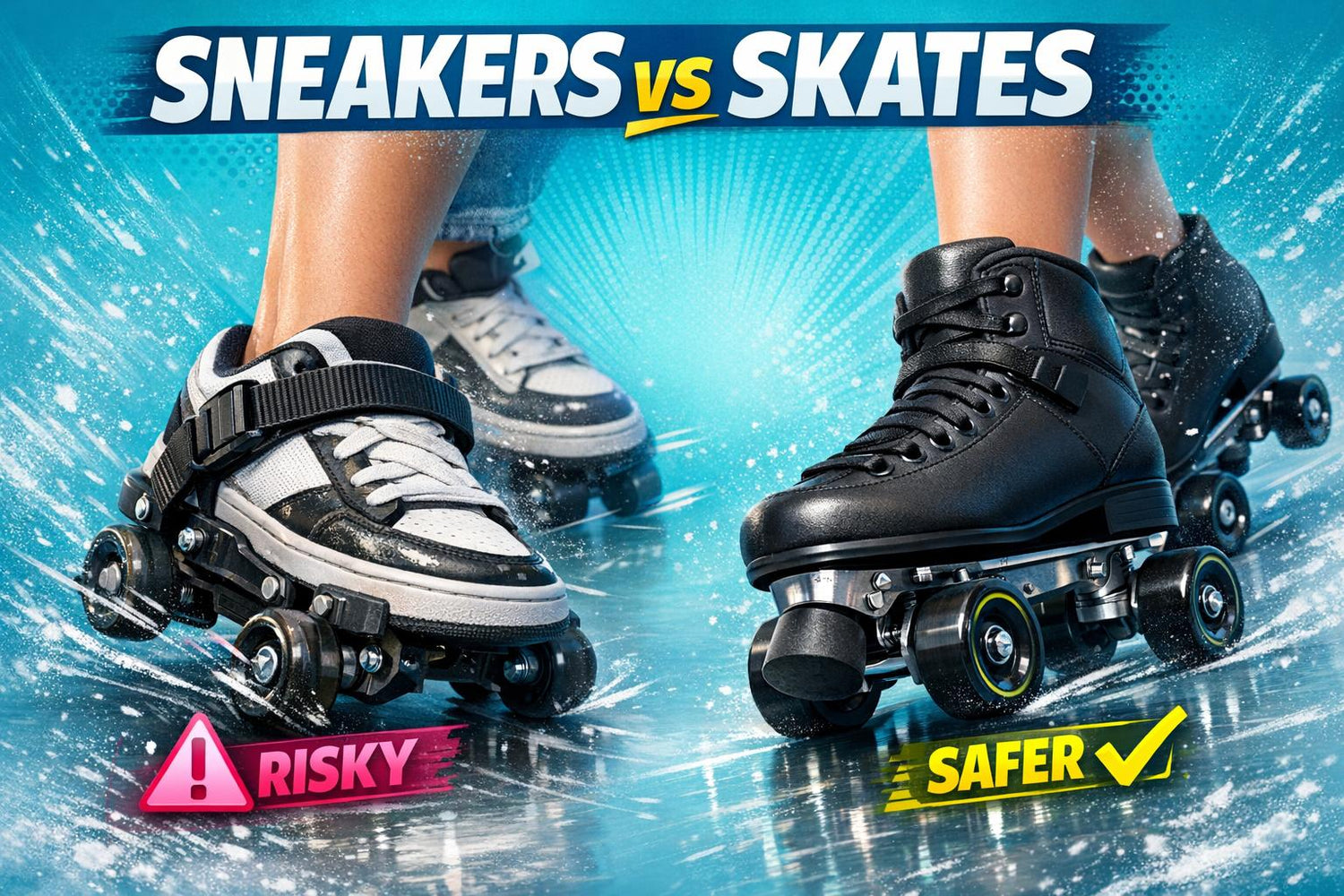
Skating with your regular sneakers? It’s possible but not always safe or practical. Sneakers aren’t designed for skating - soft soles, flat heels, and limited ankle support can make them unstable and risky. However, with tools like Wheelfeet (strap-on roller skate attachments), you can turn certain sneakers into skates without permanently modifying them.
Here’s the deal:
- Why sneakers don’t work well: Flexible soles, lack of heels, and poor lateral support make skating harder and less safe.
- Conversion kits: You can drill skate plates into sneakers, but it’s costly ($270–$700) and works only with specific shoe types (e.g., Vans, Converse).
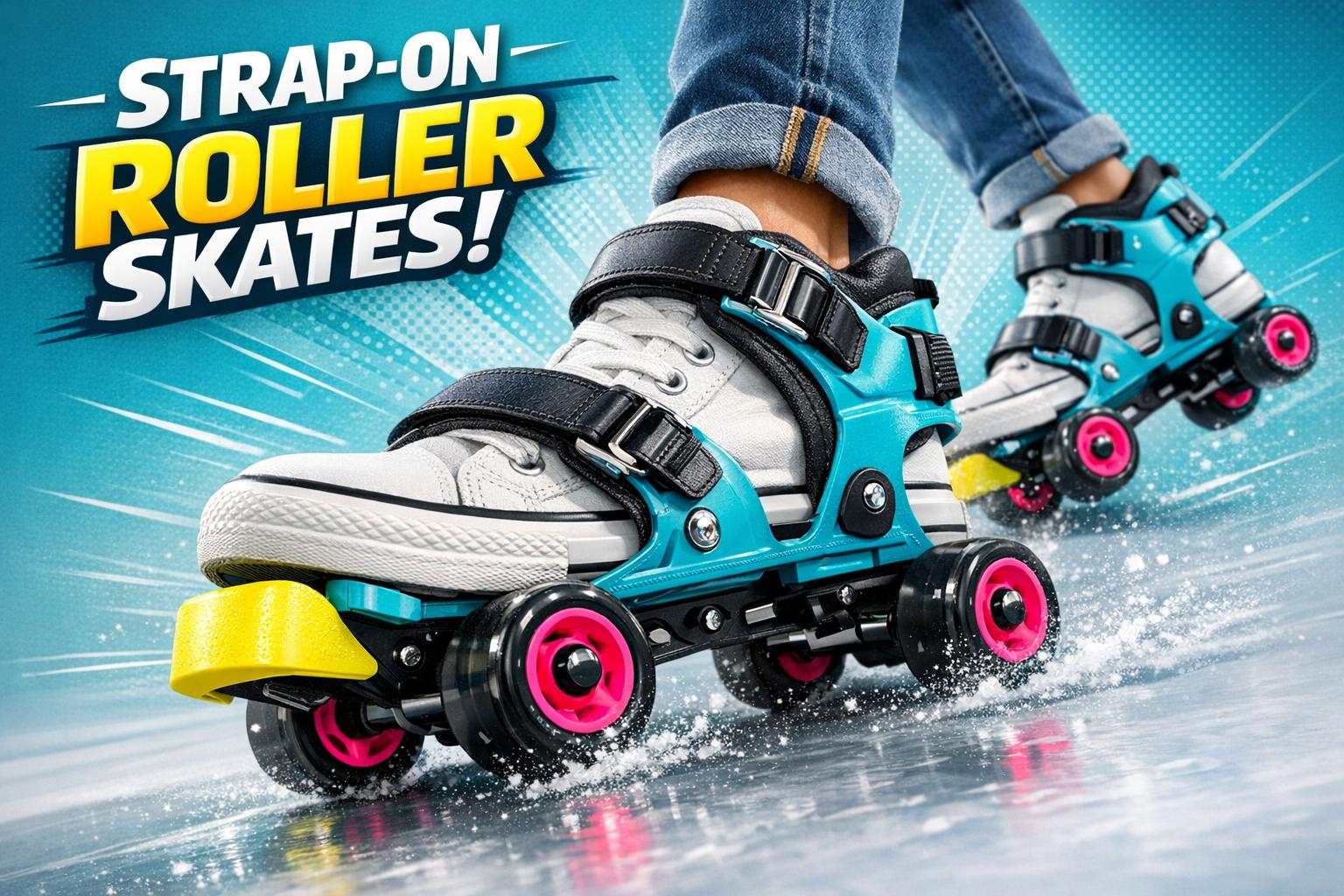
- Roller skate attachments: Products like Wheelfeet ($199) strap onto sneakers, offering a safer, reversible option for casual skating.
For serious skating, stick to purpose-built gear like skate boots or Snowfeet* for snow adventures. They’re safer, more durable, and designed for performance.
Attachable Wheels Transform Shoes Into Skates
The Problem: Why Sneakers Are Not Built for Skating
Sneakers are made for walking and running, not for the unique demands of skating. Adding wheels changes the dynamics entirely, and sneakers just aren't up to the task.
Key Limitations of Using Sneakers for Skating
The main issue lies in sole rigidity. Skate boots are designed with stiff, hard soles that evenly distribute your weight across the mounting plate. Sneakers, on the other hand, have soft, flexible soles that buckle under pressure. As Cruz Skate Shop explains:
"A rigid sole provides a stable platform for mounting wheeled mechanisms, minimizing flex and ensuring efficient energy transfer. Conversely, a flexible sole will compromise control and increase the risk of instability."
Another major problem is heel geometry. Skate boots feature a slight heel, which helps shift your weight forward - a crucial detail for balance while skating. Sneakers, however, are typically flat, which pushes your center of gravity backward. This imbalance increases the risk of falling. Medusa Skates puts it simply:
"Sneaker/shoe skates look super cool but they don't make the best roller skate... Sneakers don't have a heel and you risk falling backward more frequently."
Then there's ankle support. Skate boots are tall and rigid, offering the stability needed to handle the lateral forces of skating. Low-top sneakers, by contrast, provide almost no side-to-side support, leaving your ankles vulnerable to injury.
These design flaws make sneakers unsuitable for skating, but they also create significant challenges when trying to convert them into functional skates.
Why Most Sneakers Are Not Skate-Compatible
Even if you wanted to turn sneakers into skates, the process is far from straightforward. Mounting a skate plate involves drilling into the sole, but most sneaker soles are too soft to hold bolts securely. While you can reinforce them with a custom nylon insole (which costs around $40), a full professional conversion can run anywhere from $270 to $700 - and that's before you even buy the shoes.
There are also strict physical requirements for skate conversion. The sole must be flat and made of rubber, with less than 5mm of surface variation. It also needs to be at least 7mm thick at the front and 13mm at the back, and fit within U.S. men's sizes 3 to 12. Most sneakers don't meet these specifications, making them a poor choice for skating.
| Feature | Traditional Skate Boot | Standard Sneaker |
|---|---|---|
| Sole Construction | Rigid for weight distribution | Flexible and cushioned |
| Heel Height | Slight heel to prevent backward falls | Usually flat (zero-drop) |
| Ankle Support | High rigidity | Low to moderate |
| Mounting Compatibility | Pre-designed for plates | Requires drilling and reinforcement |
| Durability Under Load | Built for skating stress | Prone to tearing |
How to Make Sneakers Skate-Ready
So, you've got a pair of sneakers you love, and you're wondering if they can double as skates. It's doable, but only if they meet some very specific criteria. Let’s break it down.
What Makes a Sneaker Skate-Compatible
Not all sneakers are up for the task. To handle the demands of skating, a sneaker needs to check a few key boxes. The most important? A rigid sole. A stiff sole ensures your weight is evenly distributed across the skate plate and allows for better energy transfer. On the flip side, a flexible sole can lead to poor control and instability, which is the last thing you want while skating.
The sole should be flat and made of hard rubber, with a thickness of 7mm at the front and between 13–32mm at the rear. Sneakers with thick, cushioned soles - like running shoes or casual lifestyle sneakers - are a big no. They tend to compress under pressure and can’t securely hold the mounting hardware.
Attaching Wheels or Mounting Plates to Sneakers
The most reliable way to convert sneakers into skates is by drilling through the sole and attaching a skate plate with bolts. But here’s the tricky part: most sneaker soles are too soft to hold bolts securely. The solution? Adding a metal insole, typically made of aluminum, inside the shoe. This gives the bolts something solid to anchor into.
Pigeon’s Roller Skate Shop explains it best: “aluminum insoles designed to be mounted inside your shoe for a sturdier skate build”. A pair of these insoles, like the CIB Metal Insoles, costs about $55. Add professional mounting labor, which averages around $140, and you're looking at a decent investment before even factoring in wheels, bearings, or plates.
Pro tip: Go up ½ a size when buying sneakers for conversion. This extra room will accommodate the metal insole without making the shoe too tight. Also, stick to new sneakers - used ones may have uneven wear or weakened soles that can compromise the build.
Good vs. Poor Sneaker Candidates: A Side-by-Side Look
Here’s a quick comparison to help you figure out which sneakers are worth converting:
| Feature | Good Candidate | Poor Candidate |
|---|---|---|
| Upper Construction | Sturdy, high-top with secure laces | Slip-ons, sandals, or flimsy materials |
| Condition | Brand new, unworn | Used or heavily worn |
| Examples | Vans Sk8-Hi, Doc Martens, Jordan, Converse | Casual runners, lifestyle sneakers |
If you’re looking for specific models, Vans Sk8-Hi, Doc Martens, Air Jordans, Converse, Nike, and Adidas are popular choices. These sneakers have flat, reinforced soles and durable uppers, making them suitable for conversion. However, even the best-converted sneaker skates are better suited for light recreational use rather than intense skating.
Roller Skate Attachments: A Practical Option for Casual Skaters
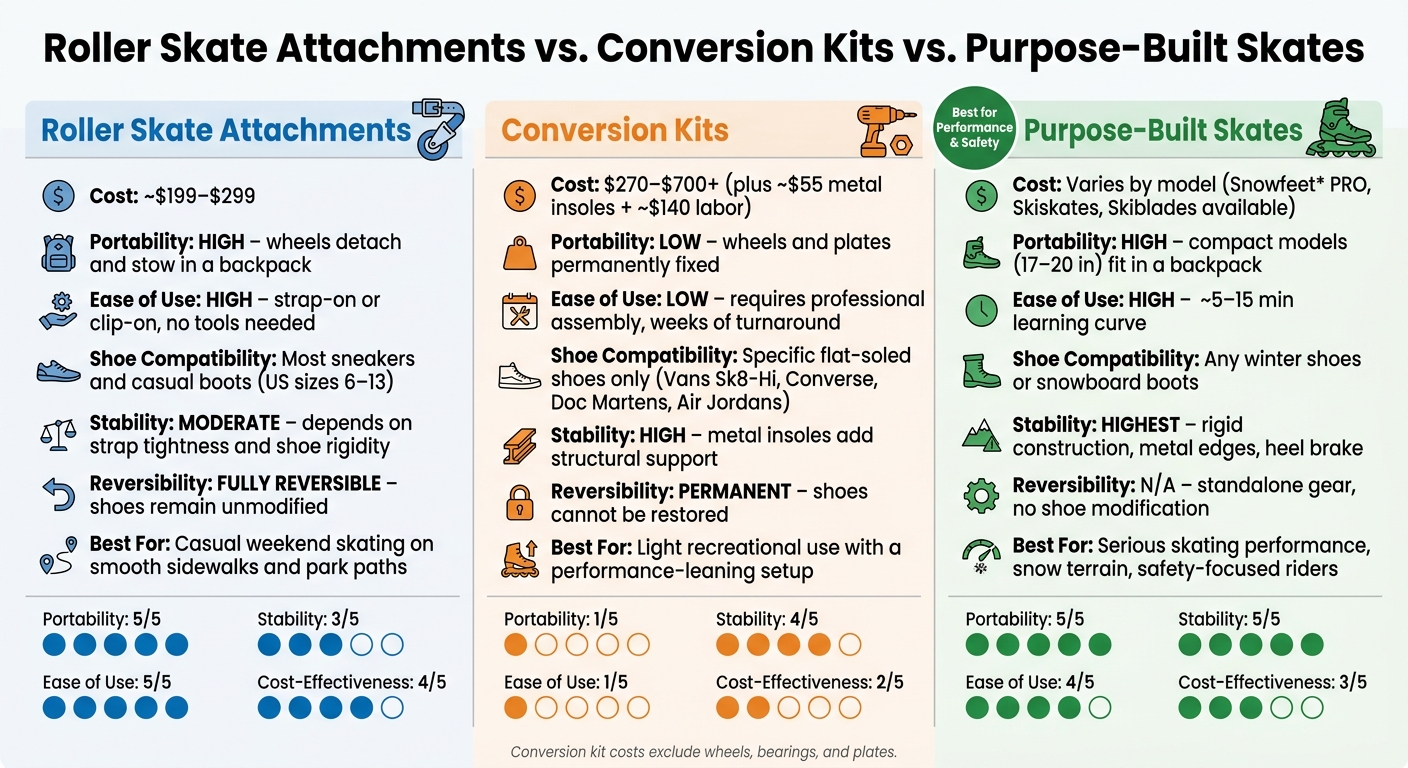
Roller Skate Attachments vs. Conversion Kits vs. Purpose-Built Skates
If the idea of drilling bolts into your favorite sneakers feels like overkill, roller skate attachments might be just what you need. These are frames with wheels that attach securely to your shoes - no modifications required.
What Are Roller Skate Attachments and How Do They Work?
Roller skate attachments come in two main styles. Clip-on systems, like those from Flaneurz, use a patented sole-mounted interface that lets you click the skate plate on or off in seconds. Strap-on systems, like Wheelfeet, rely on adjustable bindings similar to snowboard straps, locking onto your shoes without altering them.
"The unique binding system straps securely onto your favorite sneakers, trainers, or sturdy casual boots, transforming any paved surface into your personal playground." - Wheelfeet
These attachments are built for recreational use in urban settings - think smooth sidewalks, park paths, or boardwalks. One of their biggest perks is portability. You can pop the wheels off, toss them in your backpack, and walk around in your regular shoes. Wheelfeet's strap-on system fits a wide range of US shoe sizes (6 to 13), while Flaneurz's clip-on system, developed over three years and patented in 2015, boasts over 30 individual components.
Of course, all that engineering comes at a price. Wheelfeet's non-electric prototype starts at around $199 for early adopters, with a standard price of about $299. That’s a more flexible option compared to the cost and time involved in a permanent custom skate build.
Next, let’s see how these attachments compare to full conversion kits.
Roller Skate Attachments vs. Conversion Kits: A Comparison
Here’s a quick breakdown of how roller skate attachments stack up against conversion kits:
| Feature | Roller Skate Attachments (e.g., Wheelfeet, Flaneurz) | Conversion Kits (e.g., Pigeon's Roller Skate Shop) |
|---|---|---|
| Portability | High - wheels detach and can be stowed easily | Low - wheels and plates are permanently fixed |
| Ease of Use | Quick setup with a strap-on or clip-on system | Requires professional assembly and weeks of turnaround |
| Shoe Compatibility | Works with most sneakers and casual boots | Best with specific flat-soled shoes |
| Stability | Moderate - depends on strap tightness and shoe rigidity | High - metal insoles add structural support |
| Reversibility | Fully reversible; shoes stay unmodified | Permanent attachment; shoes can’t be restored |
Attachments are all about convenience and flexibility, making them ideal for casual skaters who just want to cruise around parks or sidewalks on weekends. On the other hand, conversion kits deliver better stability and control, which might appeal more to those seeking a performance-focused setup and don’t mind committing to a permanent modification.
That said, neither option matches the ankle support and rigidity of a purpose-built skate boot. While attachments are great for portability and ease, their trade-off in stability highlights why dedicated gear - like the Snowfeet* lineup - still reigns supreme for serious performance.
sbb-itb-17ade95
Safety and Performance: What to Expect When Skating in Sneakers
Turning sneakers into skates might sound like a fun idea, but it comes with some serious safety concerns. Before you jump in, it's important to understand the risks.
Common Problems With Sneaker-Based Skating
Sneakers, no matter how stylish, aren't designed for skating. Here are some of the key performance and safety issues:
Ankle support is a major problem. Most sneakers, especially low-tops, don’t provide the lateral stability you need for safe skating. Even mid-tops can’t compete with the support offered by proper skate boots.
"Avoid shoes that are too loose - tight support prevents accidents and helps balance." - Kick Speed
A good fit is crucial. If your foot isn’t snugly secured, you lose control over your movements. Regularly check the fit to avoid unnecessary risks.
Another issue is sole geometry. Sneakers typically have curved, treaded soles, which don’t align well with flat skate plates. This mismatch can make steering less precise, especially with attachment-style systems.
Braking is another weak spot. Unlike purpose-built skates that have integrated braking systems, sneaker attachments rely on how well your shoe stays secured to the frame. And if the wheels are worn out, grip becomes even worse.
Here’s a quick breakdown of common risks and ways to address them:
| Risk Area | Root Cause | How to Reduce It |
|---|---|---|
| Ankle instability | Low-top sneaker design | Opt for mid-top shoes; wear wrist guards |
| Poor balance | Loose shoe-to-frame fit | Check straps often; ensure a precise fit |
| Reduced steering | Curved sole | Use shoes with flat, rigid soles |
| Weak braking | Non-integrated brake system | Stick to smooth surfaces; keep speeds low |
| Wheel slippage | Worn or low-quality wheels | Use polyurethane wheels; inspect frequently |
While each of these issues might seem minor on its own, together they create a pretty clear picture: skating in sneakers is risky. It’s best reserved for low-speed, controlled environments like smooth park paths.
This is why specialized gear like Snowfeet* stands out. Unlike sneaker conversions, they’re designed for safety and performance, making them a smarter choice for anyone serious about skating. If you want to stay safe and get the most out of your skating experience, investing in proper gear is the way to go.
Why Snowfeet* Is a Better Choice
When it comes to snow skating, Snowfeet* stands out as the clear winner over sneaker conversions. While sneaker-based skating might seem like a clever DIY hack, it falls short in performance and safety. Snowfeet* products are purpose-built for snow skating, offering features like integrated metal edges, a built-in heel brake, and fiberglass-reinforced construction - advantages no sneaker setup can replicate.
How Snowfeet* Compares to Long Skis and Snowboards
Traditional skis and snowboards come with their own set of challenges: bulky equipment, specialized footwear, and a steep learning curve. Snowfeet* changes the game entirely. With shorter models ranging from 17 to 20 inches (44–50 cm), they’re compact enough to fit in a regular backpack. They’re also easy to attach to your winter shoes or snowboard boots, and most people can get the hang of them in just 5 minutes.
"More portable and affordable than traditional skis or snowboards." - Uncrate
The movement with Snowfeet* feels more like ice skating or inline skating, making it much easier to learn. There’s no need to worry about managing long skis or dealing with tangled tips - you’re simply gliding on snow.
Snowfeet* Product Lineup at a Glance
Snowfeet* offers a variety of models to suit different riding styles:
| Product | Length | Best For |
|---|---|---|
| Snowfeet* PRO | 20 in (50 cm) | Beginners, versatility, powder |
| Skiskates | 17 in (44 cm) | Ski slopes, professional use |
| Skiblades | 26 in (65 cm) | Snow parks and carving |
| Skiblades 99 | 39 in (99 cm) | Speed and a traditional slope feel |
If you're after a skating-on-snow experience, the shorter models like the Snowfeet* PRO or Skiskates are ideal. For those who want a closer feel to traditional skiing with better carving, the longer Skiblades are the way to go.
Snowfeet* vs. Standard Winter Sports Gear: A Comparison
Snowfeet* doesn’t just solve the problems of sneaker conversions - it also outshines traditional winter sports gear in terms of portability and ease of use.
| Feature | Snowfeet* | Traditional Skis | Snowboards |
|---|---|---|---|
| Portability | Fits in a backpack | Requires roof rack or large bag | Requires a large bag |
| Learning Curve | ~5–15 minutes | Days to weeks | Days to weeks |
| Footwear Needed | Any winter shoes or snowboard boots | Specialized ski boots | Specialized snowboard boots |
| Weight | Ultra-lightweight | Heavy | Heavy |
| Terrain | Slopes, trails, backyards | Primarily groomed slopes | Slopes and snow parks |
| Safety Tools | Metal edges + heel brake | Metal edges only | Metal edges only |
With over 50,000 riders worldwide and an impressive 4.9/5 rating from more than 5,500 verified reviews, Snowfeet* has captured the hearts of winter sports enthusiasts who want a simpler, more portable way to enjoy the snow. As one happy customer, Andrew B., shared:
"These skiblades are so much fun and easy to control. Never going back to regular skis." - Andrew B.
Conclusion: Choose Smarter, Safer Skating Gear
Skating in regular sneakers might seem like a quick fix, but they’re just not up to the task. They lack the ankle support, proper wheel attachment, and built-in braking that you need for a safe ride. No amount of DIY tinkering can fully solve these safety issues.
That’s where Snowfeet*'s Wheelfeet comes in. It’s a hassle-free, pavement-friendly option that straps securely onto most casual shoes (sizes 6–13 US). Wheelfeet gives you a smooth, stable glide and removes the wobbliness that often comes with makeshift solutions. Plus, there’s no drilling or permanent adjustments needed - just strap in and go.
As Snowfeet Store puts it:
"Wheelfeet are designed for pure, human-powered fun and freedom, allowing you to glide in the comfort of your own shoes." - Snowfeet Store
Priced at $199 for early adopters (regularly $268.95), Wheelfeet offers a safe, maintenance-free ride without the bulk of traditional gear. It’s a clear upgrade from trying to convert sneakers or relying on DIY alternatives.
So, why take risks with your safety? For $199, Wheelfeet gives you a ready-to-use, purpose-built solution that delivers safety and performance from your very first ride. Investing in the right gear is always the smarter move.
FAQs
What safety gear should I wear if I skate in sneaker attachments?
When using sneaker attachments for skating, safety gear isn’t optional - it’s a must. Make sure you’re equipped with the essentials: a helmet, knee pads, elbow guards, and wrist guards. These items are your best defense against falls and can help offset the lower stability that sneaker attachments offer compared to regular roller skates. Gear up properly, and you’ll be able to skate with more confidence and peace of mind.
Which types of pavement are safest for skating with sneaker-based skates?
The best places to skate with sneaker-based skates are smooth, flat surfaces like asphalt or concrete. These types of terrain offer a stable and even footing, reducing the chances of falls or injuries. Steer clear of rough or uneven areas - they can throw off your balance and make skating less safe.
How do I choose the right shoe size and fit for strap-on skate attachments?
To get the right shoe size for strap-on skate attachments, start by measuring your foot length accurately. Then, add about 0.4 inches (1 cm) to that measurement for a bit of extra comfort. Use this final number to pick a size from the product's chart. The fit should feel snug but not too tight. If you can, try the attachments with your shoes to make sure they’re comfortable and give you good control. A proper fit makes a big difference in both safety and performance.
Related Blog Posts
- Best Affordable Strap-On Skates: Skate on Any Shoes (2025 Guide) ← Snowfeet positioning
- What Are Strap-On Skates and How Do They Work? (Snowfeet & Wheelfeet Explained)
- Can You Skate on Any Shoes? Guide to Strap-On Roller Skates
- Double-Blade & Strap-On Skates: Why They’re Safer for Kids and New Skaters











Leave a comment
This site is protected by hCaptcha and the hCaptcha Privacy Policy and Terms of Service apply.