



















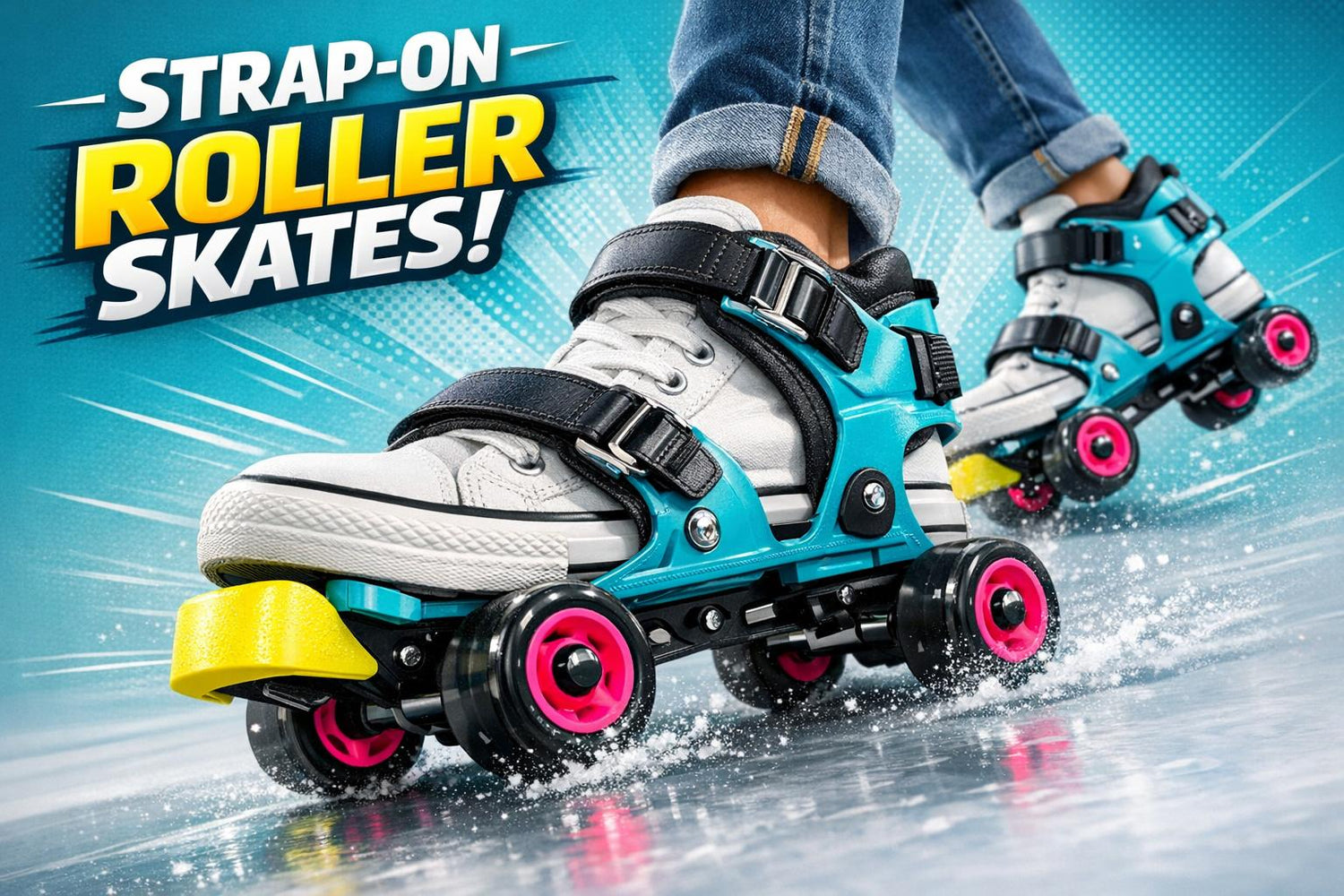
Strap-on roller skates let you skate without needing special boots. Just attach them to your everyday sneakers or boots, and you’re good to go. They’re lightweight, easy to carry, and fit most US shoe sizes (6–13). Perfect for beginners, commuters, or families, these skates offer comfort, portability, and shared use. Unlike traditional skates, you can skip the hassle of breaking in stiff boots or carrying extra shoes.
Key Highlights:
- How They Work: Attach directly to your shoes using adjustable straps.
- Who They’re For: Beginners, urban skaters, and anyone looking for convenience.
- Benefits Over Built-In Skates: Use your own shoes, lightweight for travel, and adjustable sizing.
- Best Footwear: Sneakers or casual boots with flat, sturdy soles.
Strap-on skates are a simple, fun way to enjoy skating without extra baggage. Whether you’re cruising the park or commuting, they’re a practical choice for all skill levels.
Slades Roller Skates Shoes REVIEW
How Strap-On Skates Work
Let’s break down how strap-on skates function and what makes them tick.
Parts of a Strap-On Skate
Strap-on skates are made up of several components that work together to provide a smooth ride. The frame (also called the plate) is the foundation that holds everything in place and supports your foot. Attached to the frame are trucks, which connect the wheels and pivot around a central kingpin. A 10° kingpin angle offers stability for beginners, while steeper angles make the skates more responsive and agile.
The cushions (or bushings) wrap around the kingpin and control how the trucks tilt when you shift your weight. Softer cushions make turning easier. Then there are the wheels, arranged in a 4-wheel inline setup. Their hardness, measured in durometer, determines how well they handle different surfaces. For outdoor use, softer wheels (74A–84A) are ideal - they grip uneven sidewalks and pavement better. Inside each wheel, you’ll find two bearings that allow the wheels to spin freely. Higher-quality bearings mean smoother and faster rides.
What sets strap-on skates apart is their adjustable straps, which replace the need for a fixed boot. This design lets you attach the skates directly to your shoes.
| Component | Function | Key Detail |
|---|---|---|
| Frame/Plate | Structural base | Fits US sizes 6–13 |
| Trucks & Kingpin | Connects wheels to frame | 10° = stable; steeper = more agile |
| Cushions | Controls truck movement | Softer = easier turning |
| Wheels | Provides movement | 74A–84A for outdoor surfaces |
| Bearings | Enables wheel spin | Two per wheel; removable shields |
| Binding/Straps | Secures skate to shoe | Adjustable, one-size-fits-most |
How to Attach Strap-On Skates to Your Shoes
Attaching strap-on skates is simple, but doing it right is key for safety and performance. Here’s how to do it:
- Position your shoe on the frame: Place your shoe on the frame, ensuring your heel is aligned with the back of the binding.
- Start with the toe strap: Tighten the toe strap first to anchor your shoe in place.
- Secure the side and ankle straps: Work your way back, tightening each strap firmly to eliminate any shifting.
- Test the fit: Wiggle your foot to check for movement. If your shoe shifts, tighten the straps further.
"The unique binding system straps securely onto your favorite sneakers, trainers, or sturdy casual boots, transforming any paved surface into your personal playground." - Snowfeet Store
A common beginner mistake is leaving the straps too loose, thinking it’ll be more comfortable. It won’t. Loose straps reduce control and increase the risk of falling. Tight straps are your best friend.
What Footwear Works With Strap-On Skates
The best shoes for strap-on skates are sneakers, trainers, or casual boots with flat, sturdy soles. These provide a solid base for the bindings to grip, keeping your foot stable as you skate. Avoid shoes with soft soles, sandals, or anything with a thick heel - these can flex under pressure or interfere with the straps.
Most strap-on skate models, like those from Wheelfeet, fit US sizes 6–13 (EU 38–47), making them versatile enough for most adults. This wide size range means one pair can often be shared among family members. Plus, the ability to use your own footwear is a major perk compared to traditional skates or winter sports gear like ski boots, which lock you into specific, rigid setups. Snowfeet* has designed their skates with this flexibility in mind, offering a level of convenience that traditional ski or snowboard gear just can’t match.
Strap-On Skates vs. Built-In Roller Skates: Key Differences
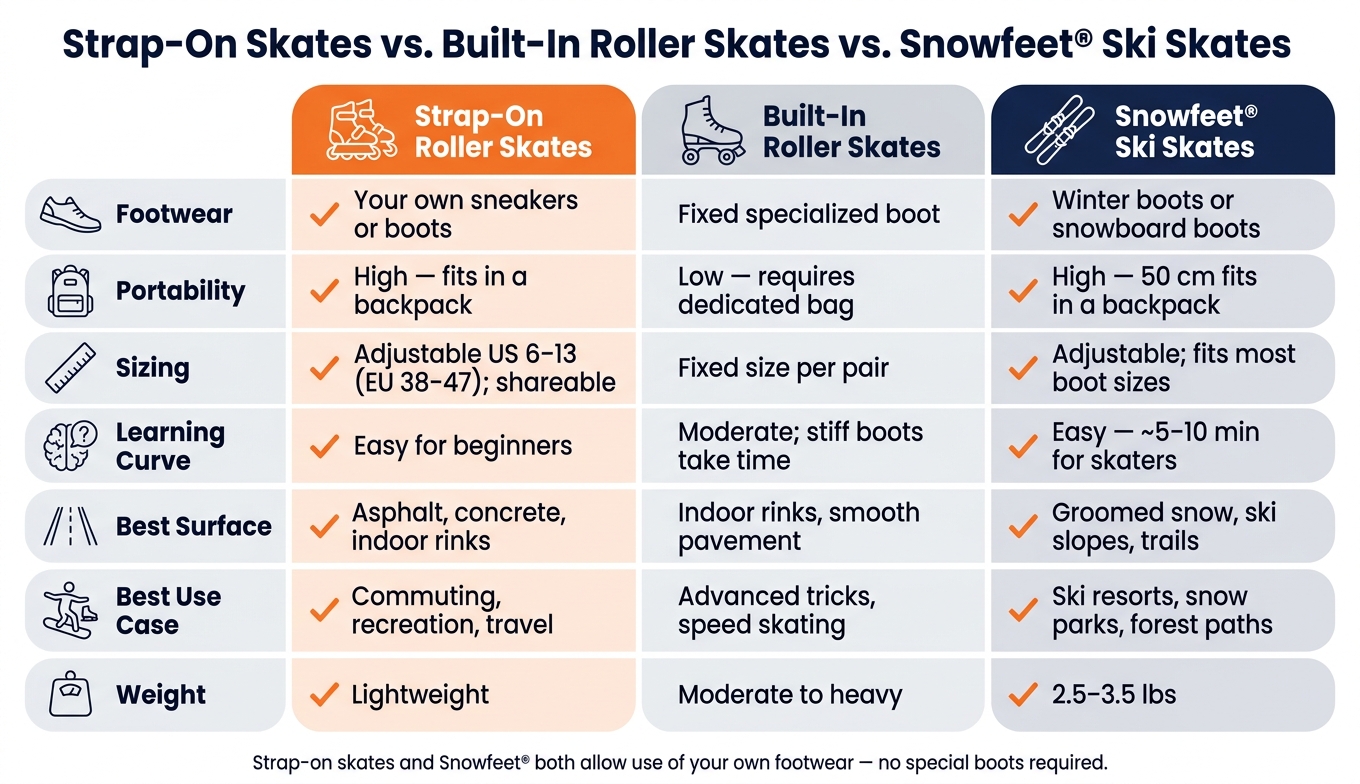
Strap-On Skates vs. Built-In Roller Skates vs. Snowfeet: Full Comparison
Strap-on skates bring a fresh twist to traditional roller skating, offering a level of convenience and flexibility that built-in roller skates just can’t match. Let’s break down the key differences.
Portability and Easy Transport
Built-in roller skates come with a fixed boot attached to the frame, which means you’re lugging around the entire setup, even when you’re not skating. Strap-on skates flip this concept on its head. With models like Wheelfeet, you’re only carrying the frame, wheels, and straps, while your regular shoes stay on your feet.
These skates are lightweight and compact, sliding easily into a backpack or tote. Whether you’re commuting, traveling, or heading to the park, strap-on skates make packing simple. On the other hand, built-in skates require a dedicated bag and can feel bulky when you’re on the go.
But portability isn’t the only advantage - using your own footwear is another game-changer.
Using Your Own Footwear
Built-in skates lock you into a specific boot design, which can lead to blisters, pressure points, and general discomfort - especially during longer sessions. Strap-on skates solve this issue by letting you wear your own sneakers or boots. They’re adjustable to fit US shoe sizes 6–13, making them shareable with friends or family.
"Forget uncomfortable, traditional inline skate boots! Wheelfeet are innovative 4-wheel skates designed for pure, human-powered fun and freedom." - Snowfeet Store
"The adaptability facilitates use across various shoe sizes and types, promoting broader participation." - Cruz Skate Shop
This flexibility and comfort make strap-on skates a standout option for casual skaters.
| Feature | Strap-On Skates | Built-In Roller Skates |
|---|---|---|
| Footwear | Use your own shoes | Fixed specialized boot |
| Portability | Compact, fits in a bag | Bulky, requires a dedicated bag |
| Sizing | Adjustable; shareable | Fixed size per pair |
| Learning Curve | Easy for beginners | Moderate; stiff boots take time to adjust |
| Best For | Commuting, recreation, travel | Advanced tricks, speed skating |
How Snowfeet* Shares These Advantages
The same benefits of strap-on roller skates carry over into winter sports, where Snowfeet* has made its mark. Just like strap-on skates, Snowfeet* ski skates attach to your regular winter boots or snowboard boots. No more renting stiff ski boots or struggling with oversized skis in crowded lodges.
Traditional ski brands like Rossignol and Salomon design their gear around long skis and specialized boots, which require extra storage and come with a steeper learning curve. Snowfeet* takes a completely different route. Their shortest ski models start at just 38 cm, making them small enough to toss in a backpack. As one user, Brad Tolin, put it:
"Also a big plus - they're lightweight and much easier to carry around than full-size skis." - Brad Tolin
This combination of portability, simplicity, and no need for specialized footwear makes Snowfeet* the winter equivalent of strap-on roller skates - practical, fun, and easy to use. It’s a fresh approach that’s reshaping how people think about both summer and winter sports.
sbb-itb-17ade95
How to Choose the Right Strap-On Skates
What to Look for Before Buying
The skating surface is key when picking strap-on skates. For outdoor surfaces like pavement or concrete, or indoor rinks, the wheel size makes a big difference. Larger wheels (90–110 mm) are great for speed and covering long distances, while smaller wheels (80–84 mm) offer better control in tight, urban spaces. Beginners should look for skates with a hard-boot shell for extra ankle support and softer wheels (78A–80A) to handle rougher surfaces. On the other hand, harder wheels (82A–85A) work better on smooth pavement. Snowfeet* has taken these factors into account to design winter models that meet these needs.
Snowfeet* Options for Winter Skating
When it comes to snow, Snowfeet* has created strap-on ski skates that work well on slopes, groomed trails, or even your backyard hill - all while using your regular footwear.
"Snowfeet PRO are here to make skiskating more accessible to everybody... even if you have never skied before, Snowfeet feel so natural that anyone can pick up this sport." - Snowfeet*
| Product | Length | Ideal For | Skill Level |
|---|---|---|---|
| Snowfeet PRO (50 cm) | 20 in | Groomed snow, trails, backyards | Beginner to Intermediate |
| Skiskates (44 cm) | 17 in | Professional ski slopes, speed | Intermediate to Advanced |
| Skiblades (65 cm) | 26 in | Slopes, snow parks | Intermediate |
| Skiblades (99 cm) | 39 in | Carving, stability at high speed | Intermediate to Advanced |
The Snowfeet PRO, priced at $275, is a great entry-level option. Its fiberglass-reinforced build has earned rave reviews, with 90% of 2,296 users giving it 5 stars. For faster, more responsive rides on groomed slopes, the Skiskates (44 cm) are a solid choice at $575, thanks to their wood core construction. If stability at high speeds is your priority but you’re not ready for full-length skis, the Skiblades (available in 65 cm for $635 and 99 cm for $675) are ideal.
Strap-On Roller Skates vs. Snowfeet*: Side-by-Side Comparison
Here’s a quick breakdown of how traditional strap-on roller skates stack up against Snowfeet* ski skates in different environments:
| Feature | Strap-On Roller Skates | Snowfeet* Ski Skates |
|---|---|---|
| Primary Surface | Asphalt, concrete, indoor rinks | Groomed snow, sledding hills, hiking trails |
| Compatible Footwear | Sneakers or athletic shoes | Winter boots or snowboard boots |
| Control Method | Heel brake or T-stop | Metal ski edges and heel brake |
| Portability | High; fits in a bag | High; 50 cm fits in a backpack |
| Learning Curve | Moderate | Easy; about 5–10 minutes for skaters |
| Best Use Case | Urban commuting, recreation | Ski resorts, snow parks, forest paths |
The choice ultimately depends on where you plan to skate. If you’re sticking to pavement and urban areas, traditional strap-on roller skates are a solid pick. But for snowy conditions, Snowfeet* ski skates offer the same convenience with added features like metal ski edges, making them a compact and beginner-friendly option. Unlike traditional ski brands such as Rossignol or Salomon, Snowfeet* stands out for its versatility and ease of use across snowy terrains.
Safety and Maintenance Tips
Basic Safety Rules for Strap-On Skates
Before hitting the pavement, make sure you’re equipped with the right protective gear. This includes a skate-specific helmet, wrist guards, knee pads, and elbow pads. Why? Because wrist and hand injuries make up 37% of all inline skating injuries, with two-thirds of those being fractures. Head injuries, though less common, still account for about 5% of skating-related injuries.
"Many roller skating injuries are preventable if you follow these safety tips." - OrthoInfo, AAOS
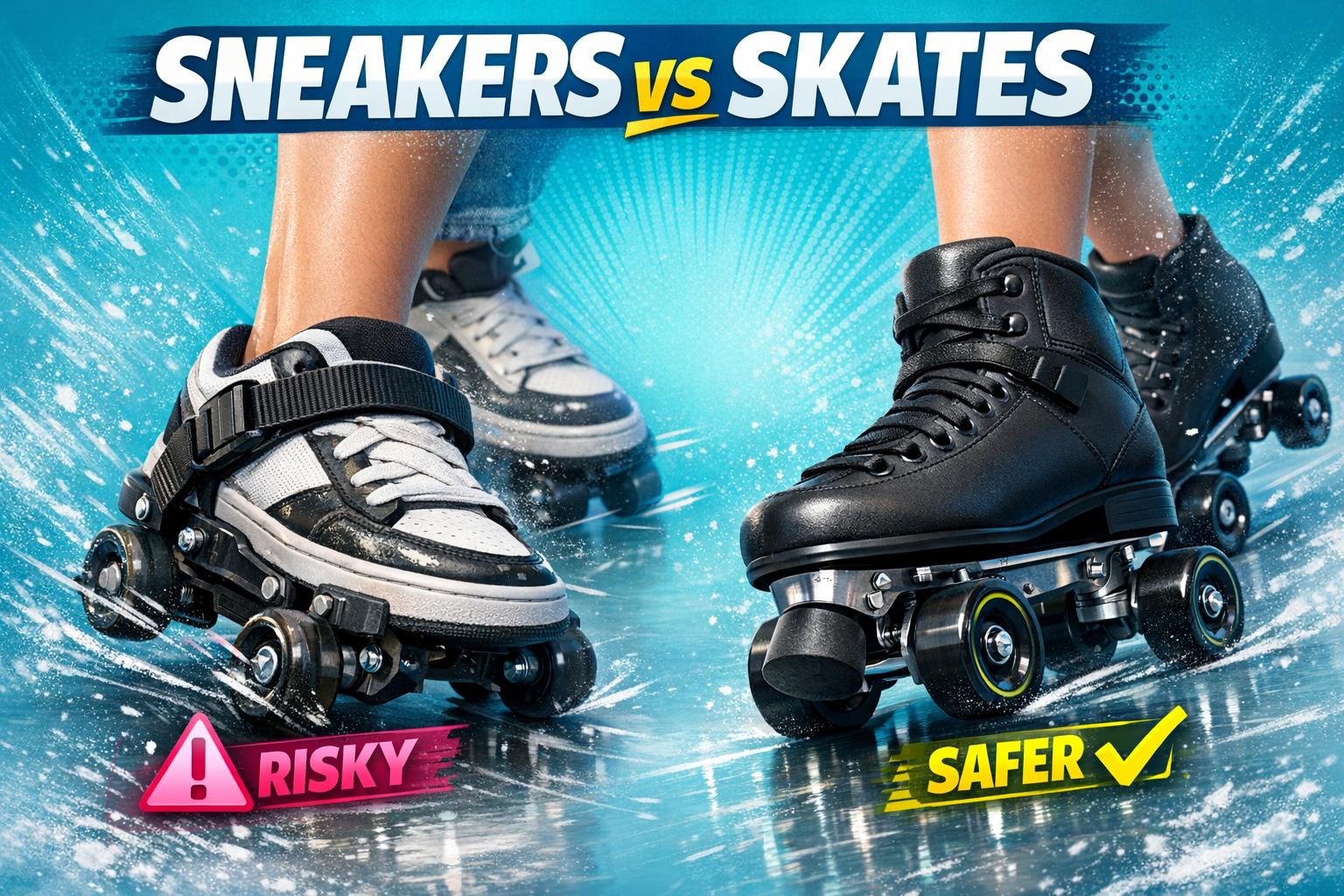
Your footwear matters too. Choose sturdy sneakers or boots with strong ankle support, and double-check that your skate straps are snug before you start moving. Loose straps can lead to accidents. Also, take 5–10 minutes to warm up your muscles before skating. And while it might be tempting, skip the headphones - staying aware of your surroundings is key to avoiding collisions with traffic or other skaters.
By following these safety measures, you’re not just protecting yourself - you’re also ensuring your skates perform at their best.
How to Maintain Strap-On Skates
Keeping your skates in good condition doesn’t have to be complicated. After each use, wipe down the boot shells and frames with a cloth to remove dirt and moisture. Air out the liners and insoles, but avoid putting them near heaters, as this could cause warping.
Wheels don’t wear evenly, so rotate them every 4–6 rides. Swap wheel 1 with wheel 3 and wheel 2 with wheel 4, flipping them at the same time. If your bearings start to make crunching or grinding noises, it’s time for a clean. Soak them in isopropyl alcohol, let them dry completely, and add a few drops of lubricant. Ideally, clean your bearings every six months - or sooner if you’ve been skating in rain or on dirty surfaces.
Don’t forget to check your straps and buckles weekly. Look for signs of fraying or broken clips, as these are crucial for keeping your foot secure.
| Task | Frequency | What to Do |
|---|---|---|
| Wipe boots and frames | After each use | Use a cloth to remove dirt and moisture |
| Inspect straps and buckles | Weekly | Look for fraying or damage |
| Rotate wheels | Every 4–6 rides | Swap and flip for even wear |
| Clean and oil bearings | Every 6 months | Soak in isopropyl alcohol, then add lubricant |
| Replace wheel nuts | Annually | Swap out worn nyloc threads |
Caring for Snowfeet* Products
Snowfeet* products require a bit of extra attention due to their winter-specific use. After each session, dry the metal edges thoroughly to prevent rust. Cold weather can make straps brittle, so check them often for cracks or stiffness. If you spot any wear, replace them immediately. Replacement straps are available from Snowfeet* starting at $6, making maintenance affordable.
When storing your Snowfeet*, keep them in a cool, dry place - preferably in a padded bag to protect the edges and bindings. If they get wet while you’re out on the slopes, wipe them down to remove moisture before putting them away. For an added touch, apply a light coat of ski wax to the base. This not only keeps the glide smooth but also protects the surface. Snowfeet* even offers compatible wax in their accessories lineup. These simple steps will help your Snowfeet* skates stay in top shape for many winter adventures.
Conclusion: Why Strap-On Skates and Snowfeet* Stand Out
Strap-on skates tackle one of the biggest challenges of traditional roller skates: you don’t need special shoes to enjoy them. Whether you’re cruising through the park during lunch, navigating a large campus as a student, or looking for gear the whole family can share, these skates let you stick with the shoes you already love - no uncomfortable break-in period required. Plus, their adjustable design means one pair can fit multiple shoe sizes, saving families the trouble (and cost) of buying separate pairs for everyone.
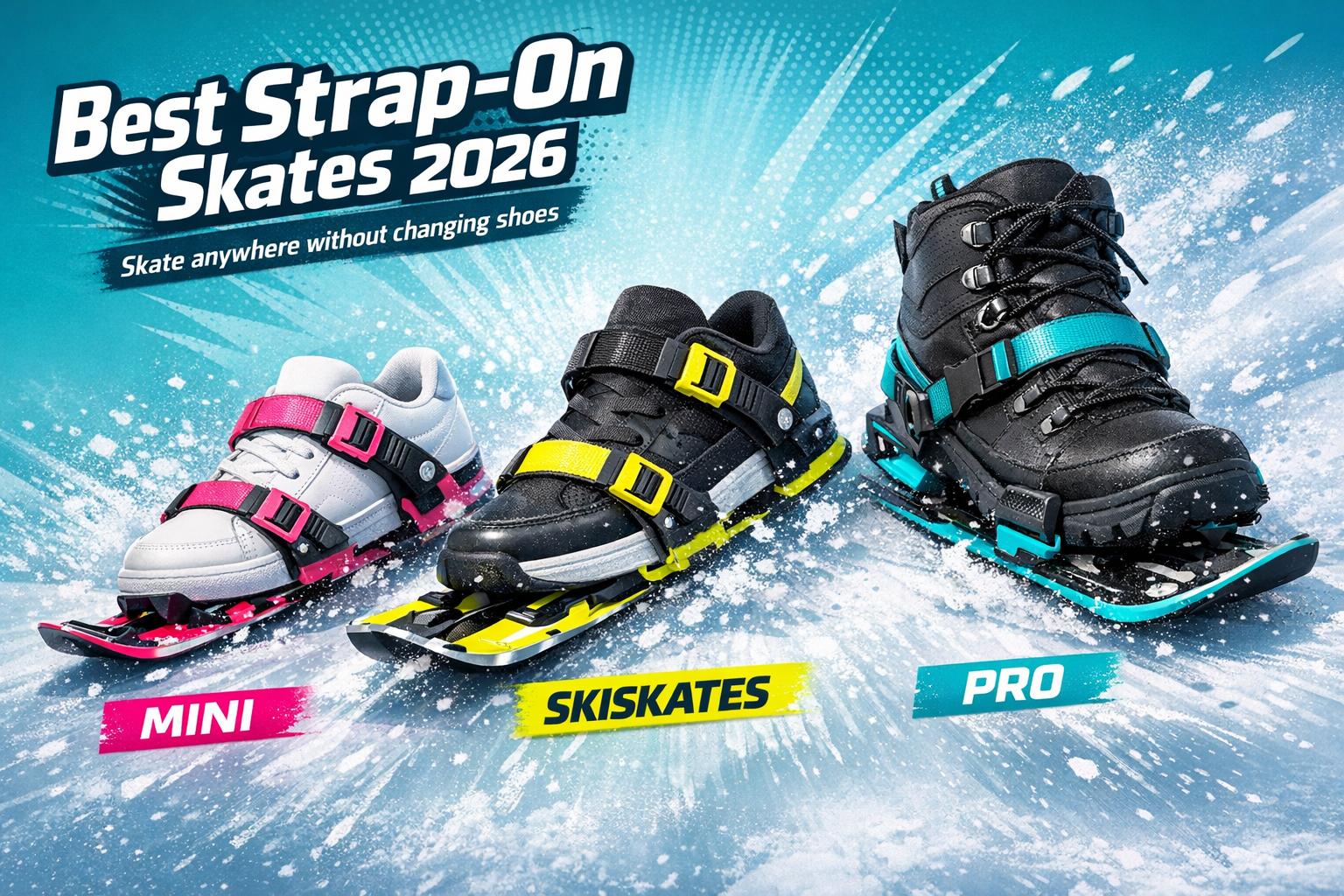
Snowfeet* Mini Ski Skates take portability to a new level. Weighing just 2.5–3.5 lbs, they’re light enough to throw in your backpack - no need to lug around bulky ski gear.
But the versatility doesn’t stop there. Snowfeet* expands the strap-on idea to winter sports. While regular strap-on roller skates are great for smooth paths and rinks, Snowfeet* products attach to your everyday winter boots, letting you glide down slopes or hit resort trails with ease. As Brad Tolin puts it:
"These ski blades are a blast to use. Super easy to control, quick to turn, and way more forgiving than traditional skis."
FAQs
Can strap-on skates damage my shoes?
Strap-on skates, like Snowfeet, are built to attach firmly to your shoes without causing any damage. They work with a variety of footwear styles and don't require any changes that might harm your shoes. The design focuses on providing a secure fit while keeping your shoes safe.
How do I stop safely on strap-on skates?
To stop safely while using strap-on skates like Snowfeet, try a controlled heel or toe drag. Another option is to gradually reduce your speed by shifting your weight. You can also lean back slightly to engage the heel brake or perform a controlled glide to slow down.
Make sure to practice these techniques in a safe, open space and always wear protective gear like a helmet and pads to stay safe.
Are Snowfeet* easier than traditional skis?
Snowfeet* strap-on skates are much simpler to pick up than traditional skis, especially if you're just starting out. Unlike skis or snowboards, which require you to learn specific techniques and balance on long, stiff equipment, Snowfeet* strap right onto your regular shoes. This makes the whole experience feel a lot more natural and easy to grasp.
Their lightweight, compact design means you don’t need a ton of extra gear. This makes them a great, hassle-free option for casual users and beginners looking for a fun way to enjoy the snow.
Related Blog Posts
- Best Affordable Strap-On Skates: Skate on Any Shoes (2025 Guide) ← Snowfeet positioning
- What Are Strap-On Skates and How Do They Work? (Snowfeet & Wheelfeet Explained)
- Can You Skate on Any Shoes? Guide to Strap-On Roller Skates
- Best Ice Skates for Family Fun (Affordable Strap-On Skates for Everyone)











Leave a comment
This site is protected by hCaptcha and the hCaptcha Privacy Policy and Terms of Service apply.