



















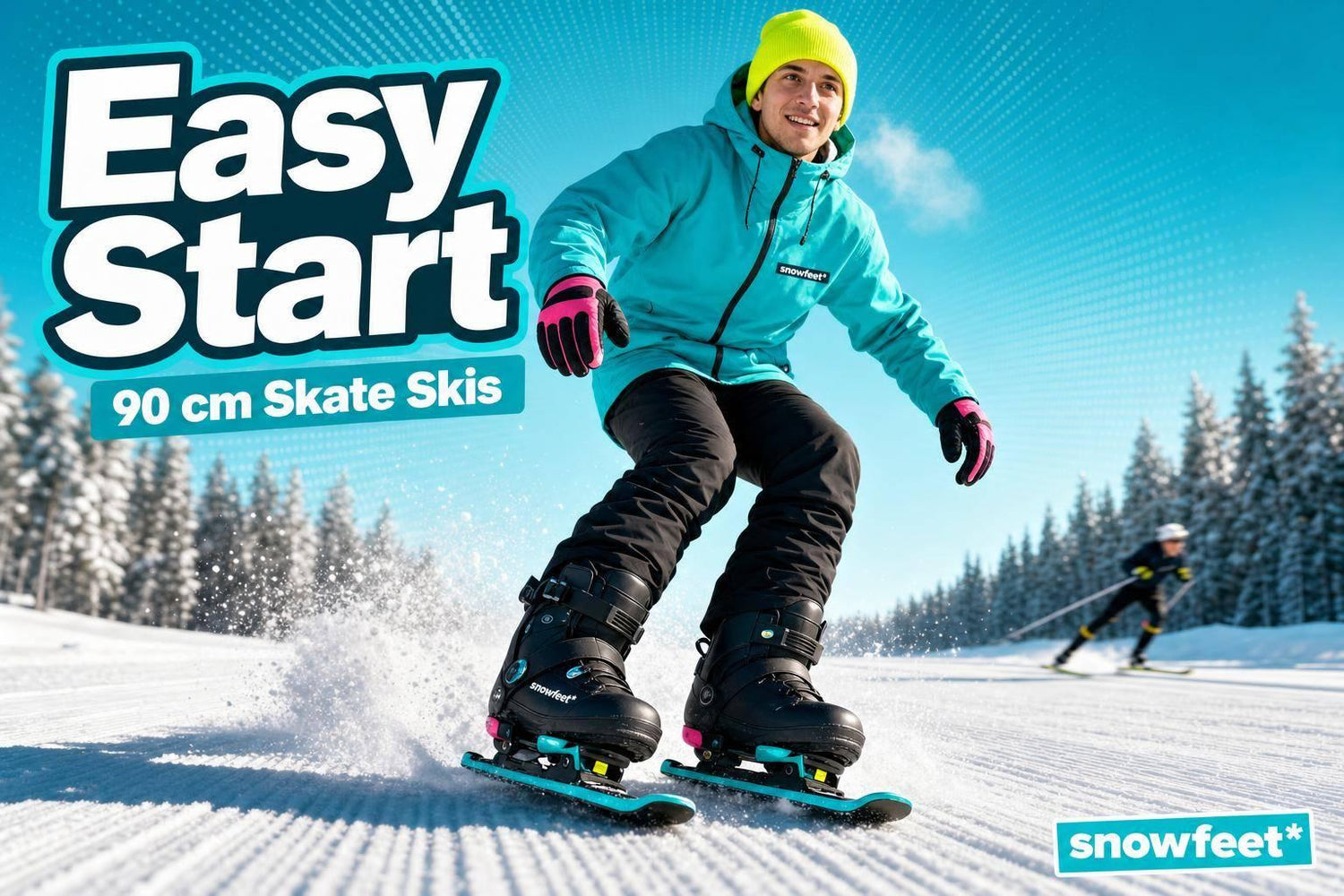
Yes - if you're new to skate skiing and want an easier start, the NORDIC 90 cm is worth a look. It trades some glide and top speed for more control, less gear stress, and easier transport. At $450, it won't beat full-length skate skis for distance or fast training, but it can make your first few days on snow less intimidating.
Here’s the short version:
- Best for: beginners, casual skiers, short trail sessions, travel
- Main plus: short 90 cm (35 in) length feels less awkward than 150–190+ cm skate skis
- Boot setup: works with regular winter boots in one version, which can cut startup cost
- Upkeep: fishscale base means no kick wax
- Main downside: less glide, less speed, and less room to grow if you want long workouts or racing
If I were helping a first-timer in my ski shop, I’d put it like this: if long skis feel like two slippery pool noodles with attitude, this setup may feel a lot less scary :) It’s not the top pick for speed. But for learning, local laps, and simple fun, it makes a strong case.
| Point | NORDIC 90 cm | Full-length skate skis |
|---|---|---|
| Learning ease | Higher | Lower for most beginners |
| Control at low speed | Better | Harder at first |
| Glide | Shorter | Longer |
| Boot cost | Lower if you use winter boots | Higher with XC boots |
| Best use | Casual sessions, travel, first steps | Training, distance, racing |
So, my take is simple: buy it for ease and control, not for speed.
What Sets the Snowfeet* NORDIC Cross-country 90 cm Apart
Short length, lighter feel, and easier handling
The big thing here is simple: it’s short, light, and easy to handle. At 90 cm, it feels less awkward than a full-length skate ski, which is a big plus when you’re new and still getting your balance. Turning and steering feel easier, and that can make your first few outings a lot less frustrating.
There is a tradeoff, though. You give up some glide compared with longer skis. But for many beginners, that’s a fair deal. A little less speed, a lot less hassle.
Bindings, boot compatibility, and simpler setup
It comes with bindings that fit regular winter shoes, and Snowfeet* also offers a cross-country ski binding version for ski boots. It fits US 6–13 (EU 38–47).
That means you can get started without buying ski boots right away. For a lot of people, that lowers the cost and cuts down on gear stress. And, honestly, that matters. The less stuff you need to figure out before your first day on snow, the more likely you are to get out there and enjoy it.
Fishscale grip, low-maintenance design, and easy portability
The fishscale base helps with grip and lets you skip kick wax, which keeps upkeep simple. That’s nice if you want more skiing and less fiddling in the parking lot :) The compact size also makes these easy to pack and carry.
That portability comes in handy for:
- Local groomed trails
- Short practice sessions
- Weekend trips
- Early learning days before moving to longer skis
So, the whole setup leans toward ease: less gear, less maintenance, and less bulk to haul around. Next is how that setup feels on a first ride.
How the NORDIC 90 cm Performs on a Beginner's First Rides
Learning curve: faster to start, but balance still takes practice
Once the setup is done, you get to the part that matters: how it feels on snow.
The 90 cm length helps right away. It looks less intimidating, and it tends to feel that way too. Because the ski is shorter, it’s a bit easier to focus on the basics like the skate push, weight shift, and arm swing.
That doesn’t mean skate skiing turns easy overnight. It doesn’t. The side-to-side push-and-glide motion still feels a little odd at first, and short skis don’t magically fix that. What they do help with is the early learning stage. Drills feel less clunky. Balance work feels a bit more manageable. Even then, plan on a few wobbly sessions before things start to click.
Stability, speed control, and stopping at beginner pace
On groomed flats and mellow terrain, the short length feels calm at beginner speed. That’s a nice thing when you’re still figuring out edges and weight transfer and, let’s be honest, trying not to look like a shopping cart with one bad wheel.
Direction changes take less effort, which helps a lot in those first rides. Speed control also feels more forgiving. On flat terrain or light downhills, the shorter setup can make it easier to manage pace and stop without that “uh oh, this is getting away from me” feeling.
Where this setup works best: local trails, short sessions, and travel
This setup makes a lot of sense for after-work laps, family outings, and weekend trips. The compact size is easy to carry, stash in a car, and store at home.
That makes it a good fit for short, low-pressure practice on local groomed trails. It also works well on travel days, when you want gear that doesn’t feel like a whole project to bring along.
This Nordic Ski Can Be Attached to Any Winter Shoes | Snowfeet Cross-country Skate Skis | 90 cm
sbb-itb-17ade95
NORDIC 90 cm vs Long Skate Skis and Other Short Skis
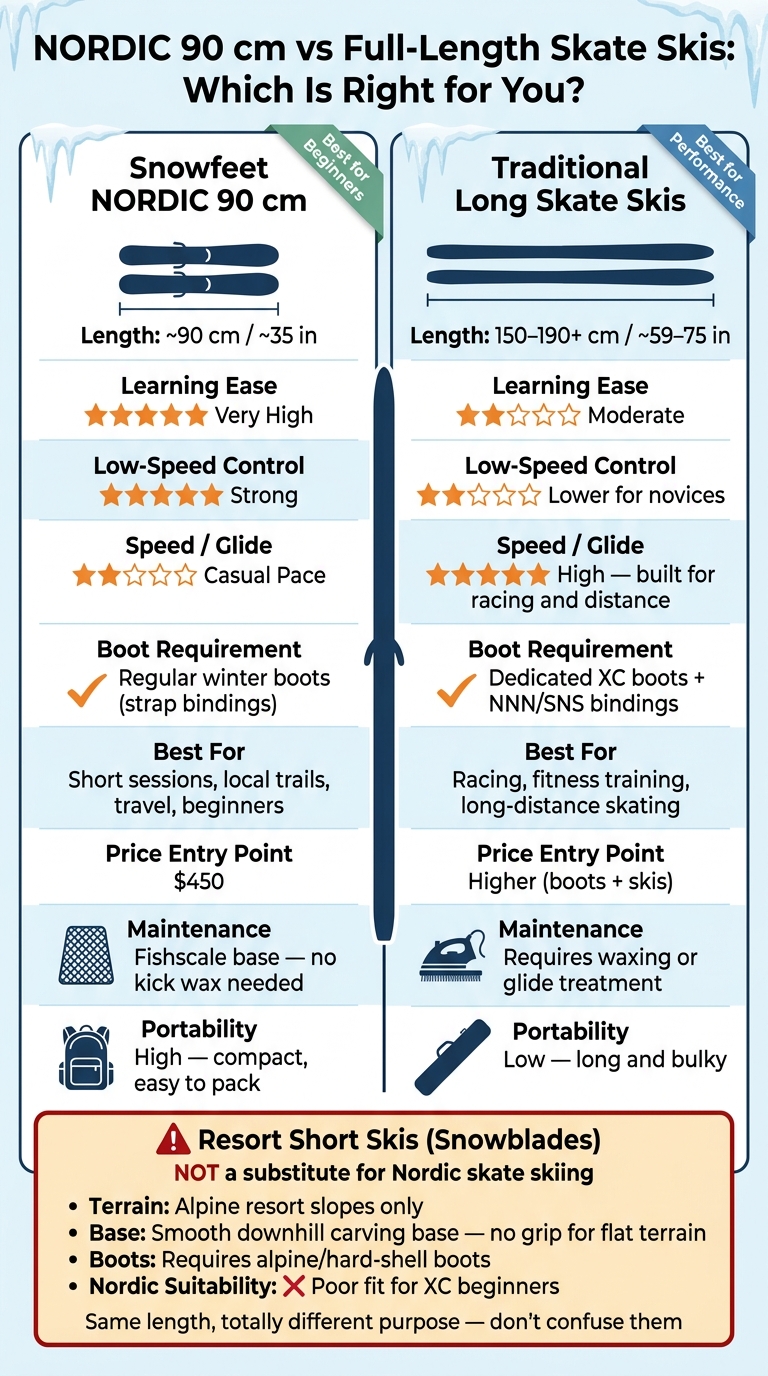
NORDIC 90 cm vs Full-Length Skate Skis: Beginner's Guide
How it compares to long skate skis
For beginners, the big issue isn’t just ski length. It’s what that length does on snow.
The main thing that changes? Control. More specifically, how fast the ski starts to feel manageable.
Long skate skis are built for efficiency. They glide farther with each stride, hold speed better, and make more sense for serious fitness sessions or racing on groomed tracks. If that’s your goal, they’re the better pick.
But early on, that extra length can work against you. There’s simply more ski to handle underfoot. At slow speeds, balance feels tougher, and small mistakes can feel bigger than they are. The Snowfeet* NORDIC Cross-country 90 cm strips a lot of that away. It feels easier to control at low speeds and less nerve-racking on day one. So, for most beginners, the choice comes down to learning curve, not max glide.
| Feature | Snowfeet* NORDIC 90 cm | Traditional Long Skate Skis |
|---|---|---|
| Length | ~90 cm / ~35 in | 150–190+ cm / ~59–75 in |
| Learning ease | Very high | Moderate |
| Low-speed control | Strong | Lower for novices |
| Speed / glide | Casual pace | High; built for racing and distance |
| Boots | Regular winter boots via strap bindings | Dedicated XC boots and compatible bindings (NNN/SNS) |
| Best for | Short sessions, local trails, travel | Racing, fitness training, long-distance skating |
The trade-off is pretty simple: you give up some top-end glide and efficiency. For a beginner doing a few laps after work or heading out on a weekend, that usually isn’t the main concern anyway.
How it compares to short downhill snowblades and similar products
Now for the other comparison, because this trips people up a lot.
Some short skis may look close at a glance, but they’re built for a totally different job. Resort-style short skis, like snowblades, are made for downhill carving. They belong on alpine resort slopes, not Nordic trails.
The Snowfeet* NORDIC Cross-country 90 cm is made for Nordic use. Its fishscale grip helps with propulsion on flat and rolling terrain. A smooth downhill base doesn’t do that. That’s the whole point. Snowblades don’t fix the skate-ski learning problem; they’re just the wrong tool.
| Feature | Snowfeet* NORDIC 90 cm (XC Skate) | Resort-Style Short Skis (Snowblades, etc.) |
|---|---|---|
| Intended terrain | Groomed Nordic trails, flat/rolling terrain | Alpine resort slopes, chairlift-served downhill runs |
| Base design | Fishscale grip for propulsion and control | Smooth, downhill-oriented bases optimized for carving |
| Skate-ski suitability | High | Low |
| Boots | Strap-style bindings that work with regular winter boots | Typically require alpine or dedicated hard-shell boots |
| Beginner learning use | Excellent for cross-country beginners | Poor fit for learning Nordic skate technique |
For Nordic beginners, the category matters just as much as the length. That’s the part that often gets missed, and it’s what drives the verdict.
Verdict: Is the NORDIC 90 cm Worth It for Skate-Ski Beginners?
The big call here is simple: does easier learning matter more to you than top-end glide? If yes, the NORDIC 90 cm makes a lot of sense.
Best for casual beginners who want control, portability, and a lower-cost entry point
If you’re new to skate skiing and want something that feels less technical from day one, the NORDIC 90 cm is the easier way in. At $450, the Snowfeet* NORDIC Cross-country 90 cm gives beginners a solid way to try skate skiing without going all-in on a pricey setup.
One of the biggest perks? You can use regular winter boots with the bindings. That cuts down the upfront cost and makes the whole setup feel a lot less like a gear project. In plain English: it’s a smoother entry point for beginners.
You’ll still need to work on balance. There’s no magic wand here. But the shorter ski tends to make those first sessions feel less nerve-racking, which can be a big deal when you’re just trying to stay upright and get the motion down.
Still, easier control only helps if that lines up with what you want from skiing.
Not the right fit for racers or skiers focused on speed and glide
This is where the trade-off shows up. The NORDIC 90 cm is a beginner tool, not a performance ski. If you want to race, train for fitness on a set plan, or do long-distance sessions on groomed tracks, the 90 cm format will start to feel like it’s holding you back.
It gives up speed and glide to make control easier. That’s the deal. Longer skate skis are built for better efficiency, and skiers who care most about speed will do better with a full-length XC setup and proper XC boots.
For beginners who want control, simplicity, and a lower-cost start, though, it does the job well.
FAQs
Can I really learn skate skiing on 90 cm skis?
Yes - you can learn to skate-ski on 90 cm skis like the Snowfeet NORDIC.
In fact, that short length can make the first day feel a lot less awkward. Compared with standard 160 cm to 195 cm cross-country skis, compact skis are easier to handle, less intimidating, and more natural under your feet.
Here’s why they tend to feel easier for beginners:
- Better balance from the shorter length
- Easier maneuvering when you turn or adjust
- A more intuitive feel, so you can focus on your stride instead of fighting the skis
A lot of users pick up the basics in just one day. That means you can spend less time feeling clumsy and more time enjoying the glide :)
Are regular winter boots enough for beginners?
Yes. Regular winter boots are enough for beginners using Snowfeet NORDIC skis.
One of the big perks of the Snowfeet system is that you can skip ski boots. That makes getting started a lot easier, and, honestly, a lot less of a hassle :)
The adjustable bindings fit many standard waterproof winter boots and snowboard boots. Snowfeet recommends waterproof winter shoes with firm ankle support for better stability while you're learning.
How long before I outgrow the NORDIC 90 cm?
You may never outgrow the NORDIC 90 cm. It’s easy to turn, steady underfoot, and simple to control, which makes it a great pick for first-timers and seasoned skiers who care more about agility than all-out speed.
Longer skis can be the better call if your main goal is going fast. But the NORDIC 90 cm still gives you a lot to like: more confidence, easy carrying, and solid range for groomed tracks, light backcountry, and day-to-day recreational use.











Leave a comment
This site is protected by hCaptcha and the hCaptcha Privacy Policy and Terms of Service apply.