



















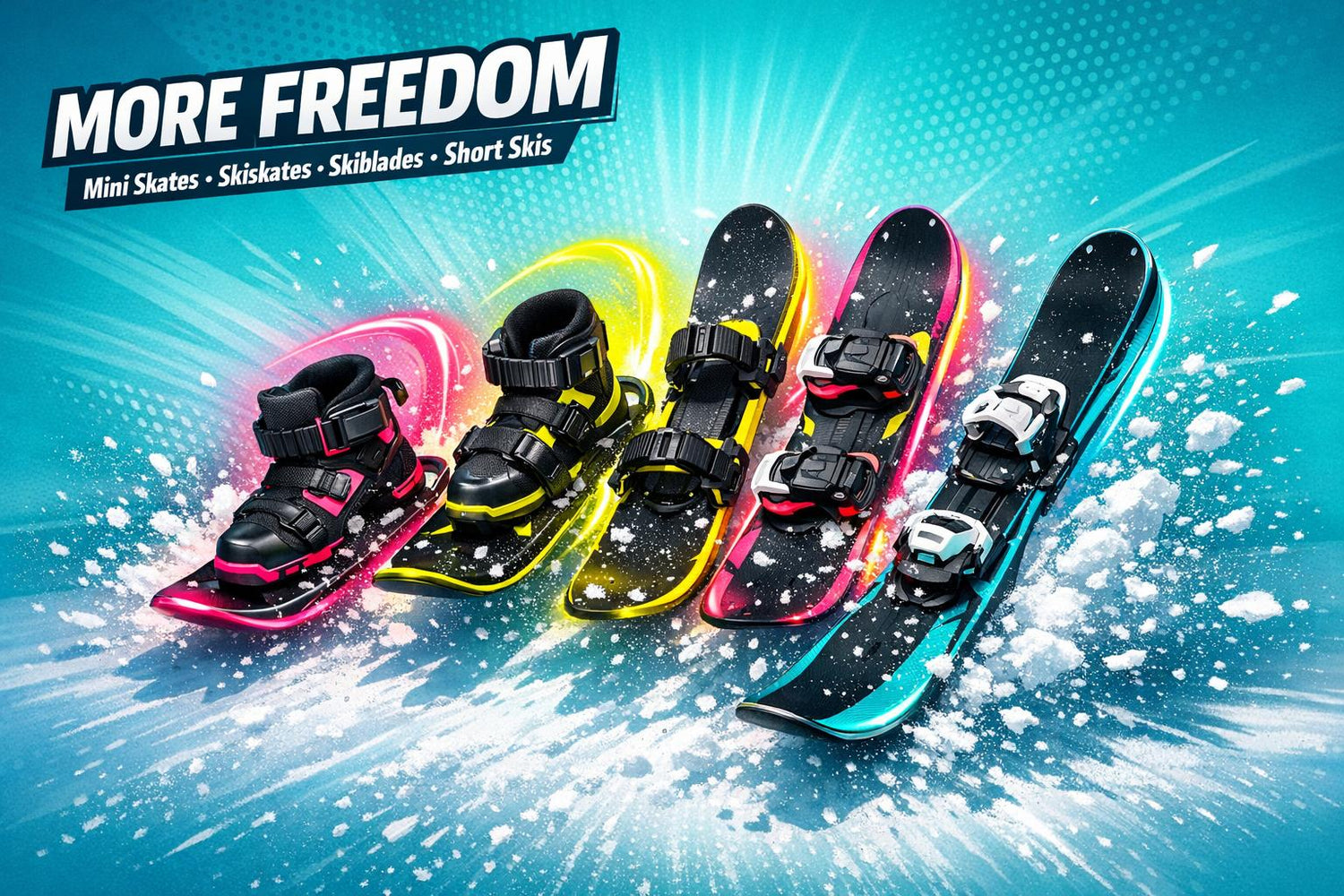
If you’re tired of the hassle that comes with snowboarding - like re-strapping on flats or lugging bulky gear - Snowfeet might be your new favorite thing. These compact, independent ski alternatives let you ditch the big board and move with more freedom on the slopes. Options like Mini Ski Skates, Skiskates, Skiblades, and Short Skis offer everything from skate-like agility to all-mountain carving, all while fitting in a backpack. They’re lightweight, easy to carry, and compatible with your snowboard boots in many cases.
Here’s the quick breakdown:
- Mini Ski Skates: Super portable (17 inches), great for quick tricks and tight turns, but not ideal for deep powder or high speeds.
- Skiskates: Slightly longer (up to 20 inches), offering better carving control while keeping that nimble, skate-like feel.
- Skiblades: More stable (26–39 inches) with sharp edge control, perfect for groomed runs and park features.
- Short Skis: At 47 inches, they’re the most stable and versatile, handling everything from moguls to light off-piste terrain.
Each option has its strengths and trade-offs, but all give you a lighter, more flexible way to enjoy the mountain. Whether you’re into tricks, carving, or just want less bulk, there’s a Snowfeet product for you. Prices start at $250 for Mini Ski Skates and go up to $775 for Short Skis. Ready to switch things up? Let’s dive in.
Snowfeet* vs. Skiskates Comparison | First Time Review by Snowboarder
1. Snowfeet* Mini Ski Skates
At just about 17 inches long - roughly the size of a shoe - Snowfeet* Mini Ski Skates are a unique twist on downhill fun. They’re not your typical snowboard, but they bring plenty of excitement to the slopes. These mini skates strap onto your regular winter or snowboard boots, weigh less than 5 lbs per pair, and fit neatly into a regular backpack. Let’s break down what makes them stand out: independent movement, easy portability, versatility on different terrains, and their trick-friendly design.
Freedom of Movement
Unlike a snowboard, where both feet are locked into a single platform, Mini Ski Skates let each foot move freely. This means you can sidestep, pivot, or even skate forward on flat sections. You can also walk through lift lines without the hassle of unstrapping. The movement feels similar to inline skating, and it helps reduce muscle fatigue since you can adjust your stance throughout the day.
Portability
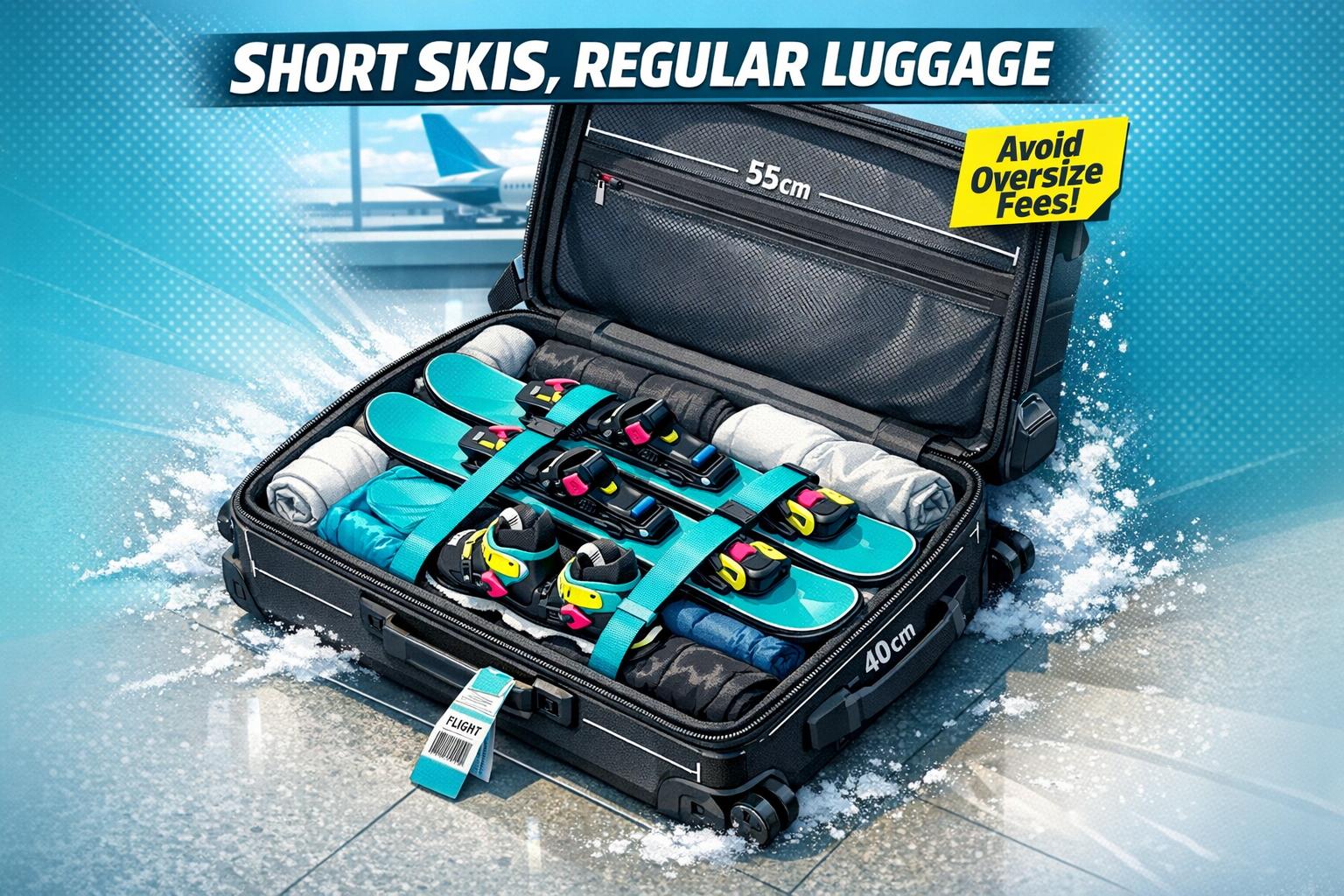
Forget about lugging a heavy snowboard. At under 5 lbs per pair, Mini Ski Skates are light enough to toss into a standard backpack. Whether you’re heading to resorts in Colorado or Vermont, you’ll appreciate how easy they are to transport - no oversized baggage fees or awkward gear to haul around.
Versatility on the Slopes
Mini Ski Skates shine in areas where snowboards can feel clunky. Their short length makes them perfect for navigating tight tree runs, moguls, and groomed trails. They’re also great for snow parks and packed forest paths. That said, they’re not ideal for deep powder or high-speed downhill runs, as their smaller edge length and surface area limit their stability in those conditions. They’re best for playful, stop-and-go riding rather than tearing down steep slopes.
Made for Tricks and Jumps
Mini Ski Skates are all about agility. Their low swing weight makes spins - like 180s and 360s - feel natural, even at slower speeds. While snowboards are better for big, high-speed jumps, Mini Ski Skates excel at playful tricks like grabs, presses, and rail features. They bring a vibe that’s closer to aggressive inline skating, offering tons of creative freedom on the mountain. As Snowfeet* founder Zbyněk puts it:
"I love how easy they are to ski and skate and how many different kinds of tricks I can perform without much effort and almost no restrictions."
2. Snowfeet* Skiskates
Skiskates take the inline skating-inspired feel of Mini Ski Skates and step it up with better carving precision. Measuring 44 cm and 50 cm long (about 17 and 20 inches), these are perfect for riders looking for a skate-like experience on groomed slopes without the hassle of lugging around bulky snowboard gear.
Freedom of Movement
What sets Skiskates apart is the freedom they offer. Each foot moves independently, unlike the fixed stance of a snowboard. This design lets you pivot, sidestep, or make quick adjustments mid-run without needing to pause. The slightly longer length adds stability, giving you more control for smooth, confident carving on groomed trails.
Portability
Their small size is a game-changer for convenience. Forget about dragging around oversized board bags - Skiskates can easily fit in a backpack. Whether you're driving up to a Colorado resort or flying to your favorite ski spot, these are a breeze to carry.
Terrain Versatility
Skiskates shine on groomed trails, terrain parks, and moderate resort runs. Their compact design makes them super nimble for navigating tight spots, like moguls, tree runs, or crowded slopes. The 50 cm PRO model even has a raised tip and tail, giving it a slight edge on ungroomed snow. While they’re not built for deep powder or high-speed mountain descents, they’re a solid choice for everyday resort adventures.
Trick and Jump Potential
With their twin-tip design and compact size, Skiskates make tricks and jumps feel effortless. Quick spins, small jumps, and playful jibbing are where they really stand out. As Snowfeet* founder Zbyněk explains:
"Skiskates is the best product for slopes we developed so far. I love how easy they are to ski and skate and how many different kinds of tricks I can perform without much effort and almost no restrictions."
While snowboards offer better stability at high speeds, Skiskates are perfect for creative park laps, quick 180s, and side hits. Plus, with a price range of $190–$250, they’re a budget-friendly alternative to most mid-range snowboards. Up next, we’ll look at how Snowfeet* Skiblades take agility to the next level.
3. Snowfeet* Skiblades
Snowfeet* Skiblades bring the freedom of independent foot movement into a skiing-like experience. Available in two lengths - 65 cm (26 inches) and 99 cm (39 inches) - they strike a balance between ultra-compact Skiskates and traditional snowboards, offering precise edge control and agility.
Freedom of Movement
One of the biggest differences from snowboarding is that each foot operates independently. On a snowboard, both feet are locked onto a single platform - you move the whole board or not at all. With Skiblades, you can pivot one foot, navigate around obstacles, and shift your weight mid-turn without committing your entire body. This flexibility opens up a whole new level of control.
Portability
Snowboards are long - usually 140–165 cm - and require their own bag for transport. Skiblades, at just 65–99 cm, fit easily into a standard duffel bag or the trunk of your car. As one user, heyjerz, pointed out, they're "a lot easier to haul around the hills and on vacation than traditional skis." For anyone driving to a resort or flying to a mountain town, this convenience is a game changer.
Terrain Versatility
Skiblades shine on groomed runs, terrain parks, moguls, and tight tree lines - basically the areas where most U.S. resort riders spend their time. Their short length allows for quick edge-to-edge transitions, making them feel effortless on blue and black groomers. In moguls or tree runs, the compact size minimizes the risk of catching a tip or tail on obstacles that might trip up a longer snowboard.
That said, they're not ideal for everything. In deep powder, a longer, wider snowboard will provide better float. But for mixed conditions - morning corduroy, afternoon bumps, and side hits - Skiblades deliver unmatched agility, perfect for those who enjoy creative lines and precise maneuvers.
Trick and Jump Potential
Both the 65 cm and 99 cm Skiblades feature a twin-tip design, making switch riding and landings a breeze. Spins like 180s and 360s feel easier thanks to the reduced swing weight of their shorter length. Flat-ground tricks, like butters and presses, are intuitive due to their playful flex. Beginners can start small, practicing centered landings on jumps, and progress to more complex tricks.
Starting at $635 for the 65 cm model, Skiblades are a solid investment for riders looking to add a skate-inspired, expressive style to their time on the mountain.
sbb-itb-17ade95
4. Snowfeet* Short Skis
Snowfeet* Short Skis take the concept of agility to the next level. Measuring just 120 cm (47 inches), these skis are designed for all-mountain performance while keeping things lightweight and compact. Shorter than standard skis or snowboards, they offer a versatile ride for those who want to explore the mountain without the bulk.
Freedom of Movement
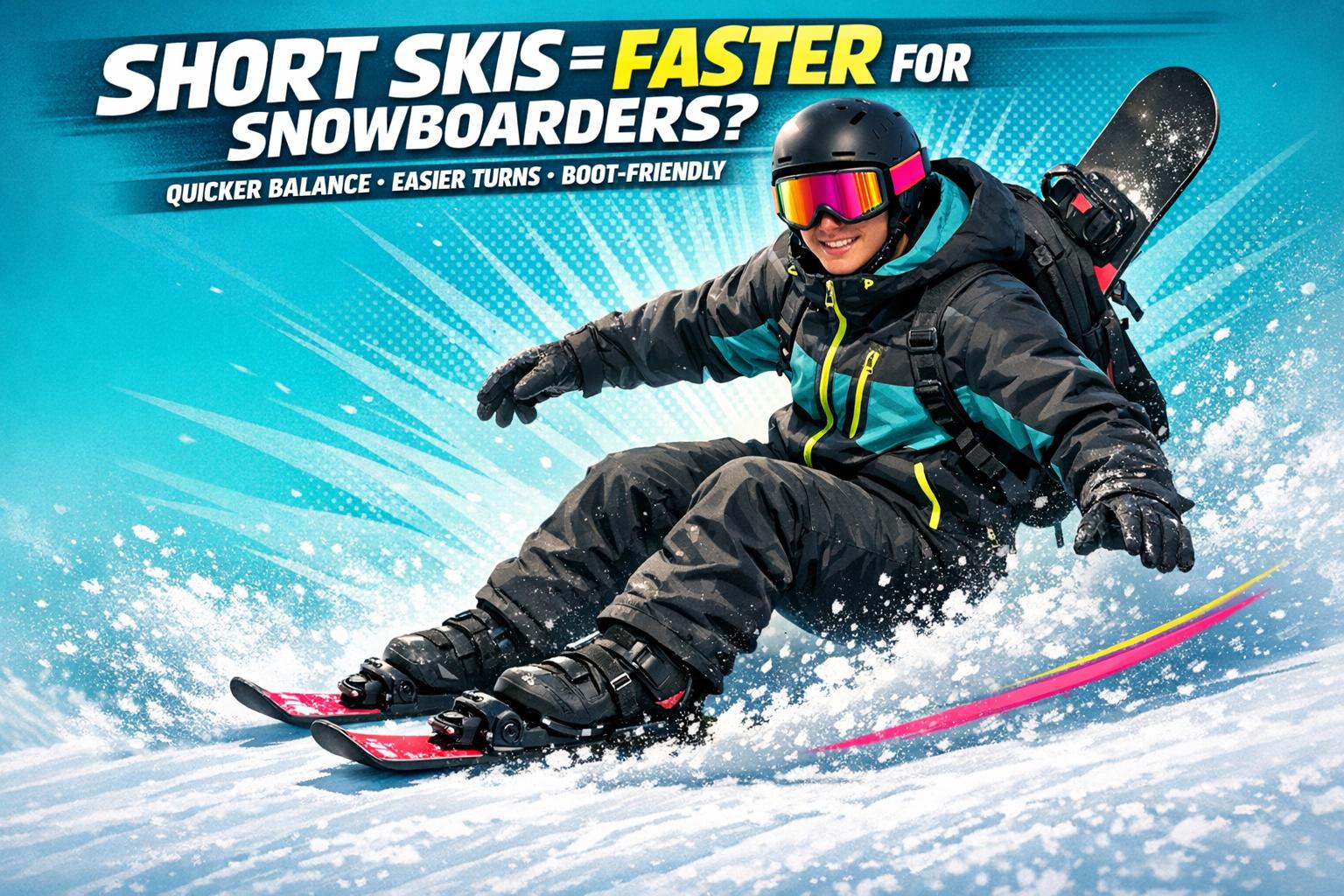
Unlike a snowboard, where both feet are locked in place, Short Skis allow each leg to move independently in a natural, forward-facing stance. This means you can skate through lift lines, step around obstacles, and adjust your footing mid-run without committing your entire body. This flexibility reduces muscle fatigue, giving you more energy throughout the day. For snowboarders who've struggled on flat terrain, pushing with one unstrapped foot, this feature is a game-changer.
Portability
While larger than Skiskates or Mini Ski Skates, Short Skis are still 30–50% shorter than traditional skis. They’re easier to pack into a car or store in tight spaces, like a small apartment. Plus, they work with snowboard boots when paired with the right bindings, so you won’t need to lug around heavy ski boots. If you're planning a weekend trip to popular resorts in Colorado, Utah, or Vermont, this compact design makes traveling simpler and less stressful.
Terrain Versatility
Short Skis are built for a variety of conditions, making them a solid choice for all-mountain riders. On groomed runs, the shorter length lets you carve sharp, slalom-style turns with ease. In moguls and tree runs, the independent leg movement allows you to step, hop, and pivot around tight spaces where a snowboard might get caught. They also hold up well in light off-piste conditions and spring slush. The only real downside? Deep powder. A wider snowboard will always float better in chest-deep snow. But for the typical mix of hardpack, bumps, and side hits that most U.S. resort riders encounter, Short Skis are a dependable choice - and they open up opportunities for creative freestyle riding.
Trick and Jump Potential
The lighter swing weight of a 120 cm ski makes tricks like 180s and 360s feel easier compared to a full-length snowboard. Flat-ground butters and nose presses also feel more natural, thanks to the forward-facing stance. For small-to-medium park features or side hits, Short Skis are playful and forgiving. Each foot can independently adjust on uneven landings, reducing the chance of catching an edge. While advanced big-air tricks at high speeds might still favor longer skis or boards, Short Skis are perfect for everyday freestyle fun. Starting at $775, they’re the go-to option for riders looking for premium all-mountain performance in the Snowfeet* lineup.
Pros and Cons
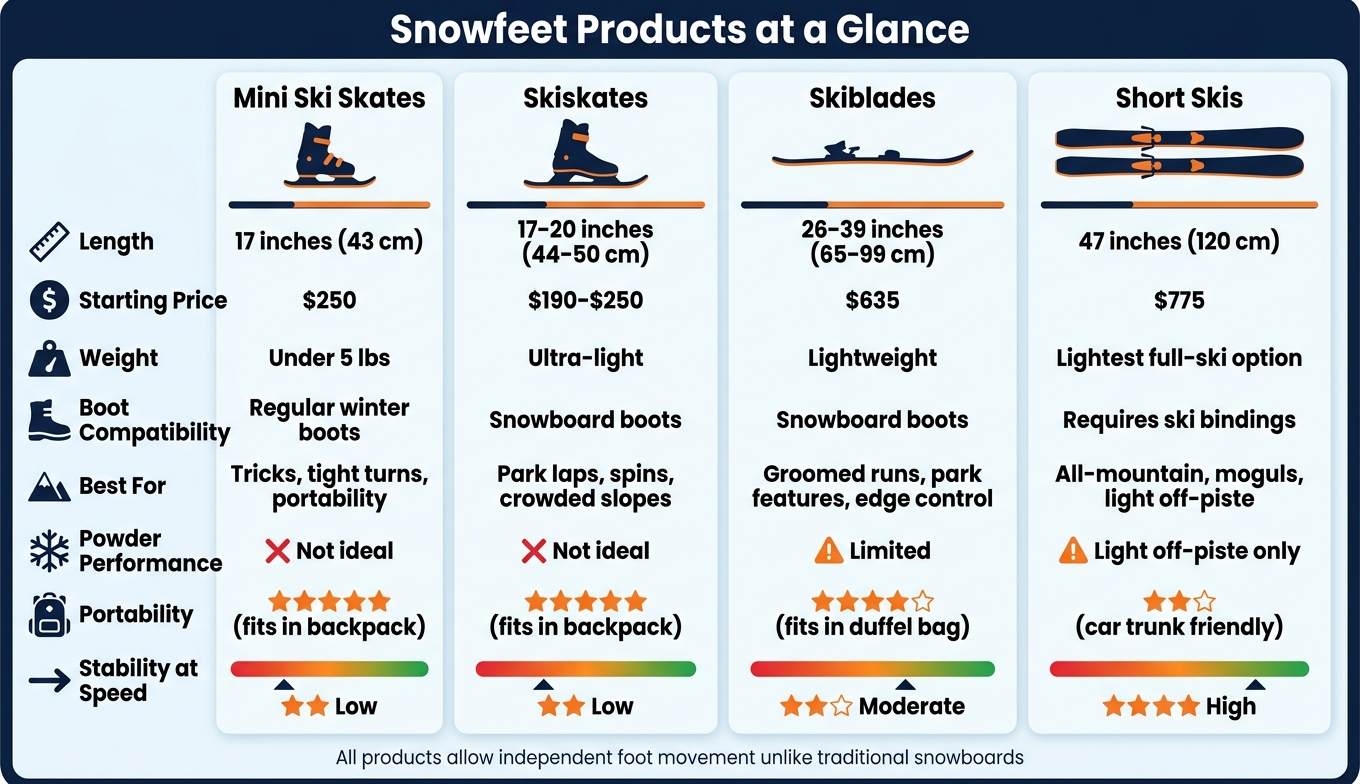
Snowfeet Products Compared: Size, Price & Best Use
Here's a comparison of how Snowfeet* products stack up against traditional snowboarding. Each product offers unique advantages and trade-offs:
| Product | Pros vs. Snowboarding | Cons vs. Snowboarding |
|---|---|---|
| Mini Ski Skates | Fits in a backpack; skate-like feel; great for quick tricks and tight turns; works with regular winter boots | Least stable at higher speeds; struggles in deep powder; feels the most different from snowboarding |
| Skiskates (44 cm) | Ultra-compact; quick to learn (about 5 minutes); ideal for spins, small jumps, and navigating crowded slopes; compatible with snowboard boots | Less stable on fast runs; not designed for deep powder or aggressive carving |
| Skiblades (65–99 cm) | More stable than mini options; quick edge-to-edge transitions; works with snowboard boots; handles groomed runs and park features well | Lacks the float and high-speed stability of a full snowboard in powder |
| Short Skis (120 cm) | Most stable and versatile in the lineup; independent leg movement reduces fatigue; performs well on groomed runs, moguls, and light off-piste terrain | Requires professional ski bindings (not snowboard boots); less portable than shorter models; doesn't replicate the locked-in feel of a snowboard |
The table highlights a clear trade-off: Snowfeet* gear sacrifices some of the stability and powder performance of a full-sized snowboard for greater freedom, agility, and portability. This shift in focus is what makes these products stand out for resort riders.
As user Brad Tolin explains:
"Only trade-off is at higher speeds, where longer skis still feel more stable - but for overall fun and maneuverability, these are hard to beat."
While traditional snowboards shine in deep powder, high-speed carving, and tackling big-mountain terrain, Snowfeet* products offer a lighter, more flexible, and less tiring alternative. Their design caters to the everyday mix of resort runs, park features, and crowded lift lines that most riders in the U.S. encounter. Plus, the ability to move each leg independently significantly reduces muscle fatigue - something snowboards can't match.
These trade-offs show how Snowfeet* can redefine your mountain experience, offering a fresh way to enjoy the slopes.
Conclusion
Snowfeet* products don’t replace your snowboard - they open up a whole new way to enjoy the slopes. Whether you’re hitting local hills or planning a weekend getaway to the Rockies or Vermont, these compact options bring more movement, less bulk, and a fresh take on mountain adventures.
Each Snowfeet* product offers something distinct to suit different riding styles. If you’re into park laps and tricks, check out the Skiskates ($575) or Skiblades 65 cm ($635). For all-mountain riders craving stability, the Skiblades 99 cm ($675) or Short Skis ($775) are excellent choices. And if portability is your top priority, the Mini Ski Skates (starting at $250) are hard to beat.
While traditional snowboards shine in deep powder and high-speed carving, let’s be real - most U.S. resort days involve groomed runs, park features, and busy lift lines. For that everyday mix, Snowfeet* gear offers a lighter, more playful ride that’s easier on your body.
Pick the Snowfeet* gear that fits your style and give it a try for half a day on the slopes. The learning curve is quick, and the fun? Totally worth it.
FAQs
Which Snowfeet* model feels closest to snowboarding?
The Snowfeet Skiskates (44 cm) bring a snowboarding vibe to the slopes. Thanks to their parabolic design and slim waist, they’re built for sharp carving, quick turns, and fun tricks. These skiskates are compact and easy to handle, giving you a playful, flexible riding experience. If you’re into tricks or love spending time in terrain parks, these are right up your alley.
Do I need ski boots or will my snowboard boots work?
You don’t need ski boots to enjoy Snowfeet* gear like skiblades or skiskates - your snowboard boots will do just fine. The adjustable, tool-free bindings fit US sizes 6–14.5 for snowboard boots and 4.5–14.5 for ski boots. This flexibility makes Snowfeet a lightweight and portable option, perfect for snowboarders looking for more versatility on the slopes without the hassle of switching to ski boots.
Are Snowfeet* products allowed at most U.S. ski resorts?
Snowfeet* products, such as Skiblades and Skiskates, are typically permitted at the majority of ski resorts across the U.S. That said, resort policies can vary, so it’s a smart idea to double-check the rules of the specific resort you’re planning to visit. Some places might have restrictions on certain types of gear.











Leave a comment
This site is protected by hCaptcha and the hCaptcha Privacy Policy and Terms of Service apply.