



















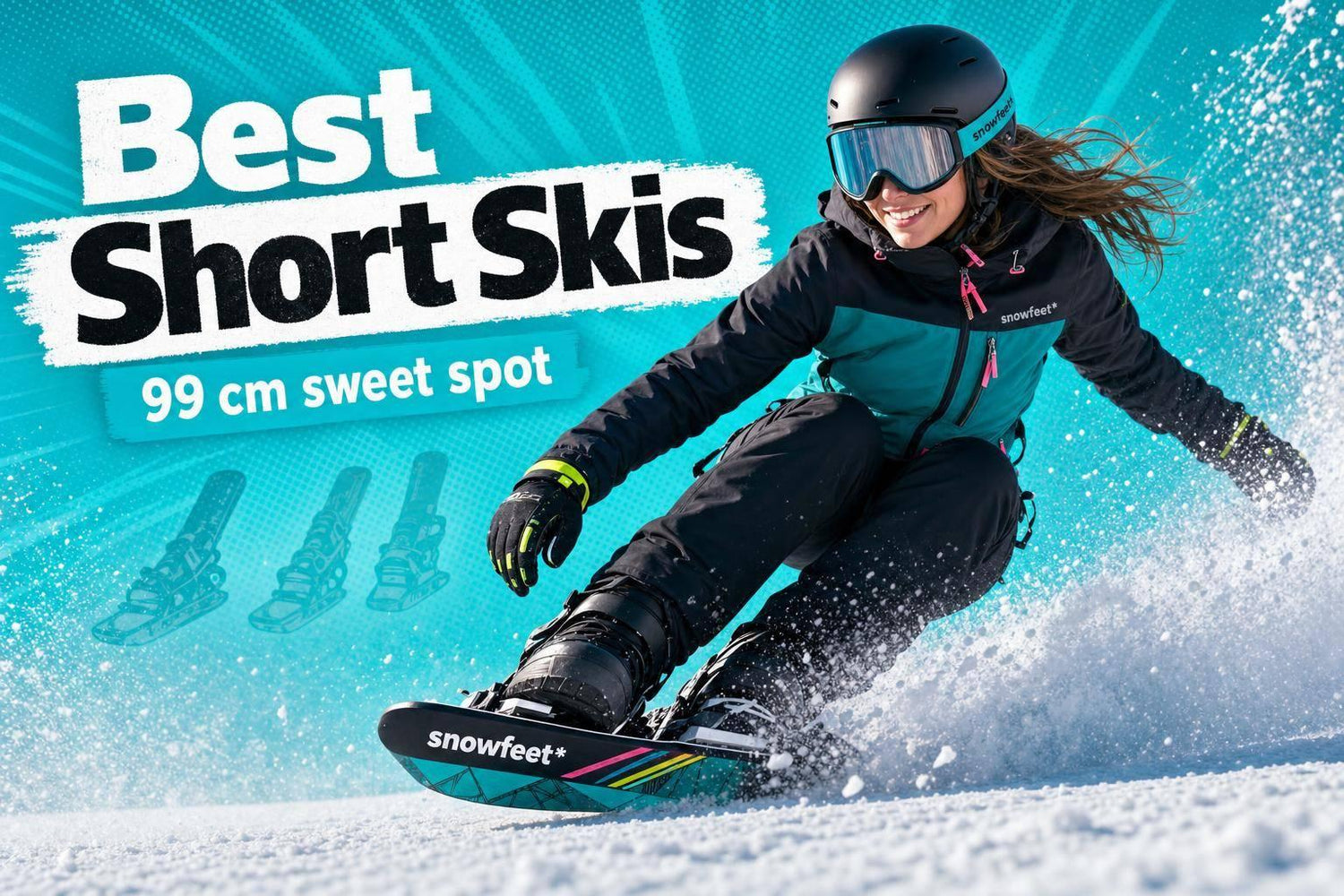
If you want the short answer, here it is: for most women in 2026, the Snowfeet* Skiblades 99 cm look like the best all-around pick. They give you an easy turning feel, more calm than tiny skiblades, and far less bulk than full-size skis.
Here’s the simple breakdown:
- 44 cm Skiskates - from $460: best for travel, park laps, and skate-style fun
- 65 cm Skiblades - from $590: best for beginners, lighter skiers, and easy groomer days
- 99 cm Skiblades - from $690: best all-around short-ski option for most riders
- 99 cm POWDER - from $690: best if you spend more time in soft snow and spring slush
- 120 cm Short Skis - $950: best if you want a ride that feels closer to full-length skis
- 150–165 cm women’s skis: best for high-speed skiing, icy runs, and rough late-day snow
So, if you want easy turns, less gear to carry, and less stress on the hill, shorter skis make a lot of sense. If you care most about speed, edge hold, and calm in chopped-up snow, longer skis still win.
Snowboarder tries Snowfeet* | Which Snowfeet* Short Ski is the Best? | Snowblades 44, 65, 99 Review
Quick Comparison
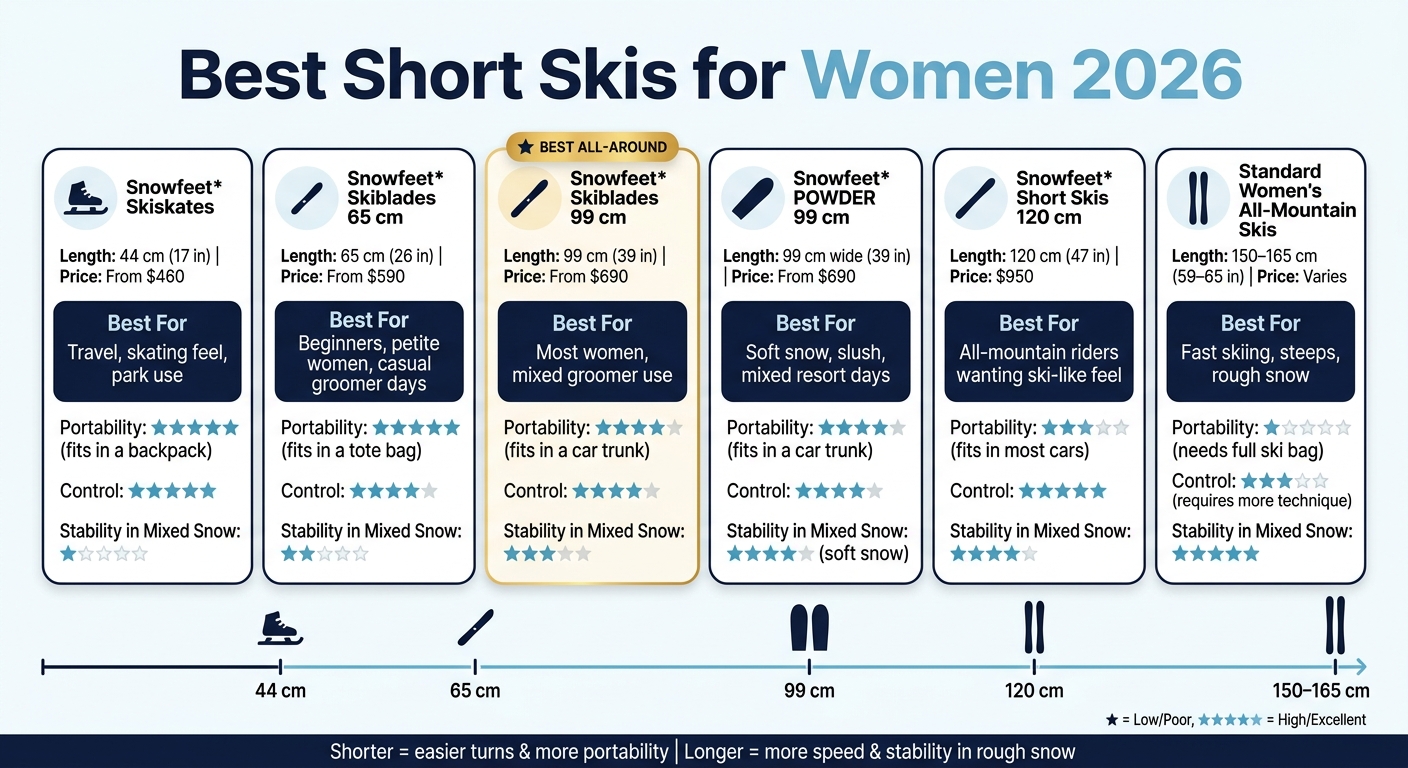
Best Short Skis for Women 2026: Side-by-Side Comparison
| Ski | Length | Best For | Main Watch-Out | Price |
|---|---|---|---|---|
| Snowfeet* Skiskates | 17 in. / 44 cm | Travel, skating feel, park use | Not great at higher speeds | From $460 |
| Snowfeet* Skiblades | 26 in. / 65 cm | Beginners, petite women, casual skiing | Limited in powder and rough snow | From $590 |
| Snowfeet* Skiblades | 39 in. / 99 cm | Most women, mixed groomer use | Less calm than long skis on ice | From $690 |
| Snowfeet* POWDER | 39 in. / 99 cm | Soft snow, slush, mixed resort days | Less sharp on firm snow | From $690 |
| Snowfeet* Short Skis | 47 in. / 120 cm | More support, more ski-like feel | Less easy to pack than shorter models | $950 |
| Standard women’s skis | 59–65 in. / 150–165 cm | Fast skiing, steeps, rough snow | More work to turn and carry | Varies |
My take? 99 cm is the sweet spot. It’s short enough to stay fun and easy, but long enough to feel more settled underfoot. If you want the closest thing to a normal ski without hauling around a full coat-rack setup in the parking lot, go 120 cm.
And if your top goal is stuffing your skis into a bag and heading out the door with a grin, well, the 44 cm and 65 cm models are hard to ignore :)
1. Snowfeet* Skiskates 44 cm
For women who want the smallest and easiest-to-carry setup, Snowfeet* Skiskates are the playful pick. They’re just 44 cm long - about 17 in. - so, yep, they’re small enough to slide into a backpack.
Control at Moderate Speeds
Skiskates turn with a skating-style motion, which tends to feel natural if you’ve spent time on skates or playing hockey. At moderate speeds, they’re super easy to steer and fun to thread through busy runs.
There’s a catch, of course. These aren’t made for bombing downhill at top speed. If you push past a comfortable pace, they can start to feel chattery.
Stability on Mixed Terrain
On packed, groomed snow, they feel lively and quick. But when the snow gets rougher - think icy spots, small bumps, or light slush - they ask more from your balance than longer skis do.
They work best on:
- Groomed slopes
- Snow parks
They’re less suited to deep powder, where longer skis give you more float and a smoother ride.
Portability and Travel Fit
This is where Skiskates shine. The pair weighs about 2.6 lbs (1.2 kg) and fits in a standard backpack or carry-on. No ski bag. No roof rack. No checked luggage. That makes travel a whole lot less annoying, especially if you’re flying to ski spots or bouncing between resorts.
Boot Compatibility
Snowfeet* sells both ski-boot and snowboard-boot versions. They fit US women’s 4.5–14.5 (EU 36–49) and US 6–13 (EU 38–47), so a lot of riders can use boots they already own.
If you want more stability but still like the feel of short skis, the 65 cm Skiblades are the next step up.
2. Snowfeet* Skiblades 65 cm
At 65 cm, these Skiblades are the easy next step from the 44 cm Skiskates. They still feel small and easy to carry, but on snow they’re calmer and more planted.
Control at Moderate Speeds
That extra length gives you a steadier, more predictable ride on groomed runs. You still get quick turns, but with a bit more backup under your feet. That makes them a nice pick for newer skiers and laid-back riders who want the fun feel of short skis without the twitchy side of the 44 cm version.
Stability on Mixed Terrain
On groomers, they do well and can handle light mixed snow without much fuss. If the snow gets rough, chopped up, or you like to ski faster, you’ll want more ski under you. In that case, the 99 cm or 120 cm models make more sense.
Portability and Travel Fit
At about 1.1 lb per ski, these are still easy to pack, carry, and stash away. Tossing them in the car or bringing them on a trip feels pretty painless :)
Boot Compatibility
The ski-binding version fits a broad range of adult ski boots, and Snowfeet* also offers snowboard-boot setups.
For women who want more speed security and better performance in mixed snow, the 99 cm Skiblades are the next move.
3. Snowfeet* Skiblades 99 cm
If the 65 cm Skiblades feel a bit too tiny, the 99 cm version hits a nice sweet spot. You get more calm and more confidence, but you still keep that short-ski vibe. At 99 cm (39 inches), they feel more planted without turning into a full-size ski. And at $690, they’re a strong middle-ground pick for a lot of women.
Control at Moderate Speeds
That extra length gives you more edge hold on green and blue runs, and turns still feel quick and easy to start. The sidecut helps these Skiblades come around fast and carve clean lines, which is a big part of the fun.
Stability on Mixed Terrain
On groomers, they do well at moderate resort speeds. When the snow gets choppy later in the day or you run into small bumps, the short length makes it easier to pivot around rough spots instead of getting tossed off line. That said, if you like more speed or spend time on icy steeps, a standard 150–165 cm all-mountain ski will still feel more locked in.
Portability and Travel Fit
At about 2.79 lb per ski with binding, they’re still way easier to pack than full-length skis. That’s a nice perk if you travel a lot or just don’t want giant skis taking over your car, closet, or garage.
Boot Compatibility
Snowfeet* offers three binding options for the 99 cm Skiblades:
- Simple ski boot bindings: fits US sizes 4.5–14.5
- Pro ski boot bindings
- Snowboard boot bindings: fits US sizes 6–14.5
Ski boot bindings give you the best edge control. Snowboard boots feel more comfy, but you give up some precision.
If you want more float and a bit more speed, but still want something shorter than standard skis, the 120 cm Short Skis are the next move.
4. Snowfeet* POWDER 99 cm
Compared with the 99 cm Skiblades, the POWDER gives up some edge bite in exchange for more float and an easier feel in soft snow. That wider shape helps a lot in soft, slushy, and uneven conditions. So, if you want a 99 cm ski with more float than the narrower Skiblades 99 cm, this is the better pick.
Control at Moderate Speeds
At 99 cm, this ski stays quick from edge to edge and easy to turn without forcing it around. That makes it forgiving for intermediate skiers who like to stay at moderate speeds. Next to the narrower Skiblades 99 cm, the POWDER feels calmer when the snow gets mixed up, but it won’t feel as crisp on firm groomers.
Stability on Mixed Terrain
The wider build gives you a steadier platform when the mountain gets choppy. If you ski now and then and want a bit more confidence when conditions change, this model just makes sense. Standard 150–165 cm all-mountain skis still do better at very high speeds and cut down chatter more, but they also take more effort to handle.
Portability and Travel Fit
At 99 cm (39 in.), the POWDER is easy to fit in most car trunks and many ski bags. That’s a whole lot simpler than dealing with typical women’s all-mountain skis in the 150–165 cm range.
Boot Compatibility
The POWDER 99 cm works with ski boots or snowboard boots. Ski boots give you sharper edge control. Stiff snowboard boots feel better over a long day. Soft boots are less stable. If you want more length and a calmer ride on firmer snow, the next option is the 120 cm Short Skis.
sbb-itb-17ade95
5. Snowfeet* Short Skis 120 cm
At 120 cm (about 47 in.), these sit right in the middle between playful short skis and full-length women’s skis. If the 99 cm models still seem a bit too short, this is the next step up. You still get the compact Snowfeet* feel, just with a bit more ski under you.
Control at Moderate Speeds
That extra length changes the feel in a good way. The ski feels more settled, turn initiation stays easy, and edge-to-edge moves feel smooth and natural. For beginners, casual intermediate skiers, lighter riders, and women coming back after time away, that matters a lot.
This model works well for groomed runs and a confidence-first kind of day on the mountain. It’s forgiving, calm, and easy to trust at moderate resort speeds. Just don’t expect it to love hard charging or fast, aggressive carving. That’s not its lane.
Stability on Mixed Terrain
When the snow gets a little messy, the 120 cm model does better than the shorter Snowfeet* options. Chopped-up patches, small bumps, and snow that changes from one stretch to the next feel less twitchy here.
The longer running surface gives you more support on uneven snow. It also helps if you make a small balance mistake - kind of like having a little extra margin for error, which is always nice :). For normal resort days and light all-mountain use, this is a strong short ski pick.
Portability and Travel Fit
Compared with standard 150–165 cm skis, the 120 cm length is much easier to deal with. It’s easier to carry, easier to store, and easier to bring on a trip.
No, it’s not as tiny as the 44 cm Skiskates or 65 cm Skiblades. But the edge over standard skis is still big, especially for weekend trips or for women who want gear they can carry on their own without feeling like they’re wrestling a coat rack through the parking lot.
Boot Compatibility
The 120 cm Short Skis work with standard alpine ski boots, which is a nice plus. A lot of women can use the boots they already own.
Next, compare this model with standard women’s all-mountain skis in the 150–165 cm range.
6. Standard Women's All-Mountain Skis (150–165 cm)
Standard skis are the old-school benchmark for comfort at speed and stability in mixed snow. They’re the kind of resort skis many women have used through rental shops and ski school. You get that classic alpine feel, but there’s a catch: they need more length than Snowfeet. Compared with Snowfeet* 120 cm, they feel more planted once you pick up speed, but they’re not as easy to steer.
Control at Moderate Speeds
Standard skis take more skill to turn than short skis. That matters a lot for lower-intermediate skiers, or for anyone who wants smooth, easy turns at slower speeds.
A shorter option like the Snowfeet* 120 cm can feel easier from the first run. Less work, less fighting the ski, more “okay, I’ve got this.”
Stability on Mixed Terrain
This is where standard all-mountain skis shine. They deal with chopped snow, slush, and light powder better than very short skis. The longer platform helps them glide over ruts and pushed-around snow, so the ride feels less chattery and more under control.
If the day starts groomed and ends with piles of soft junk all over the trail, standard skis usually handle that mess with less drama.
Portability and Travel Fit
Here’s the main drawback: they take up a lot more space.
A 150–165 cm ski needs more room at home, a full-length ski bag for travel, and extra space in the car. Sure, they fit airline and car limits, but they’re still a lot bulkier than Snowfeet.
By contrast, Snowfeet* models are much easier to pack, carry, and tuck into small spaces. That’s a big plus for women who fly to ski trips or just don’t want giant gear leaning against the wall all year.
Boot Compatibility
Standard all-mountain skis are built for traditional alpine ski boots and bindings. DIN settings should be adjusted by a certified technician. Lighter skiers often do better in women’s-specific boots with a softer flex.
This setup gives you great precision, but it’s also more technical and less flexible than the boot choices available with Snowfeet*. If you already own alpine boots that fit well and want that classic resort setup, standard skis are a solid match.
Next, compare these trade-offs in control, stability, portability, and boot setup.
How They Compare: Control, Stability, Portability, and Boot Setup
Use this comparison to line up ski length, control, portability, and boot setup with how you like to ride.
| Model | Length | Best For | Control at Moderate Speed | Stability in Mixed Snow | Portability | Boot Compatibility | Price (USD) |
|---|---|---|---|---|---|---|---|
| Snowfeet* Skiskates | 44 cm (17 in) | Skaters, playful riders | Very high - skate-like turns on groomed slopes | Low | Fits in a backpack | Ski or snowboard boots | From $460 |
| Snowfeet* Skiblades | 65 cm | Beginners, petite women | High - very easy to steer | Low to moderate | Fits in a tote bag | Ski or snowboard boots | From $590 |
| Snowfeet* Skiblades | 99 cm | Intermediate riders | Good - solid edge hold | Moderate | Fits in a car trunk | Ski or snowboard boots | From $690 |
| Snowfeet* POWDER | 99 cm (wide) | Powder and soft-snow riders | Good | Moderate, especially in soft snow | Fits in a car trunk | Ski or snowboard boots | From $690 |
| Snowfeet* Short Skis | 120 cm | All-mountain riders | Very good - closest to a traditional ski feel | High | Fits in most cars, but less easily than shorter models | Alpine ski boots | $950 |
| Standard Women's All-Mountain Skis | 150–165 cm | Experienced, speed-focused | Requires more technique | Highest | Needs a full ski bag | Traditional alpine boots | Varies widely |
Here’s the big trade-off, plain and simple: shorter Snowfeet* models give you more control and easier transport, while the 120 cm model and standard skis bring more stability when the snow gets rough or your speed goes up.
That’s the heart of it. Shorter gear feels nimble and easy. Longer gear feels calmer once conditions get messy.
Next, the pros and cons section gets into where each model shines and where it gives a little back.
Boot setup is one spot where Snowfeet* makes life easier. Every model except the 120 cm works with ski or snowboard boots. That means less hassle and more freedom if you don’t want to be stuck with a classic alpine-only setup.
Sizing by Height
If length is the main thing you care about, use the guide below as a quick gut check.
For most women, 65 cm gives the easiest learning curve, 99 cm hits the best middle ground, and 120 cm feels closest to a standard ski.
Pros and Cons by Model
Each model fits a different kind of rider and a different kind of snow day. So instead of staring at specs and wondering what they mean on the hill, use this table as the fast version.
| Model | Main Advantages | Main Trade-Offs | Best Fit | Skip If |
|---|---|---|---|---|
| Skiskates 44 cm | Most portable; best for travel and skating-style fun | Twitchy at speed; limited edge hold on ice; sinks in deep powder | Travelers, skaters, casual resort visitors | Fast, steep runs or icy hardpack |
| Skiblades 65 cm | Very forgiving for lighter women; still compact | Limited at speed and in powder or heavy chop | Beginners, lighter women, groomed resort days | High-speed carving or frequent powder days |
| Skiblades 99 cm | Best all-around short-ski choice; solid edge grip | Can feel chattery on steep, icy runs | Beginners to intermediates who want one setup for most groomer days | Advanced skiers on steep terrain |
| POWDER 99 cm | Wider profile floats better in soft snow; easy to maneuver in narrow terrain | Slower edge-to-edge on hardpack | Intermediate women exploring powder and soft-snow days | Skiers who mostly stick to firm, groomed runs |
| Short Skis 120 cm | Very good - most ski-like feel; confident at moderate-to-higher speeds | Less packable; requires alpine ski boots | All-day riders who want stability without managing 150+ cm of ski | Anyone who wants the skate-style freedom of shorter blades |
| Standard Skis 150–165 cm | Best stability and edge hold at speed; most versatile across groomers, crud, and deeper snow | Bulky to carry; steeper learning curve; less forgiving at low speeds | Strong intermediate skiers focused on performance and progression | Beginners or anyone who finds traditional skis overwhelming |
Here’s the simple read on all of this: go shorter if you want ease, low hassle, and something you can toss in a bag without a wrestling match. Go longer if you want more speed, more calm underfoot, and a ride that feels closer to a standard ski.
And yeah, one pattern jumps out fast. 99 cm works for most riders. It hits that sweet spot between fun and control. If you want a more ski-like ride with extra stability, 120 cm is the better pick for women who don’t want to deal with a full-length ski.
Conclusion
Once you stack up control, stability, portability, and boot setup, the pick is pretty simple: it depends on how you ski and how much hassle you’re willing to deal with.
If you’re a complete beginner or a lighter rider, the Snowfeet* Skiblades 65 cm are the best match. If you’re a beginner or a nervous intermediate, the 99 cm is the safer bet for most people. If travel matters a lot, go with the 44 cm Skiskates if you want the smallest option possible, or the 65 cm Skiblades if you want something that’s still easy to pack but a bit easier to handle.
For playful riders and people who spend more time in soft snow, the Snowfeet* POWDER 99 cm makes a lot of sense because it gives you better float and easy turning. If you want more stability and more confidence at higher speeds, the Snowfeet* Short Skis 120 cm are the better fit. For most people, though, 99 cm is the easiest all-around choice. Pick 120 cm only if you want something that feels closer to a standard ski.
Standard 150–165 cm all-mountain skis still make sense for advanced skiers who care most about high-speed stability on steep, icy terrain. That’s where long skis still have the edge. They’re better for pure speed and rough-snow stability. But Snowfeet* stands out for ease, portability, and a much lower-stress day on the mountain.
Final verdict: For most casual women skiers in 2026, the Snowfeet* Skiblades 99 cm give the best mix of control, portability, and fun. If you want easier turns, less bulk, and a more enjoyable day-to-day ride, Snowfeet* is the smarter pick.
FAQs
How do I choose between 65 cm, 99 cm, and 120 cm skis?
Pick the length that fits your skill level and the kind of ride you want:
- 65 cm: best for beginners and the most nimble feel
- 99 cm: a nice middle ground of stability and easy turning
- 120 cm: best for more speed, more precision, and a more classic ski feel
And yeah, all three are easier to carry than standard skis. That part alone is pretty nice :)
Are short skis good for beginners and nervous skiers?
Yes. Short skis and snowblades can be a smart pick for beginners and nervous skiers because they feel less intimidating and are easier to control than longer skis.
There’s just less ski to deal with. That often means a shorter learning curve, more confidence, less leg fatigue, and a friendlier ride on groomers and around the resort.
For a lot of new skiers, that can make the whole sport feel a lot more fun from day one :)
Can I use my current ski or snowboard boots with Snowfeet*?
Yes. Most Snowfeet* models work with your current snowboard boots because they use an integrated, non-release binding system.
Snowboard boots pair well with:
- Skiskates (44 cm)
- Skiblades (65 cm and 99 cm)
For the 120 cm models, ski boots work best.











Leave a comment
This site is protected by hCaptcha and the hCaptcha Privacy Policy and Terms of Service apply.