



















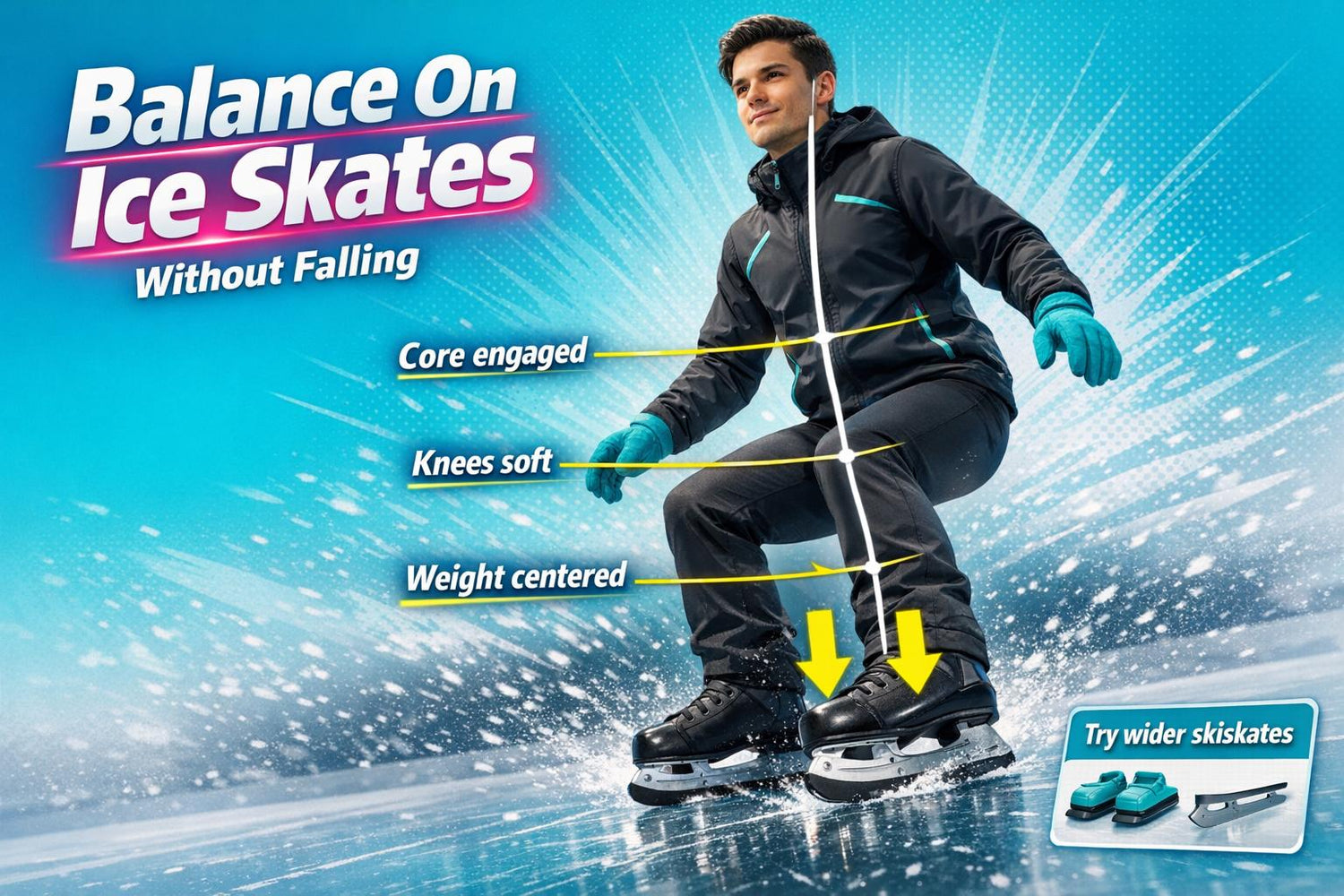
Balancing on ice skates can feel tricky at first, but with the right techniques, you can stay upright and confident. Here's what you need to know:
- Posture Matters: Keep your knees bent, back straight, and weight slightly forward on the balls of your feet.
- Engage Your Core: Strong core muscles help you stay stable and adjust quickly on the ice.
- Avoid Common Mistakes: Don’t look down at your feet or stand too stiffly - both can throw off your balance.
- Practice Drills: Try one-leg stands, gliding on one foot, and small steps to improve control.
For beginners, tools like Snowfeet* Skiskates offer a wider, more stable base compared to regular skates, making it easier to find your balance. Whether you’re practicing on or off the ice, consistency is key. Stick with it, and you’ll see progress in just a few weeks! 😊
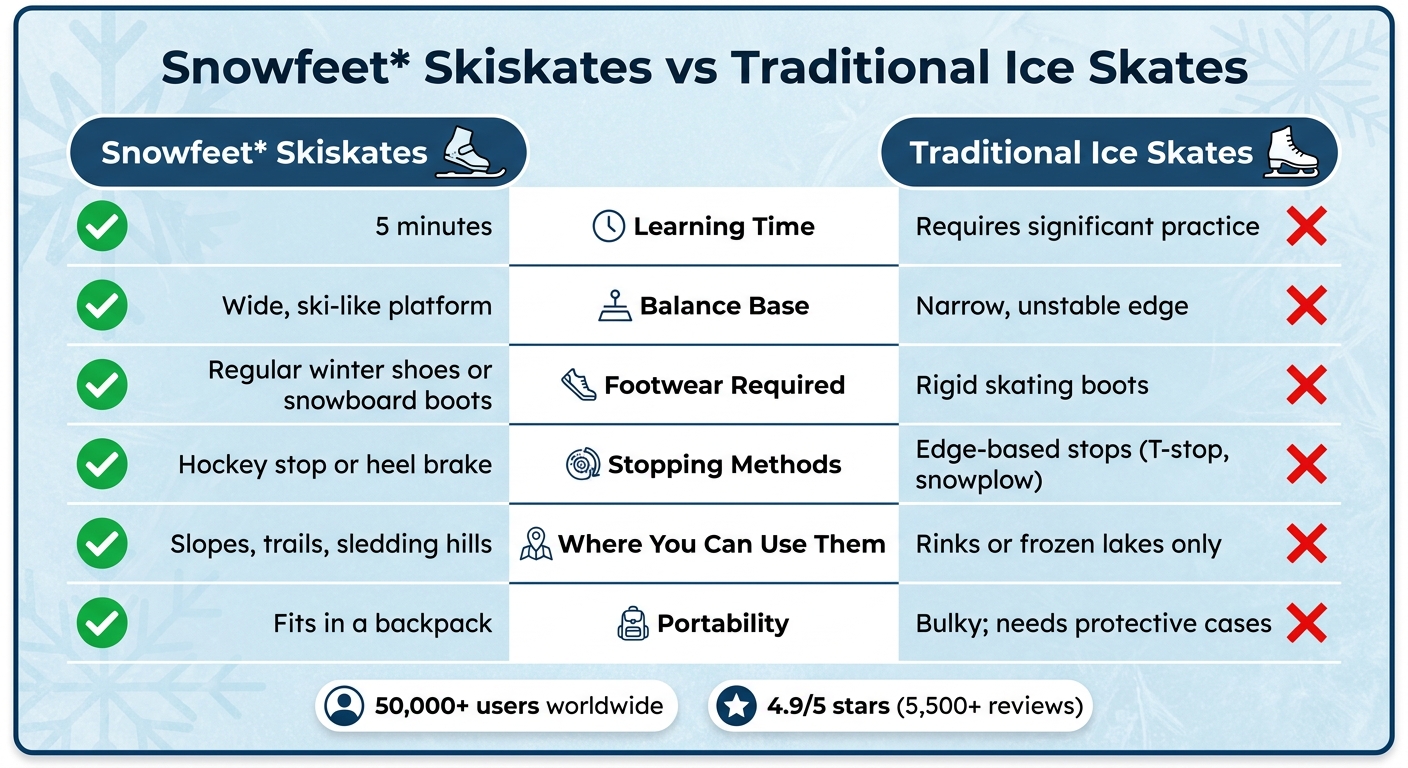
Snowfeet Skiskates vs Traditional Ice Skates Comparison Chart
QUICK TUTORIAL ON HOW TO SKATE AND BALANCE PROPERLY ON ICE
Ice Skating Balance Fundamentals
Balancing on ice is a whole different ballgame compared to standing on solid ground. Instead of relying on your entire foot for stability and friction, you're perched on a thin metal blade - about 1/8 inch wide - gliding over a slick surface. It’s like walking a tightrope, except the rope is constantly shifting beneath you.
Skating also flips the script on how you move. Walking uses a heel-to-toe stride with straight legs, but skating demands a bent-knee posture and careful weight distribution. This lowers your center of gravity and helps absorb shocks. Beginners often make the mistake of leaning too far back, which almost guarantees a quick slip.
Your core muscles are the unsung heroes here. Nathan Anthony from Racine Ice Center sums it up perfectly:
"Your core plays a huge role in maintaining balance while ice skating. It's the powerhouse that controls your posture, stability, and ability to make quick adjustments".
Engaging your core is non-negotiable because the ice’s slippery surface doesn’t give you any margin for error. A strong core keeps you aligned and ready to react.
Why Balance Matters for Ice Skating
Balance isn’t just about staying upright - it’s the backbone of every move you make on the ice. Without it, simple tasks like turning or stopping become a struggle, and you’ll wear yourself out quickly. Think of balance as the glue that holds your skating skills together.
It also plays a big role in keeping you safe. When you’re steady and in control, you’re far less likely to fall awkwardly or injure yourself. Most skaters notice their balance improving significantly within 2 to 4 weeks of regular practice. Fewer falls mean more time enjoying the ice and less time dusting yourself off.
Common Balance Problems for Beginners
If you’re just starting out, chances are you’ll run into a few common mistakes. One of the biggest? Looking down at your feet. It’s natural to want to check what your skates are doing, but this shifts your head forward, throws off your spinal alignment, and makes you more prone to falling. Instead, keep your eyes on the horizon.
Another rookie error is the "waddle." New skaters often keep their feet too far apart and step forward instead of gliding. Proper skating involves a more linear motion, almost like walking a tightrope, with pushes coming from the side rather than straight ahead. Locking your knees or standing too upright is another issue - it makes quick adjustments nearly impossible. The right stance? Knees slightly bent, feet shoulder-width apart, and just a hint of a forward lean.
Fear can also be a major hurdle. When you’re scared of falling, your body tenses up, making balance even harder. Nathan Anthony points out:
"Good posture isn't just about standing up straight; it's about maintaining an engaged and active body position that allows you to make adjustments quickly while skating".
Staying flexible and ready to move is far more effective than being stiff. Once you understand these common pitfalls, you’ll be better prepared to tackle the corrective techniques coming up. Plus, mastering these basics can even enhance your experience with advanced gear like Snowfeet* Skiskates, designed to address these exact challenges.
How to Maintain Balance on Ice Skates
Correct Posture and Stance
Your body position is key to staying steady on the ice. Start by standing with your feet shoulder-width apart and keeping your knees slightly bent. This lowers your center of gravity, making it easier to stay balanced. Keep your back straight, chest open, and eyes looking ahead - this helps keep your hips aligned over your skates.
One mistake many beginners make is trying to balance by leaning with their shoulders. Instead, focus on making small adjustments with your ankles. Keep your arms loose and relaxed to avoid unnecessary tension.
Once you’ve got the posture down, it’s time to think about how to distribute your weight for better stability.
How to Distribute Your Weight for Stability
Balancing on ice is all about where you place your weight. The trick? Lean slightly forward so your weight is on the balls of your feet. If you lean back, you’re more likely to lose control and fall. Keep your center of gravity directly over your skates for the best balance.
When you’re gliding, aim to apply even pressure on both blades. This prevents that shaky, uneven feeling. And don’t underestimate the role of your core - it’s like your body’s built-in stabilizer. As Nathan Anthony from Racine Ice Center puts it:
"Your core is the engine that drives balance. Weak abdominal and lower back muscles can cause uncontrolled wobbles".
Engaging your core muscles makes a noticeable difference. Once you’ve got weight distribution figured out, you’re ready to try some balance-boosting drills.
Simple Balance Exercises for Beginners
Want to get better at balancing? Practice makes perfect. Start with these beginner-friendly drills to build confidence and control:
- One-leg stands: Use the rink wall for support if needed. Lift one foot off the ice and hold it for a few seconds. This mimics the motion of pushing off while skating. Once you’re comfortable, try gliding on one leg while extending the other behind you.
- Tightrope walk: Place the heel of one skate directly in front of the toes of the other, forming a straight line. It may feel awkward at first, but it’s great for improving leg control.
- Tiny steps: While standing still, take small steps using just the edges of your blades. This helps fine-tune your motor skills.
You can also work on your balance off the ice. Exercises like squats, wall sits, and planks strengthen your legs and core, giving you a more stable stance on the rink.
Most skaters see real progress within 2 to 4 weeks of consistent practice, especially if they hit the ice 3 to 4 times a week. Keep at it, and you’ll feel more confident every time you skate!
Snowfeet* Skiskates: A Better Way to Balance on Ice
What Makes Snowfeet* Skiskates Different?
Snowfeet* Skiskates bring a fresh approach to balancing on ice, making skating more accessible and fun. Unlike traditional ice skates with their narrow metal blades that can be tricky for beginners, Snowfeet* offer a wider, more stable base. At 44 cm long, they strike the perfect balance: "long enough to ski, short enough to skate".
Another standout feature? You don’t need stiff skating boots. Snowfeet* work with regular winter shoes or snowboard boots. That means no painful break-in period like you’d face with traditional skates. Plus, this setup gives you better ankle flexibility and comfort right from the start. Their design mimics the movements of ice hockey and inline skating, so if you’ve tried either, balancing on Snowfeet* will feel natural. For those familiar with on-ice drills, these skiskates make it easier to translate those skills into real-world stability.
With over 50,000 users worldwide and more than 5,500 glowing reviews averaging 4.9/5 stars, Snowfeet* have clearly made their mark. And here’s the kicker: you can learn to use them in just 5 minutes - no professional lessons required. That’s a game-changer compared to the hours of practice needed with traditional ice skates.
These features set Snowfeet* apart, offering clear advantages over traditional ice skates.
Why Snowfeet* Beats Traditional Ice Skates
Snowfeet* Skiskates aren’t just easier to learn; they outshine traditional ice skates in several key ways:
| Feature | Snowfeet* Skiskates | Traditional Ice Skates |
|---|---|---|
| Learning Time | 5 minutes | Requires significant practice |
| Balance Base | Wide, ski-like platform | Narrow, unstable edge |
| Footwear Required | Regular winter shoes or snowboard boots | Rigid skating boots |
| Stopping Methods | Hockey stop or heel brake | Edge-based stops (T-stop, snowplow) |
| Where You Can Use Them | Slopes, trails, sledding hills | Rinks or frozen lakes only |
| Portability | Fits in a backpack | Bulky; needs protective cases |
Unlike traditional ice skates, which are limited to rinks or frozen lakes, Snowfeet* shine on slopes, hiking trails, and even sledding hills. Their compact size means you can toss them in a backpack, a huge plus compared to lugging around bulky skates that require blade guards and protective cases.
Stopping is easier, too. Beginners can rely on a heel brake in addition to the hockey stop, which can take a while to master on regular skates. And when it comes to safety, Snowfeet* have an edge. Falling is less risky compared to traditional skis or snowboards, as there’s no heavy equipment to twist or tangle your limbs.
As user Brad Tolin shares:
"These skiblades are a blast to use. Super easy to control, quick to turn, and way more forgiving than traditional skis".
sbb-itb-17ade95
Snowfeet* Skiskates vs. Traditional Skis and Snowboards
Compact Design vs. Bulky Equipment
Traditional skis and snowboards can be a hassle to transport - they're long, heavy, and often require roof racks or extra storage. Snowfeet*, on the other hand, are a game-changer. Measuring just 44 cm in length, they can fit right into a backpack. That means you can easily carry them on public transit, toss them in your car trunk, or even bring them along on a hike. Plus, their compact size lets you explore places that would be impossible with bulky gear, like narrow forest trails. And because they’re so lightweight, they’re much easier for beginners to handle.
Easier Learning for New Users
One of the biggest hurdles with traditional skiing and snowboarding is the stiff, specialized boots. They’re not exactly comfortable, and they can make learning feel awkward. Snowfeet* ditch the need for all that. You can use them with any waterproof winter shoes, so you’re ready to go almost immediately. Their design feels natural, especially if you’ve ever tried skating before. The lack of heavy, restrictive gear also improves your balance and makes you more agile. And here’s a bonus: falling is less intimidating. Without heavy equipment strapped to your feet, the risk of leverage-related injuries drops significantly.
Use on Multiple Surfaces
Skis and snowboards are mostly tied to ski resorts and groomed slopes. Snowfeet*? They’re way more flexible. You can use them on resort slopes, snowparks, sledding hills, and even local trails. They work well on powder snow up to about 4 inches deep, giving you the freedom to explore a variety of winter terrains. And since they come with metal edges, most ski resorts allow them on their slopes. This versatility isn’t just about convenience - it’s also great for improving your balance. Trying out different surfaces helps you develop stability and adaptability in ways that sticking to groomed slopes just can’t match.
Practice Drills to Improve Your Ice Skating Balance
How to Glide and Stop Safely
Start with a simple marching glide. Stand in place on the ice and march in small, steady steps. Once you feel stable, take those steps forward. When you're comfortable, try forward swizzles. To do this, position your heels together in a "V" shape, push your feet outward, and then bring them back together smoothly. This repeated motion helps strengthen your balance and builds muscle memory.
To stop, practice the snowplow technique. Bend your knees slightly, push your heels outward, and use the inside edges of your blades to slow down or stop completely. Most people can get the hang of these drills with consistent practice over 4–6 weeks. These foundational skills not only improve your balance but also give you the confidence to try more advanced moves with Snowfeet*.
How to Turn and Crossover Without Falling
Keep your head up and your eyes looking forward. This helps you maintain a steady center of gravity and avoid unnecessary wobbling. For turning, start with C-cuts. Push one foot in a "C" shape while the other glides straight. This creates the momentum needed for smooth, controlled turns. Once you're comfortable, move on to crossovers, where you cross one leg over the other while curving. This technique helps maintain speed and control during turns.
To further improve your balance, practice edge-control holds. While gliding in a straight line, shift your weight onto one skate and roll onto either the inside or outside edge. Hold this position for 10–20 seconds. With regular practice, you'll see noticeable improvements in your stability and control. These drills also prepare you to make the most of Snowfeet* Skiskates, which offer added stability on various surfaces.
Practicing with Snowfeet* Skiskates
Once you've got the basics down, Snowfeet* Skiskates take things up a notch. They make balancing easier by lowering your center of gravity and adapting to different surfaces. Since you wear your waterproof winter shoes instead of stiff skate boots, your ankles can move more naturally. This makes drills like one-foot glides and crossovers feel much more intuitive. The flexibility of Snowfeet* complements the posture and weight distribution techniques you've already practiced, letting you focus on form without feeling restricted.
The shorter length of Snowfeet* - just 44 cm (about 17 inches) - means you're closer to the ice, which helps with balance. Plus, their compact design allows you to practice almost anywhere: resort slopes, snowparks, or even local trails. This variety keeps things interesting and speeds up your learning as you adapt to new conditions. Unlike traditional skis, which can be heavy and awkward, Snowfeet* are lightweight and easy to manage. This means you can focus on improving your technique without worrying about big falls or unnecessary strain on your joints.
Conclusion
Staying balanced on ice skates comes down to a few key factors: good posture, evenly distributed weight, and consistent practice. If you hit the ice 3–4 times a week, you’ll likely see noticeable progress in about 4–6 weeks. These basics lay the groundwork for more focused training, both off and on the ice.
Off the ice, exercises like planks, squats, and balance board drills are great for building core strength and ankle stability. On the ice, drills such as single-leg glides and crossovers help you develop muscle memory and gain better control over your edges. This combination of practice and training not only improves your skating but also prepares you for newer options like Snowfeet* Skiskates.
Snowfeet* Skiskates offer a fresh take on skating with their compact design and low center of gravity. You can wear them with regular winter shoes, which allows for natural ankle movement and improved stability. They’re versatile enough for resort slopes, snowparks, trails, and more - not just ice rinks. At just 17 inches long, they’re beginner-friendly and reinforce the same skills you’re working on with traditional skates. Paired with core workouts and on-ice practice, Snowfeet* Skiskates make learning smoother and quicker.
If you’ve found traditional skates challenging or are looking for something more adaptable, Snowfeet* Skiskates could be the perfect fit. They let you focus less on staying upright and more on enjoying every moment out there.
FAQs
How tight should my skates be for balance?
Your skates need to fit snugly - this helps support your feet and keeps them from sliding around, ensuring solid contact between the blade and the ice. If you're just starting out, especially with Snowfeet* Skiskates, a snug fit can make a big difference in boosting your stability and confidence. But don’t overdo it! Tightening too much can lead to discomfort or even cut off circulation. The goal is to keep your heel secure while allowing your ankles to flex freely, which is crucial for staying balanced and avoiding unnecessary spills.
What should I do if I keep falling backward?
Falling backward usually happens when you lean too far back or struggle with balance. To avoid this, try keeping a slightly forward-leaning posture with your weight centered over your blades. Bend your knees and tighten your core for better stability. If you're just starting out, tools like Snowfeet Skiskates can be a game-changer. They’re more stable and simpler to use than traditional skis or snowboards, making it easier to gain confidence and work on your balance while gliding on the ice.
Are Snowfeet* Skiskates easier than ice skates for beginners?
Snowfeet* Skiskates are a fantastic option for beginners, offering a more stable experience compared to traditional ice skates. Thanks to their wider base, they make balancing easier and help build confidence right from the start. Unlike the narrow blades of regular ice skates that can be tricky to master, Snowfeet* provide a steadier platform, making them an excellent choice for anyone new to skating or gliding sports.











Leave a comment
This site is protected by hCaptcha and the hCaptcha Privacy Policy and Terms of Service apply.