




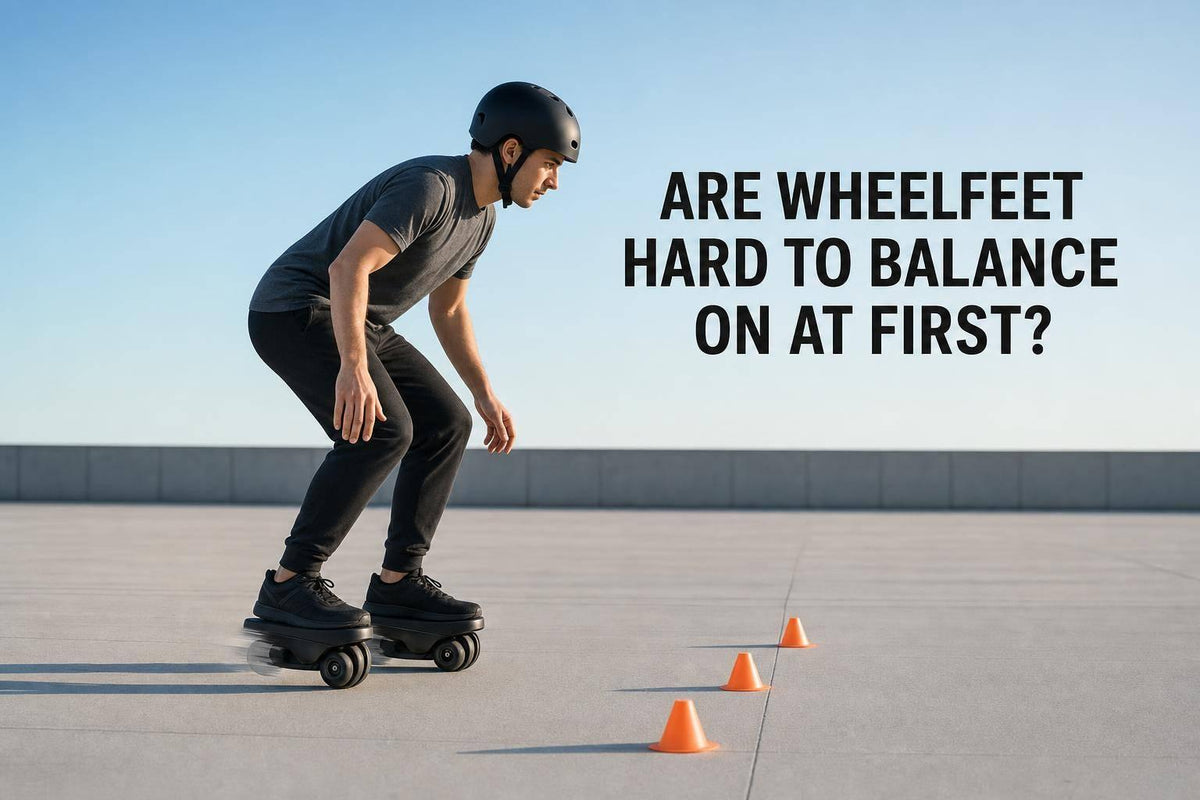
Yes - at first, they feel shaky. But for most people, that awkward phase lasts only 5 to 10 minutes if you keep your knees bent, stay centered, and start on smooth, dry pavement.
Here’s the plain answer: standing still, starting, and stopping feel harder than rolling forward. That’s why your first few minutes can feel a bit clumsy. If you’ve skated or skied before, you’ll often pick it up sooner. If not, no big deal - you just need a calm spot, low speed, and a few short drills.
What I’d keep in mind right away:
- Expect a wobble at first - that’s normal
- Use a low stance - bent knees help a lot
- Practice stopping before speed
- Smooth pavement matters
- For snow, longer Snowfeet* options often feel steadier
If I had to sum up the whole thing in one line, it’s this: Wheelfeet feel weird first, then your body starts to figure it out fast. Kind of like the first minute on ice skates, minus the frozen toes :)
Quick Comparison
| Option | Best surface | First-ride feel | Best for |
|---|---|---|---|
| Wheelfeet | Pavement | More twitchy at first | Street riders, skaters |
| Snowfeet* Skiskates 44 cm | Packed or groomed snow | Agile, less planted | Riders who want a skate-like feel |
| Snowfeet PRO 50 cm | Groomed snow | Steadier for most beginners | New snow riders |
A few numbers stand out here:
- Most beginners settle in after 5–10 minutes
- A 44 cm platform feels more nimble
- A 50 cm platform tends to feel more planted at first
So, if you’re asking, “Will I eat it right away?” - uh, not if you start slow, wear pads, and don’t lock your knees.
If you want a good visual before your first try, these can help:
- Beginner inline skating balance tips on YouTube
- How to stop on skates for beginners on YouTube
- Beginner ski stance tips on YouTube
My short take:
For pavement, pick Wheelfeet. For snow, I’d point most beginners to Snowfeet PRO 50 cm. If you want a looser, skate-like ride, Skiskates 44 cm make more sense.
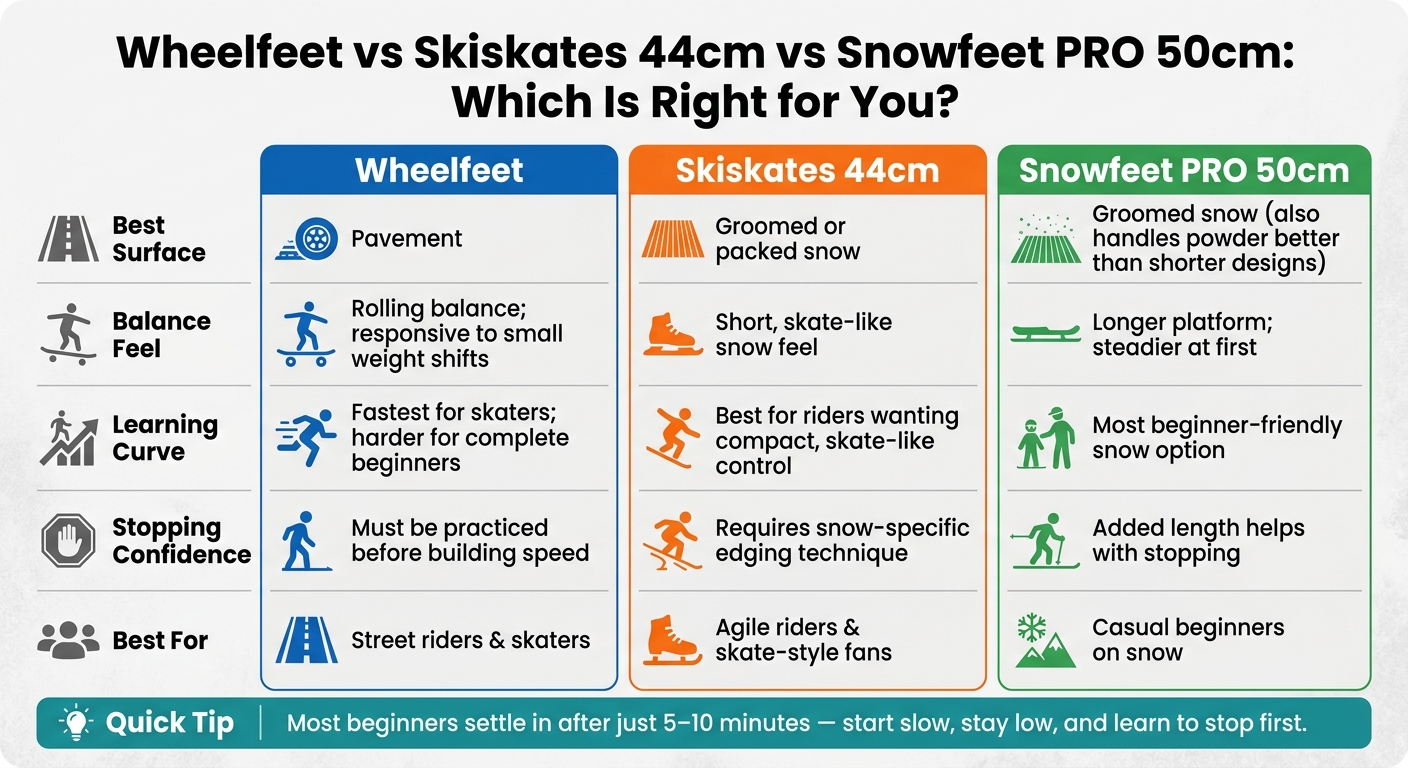
Wheelfeet vs Skiskates 44cm vs Snowfeet PRO 50cm: Which Is Right for You?
Wearable Skates | Roller Blades | Skate on Shoes | Wheelfeet | Non-electric
Why First-Time Users Feel Unstable on Wheelfeet
Wheelfeet feel shaky at first because the wheels respond right away to tiny shifts in your weight. You’re not standing on firm ground anymore. You’re on a moving base, so even a small lean can get the wheels rolling. There’s no true neutral stance here. You’re always making little balance moves in real time.
In the first few minutes, overcorrecting is a bigger issue than speed. Most new users wobble from side to side. Then they try to fix that wobble too hard, which only makes it worse. That’s why beginners often take short, careful steps and reach for a wall or rail. Funny enough, a slow glide can feel more stable than standing still. Once your weight is centered, that gentle roll gives you something to work with. And yeah, that habit of overcorrecting is one reason some riders get the hang of it faster than others.
A few things tend to make balance harder:
- Locked knees slow down your reactions and make each correction clunky.
- Leaning back puts your weight behind the wheels, which hurts control.
- Loose straps let your foot move around.
- Cracks, gravel, and dusty pavement can knock the wheels off line.
That’s also why skaters and skiers often pick it up faster than total beginners. They’re already used to balancing on gear that moves under them.
How to Balance on Wheelfeet More Easily
Use a low, centered stance and start with small movements
Start low. Bend your knees, keep your hips a bit forward, and center your weight over the wheels. Let your arms stay loose. Put your feet about shoulder-width apart, hinge a little at the hips, and look ahead, not down.
Then keep the first moves small. Shift your weight side to side. Take short marching steps. After that, try a brief glide. Don’t rush it. Each step builds on the one before it, and that makes the whole thing feel less sketchy.
Pick a good practice spot
Your first session should be on flat, dry pavement with plenty of room to slow down. Skip wet pavement, gravel, cracks, and any slope. Those can turn a calm first ride into a yard sale fast :)
Before you roll, check your fit. Wear snug athletic shoes and tighten every Wheelfeet strap evenly so your foot and the skate move as one unit. If your heel shifts, stop and retighten. For gear, wear a properly fitted helmet, wrist guards, knee pads, and elbow pads.
Practice stopping before speed or turns
Work on stopping before you mess with turns or speed. On a level surface, slow down by easing pressure and taking short, controlled steps until you come to a stop. Wheelfeet's beginner guidance puts braking and speed control first. Once stopping feels under control, the differences between riders and Snowfeet* models tend to show up fast.
sbb-itb-17ade95
Who Learns Fastest and When Snowfeet* May Feel More Stable
Skaters and skiers usually get the hang of it faster
Your background matters a lot here. Roller and inline skaters tend to learn fastest because they already know the big stuff: balance while rolling, ankle control, weight transfer, and how to slow down in a controlled way. Those skills carry over well to Wheelfeet. One study on beginner skiers found that inline skaters adapted faster than non-skaters in a maneuver test.
Ice skaters often move along fast too. The main adjustment is simple but important: wheels grip pavement in a different way than blades grip ice. Skiers and snowboarders usually spot the body position right away. The bent knees and centered stance feel familiar. But they still have to switch their brain from sliding on snow to rolling on pavement. Complete beginners usually take the longest because every move feels new at first.
Wheelfeet vs Snowfeet* Skiskates 44 cm vs Snowfeet PRO 50 cm
Gear can change how steady that first ride feels. Some setups feel twitchy and playful. Others feel calmer right out of the gate.
| Factor | Wheelfeet | Skiskates 44 cm | Snowfeet PRO 50 cm |
|---|---|---|---|
| Surface | Pavement | Groomed or packed snow | Groomed snow; also better for powder or ungroomed terrain than shorter designs |
| Balance feel | Rolling balance; responsive to small weight shifts | Short, skate-like snow feel | Longer platform; steadier at first |
| Learning curve | Fastest for skaters; harder for complete beginners | Best for riders who want compact, skate-like control | Generally the most beginner-friendly snow option |
| Stopping confidence | Must be practiced before building speed | Requires snow-specific edging technique | Added length is designed to make stopping easier |
For most casual beginners going to a ski hill, Snowfeet PRO 50 cm usually feels more stable on the first ride. That extra length is meant to help with balance, turning, and stopping compared with shorter mini-ski designs. Skiskates 44 cm are a better fit for riders who want a more nimble, skate-like feel and already ride in ski or snowboard boots.
Still, no gear turns day one into magic. Beginners need a mellow area, low speed, and time to practice stopping.
Where full-length skis still have an edge
Full-length skis still do better when speed goes up and snow gets deep. More length means more surface area, which helps in soft snow and at faster speeds. Snowfeet* products work best on groomed or packed runs, so they won't match the float of a full ski in deep snow.
That gap is also why shorter Snowfeet* models can feel less intimidating for many first-timers. They ask for less commitment, kind of like hopping on a cruiser bike instead of a road bike on day one.
Conclusion: The Easiest First Experience Depends on Surface and Goals
Yes, Wheelfeet are hard to balance on at first, but only for a short time. They can feel a little weird on your first try. Then things start to click, fast, if you keep a low stance and ride on smooth, dry pavement. Start slow. Learn how to stop first.
Your best pick comes down to where you plan to ride.
For pavement, Wheelfeet are the right tool. Go in expecting a short learning session, not instant speed. That small reset helps a lot. Once you get past that first awkward bit, the next step is simple: think about your riding surface. If you're heading onto snow, Snowfeet* models make more sense.
Snowfeet PRO 50 cm is the easiest place to start for most riders. Skiskates 44 cm fit riders who want a more agile, skate-like feel. Just know the shorter platform asks a bit more from your balance right away.
Long skis still have their lane. Full-length skis are still better for deep snow, speed, and flotation. But for groomed slopes and short fun runs, Snowfeet* products are easier to learn than long skis. They're compact, easy to carry, and ask for less buy-in on day one.
So the short version is this:
- For pavement, choose Wheelfeet
- For most snow riders, choose Snowfeet PRO 50 cm
- For skaters who want more agility, choose Skiskates 44 cm
FAQs
Can kids use Wheelfeet safely?
Wheelfeet are not a good pick for kids. They need active balance, give less ankle support than standard skates, and can be tough to stop in a safe way, especially on pavement where cracks, small debris, and traffic add risk.
They also don’t offer the same stability or purpose-built design you’d want for children. That’s a big deal when a kid is still learning balance and control. In plain English: they’re harder to manage, and the margin for error is small.
If the goal is a more beginner-friendly option, Snowfeet products are the better fit on snow. They’re more stable, easier for new riders to handle, and a safer choice in that setting.
How tight should Wheelfeet straps be?
Tighten the straps from the bottom up until your shoe stays put in the frame. No twisting. No sliding. No heel lift. If the straps are loose, Wheelfeet can feel wobbly and tougher to steer.
The fit should feel snug and locked in, not painful. If you feel pinching or numbness, back the straps off a bit. Flat shoes with firm soles also help the platform sit level, which gives you better stability.
Are Wheelfeet easier than skis for beginners?
No. Wheelfeet aren’t easier than skis for beginners.
They’re made for smooth pavement and they’re easy to carry. But here’s the catch: they give you less stability and less ankle support than full-size skates or snow gear. And that can make the first few sessions feel rough.
Most beginners have trouble with:
- balance
- stopping
- bumps, cracks, and other uneven spots in the surface
For snow, Snowfeet* gear is more beginner-friendly. Snowfeet* Skiskates (44 cm) and Snowfeet PRO (50 cm) tend to have a shorter, more natural learning curve than skis.











コメントを残す
このサイトはhCaptchaによって保護されており、hCaptchaプライバシーポリシーおよび利用規約が適用されます。